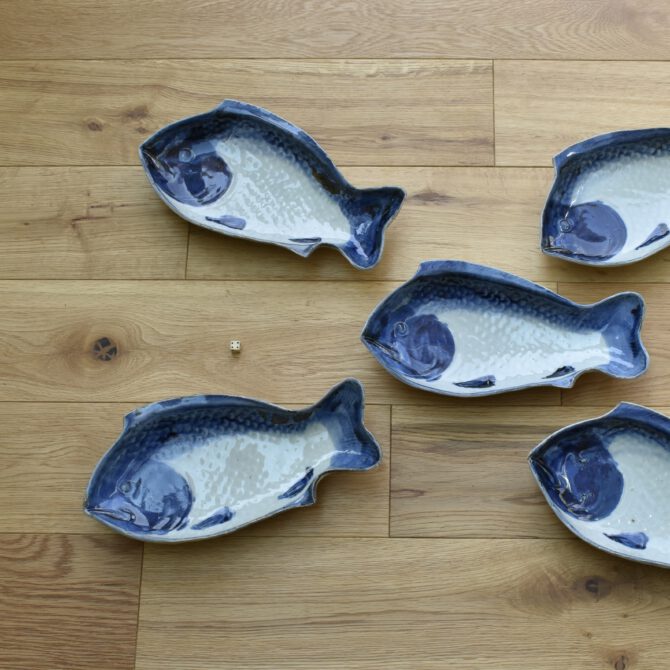
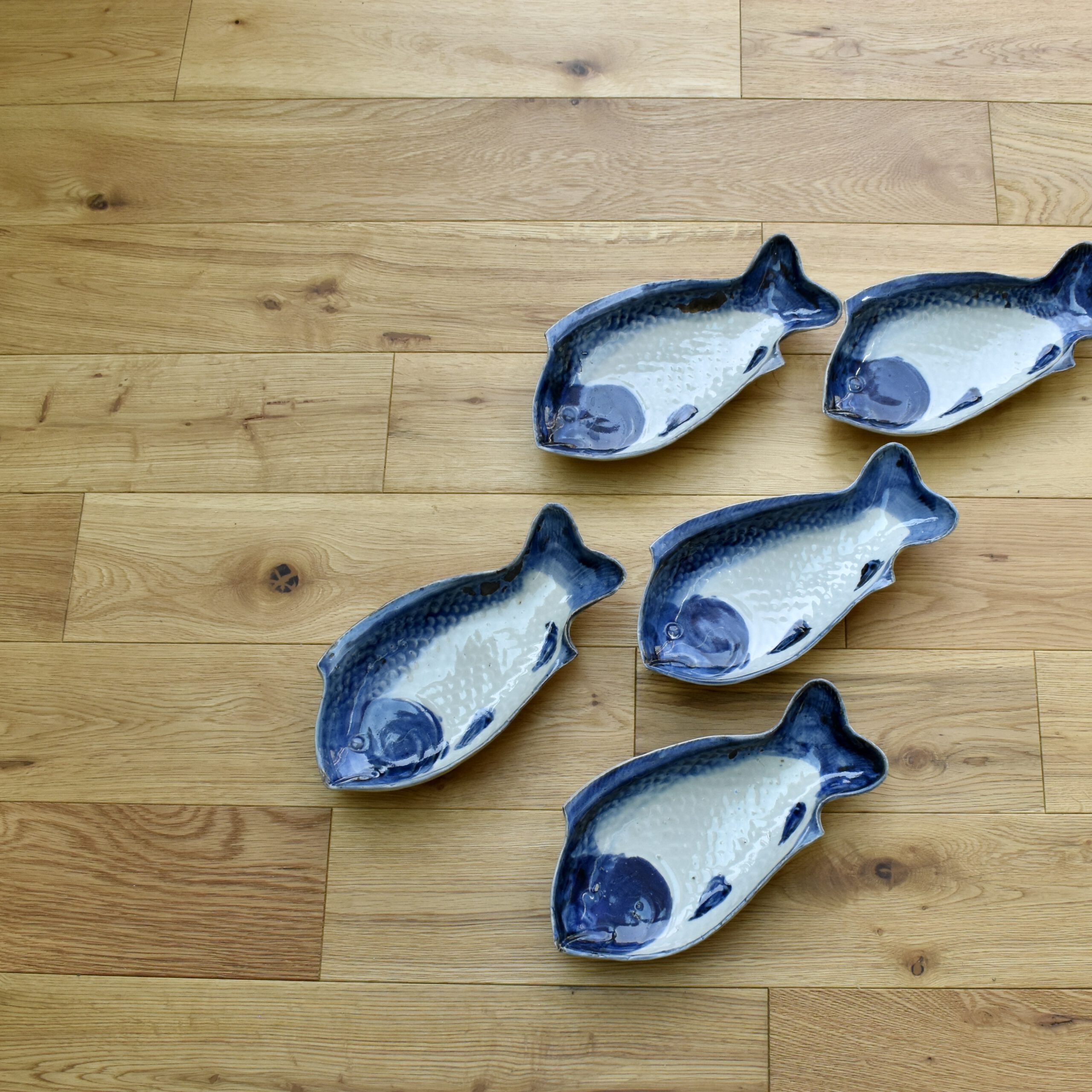
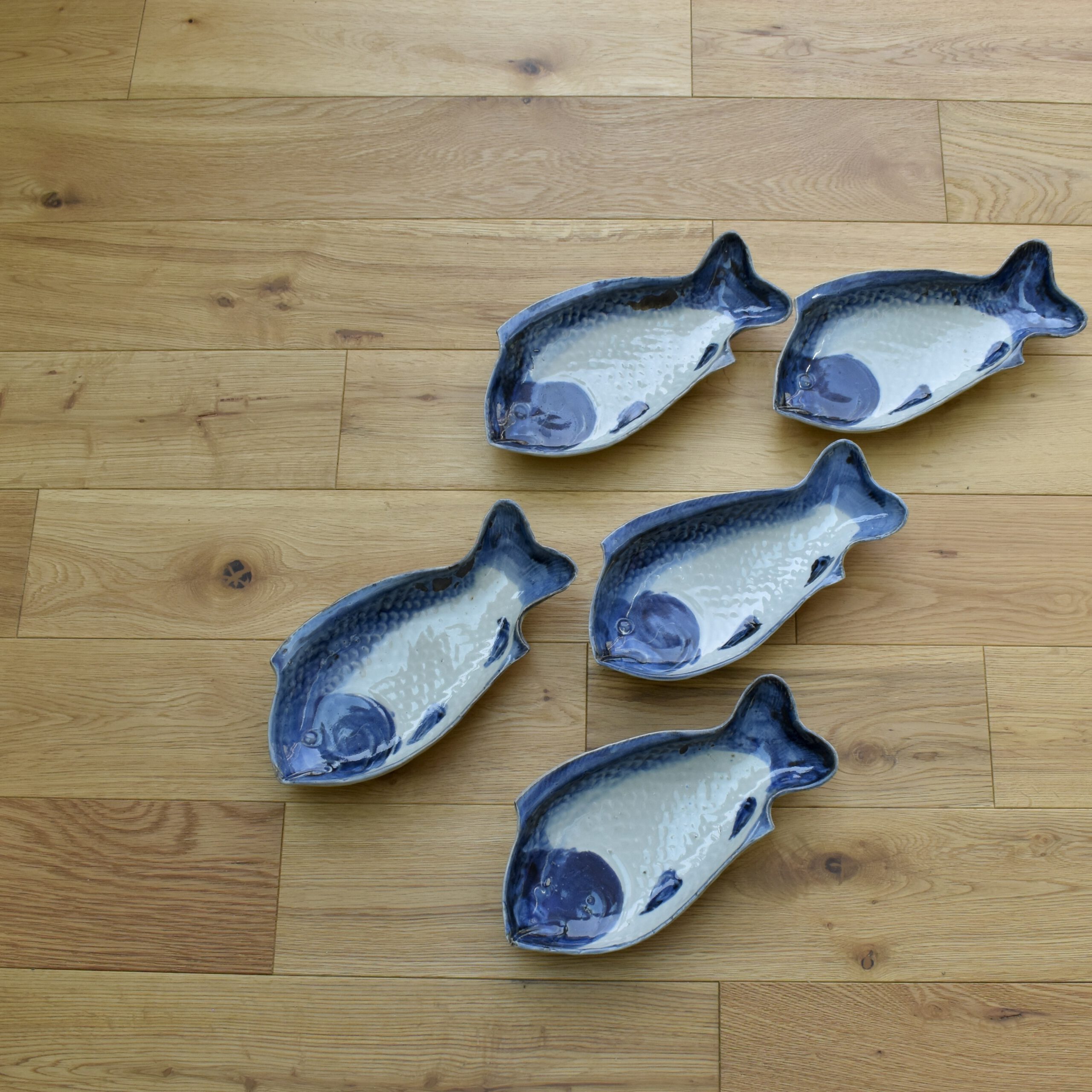
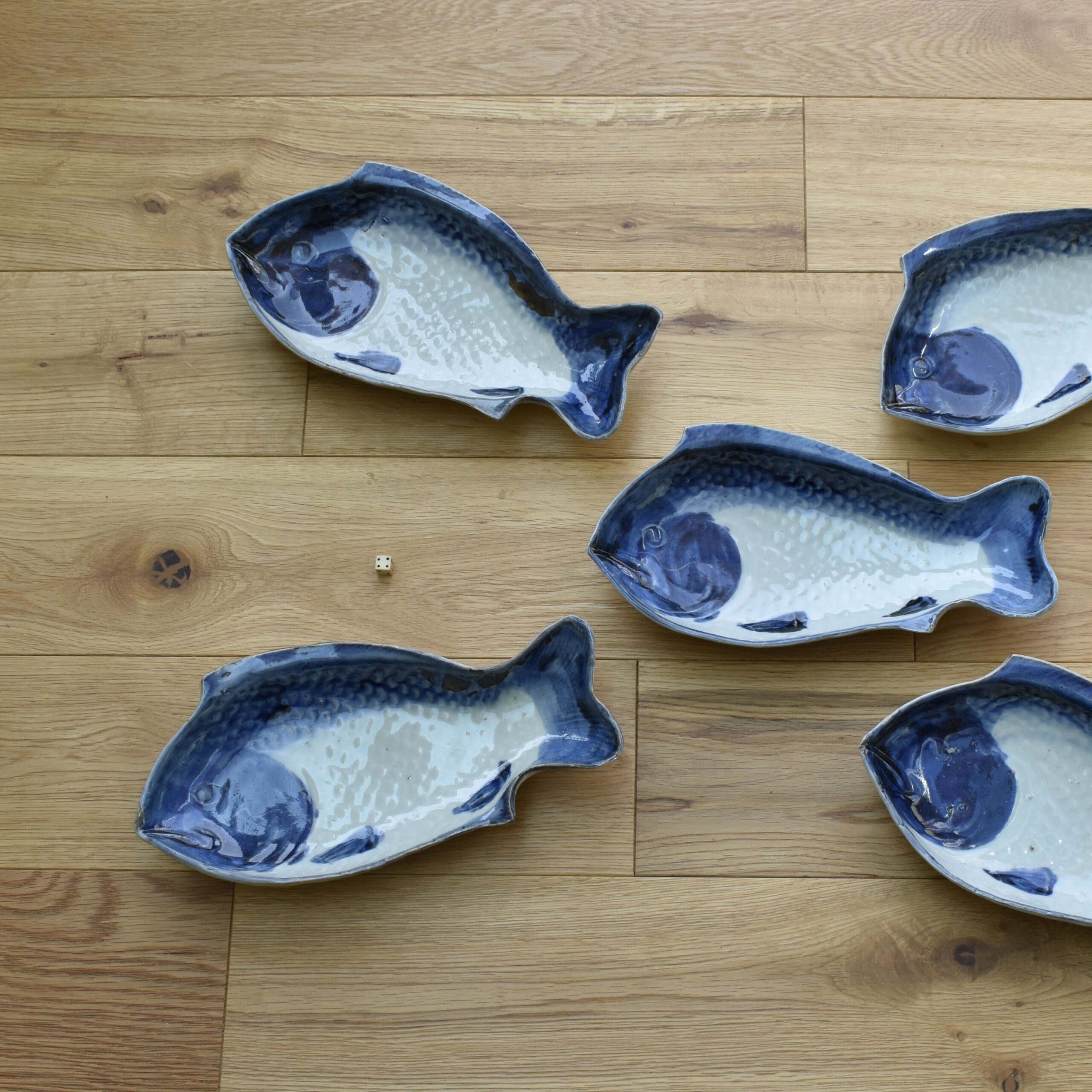
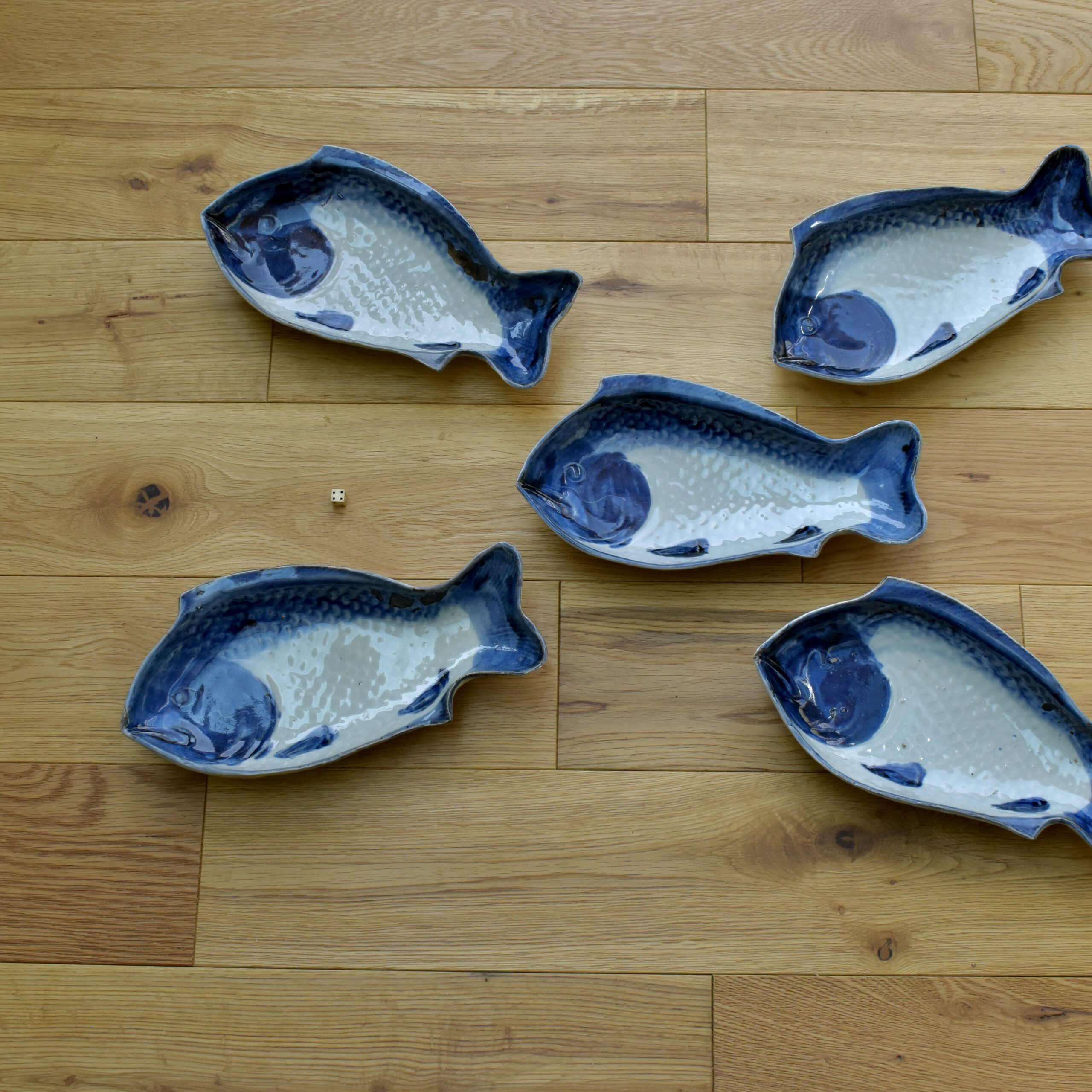
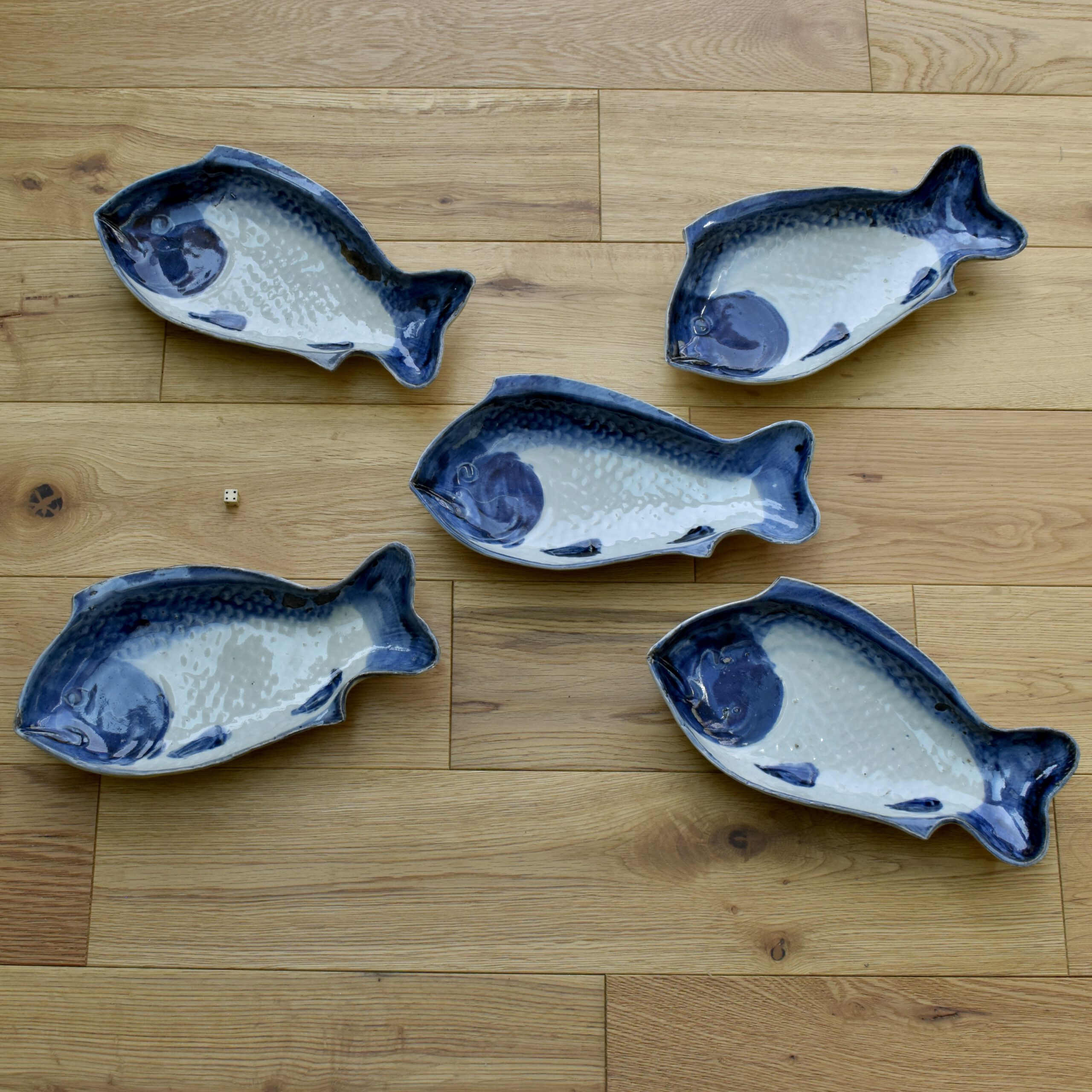
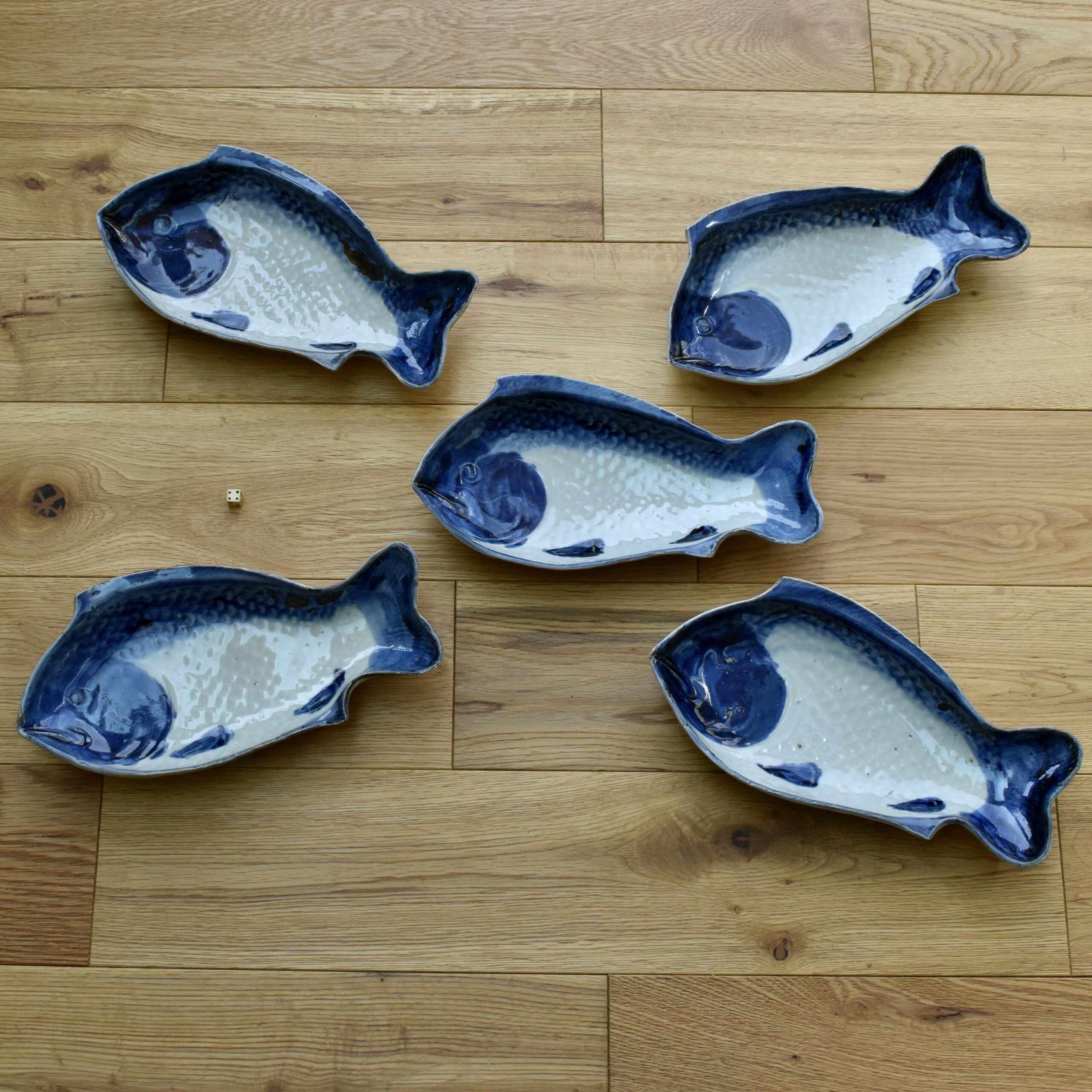
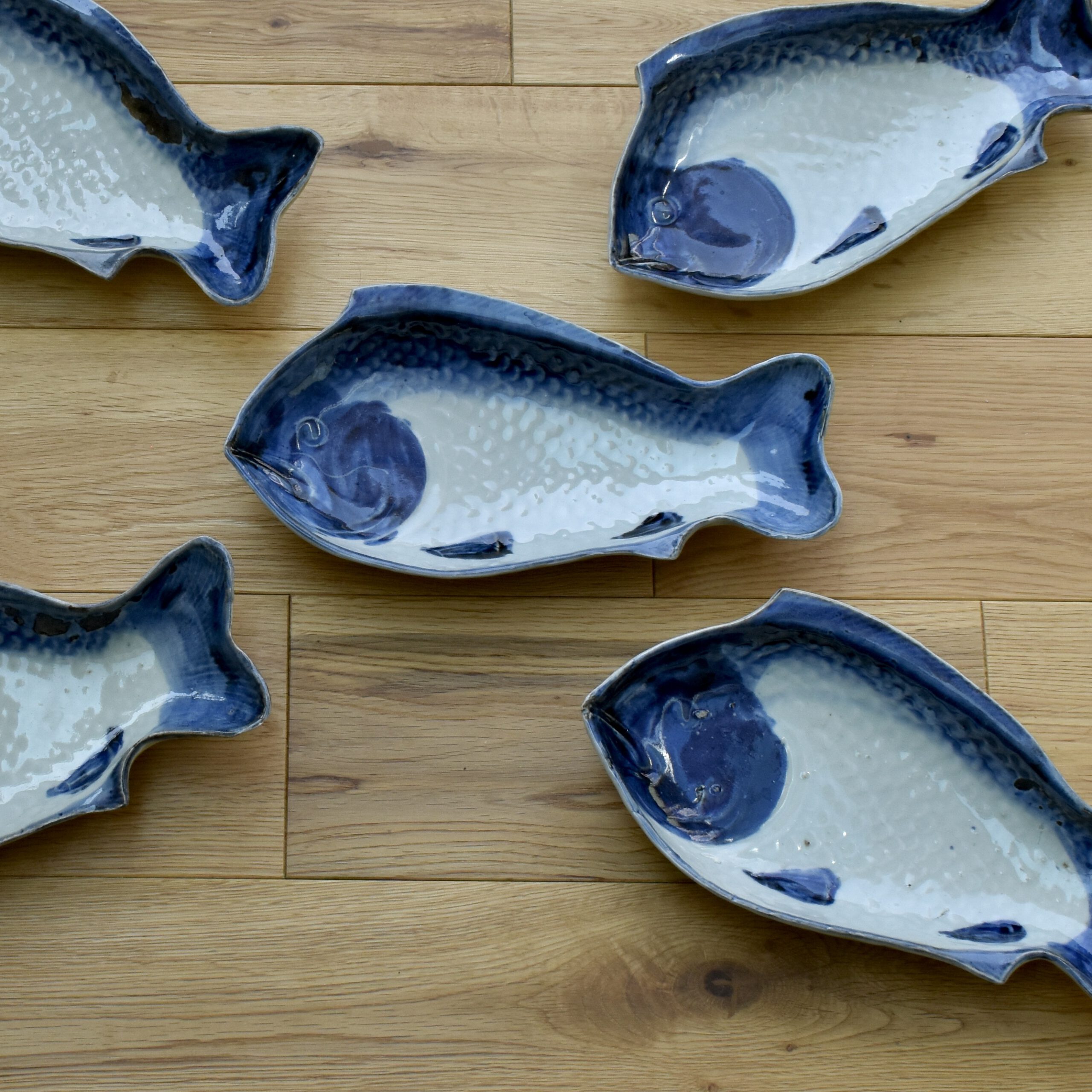
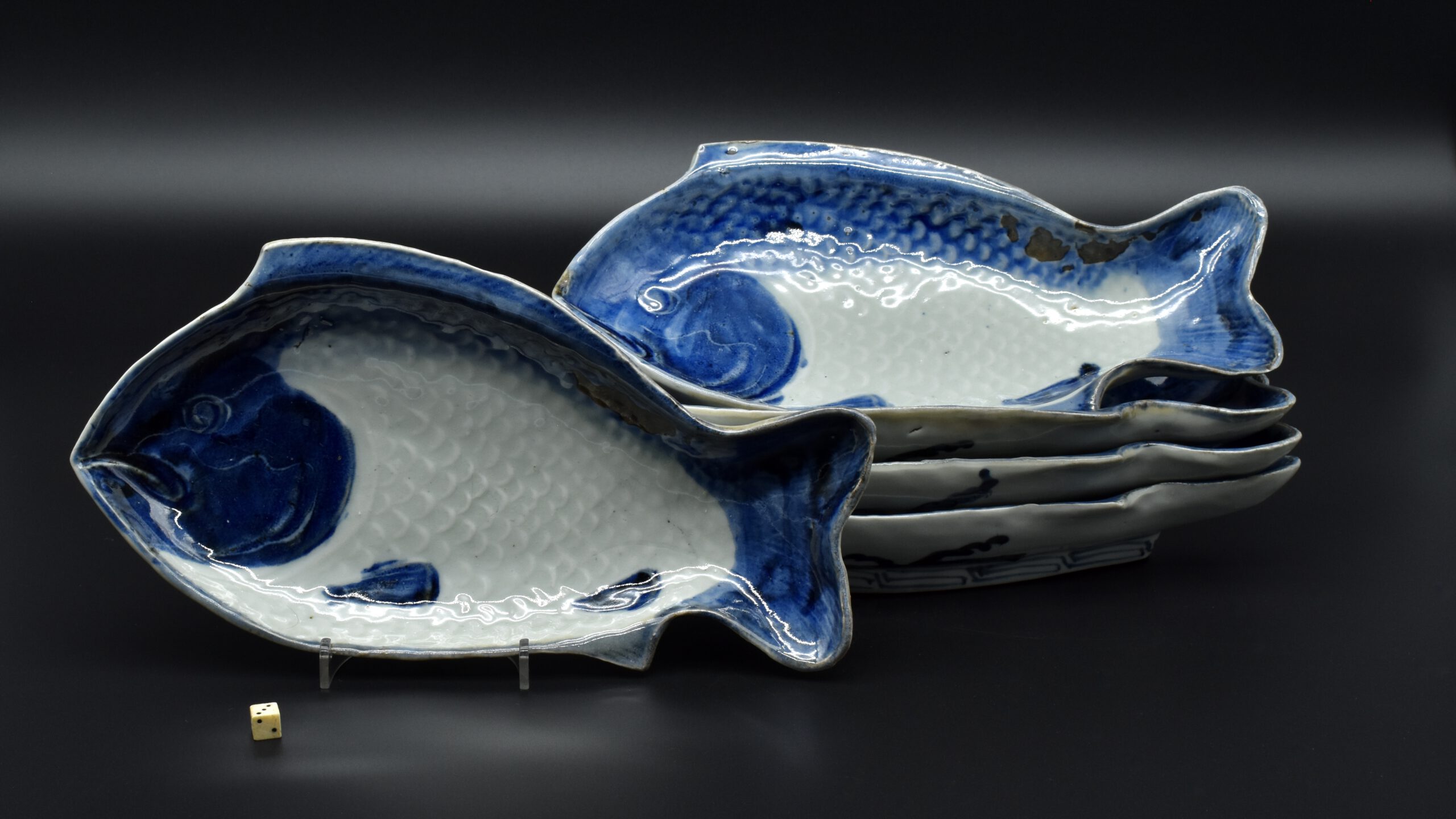
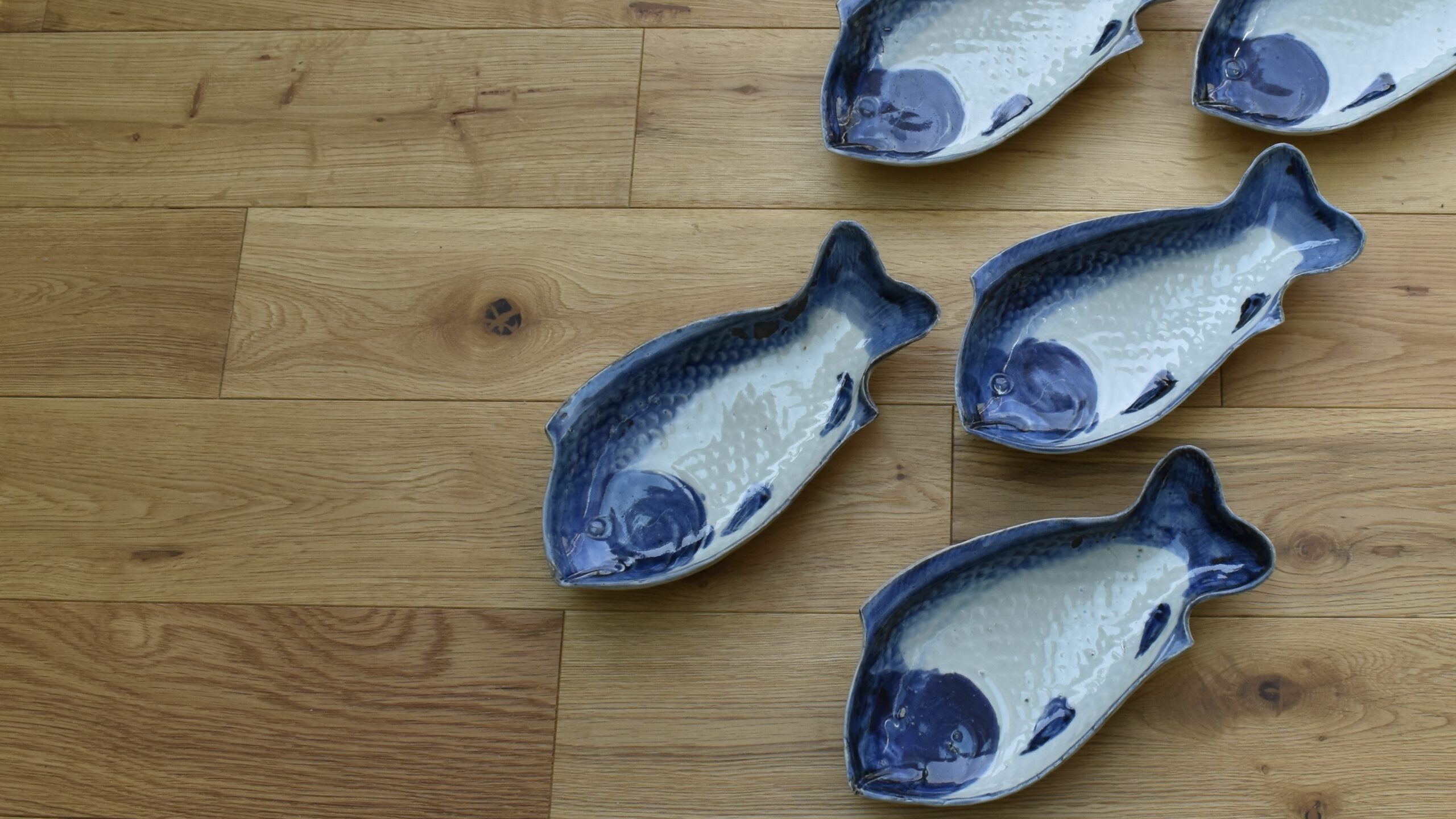
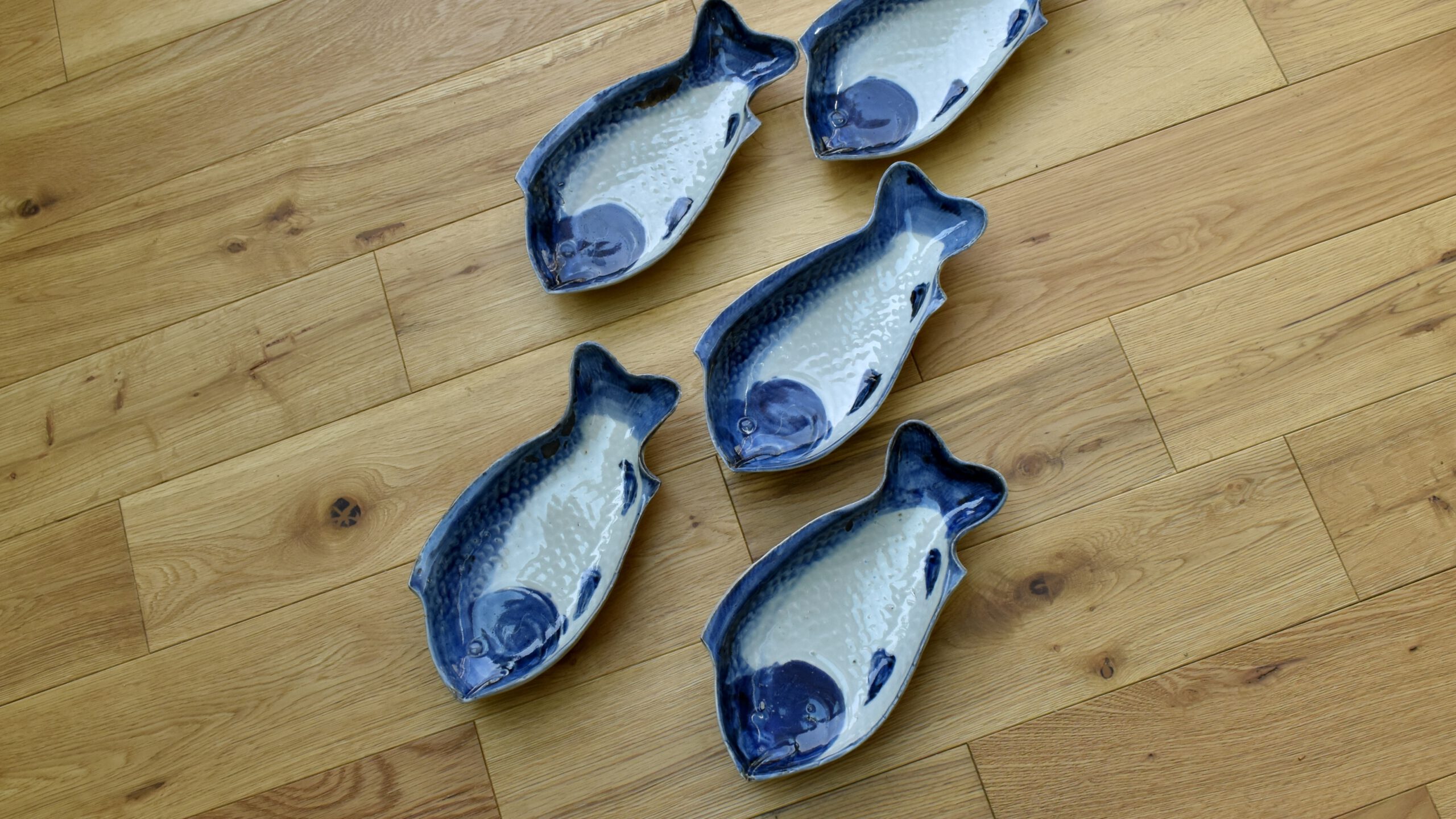
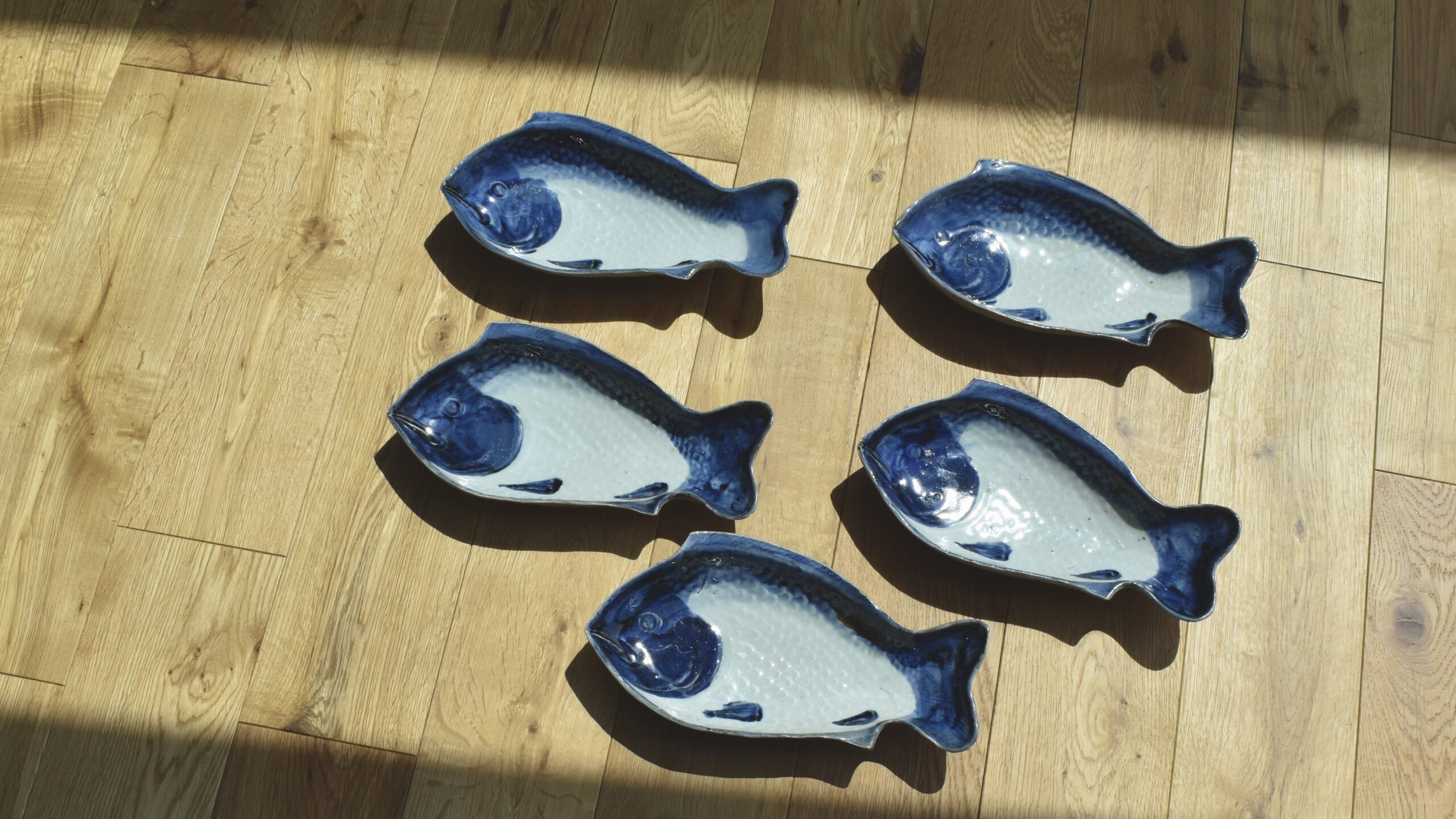
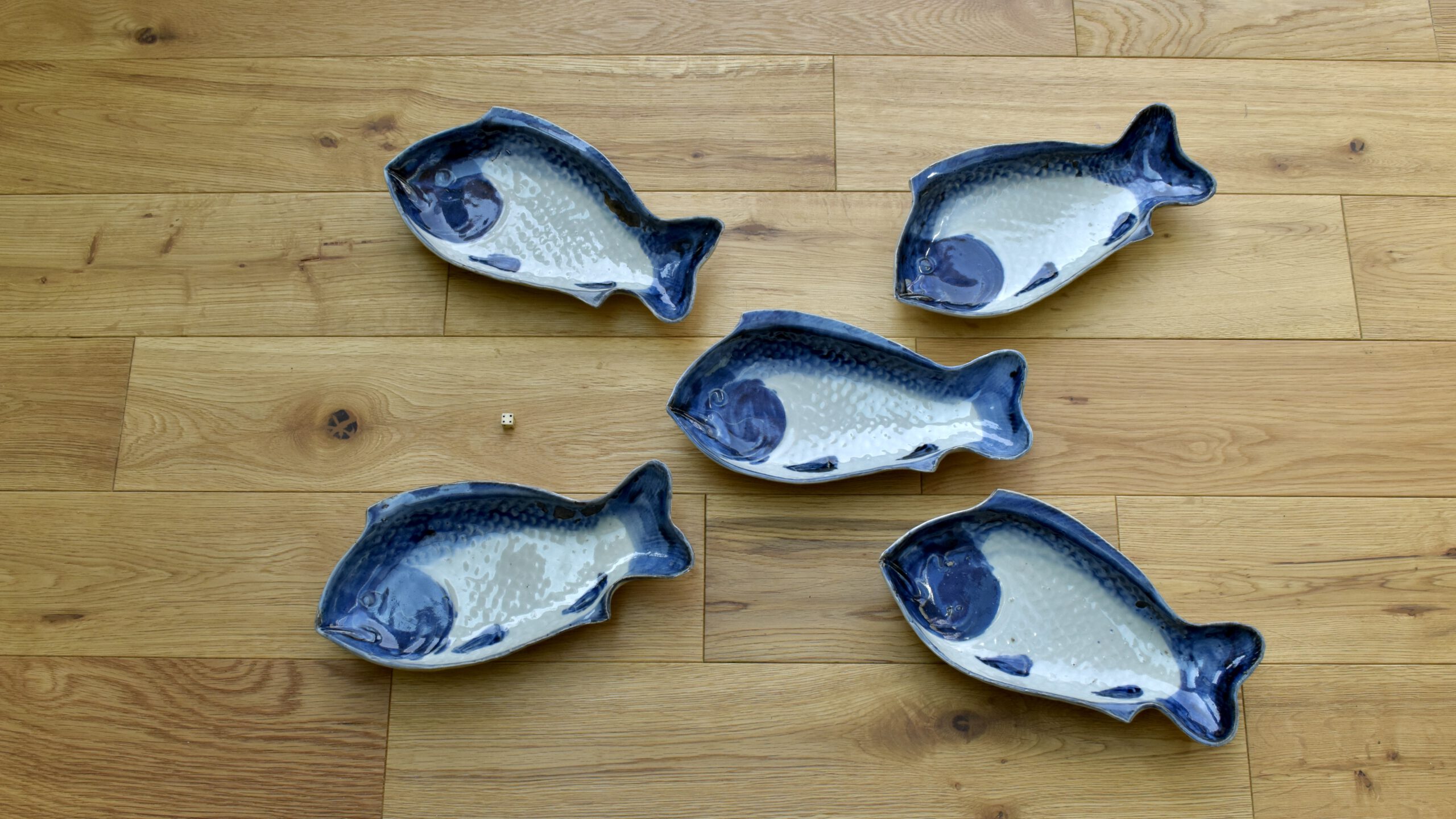
A Set of Five Late 17th or Early 18th Century Japanese Porcelain Dishes Modelled as a Sea-Bream.
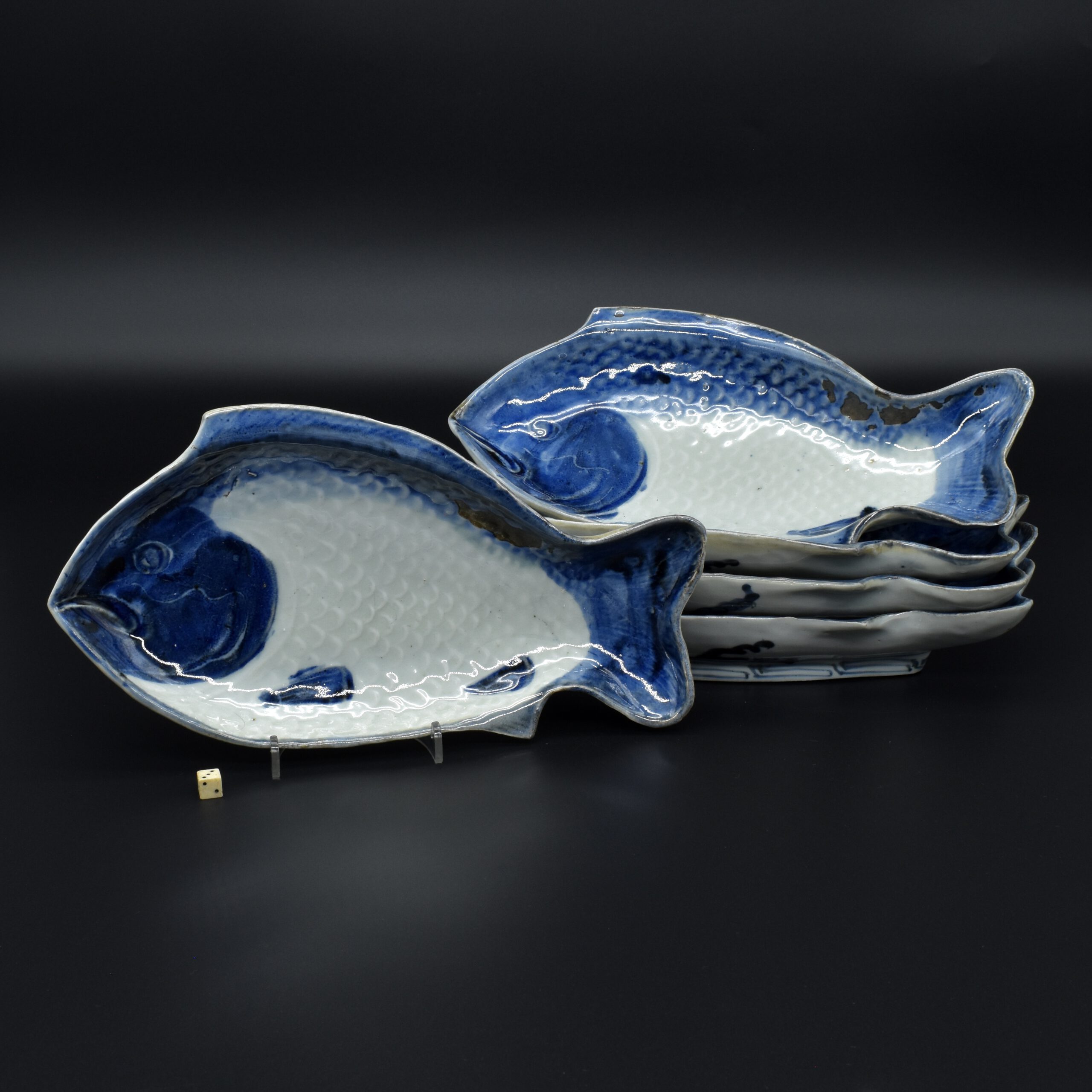
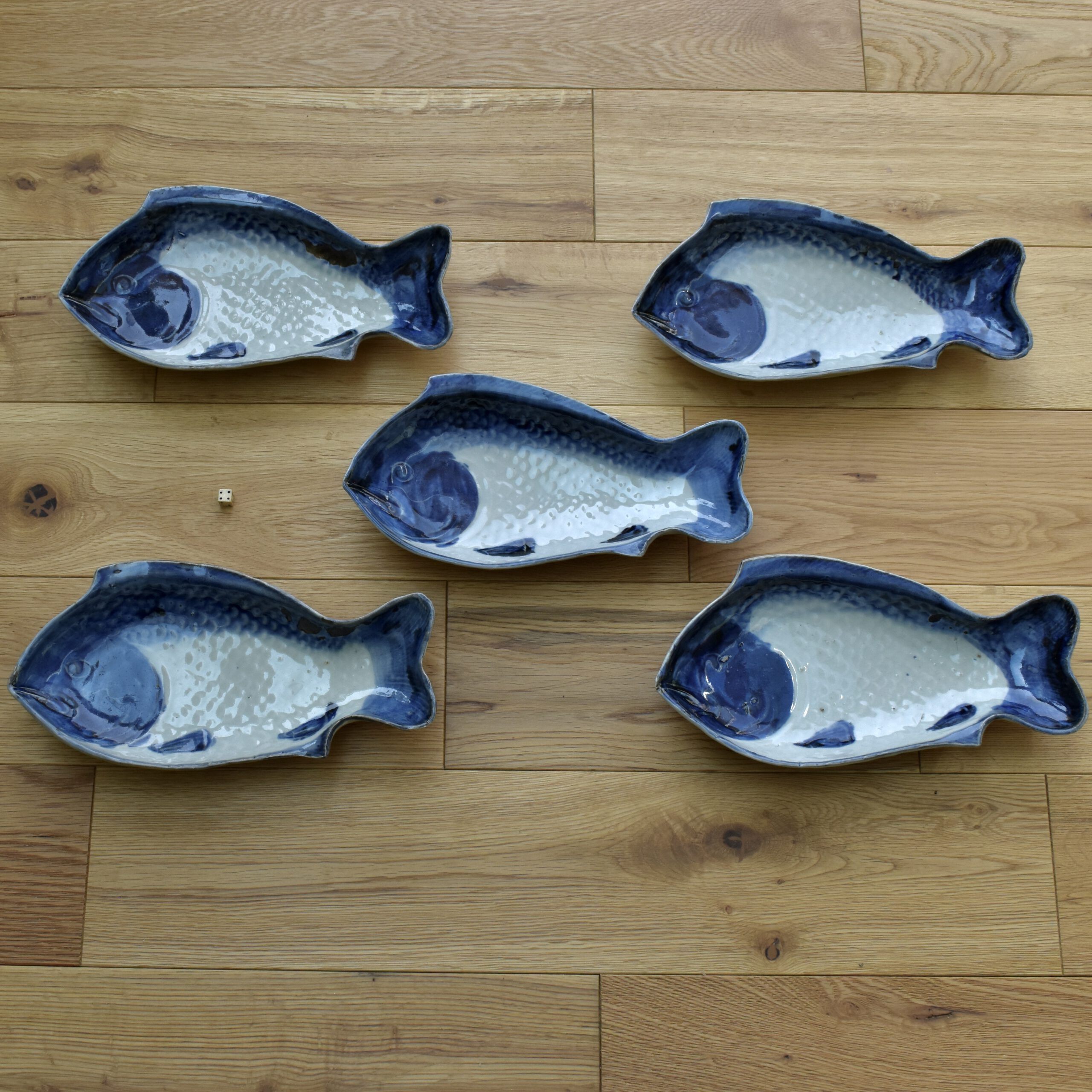
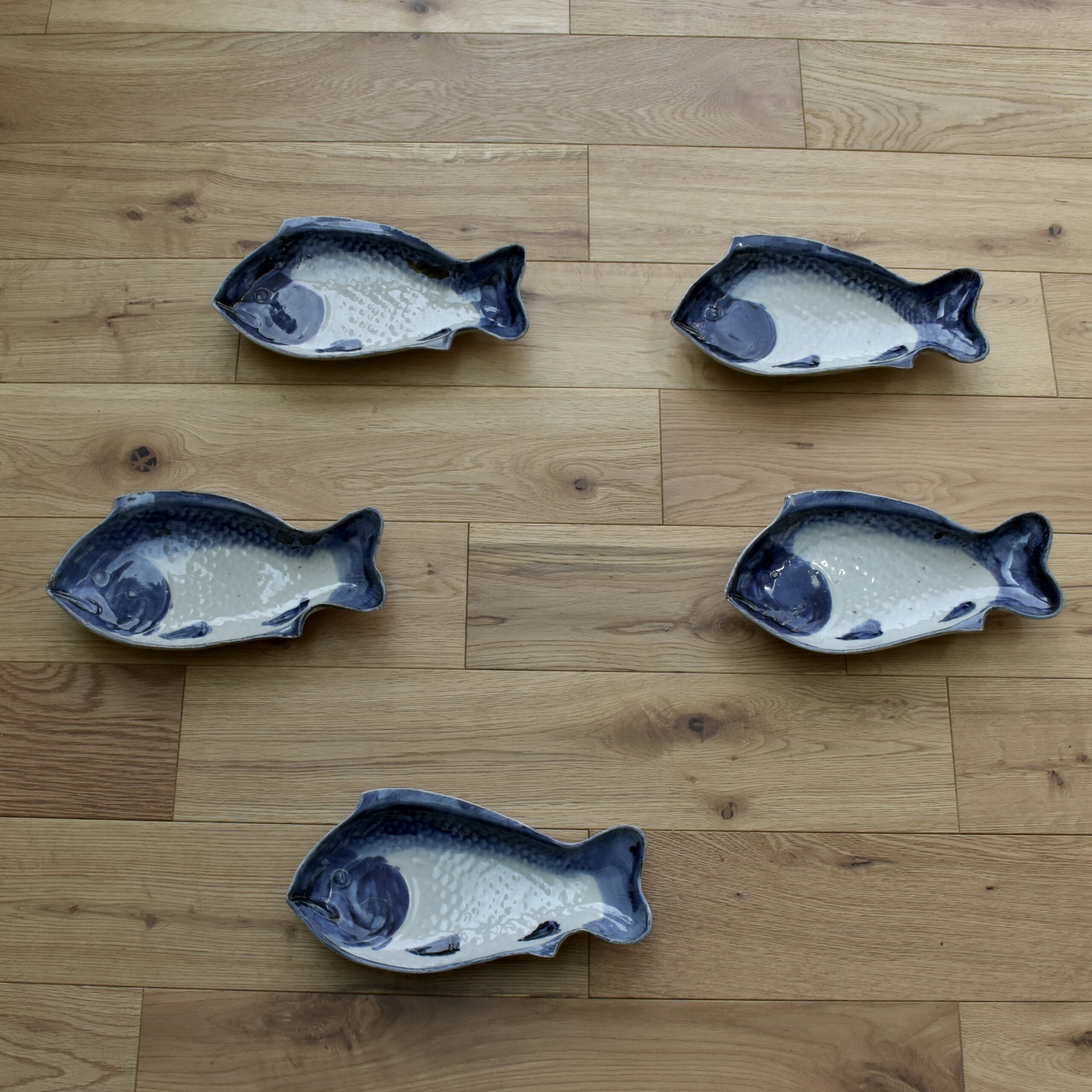
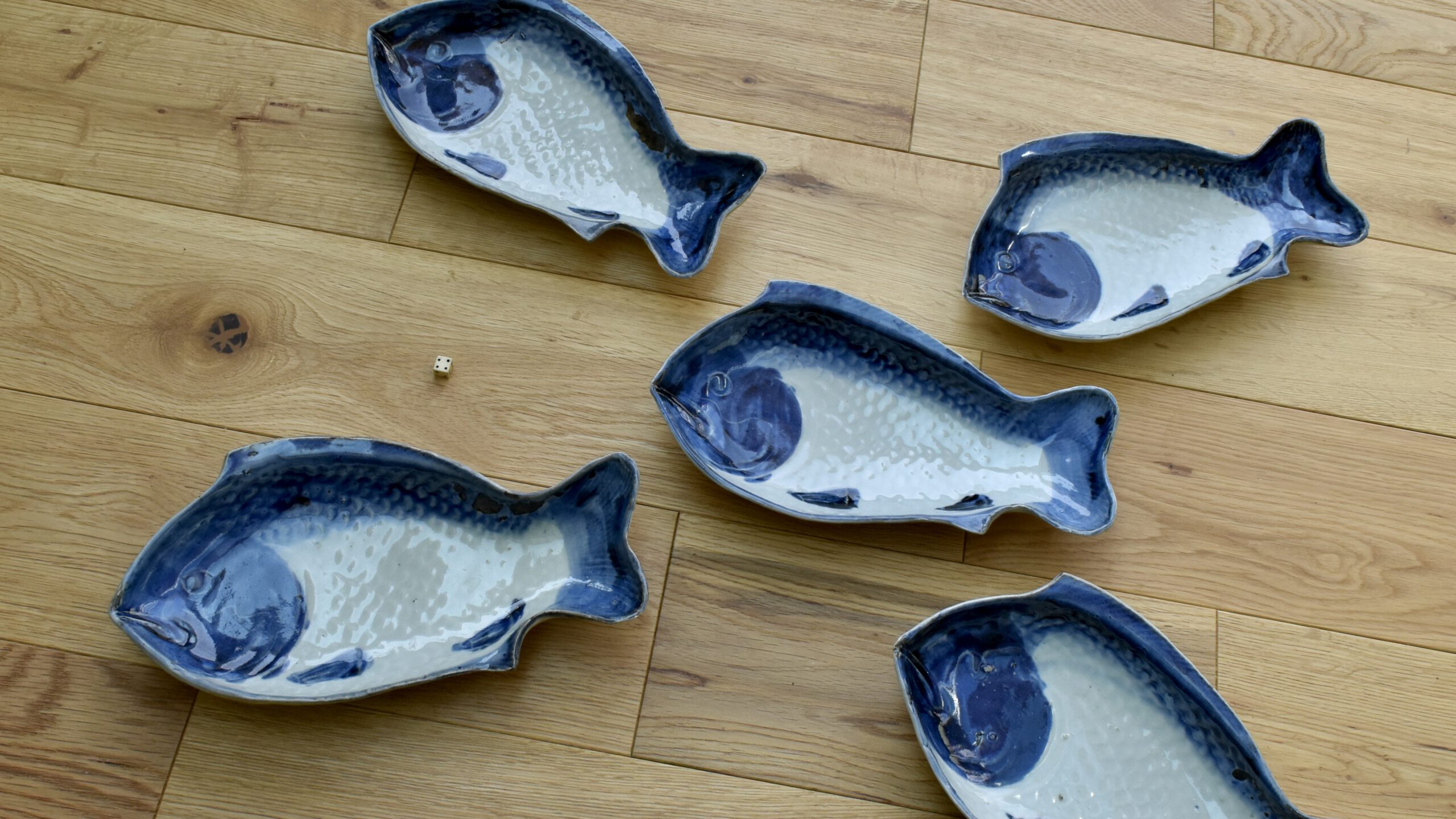
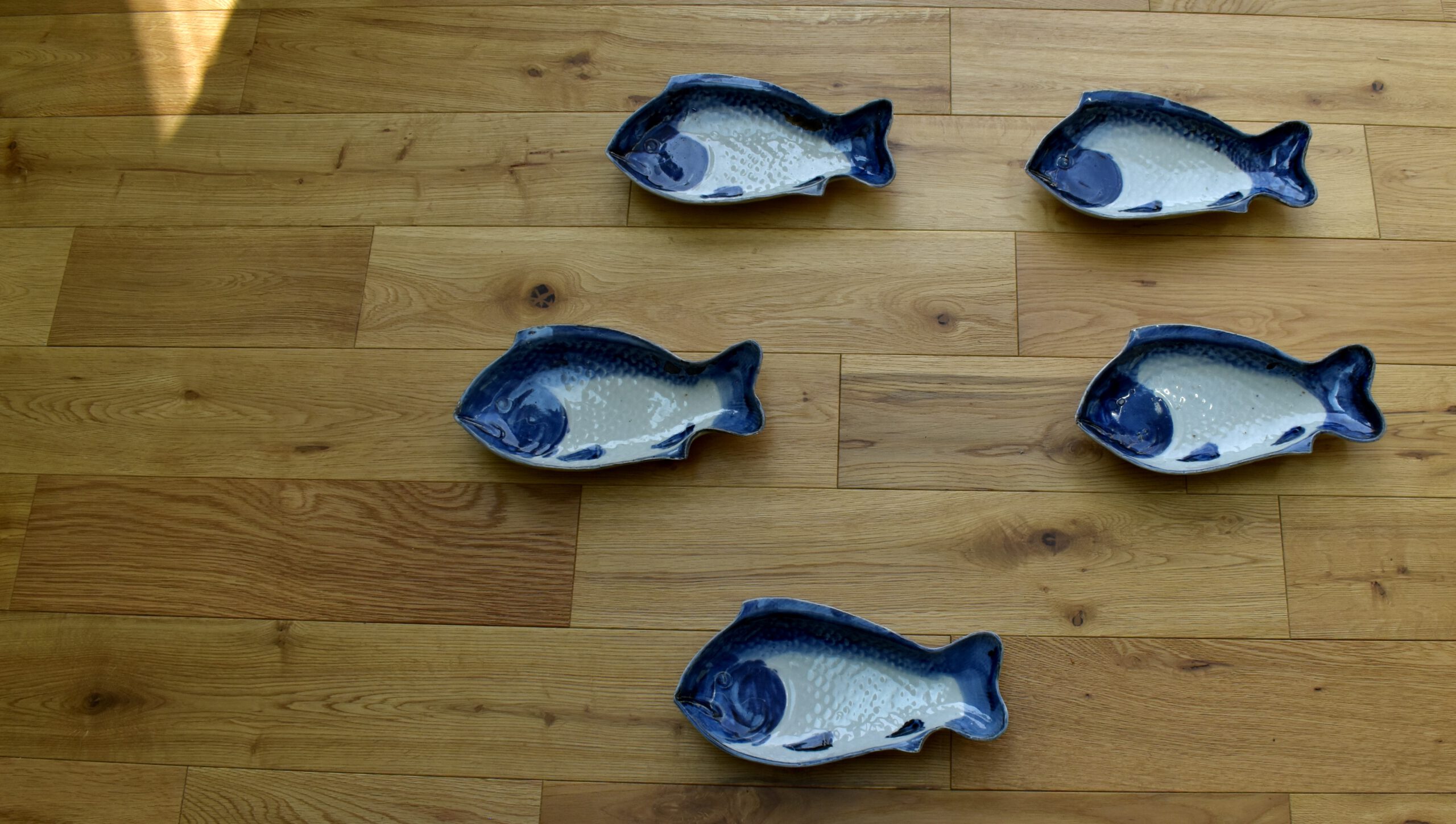
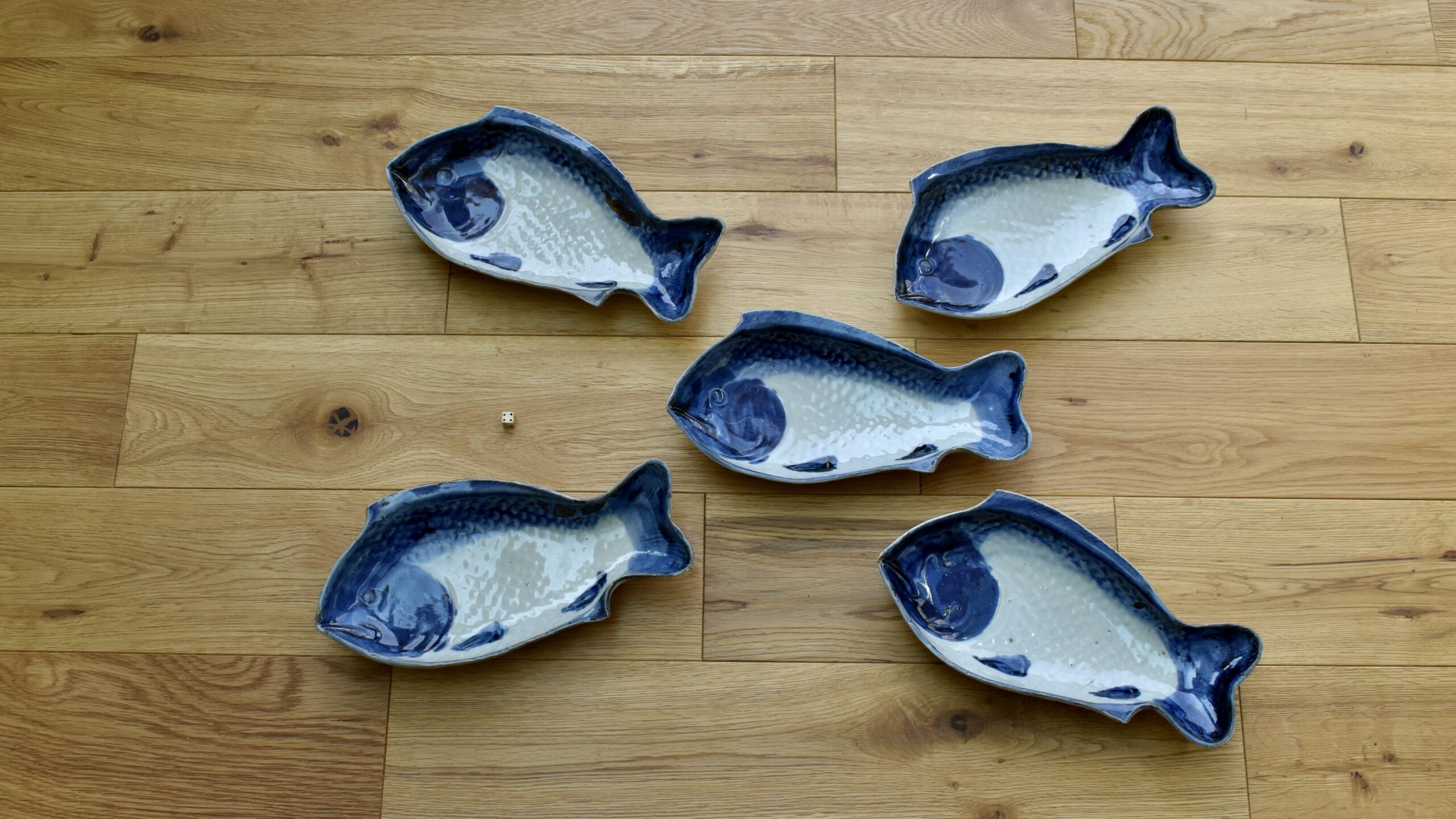
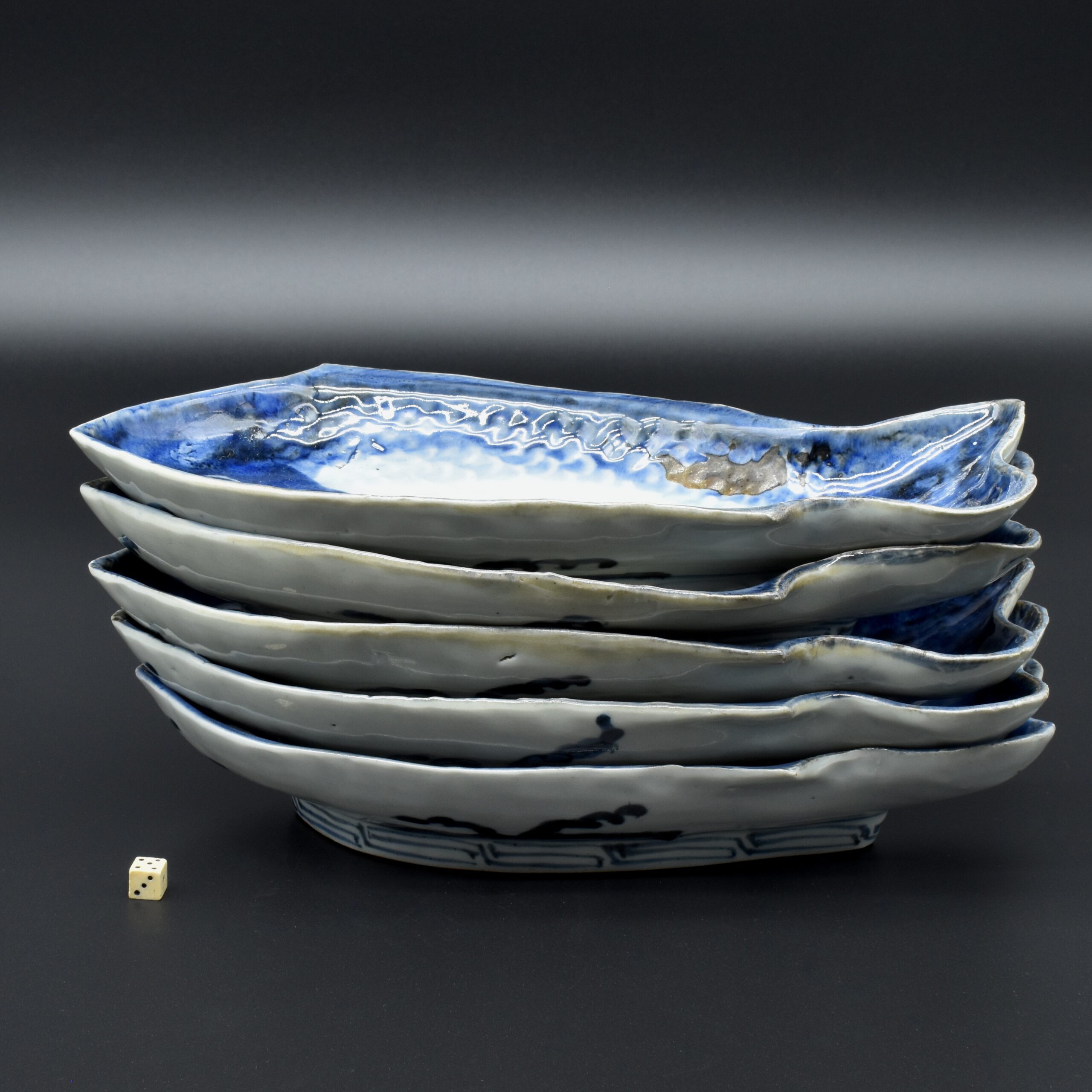
A Set of Five Japanese Porcelain Dishes Modelled as a Sea-Bream, Arita Kilns c.1690-1730. These moulded fish shaped dishes are painted in broad brush strokes of dark cobalt blue using a wet brush. The blue has settled between the scales along the paler inner edge. The eyes of the fish and a line across the gill cover are probably made using a wax resist technique. The backs are decorated with stylised waves. For other fish dishes of this type in the collection Shibata collection in the Kyushu Ceramic Museum, Japan, see ‘References’ and for dishes of this type sold by Robert McPherson Antiques, see below.
The Tai, Sea-Bream is one of the most popular fish in Japan. It is sometimes referred to as the King of Fish and is in season during Spring. It can be served in a number of different ways, but all the meat, including that from the head is used, the skin is also eaten, The scalded skin is sliced thin and mixed with scallion and ponzu (Ponzu is a citrus juice and vinegar based shoyu dipping sauce. A serving dish like the present example might have been used to offer Tai Sashimi. This dish consists of the bottom half of the fillet and is eaten raw, simply sliced, it might be served with wasabi and or different sauces. The Tai was an attribute of Ebisu one of the seven Gods of Good Fortune, and it was considered particularly auspicious to eat a whole fish at times of celebration in particular on the occasion of a marriage. The name Tai also rhymes with the word Medetai, meaning auspicious. This type of porcelain dish would probably have been produced as a set of five
SOLD
- Condition
- In excellent condition, some very slight wear. Some kiln smoke to the back, some areas where the cobalt has fired black on the front, other firing faults.
- Size
- The size will vary slight : Length : 25.3 cm (10 inches). Depth 4.1 cm (1.6 inches).
- Provenance
- N/A
- Stock number
- 27215
- References
- For a very similar Japanese Arita porcelain fish dish dated to c.1690-1730 see : Complete Catalogue of Shibata Collection (Kyushu Ceramic Museum, 2003) page 325, plate 2542. For a very similar Japanese blue and white porcelain fish dish dated to c.1690-1730 see : Complete Catalogue of Shibata Collection (Kyushu Ceramic Museum,2003) page 325, plate 2542. For a similar Japanese Porcelain dish see : The Catalogue of The Shibata Collections, The Exhibition (1) (Akihiko Shibata and Yuko Shibata and others, The Kyushu Ceramic Museum, 1990) Page 153 plate 397. For other 18th Century Japanese Porcelain dishes in the form of Sea Bream see below the Photograph Gallery.
Photos
Information
Sea Bream in Japan
The Tai, Sea-Bream is one of the most popular fish in Japan. It is sometimes referred to as the King of Fish and is in season during Spring. It can be served in a number of different ways, but all the meat, including that from the head is used, the skin is also eaten, The scalded skin is sliced thin and mixed with scallion and ponzu (Ponzu is a citrus juice and vinegar based shoyu dipping sauce. A serving dish like the present example might have been used to offer Tai Sashimi. This dish consists of the bottom half of the fillet and is eaten raw, simply sliced, it might be served with wasabi and or different sauces. The Tai was an attribute of Ebisu one of the seven Gods of Good Fortune, and it was considered particularly auspicious to eat a whole fish at times of celebration in particular on the occasion of a marriage. The name Tai also rhymes with the word Medetai, meaning auspicious. This type of porcelain dish would probably have been produced as a set of five.
18th Century Japanese Porcelain Dishes in the Form of a Sea Bream
Robert McPherson Sold Archive.
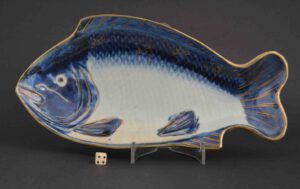
Condition
In excellent condition. A minute chip to the foot rim c.1 x 1 mm. Minor kiln smoke marks to the back.
Size
Length : 25.3 cm (10 inches)
Stock number
24191
References
For a very similar Japanese Arita porcelain fish dish dated to c.1690-1730 see : Complete Catalogue of Shibata Collection (Kyushu Ceramic Museum, 2003) page 325, plate 2542. For a very similar Japanese blue and white porcelain fish dish dated to c.1690-1730 see : Complete Catalogue of Shibata Collection (Kyushu Ceramic Museum,2003) page 325, plate 2542. For a similar Japanese Porcelain dish see : The Catalogue of The Shibata Collections, The Exhibition (1) (Akihiko Shibata and Yuko Shibata and others, The Kyushu Ceramic Museum, 1990) Page 153 plate 397.
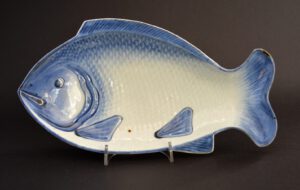
Condition
There is a small chip repaired with a black filler to the top of the caudal fin (tail) c.9 x 3mm.
Size
26 cm (10 inches)
Stock number
22414
References
For a very similar Japanese blue and white porcelain fish dish dated to c.1690-1730 see : Complete Catalogue of Shibata Collection (Kyushu Ceramic Museum,2003) page 325, plate 2542. For a similar Japanese Porcelain dish see : The Catalogue of The Shibata Collections, The Exhibition (1) (Akihiko Shibata and Yuko Shibata and others, The Kyushu Ceramic Museum, 1990) Page 153 plate 397. For a Japanese celadon glazed porcelain fish dish dated to c.1750-1780 see our `Sold Items` number 20433.
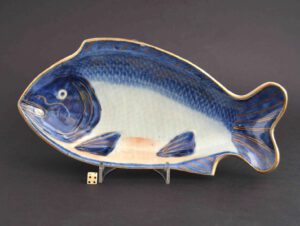
Condition
In excellent condition. A firing crack to the footrim.
Size
Length: 25.3 cm (10 inches).
Stock number
24190
References
For a very similar Japanese Arita porcelain fish dish dated to c.1690-1730 see : Complete Catalogue of Shibata Collection (Kyushu Ceramic Museum, 2003) page 325, plate 2542. For a very similar Japanese blue and white porcelain fish dish dated to c.1690-1730 see : Complete Catalogue of Shibata Collection (Kyushu Ceramic Museum,2003) page 325, plate 2542. For a similar Japanese Porcelain dish see : The Catalogue of The Shibata Collections, The Exhibition (1) (Akihiko Shibata and Yuko Shibata and others, The Kyushu Ceramic Museum, 1990) Page 153 plate 397. For a Japanese celadon glazed porcelain fish dish dated to c.1750-1780 see our `Sold Items` number 20433.