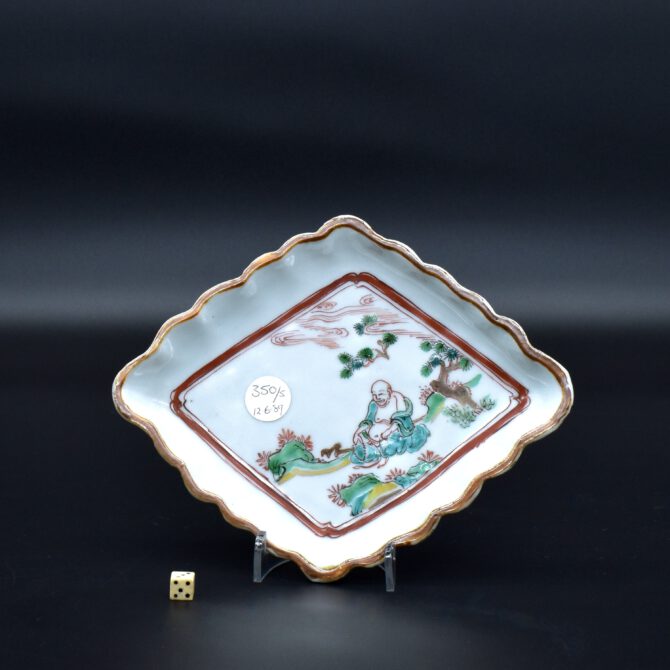
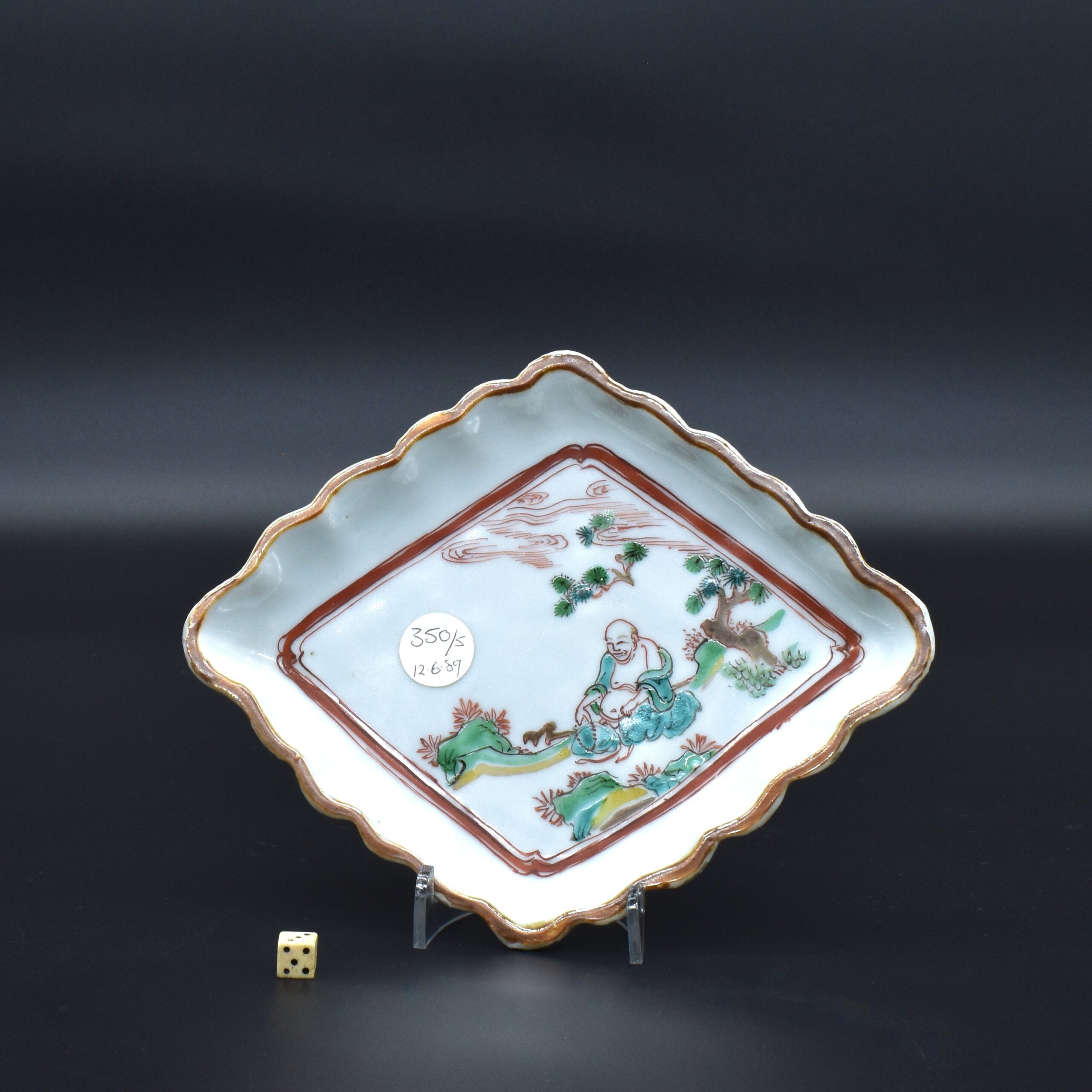
A Ming Porcelain Ko-akai Dish, Chongzhen Period 1628 – 1644.
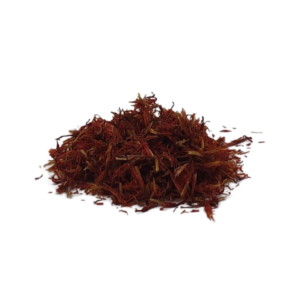
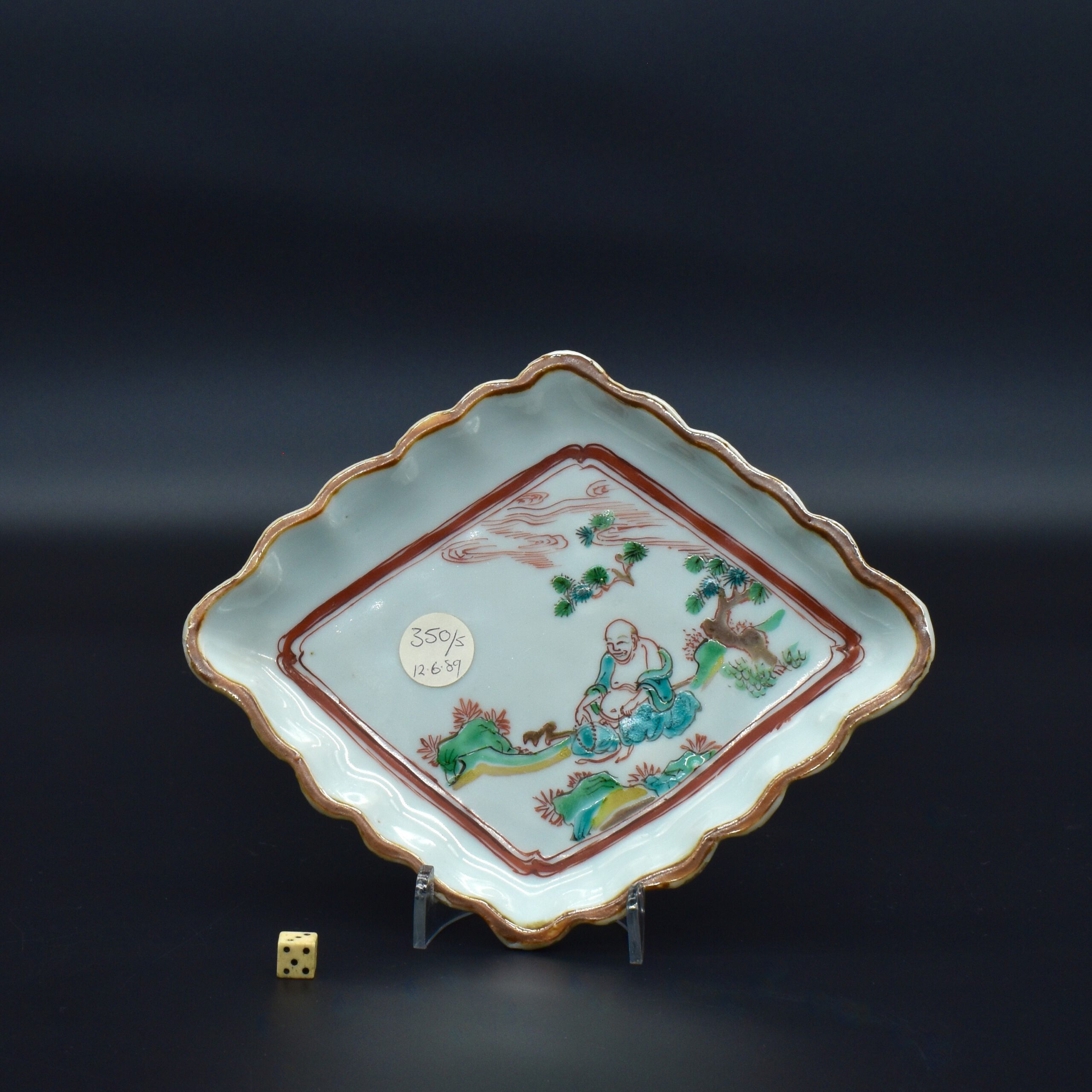
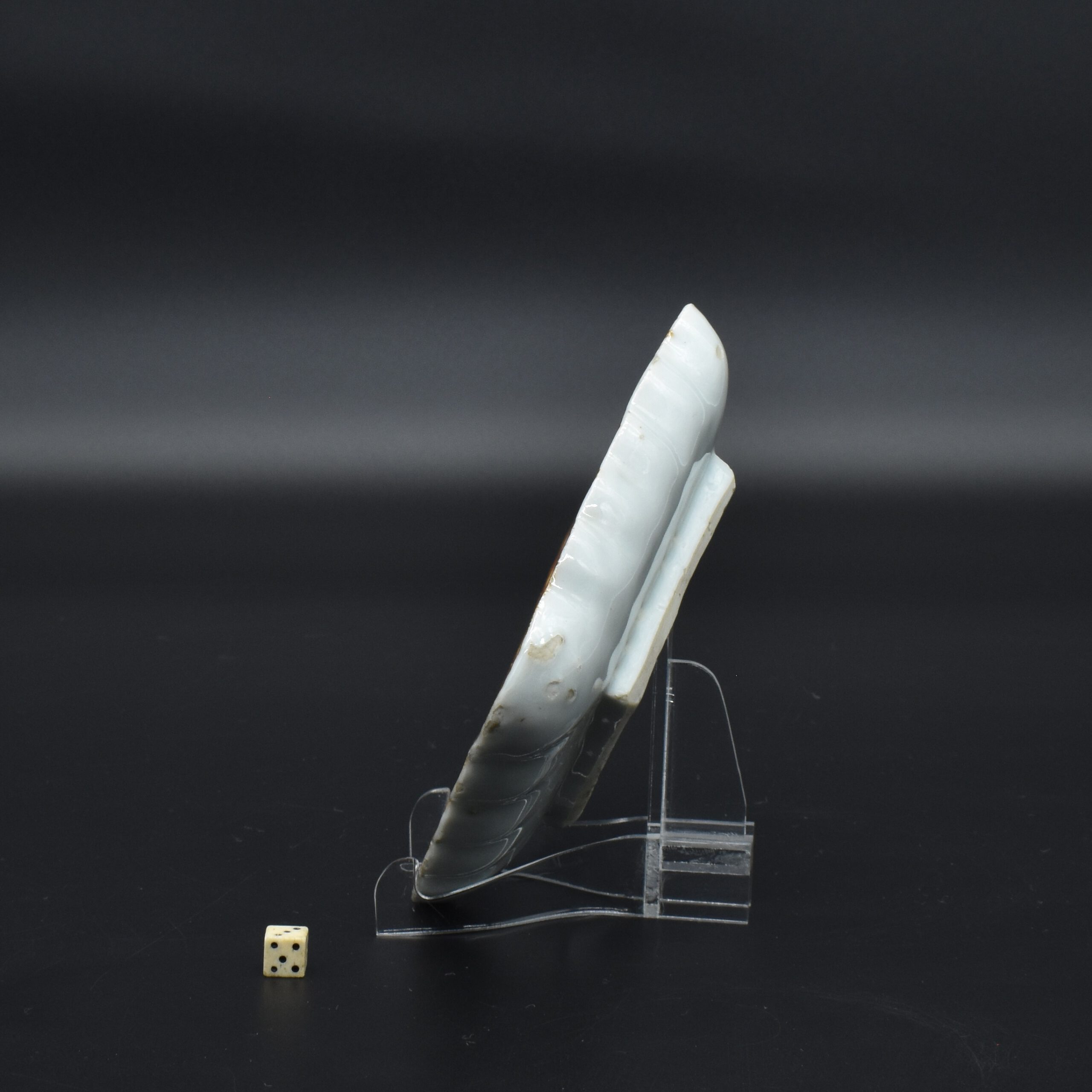
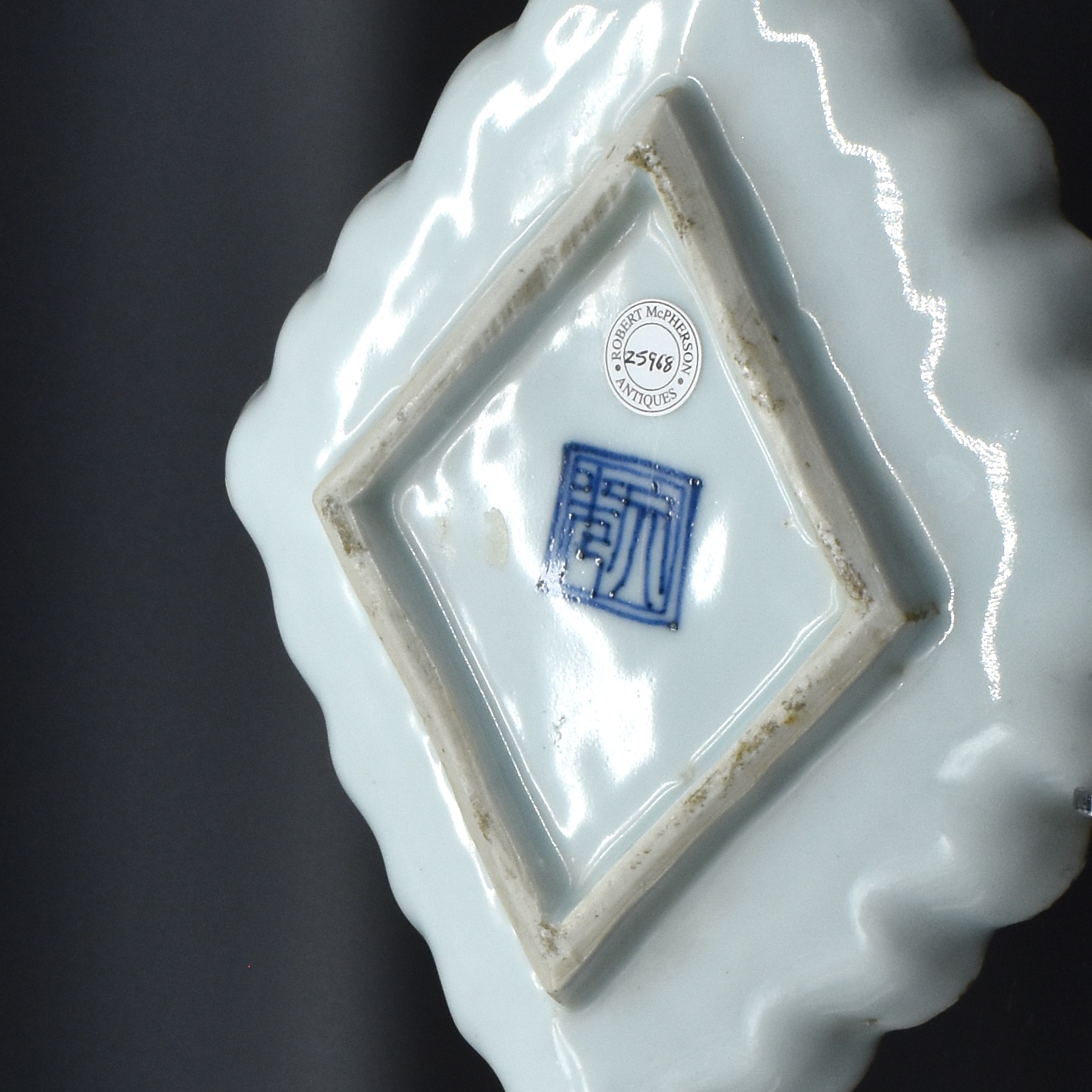
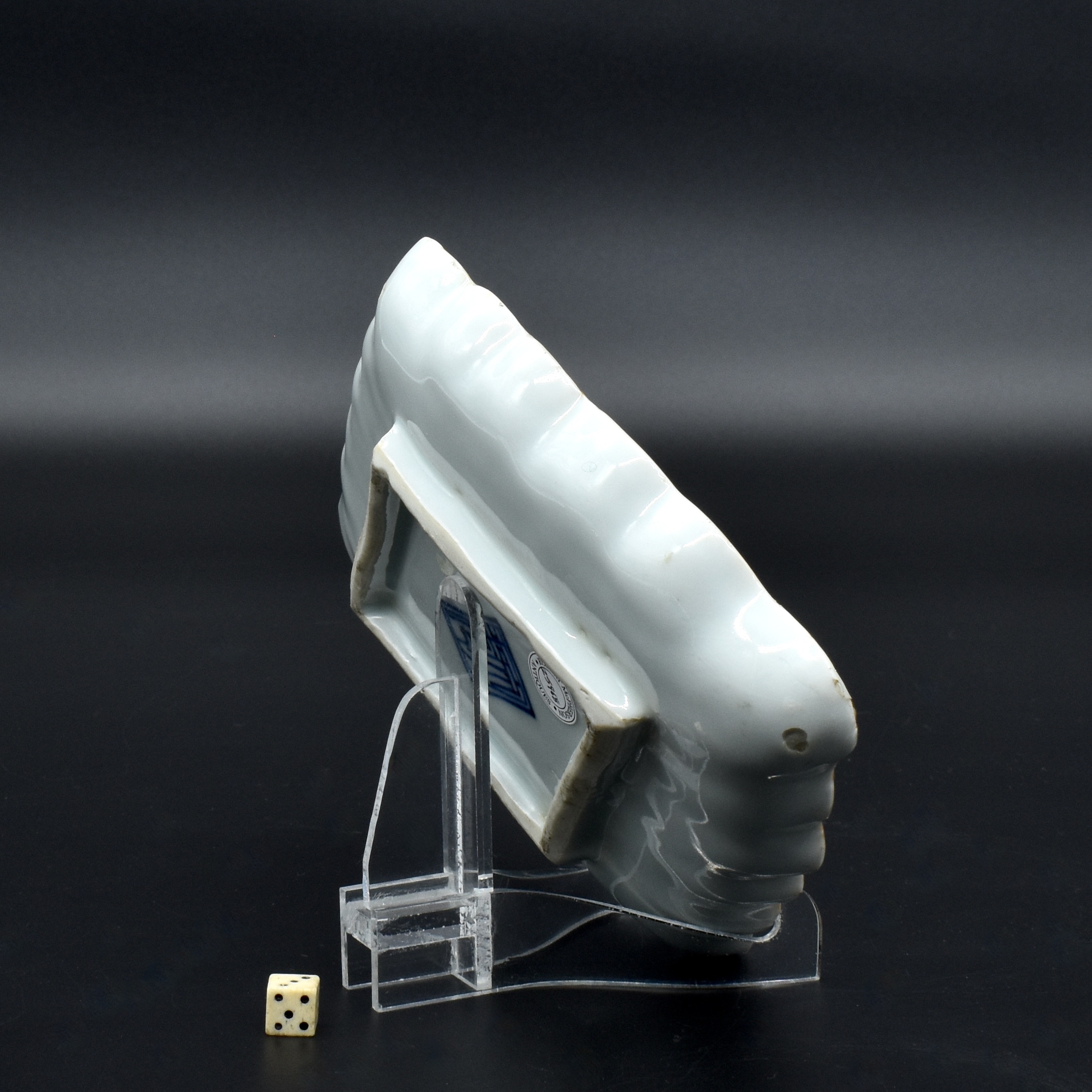
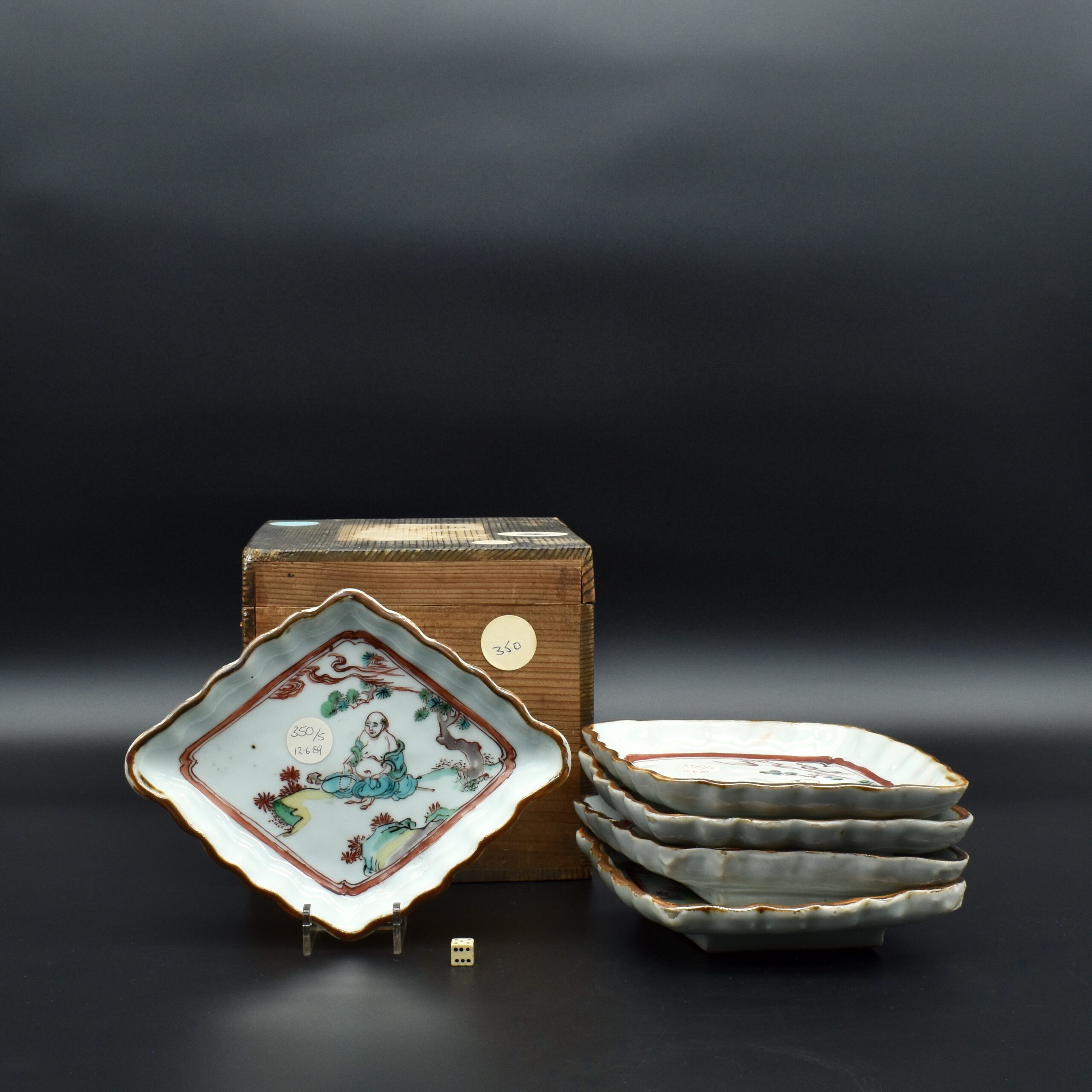
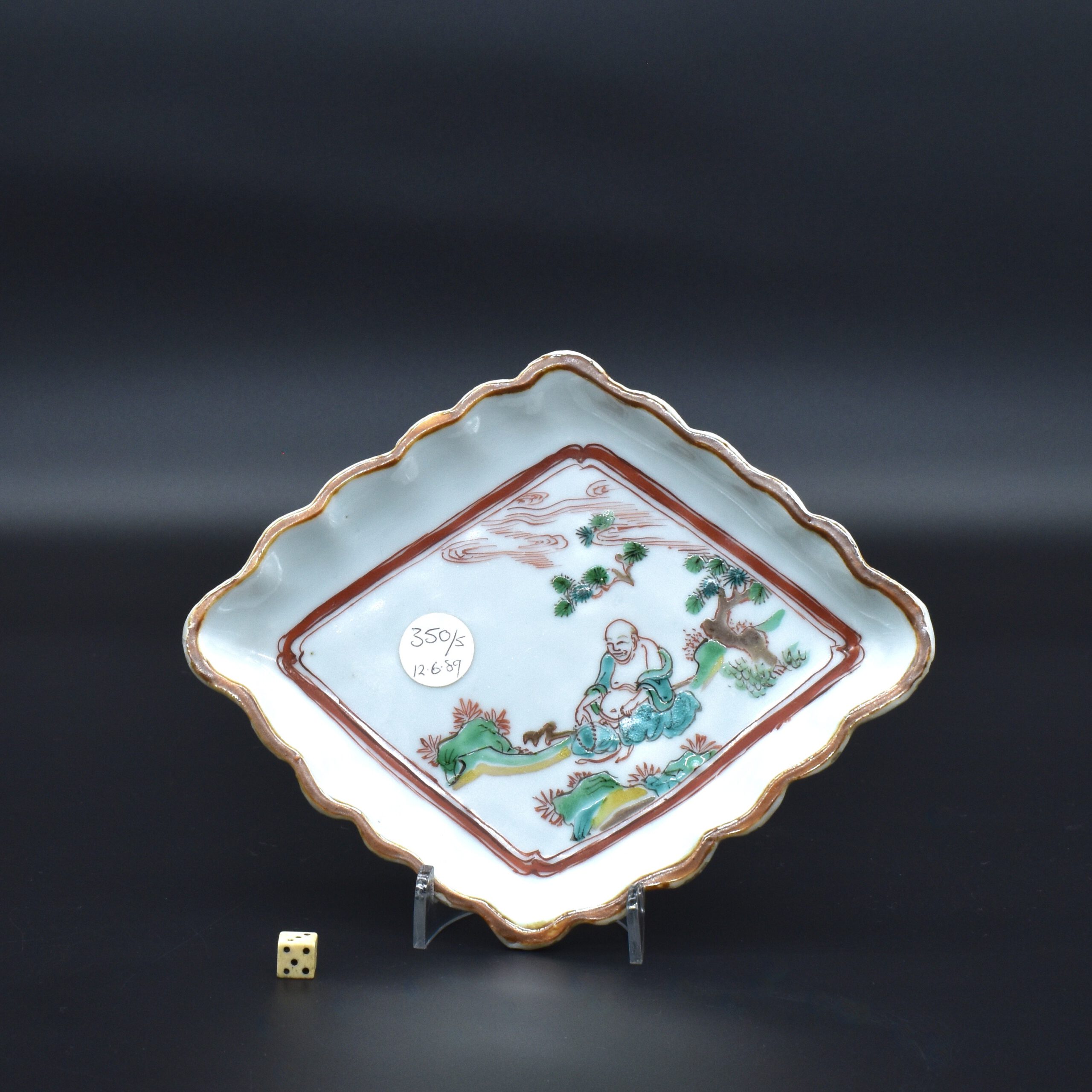
A Transitional Porcelain Dish Made for the Japanese Market, Jingdezhen Kilns, Ming Dynasty, Chongzhen Period 1628 – 1644. From The Peony Pavilion Collection (see Provenance). This late Ming dish Ko-akai porcelain dish is thickly potted and feels heavy in the hand. This serving dish Mukozuke (literally meaning beyond server) was made in for the Kaiseki meal that accompanies the Japanese tea ceremony. The back of this thickly potted Ming dish has a seal-mark, Wenguang meaning ‘literary lustre‘. The imperfections, including fritted Mushikui (insect-nibbled) rims, burst bubbles and kiln grit on the footrims all added to the Japanese aesthetic. These imperfections were something to be treasured by the Japanese, they reflect an imperfect world and the aesthetics of Wabi-Sabi. These ‘faults’ were an anathema to the Chinese, however they went along with it to satisfy the needs of their Japanese customers. The shapes created were often expressly made for the Japanese tea ceremony, especially the meal associated with tea drinking, the Kaiseki. The flat rim is dressed with an iron-oxide enamel, called 口紅 Fuchibeni in Japanese, meaning lipstick. It was used to frame ceramic designs but it also adds some strength to the fragile rim, as well as showing that the rim was not chipped. The word Fuchibeni, comes from kuchi meaning mouth and beni meaning red/safflower red.
SOLD
See Below For More Photographs and Information
- Condition
- No damage, however there are some burst bubbles to the glaze on the back.
- Size
- Width 18.7 cm (7.38 inches). Depth 3.2 cm (1.29 inches).
- Provenance
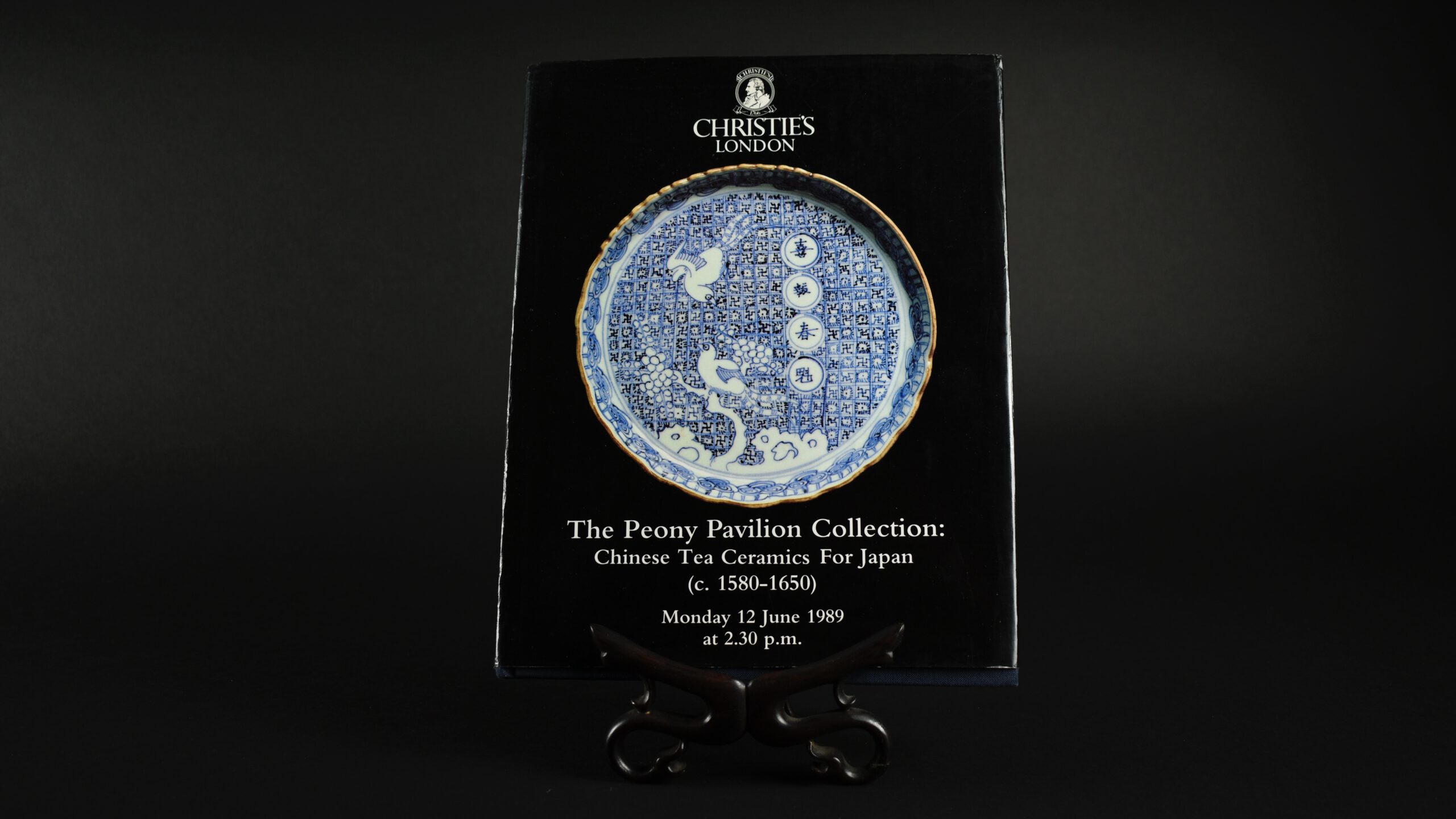
- The Peony Pavilion Collection ; Chinese Tea Ceramics for Japan (c.1580-1650). Christie`s London 12th June 1989, lot 350, set of 5. From a Private Collection, this lot was purchased, this piece as well as many others, from the Christie's sale of 1989. I was able to buy the complete group from this private collection. Christie's estimate £3,000 to £4,000 (1989), sold for £3,850.
- Stock number
- 25968
- References
- For a late Ming dish Ko-akai porcelain dish of this design, shape and size see : Leaping The Dragon Gate. The Sir Michael Butler Collection of Seventeenth-Century Chinese Porcelain' (Teresa Canepa and Katherine Butler, Ad Ilissvm, ISBN 978-1-912168-16-3. Published in 2021). Page 158, plate III.1.297. The Peony Pavilion Collection ; Chinese Tea Ceramics for Japan (c.1580-1650). Christie`s London 12th June 1989, lot 385, set of 5.
Photos
Information
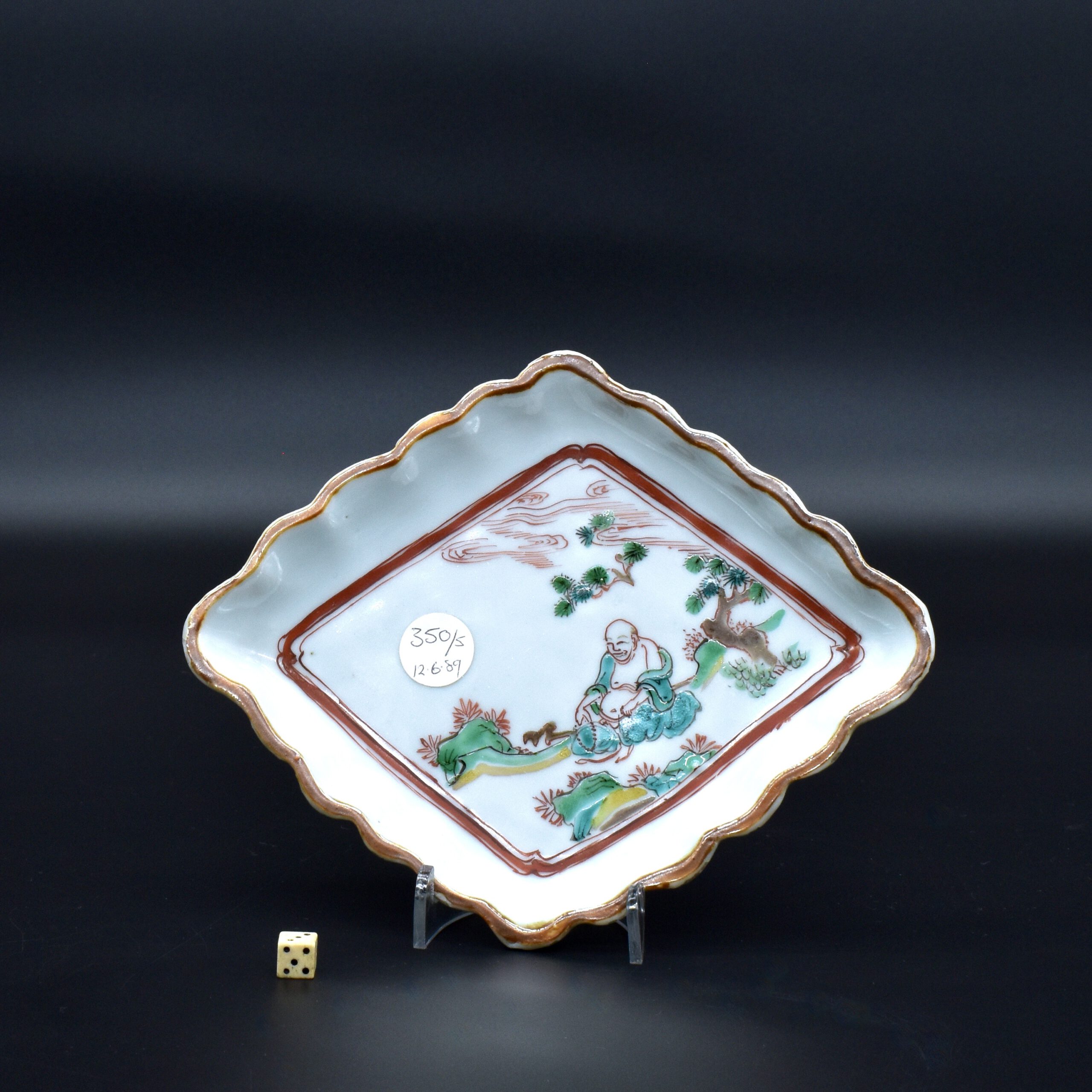
This Dish Comes from a set of Ming Five Ko-akai Dishes Sold at Christie's, King Street, London in 1989.
The Peony Pavilion Collection ; Chinese Tea Ceramics for Japan (c.1580-1650). Christie`s London 12th June 1989, lot 350, set of 5. From a Private Collection, this lot was purchased, this piece as well as many others, from the Christie's sale of 1989. I was able to buy the complete group from this private collection. Christie's estimate £3,000 to £4,000 (1989), sold for £3,850.
A Transitional Porcelain Ko-akai Enamelled Dish Made for the Japanese Market.
Robert McPherson Antiques Sold Archive Number 26258
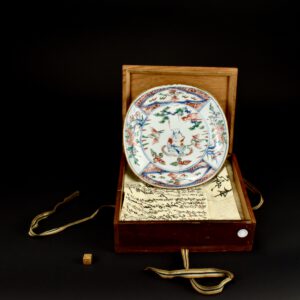
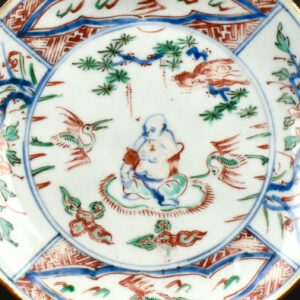
A Transitional Porcelain Ko-akai Enamelled Dish Made for the Japanese Market, Jingdezhen Kilns, Ming Dynasty, Chongzhen Period 1628 – 1644. This Ming dish Ko-akai Ming porcelain is thickly potted and so it is rather heavy. The dish was decorated in underglaze blue and fired, then it was enamelled and given its finial firing. The glaze is blue grey. This serving dish Mukozuke (literally meaning beyond server) was made in for the Kaiseki meal that accompanies the Japanese tea ceremony. Painted in underglaze cobalt blue with green, iron-red, and black. The central scene in the well depicts Budai (Hotei in Japanese), he is a Chinese deity. His name means `Cloth Sack` and comes from the bag that he carries. According to Chinese tradition, Budai was an eccentric Chinese Zen monk who lived during the 10th Century. Bearing in mind the long connection between Zen Buddhism and the Japanese tea ceremony, it is not surprising Budai takes center stage in this design. He sits on a fringed rug with the moon or sun above with pine and a cloud. Two phoenixes flank him, one of which has its head upside down. Below Budai are two ruyi-heads among stylised clouds. The border consists of two facing panels of flowering peony with orchid, the other two facing pales have a cartouche with flying phoenix against a red diaper ground. As with many pieces of Ming porcelain made for the Japanese market, this dish is deliberately made in a way that fits the Wabi-sabi aesthetic of delight in imperfection and accident. The shape is uneven, it is roughly made or should I say made with spirit and energy. The painting is free, there are imperfections such as tiny flecks of the iron red paint left on the surface. The back has allot of kiln grit within the footrim, the rim has been dressed with an iron oxide glaze.
This Ming porcelain comes with a Tomobako box with a piece of Japanese paper with writing and ten red seals. Tomobako storage boxes are an important part of Japanese culture, often made of cedar or paulownia wood. To hold the box and the lid closely together a string is used, which is knotted above the lid in a slipknot (himokake 紐掛け). It was once round, but since the beginning Edo Period (1603-1868) a flat cotton string (sanada-himo 真田紐) is more common. It took me a while to get this right, if you get it wrong it might seem safe but isn’t. Unlike many countries, traditional Japanese buildings had few if any solid walls, so shelves as we know them were not used. Precious objects were kept in boxes for a number of reasons. Western displays with objects on permanent show mean the brain starts to dismiss the objects, they just blend into their environment and become unseen. In Japan, tomobako would be opened among invited friends, they could be looked at with fresh eyes, shared and passed around. A far more down to earth reason is the extreme danger of volcanoes in Japan.
Porcelain From The Peony Pavilion.
Robert McPherson Antiques - Sold Archive.
Published : The Peony Pavilion Collection ; Chinese Tea Ceramics for Japan (c.1580-1650). Christie`s London 12th June 1989, lot 294. Sold £1,650 (set of 5). From a Private Collection, they purchased this piece as well as many others from the Christie's sale of 1989. I was able to buy the complete group from this private collection.
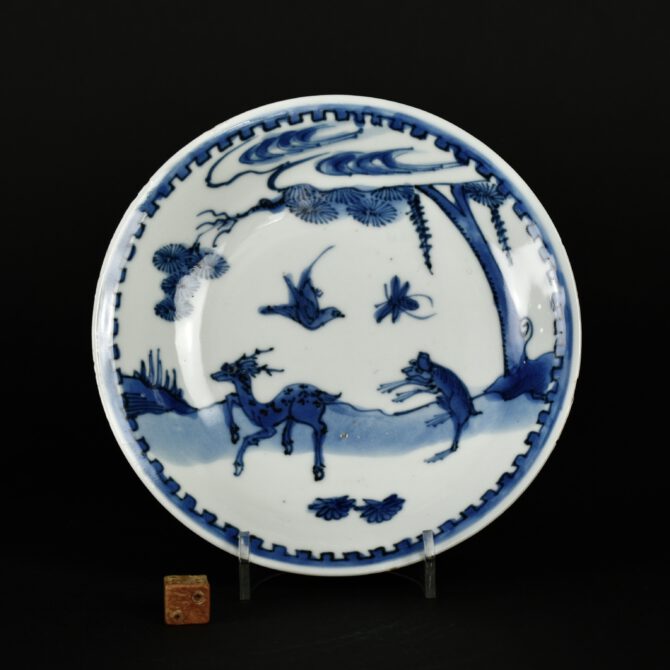
A Late Ming Blue and White Porcelain Dish for the Japanese Market, Tianqi Period 1620 – 1627. This late Ming porcelain dish would have been a Kaiseki, a serving for the Japanese Tea Ceremony meal. The design is of a monkey walking towards a deer, a wasp above with a bird in flight and a pine tree to the right. Parts of this design forms the rebus, juelu fenghou, meaning ‘may you receive high rank and emolument’. The elements taken from the design to create the rebus are ; monkey is hou with a deer lu and wasps feng. The entry for these five Ming dishes in the Peony Pavilion Catalogue has a footnote “A related polychrome example is illustrated in Transitional Wares and Their Forerunners, op. cit., p139″. We sold that dish earlier in the year (2020). See the photograph and reference below the ‘photograph gallery’. The polychrome dish was published and exhibited by the Oriental Ceramics Society of Hong Kong at the Hong Kong Museum of Art in 1981 (see References). There were five of these Ming blue and white Kaiseki dishes sold as lot 294 in the Peony Pavilion Sale in 1989, they came with a box for ten dishes. The other five from the set were sold by Christie’s as lot 295. Box Not Included.
- Condition
- In good condition, very minor mushikui frits
- Size
- Diameter 14.8 cm (5 3/4 inches)
- Provenance
- Published : The Peony Pavilion Collection ; Chinese Tea Ceramics for Japan (c.1580-1650). Christie`s London 12th June 1989, lot 294. Sold £1,650 (set of 5). From a Private Collection, they purchased this piece as well as many others from the Christie's sale of 1989. I was able to buy the complete group from this private collection.
- Stock number
- 25937
- References
- A related polychrome example sold by Robert McPherson Antiques was exhibited in Hong Kong in 1981 see : Transitional Wares and Their Forerunners' (An exhibition presented by the Oriental Ceramics Society of Hong Kong at the Hong Kong Museum of Art in 1981) page 139, colour plate 162.
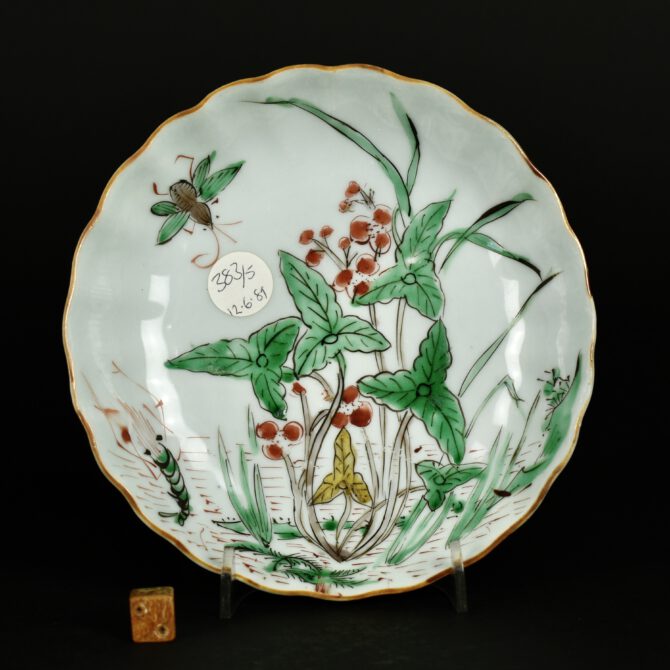
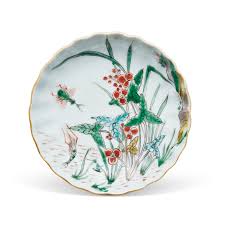
A Ming Porcelain Dish Made for the Japanese Market, Chongzhen Period c.1635-1645. This foliated Transitional Period Ko-akai Dporcelain dish is painted with bright enamels. The aquatic scene depicts arrowhead Sagittaria sagittifolia as well as other aquatic plants, there is also a leaping shrimp and a flying insect. The design is taken from a woodblock printed book, first published in the Tianqi period 1621-1627, it was a popular book in Japan, where it was known as Hasshu gafu. This Chinese book Bazhong Huapu ‘Manual of Eight Styles of Painting’ was an eight volume collection. This specific design was taken from the illustration of the poem “Arrowroot” in the sixth volume of Bazhong Huapu. The base has an apocryphal six-character Chenghua mark (Ming Dynasty 1465-1487). For more details see below the ‘Photograph Gallery’ below.
Condition
In excellent condition, a small amount of rubbing to a arrowhead leaf due to a small raised area (firing fault).
- Size
- Diameter : 15 cm (6 inches)
- Provenance
- Published : The Peony Pavilion Collection ; Chinese Tea Ceramics for Japan (c.1580-1650). Christie`s London 12th June 1989, lot 383. Sold £1,430 (set of 5). From a Private Collection, they purchased this piece as well as many others from the Christie's sale of 1989. I was able to buy the complete group from this private collection.
- Stock number
- 25964
- References
- Published : The Peony Pavilion Collection ; Chinese Tea Ceramics for Japan (c.1580-1650). Christie`s London 12th June 1989, lot 383. For a Chongzheng dish of this design from Sir Michael Butler, see : Trade Taste and Transformation, Jingdezhen Porcelain for Japan 1620 - 1645 (Julia B. Curtis with contributions from Stephen Little and Mary Ann Rogers. China Institute, China Gallery, New York 2006. ISBN 0-9774054-0-0. 2006). The same dish is also illustrated in : Seventeenth Century Jingdezhen Porcelain from the Shanghai Museum and the Butler Collection (Shanghai Museum,2006. ISBN 1-85759-417-7) page 71 plate 33.
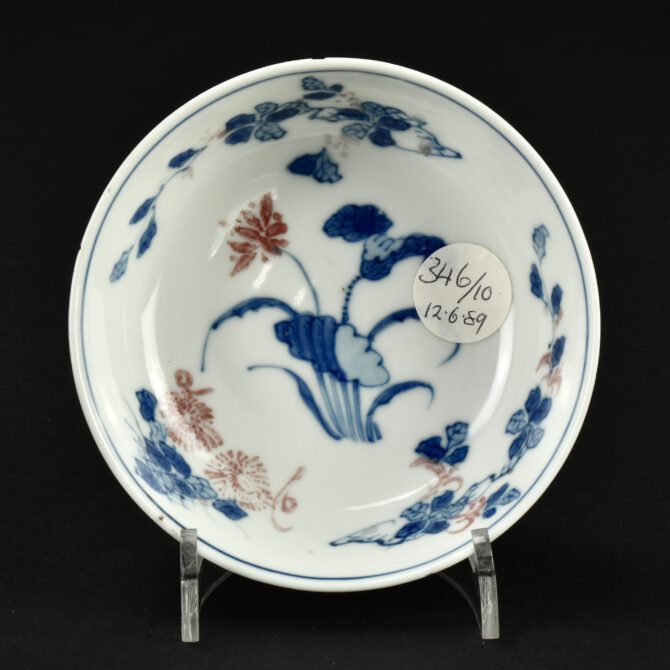
A Rare Copper-Red and Blue Semi-Eggshell Ming Bowl, Wanli Period (1573-1620), Jingdezhen Kilns, Probably Late 16th Century. Apocryphal Xuande six-character mark to base Ming (1423-1435). This finely potted bowl is painted in tones of cobalt blue with strong copper-red pigment. The leading London Dealers, Marchant, in their catalogue “Seventeenth-Century Blue and White and Copper-Red and Their Predecessors” (see references), date the pair they had in 1997 to Wanli c.1590. This is early for Chinese porcelain made for Japan, but the dating does relate to other pieces of especially finely potted Kraak as well as other blue and white porcelain made at the end of the 16th century. The pieces I have seen from this period differ to the early 17th century Chinese porcelain made for Japan in that they lack the firing cracks, roughness, or tears to the body. Those firing faults were deliberate, making the piece and therefore the owner humble, more modest, in the Japanese tradition of Wabi-Sabi. The earlier pieces are quite different. This bowl is of very high quality, it has a fine silky-smooth glaze, the blue tones are carefully placed but most extraordinary of all is the quality of the copper-red. Despite being applied before glazing it is a very temperamental pigment to work with, it can fire with greens or have flecks of green, it can look dull, grey or even disappear completely. This can happen with the most experienced studio potters of our time, yet these ten Ming bowls from the Peony Pavilion Collection have an excellent even copper-red colour. Copper-red was only just being reintroduced at this period, after production stopped in the Mid-15th Century. The design consists of flowering lotus growing out of a pond or lake with sprays of prunus with cherries, flowering lily and chrysanthemum. So many Japanese designs are deeply connected to nature, showing a respect for living things, our interconnectivity with our environment and the small part we play within the natural world. The wood box is not included with this bowl.
Condition
- In very good condition. Three minute glaze frits.
- Size
- Diameter : 9.6 cm (3 3/4 inches).
- Provenance
- The Peony Pavilion Collection ; Chinese Tea Ceramics for Japan (c.1580-1650). Christie`s London 12th June 1989, lot 346, set of 10. From a Private Collection, this lot was purchased, this piece as well as many others, from the Christie's sale of 1989. I was able to buy the complete group from this private collection.
- Stock number
- 25949
- References
- Published : The Peony Pavilion Collection ; Chinese Tea Ceramics for Japan (c.1580-1650). Christie`s London 12th June 1989, lot 346. For pair of very similar bowls, see : Seventeenth-Century Blue and White and Copper-Red and their Predecessors (Exhibition catalogue, S. Marchant & Son June 1997). They were formerly in the collection of Eugene O' Perkins and exhibited at the Phoenix Art Museum, Arizona between 1983-1988 . Another very similar bowl referred to as being from the Kangxi period was sold at Woolley and Wallis Auction, 17th of May 2022, lot 547, sold for £3,900 (Including commission and VAT). "A CHINESE UNDERGLAZED BLUE AND COPPER-RED BOWL KANGXI 1662-1722 The interior decorated with lotus sprays to the centre, encircled by floral branches at different stages of bloom, the underside decorated with two further foliage sprigs, the base with a six character Xuande mark, 11.2cm. Provenance: from an English private collection, London."
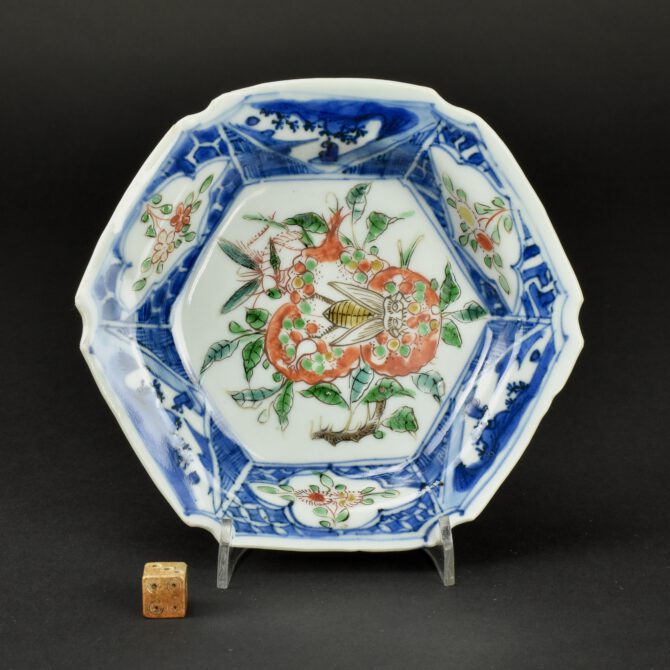
A Transitional Porcelain Dish Made for the Japanese Market, Jingdezhen Kilns, Ming Dynasty, Tianqi 1621 – 1628 or Chongzhen Period 1628 – 1644. This Ming porcelain Mukozuke (literally meaning beyond server) dish was made in for the Kaiseki meal that accompanies the Japanese tea ceremony. The hexagonal shallow form has indented corners with a flat broad rim painted in underglaze blue. This blue underglaze decoration is reminiscent of Kraak porcelain, this is perhaps unsurprising as Kraak ware was popular in 17th century Japan. Indeed, recent research has shown that some kilns in Jingdezhen produced porcelain for the Japanese market also made Kraak ware. The overglaze colours consist of a thickly applied translucent green enamel, a similar but paler green, there is also mustard yellow and aubergine. The red and black decoration is different, it sits flat on the surface of the porcelain, perhaps suggesting little or no glass binder was used. The central decoration depicts a pomegranate branch with three ripe pomegranates bursting open, their seeds of differing colours. A cicada and a grasshopper are feasting on the sweet open fruit. The cavetto has three cartouches decorated with flowering plants in enamel, colours set against a blue diaper patterns of cash (coins, meaning wealth), swastika (conducive to well-being) and a honeycomb design. The other three inverted triangular panels show a solitary seated figure on a promontory with a landscape in underglaze blue. Only one of the dishes from this group of six has an apocryphal Chenghua mark (Ming dynasty 1465-1487).
- Condition
- In very good condition, some mushikui (insect nibble, or fritting) that are normally found on this type of porcelain.
- Size
- Diameter 15 cm (5 3/4 inches).
- Provenance
- The Peony Pavilion Collection ; Chinese Tea Ceramics for Japan (c.1580-1650). Christie`s London 12th June 1989, lot 319, set of 6. From a Private Collection, this lot was purchased, this piece as well as many others, from the Christie's sale of 1989. I was able to buy the complete group from this private collection.
- Stock number
- 25959
- References
- Published in : The Peony Pavilion Collection ; Chinese Tea Ceramics for Japan (c.1580-1650). Christie`s London 12th June 1989, lot 319, set of 6, page 78. For a similar Ming dish dated to the Tianqi period but the center decoration incised see : Leaping The Dragon Gate, The Sir Michael Butler Collection of Seventeenth-Century Chinese Porcelain (Teresa Canepa and Katherine Butler, Ad Ilissvm. ISBN 978-1-912168-16-3. Published 2021). Page 150, plate III 1.204.
Christie's.
Anyone who purchased one of our enamelled dishes from The Peony Pavilion Collection will be pleased to see that a single dish of the same pattern and size made £7,220 in Christie's Hong Kong ;
A RARE ENAMELLED SAUCER DISH
CHONGZHEN PERIOD (1628-1644)
The dish is moulded with fluted petals in the well and is decorated on the interior with a pond depicting a prawn beside flowering arrowheads, with an insect in flight. The base is inscribed with an apocryphal six-character Chenghua mark.
5 7/8 in. (15 cm.) diam.
Provenance : Butler Collection.
Christie's, Hong Kong, 29 Nov 2022
Lot 2941
Sold HKD 69,300 (£7,220).
Budai / Hotei / Pagod
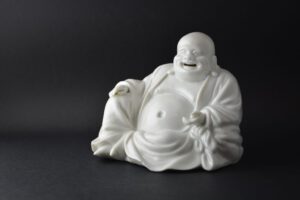
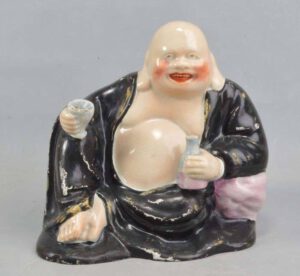
Budai (Hotei in Japanese) is a Chinese deity. His name means `Cloth Sack`, and comes from the bag that he carries. According to Chinese tradition, Budai was an eccentric Chinese Zen monk who lived during the 10th Century. He is almost always shown smiling or laughing, hence his nickname in Chinese, the Laughing Buddha. In English speaking countries, he is popularly known also as the `Fat Buddha`. In China Porcelain figures such as the present example would have been used in a family shrine while offering prayers, but in the West they would be seen as exotic curiosities, sometimes referred to as Magot or Pagod. The term Magot was used from as early as the mid 17th century to describe the European heavy set or bizarre representations in clay, plaster, copper or porcelain of Chinese or Indian figures. The term is usually used to describe the European porcelain. Pagoda Figure comes from the term pagode or religious figures housed in pagoda shrines. (Kisluk-Grosheide, `The Reign of Magots and Pagods`, Metropolitan Museum Journal 73, 2002, pp. 177, 181, 182, 184).
Tomobako Storage Boxes :
Traditional Japanese ceramic storage boxes, referred to as Tomobako are highly valued and much used in Japan. Most boxes are made from paulownia wood, it is lightweight hardwood and it’s also fire resistant, which is very useful in because Japanese buildings tend to be made of timber and have paper dividers inside. The Islands of Japan are located on a highly complex, unstable, and active geological junction where four major tectonic plates collide and subduct. These islands are essentially built upon the boundaries of these plates, with the archipelago forming as a result of the subduction and volcanic activity caused by these tectonic movements. Therefore the use of tradition tomobako is essential for the survival of ceramics in Japan. Japanese museums don’t have this luxury, so they secure the ceramic objects with nylon, which looks very much like fishing line. The paulownia is a fast growing tree, so it isn’t too expensive. It is believed that the phoenix, symbolising wisdom and prosperity, will only land on a paulownia tree when a worthy ruler is in power.
Tomobako containers that protect, store, and often certify the authenticity of the pottery inside. They are typically signed by the owner of the antique ceramic item in the box. They are tied with cord in a specific way, this is regarded as part of the a ritual ceremony among a gathering of friends in Japan. Of course not everything in these boxes is what it might seem. Some contain surprising objects, so you will have to wait and see what we have in these boxes.
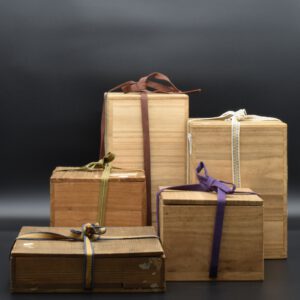
Traditional Japanese ceramic storage boxes, referred to as Tomobako are highly valued and much used in Japan. Most boxes are made from paulownia wood, it is lightweight hardwood and it’s also fire resistant, which is very useful in because Japanese buildings tend to be made of timber and have paper dividers inside. The Islands of Japan are located on a highly complex, unstable, and active geological junction where four major tectonic plates collide and subduct. These islands are essentially built upon the boundaries of these plates, with the archipelago forming as a result of the subduction and volcanic activity caused by these tectonic movements. Therefore the use of tradition tomobako is essential for the survival of ceramics in Japan. Japanese museums don’t have this luxury, so they secure the ceramic objects with nylon, which looks very much like fishing line. The paulownia is a fast growing tree, so it isn’t too expensive. It is believed that the phoenix, symbolising wisdom and prosperity, will only land on a paulownia tree when a worthy ruler is in power.
Tomobako containers that protect, store, and often certify the authenticity of the pottery inside. They are typically signed by the owner of the antique ceramic item in the box. They are tied with cord in a specific way, this is regarded as part of the ritual ceremony among a gathering of friends in Japan. Of course not everything in these boxes is what it might seem. Some contain surprising objects, so you will have to wait and see what we have in these boxes.
Fuchibeni : Glazed rims on Japanese Porcelain.