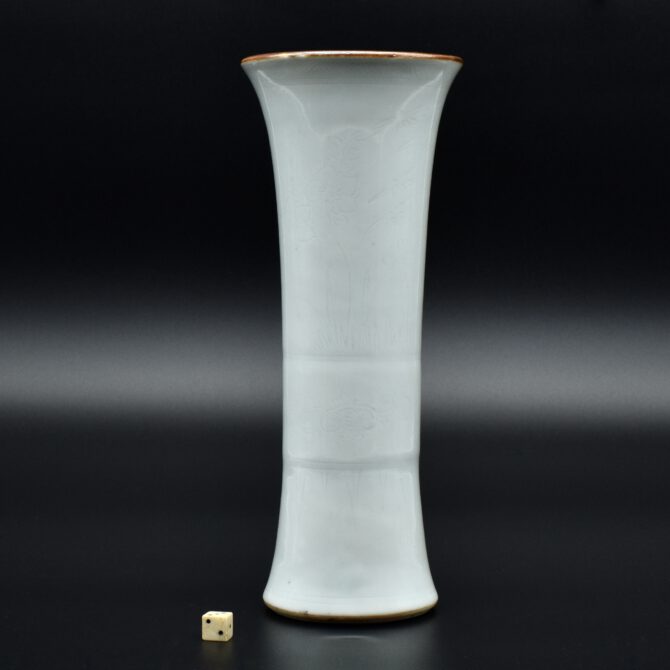
A Very Rare Shunzhi Transitional Porcelain Gu Vase Incised With An Hu Decoration, Jingdezhen Kilns.
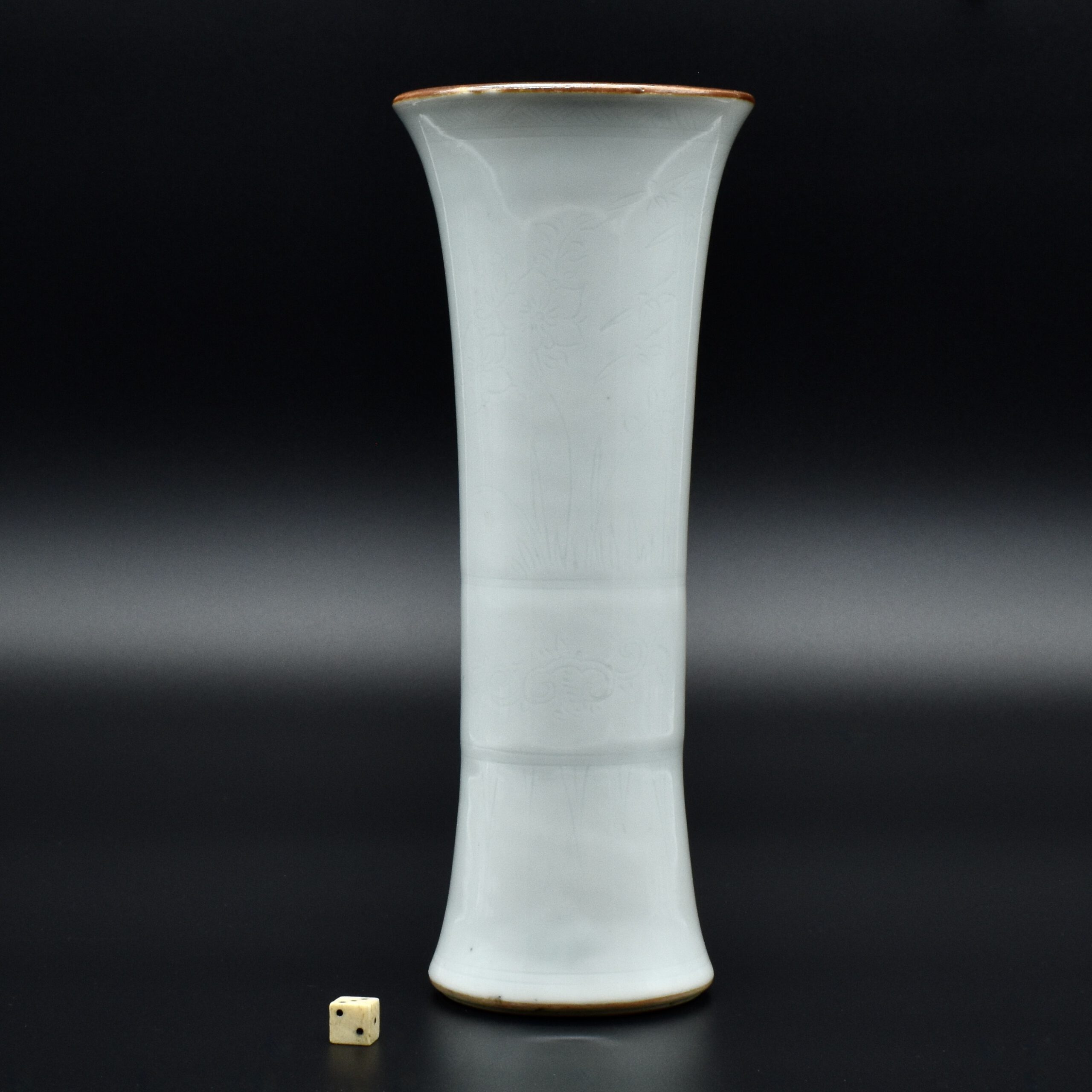
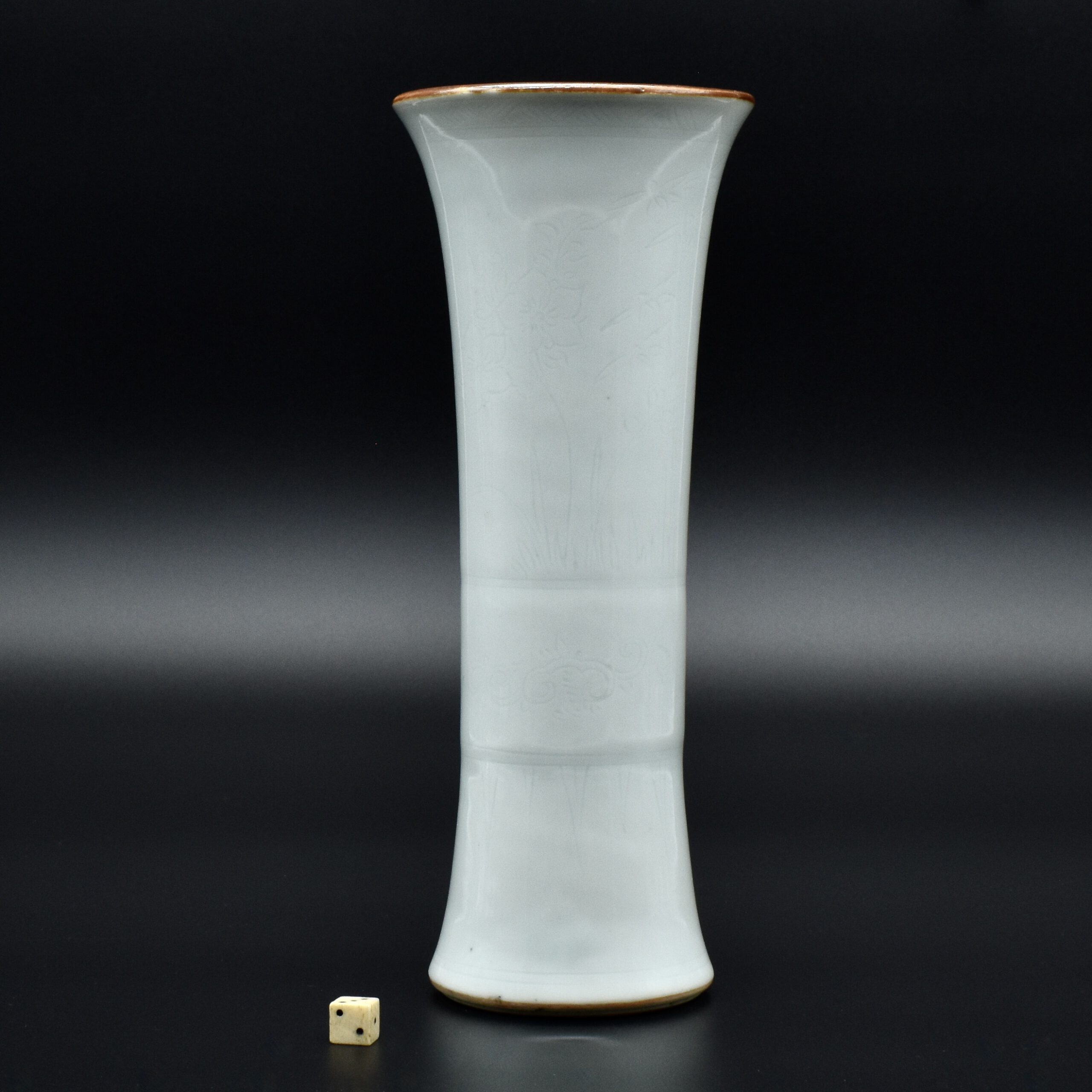
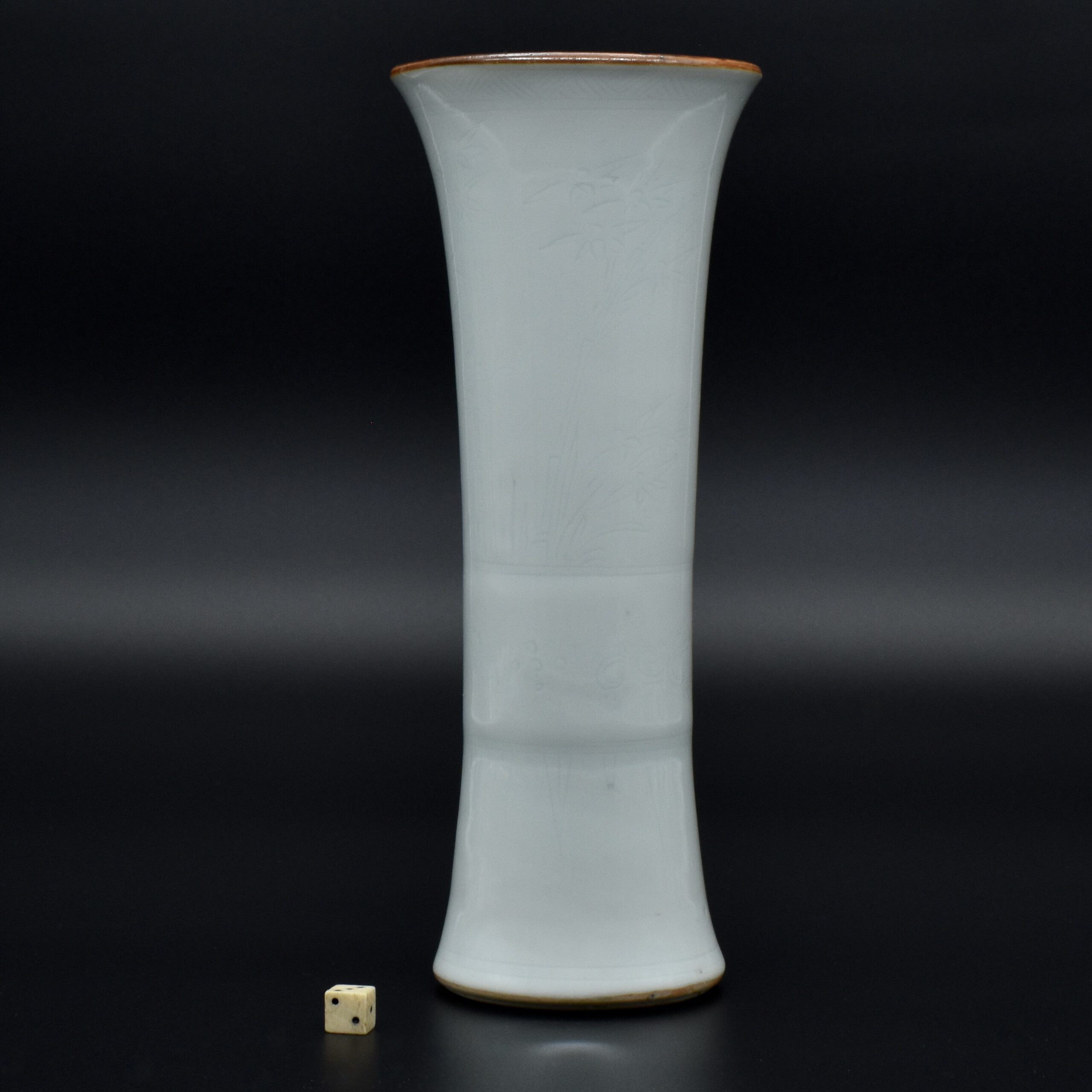
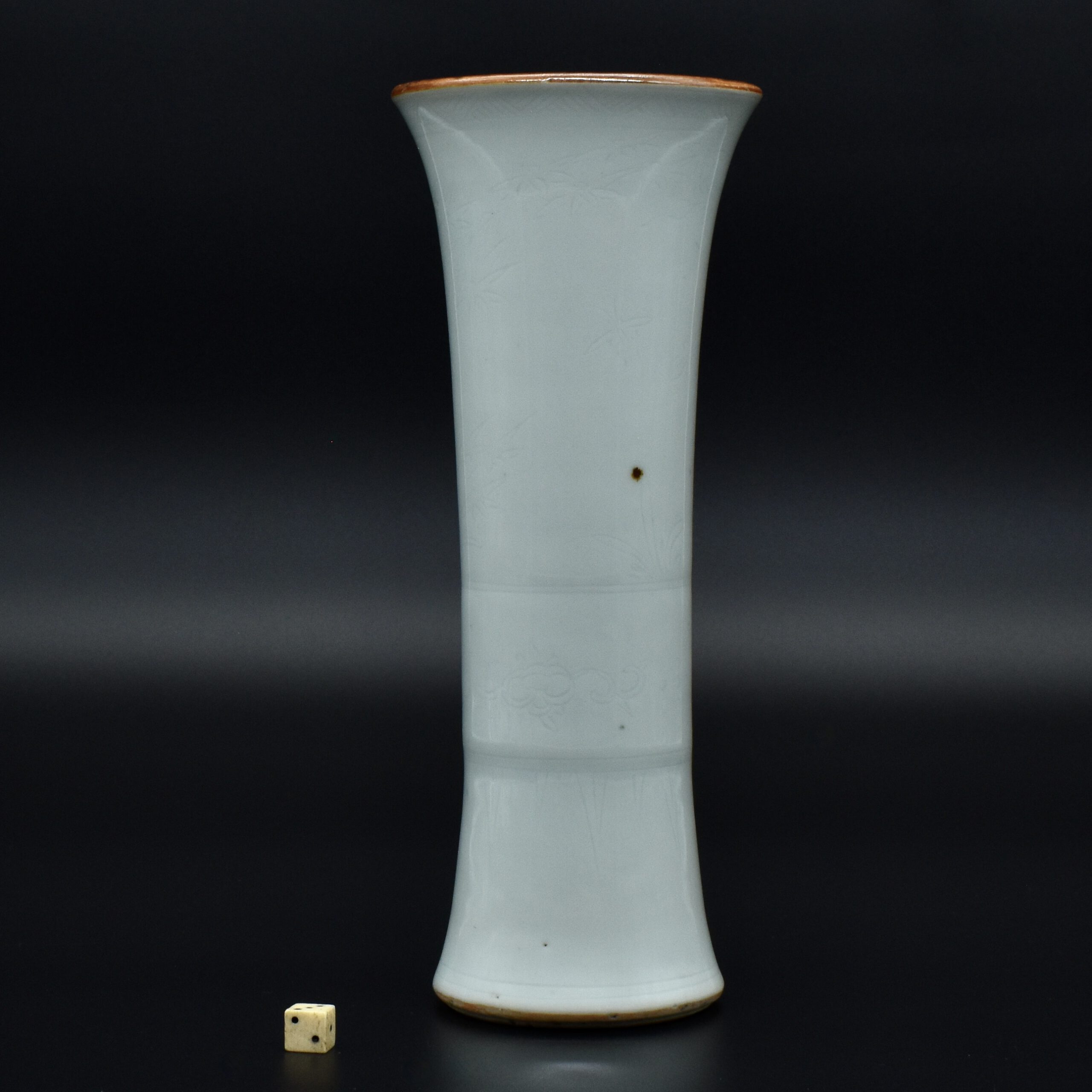
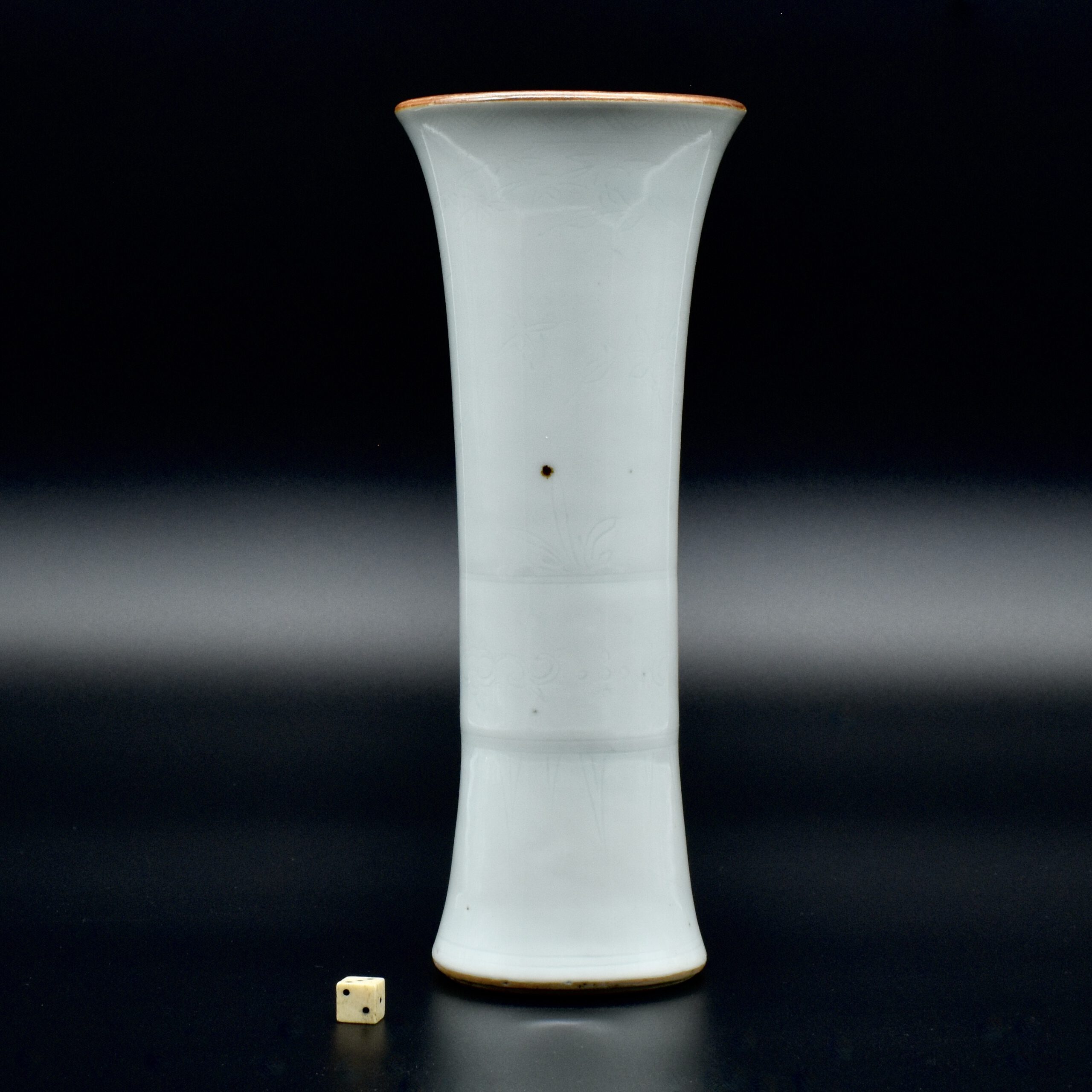
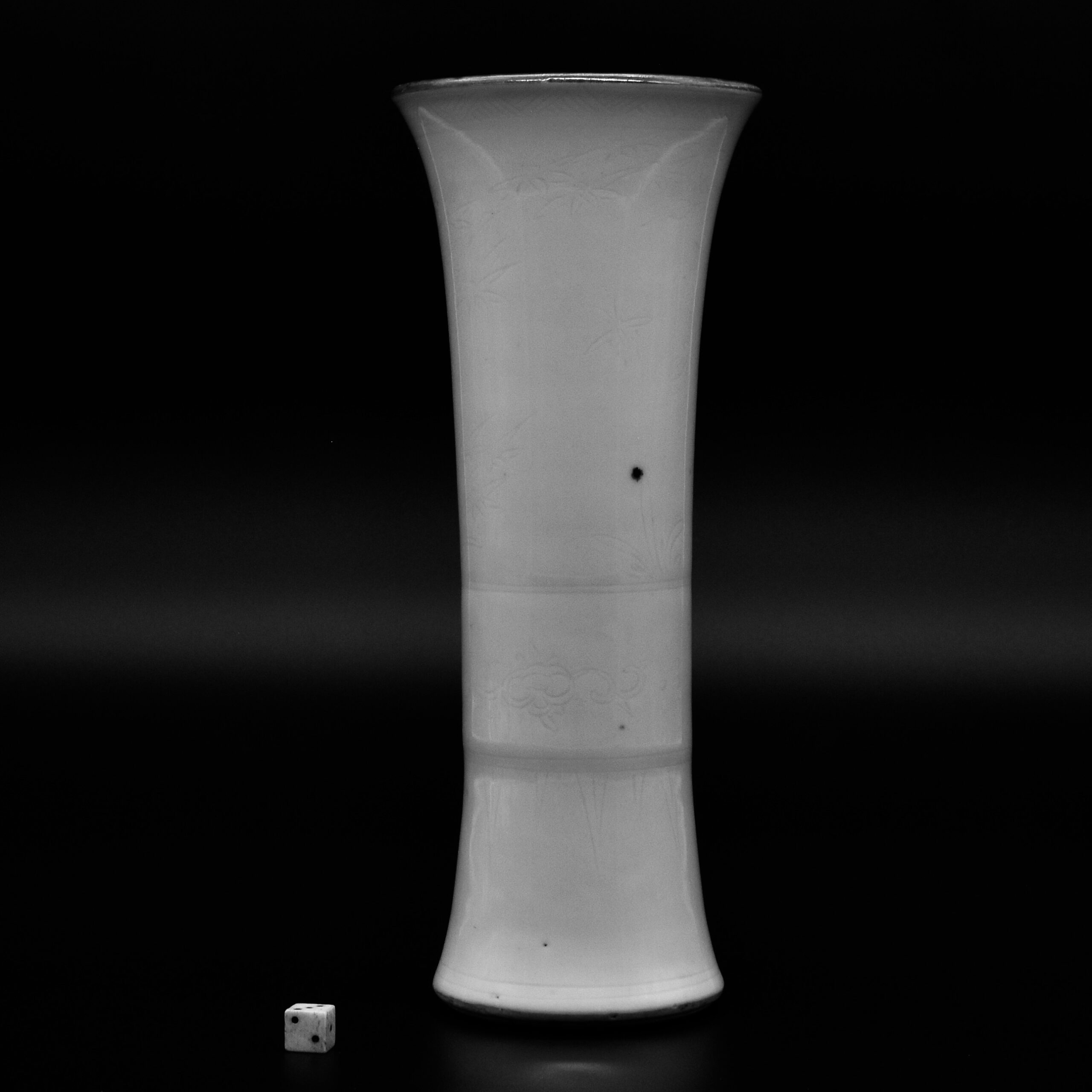
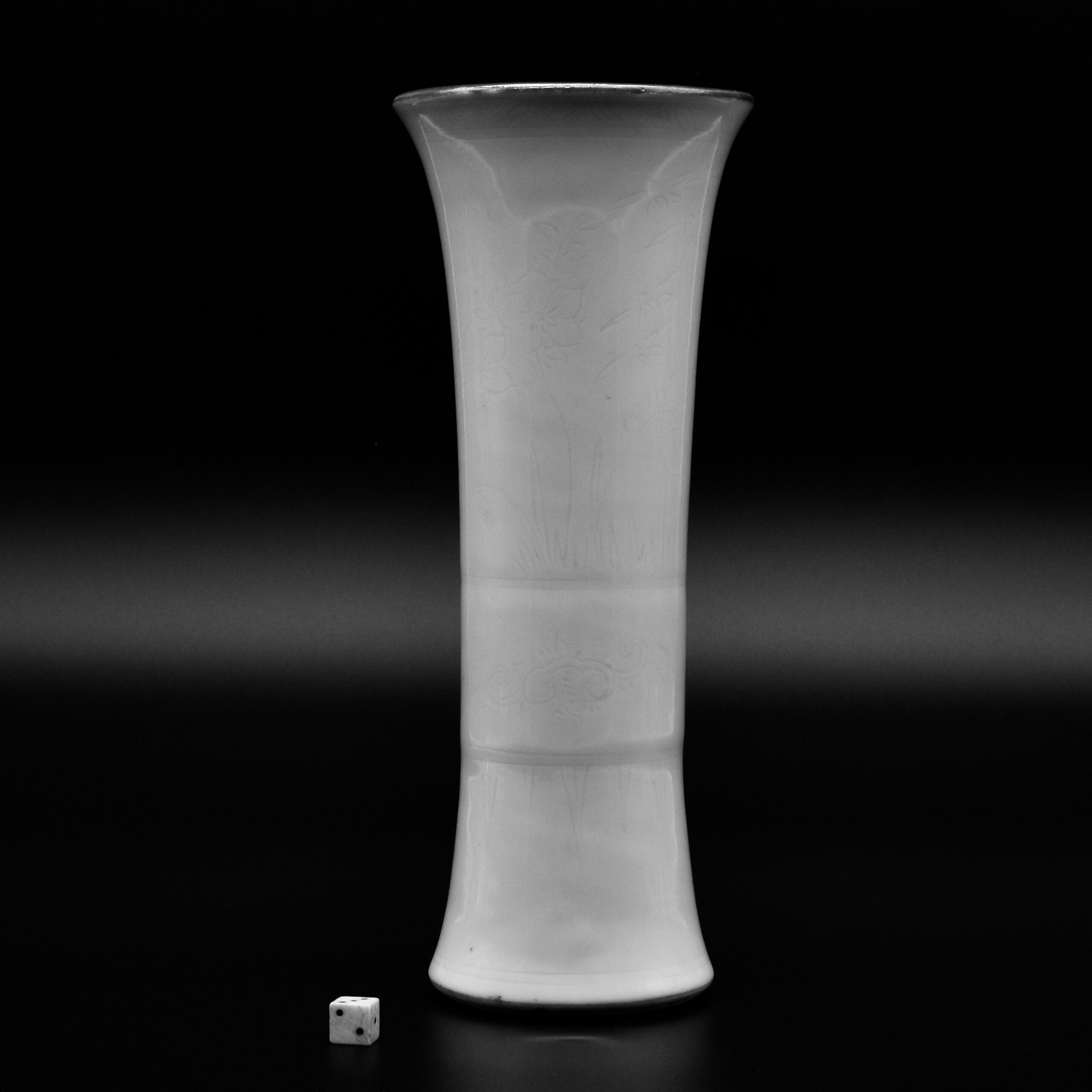
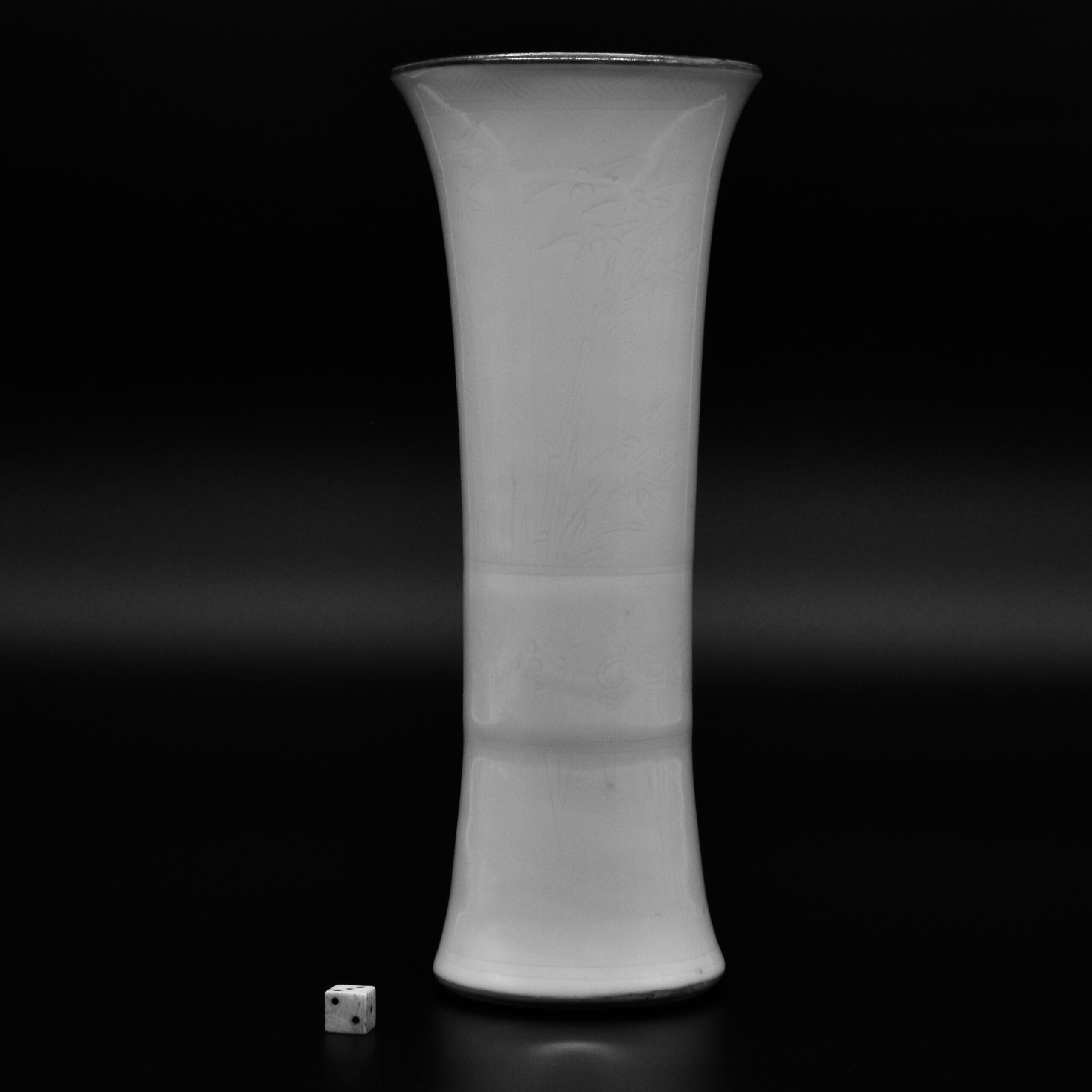
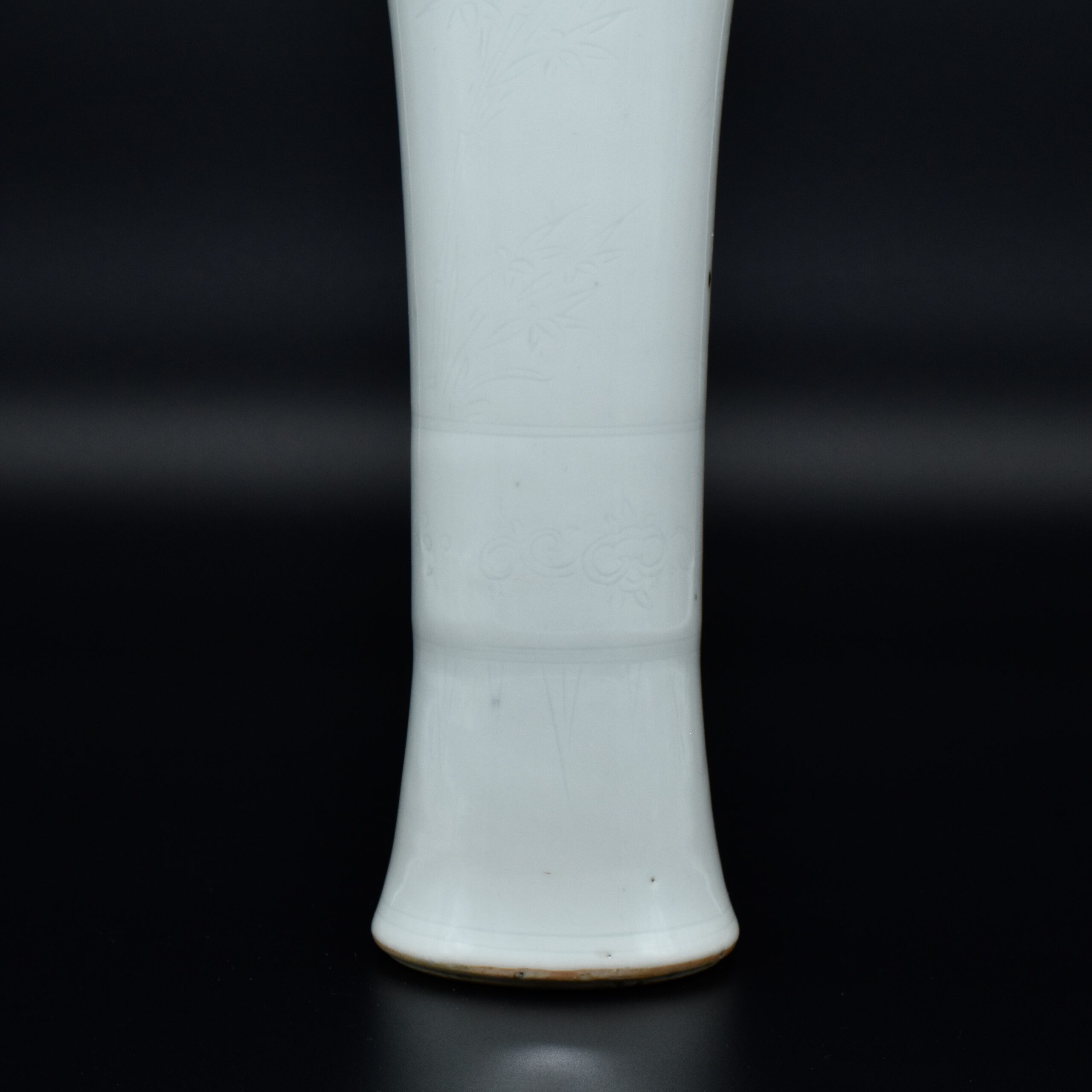
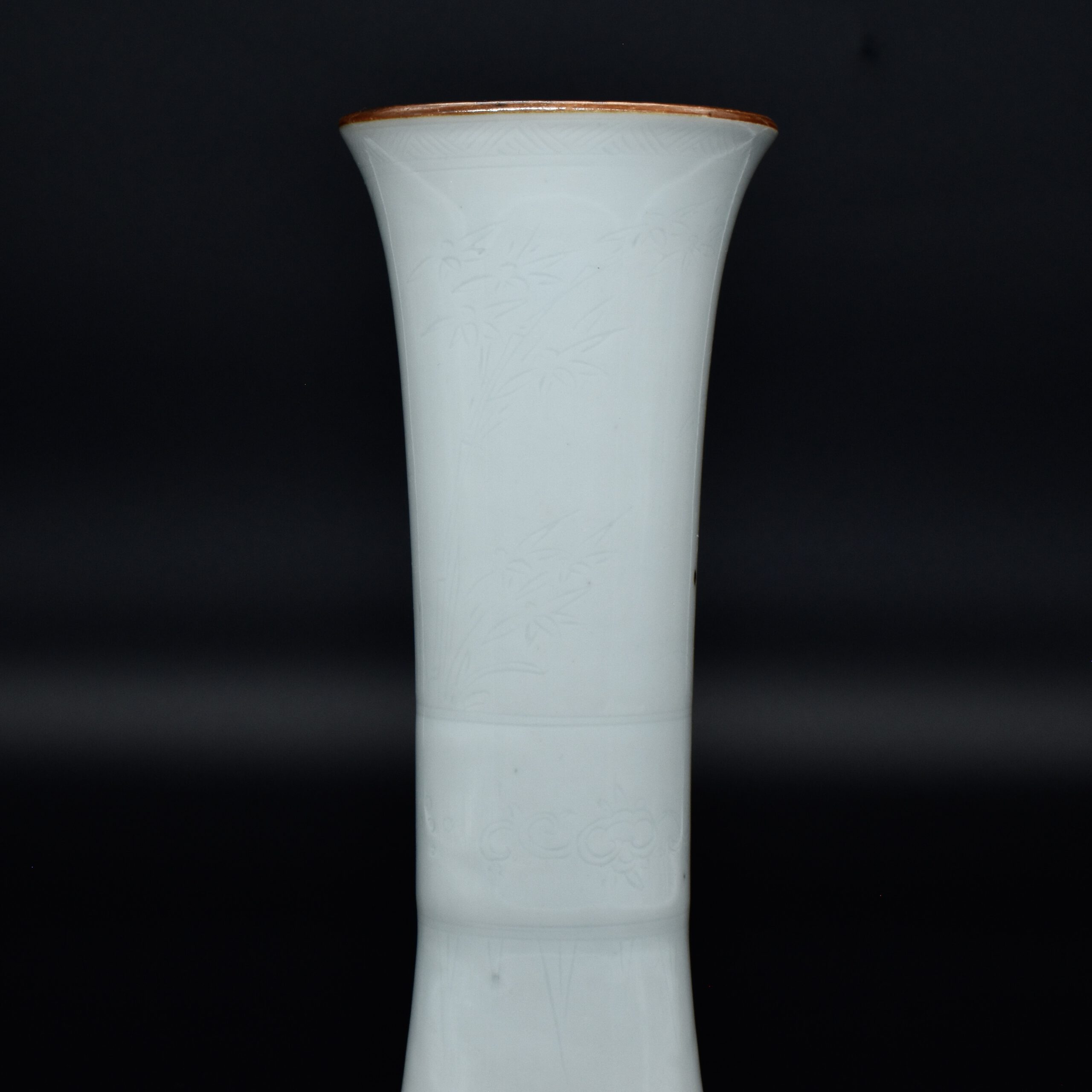
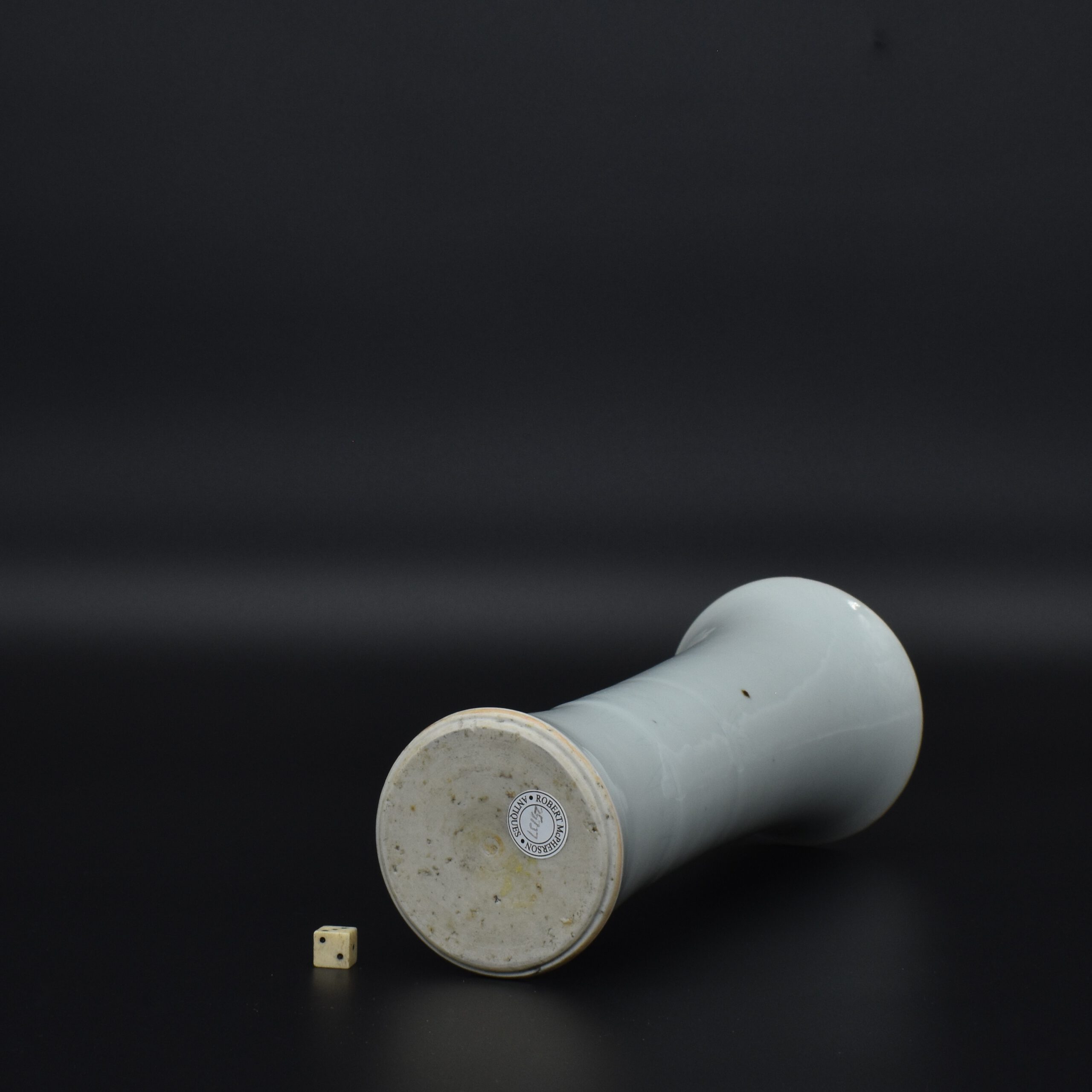
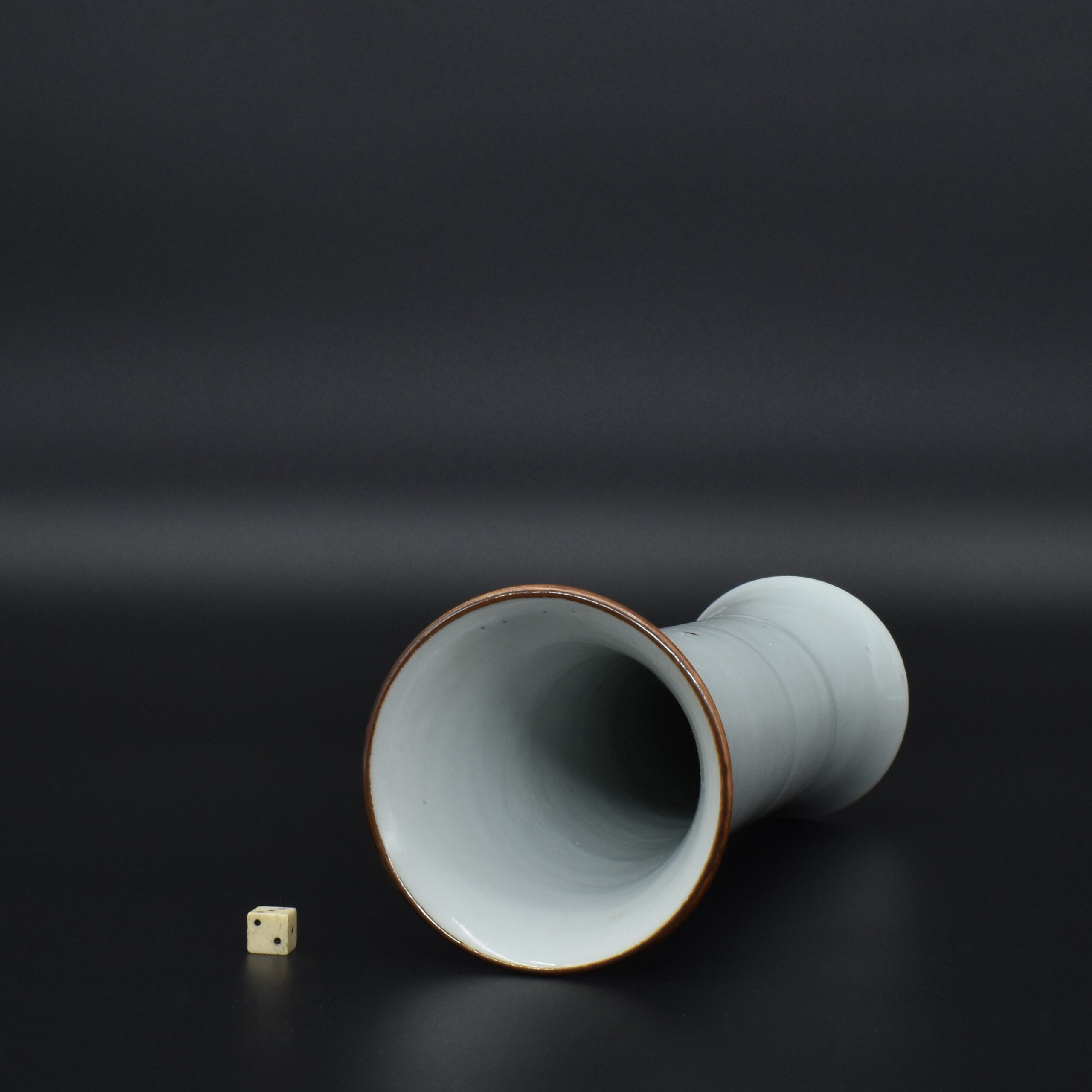
A Very Rare Shunzhi Transitional Porcelain Gu Vase Incised With An Hu Decoration, Jingdezhen Kins, Shunzhi Period (1644 – 1661). This Transitional white Gu shaped porcelain vase from Jingdezhen with An Hua (secret or hidden decoration) is very rare indeed. Even the Butler Collection possesses only three examples. There are many white porcelain objects from the mid-17th century that look similar, however these objects were made at the kilns in Dehua in Fujian province. Superficially, they look rather similar, especially if you are comparing them by photographs. The pieces, like the present gu vase are made from a less granular clay, where the porcelain body touches the glaze there is a thin but distinct neat orange-brown iron deposit. You can see this in the form of a concentric line around the base. The glaze is bluish with a slight green tinge, the glaze is smoother than the Blanc de Chine examples from Dehua. In essence, the Jingdezhen examples are neater and more carefully made. The piece on offer here has similar decoration to the blue and white porcelain examples, even the arrangement of the design is similar, it’s just that the decoration is incised with fine lines, rather than painted with cobalt blue. The lines are just as confidently and aesthetically pleasing as the blue and white examples, you need to look more carefully. I can see that to a Chinese scholar this subtlety would have been very pleasing. The decoration can be seen because the depth of the glaze is thicker where it falls into the incised lines. The top rim of this Gu shaped vase has been dressed with an iron-oxide glaze, of around 3 to 5% iron.
SOLD
See Below For More Photographs and Information
- Condition
- No damage, some very minor fine glaze scratches.
- Size
- Height 20.6 cm (8.1 inches).
- Provenance
- N/A
- Stock number
- 25737
- References
- For a larger (44.5 cm) white Gu shaped vase, which is carved rather than incised, see : Leaping The Dragon Gate. The Sir Michael Butler Collection of Seventeenth-Century Chinese Porcelain' (Teresa Canepa and Katherine Butler, Ad Ilissvm, ISBN 978-1-912168-16-3. Published in 2021). Page 499, plate III.5.3a,b. A large image of the same vase, which dated to 1640-1660 is illustrated in : Shunzhi Porcelain, Treasures from an Unknown Reign (Butler, Curtis and little, University of Washington Press,2002) page 150, item 36. The vase illustrated in both books is much larger than the example we have for sale, carved decoration is more appropriate for the size of object. Our smaller vase suits the very fine incised decoration.
Photos
Information
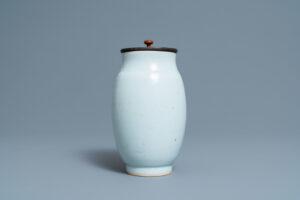
A Related Transitional Porcelain Jar, Sold at Rob Michiels Auction
H.: 19 cm
Condition: (UV-checked)
- With a restored rim chip of ca. 1 x 1,5 cm with related ca. 2 cm hairline running down the rim and extending horizontally over ca. 4 cm.
- Otherwise in good condition.
Lacking it's cover.
For Another Shunzhi Monochrome White Jar of this Type See :
Leaping The Dragon Gate. The Sir Michael Butler Collection of Seventeenth-Century Chinese Porcelain (Teresa Canepa and Katherine Butler, Ad Ilissvm, ISBN 978-1-912168-16-3. Published in 2021). Page 500, plate III.5.4.
Shunzhi 1644 - 1661 :
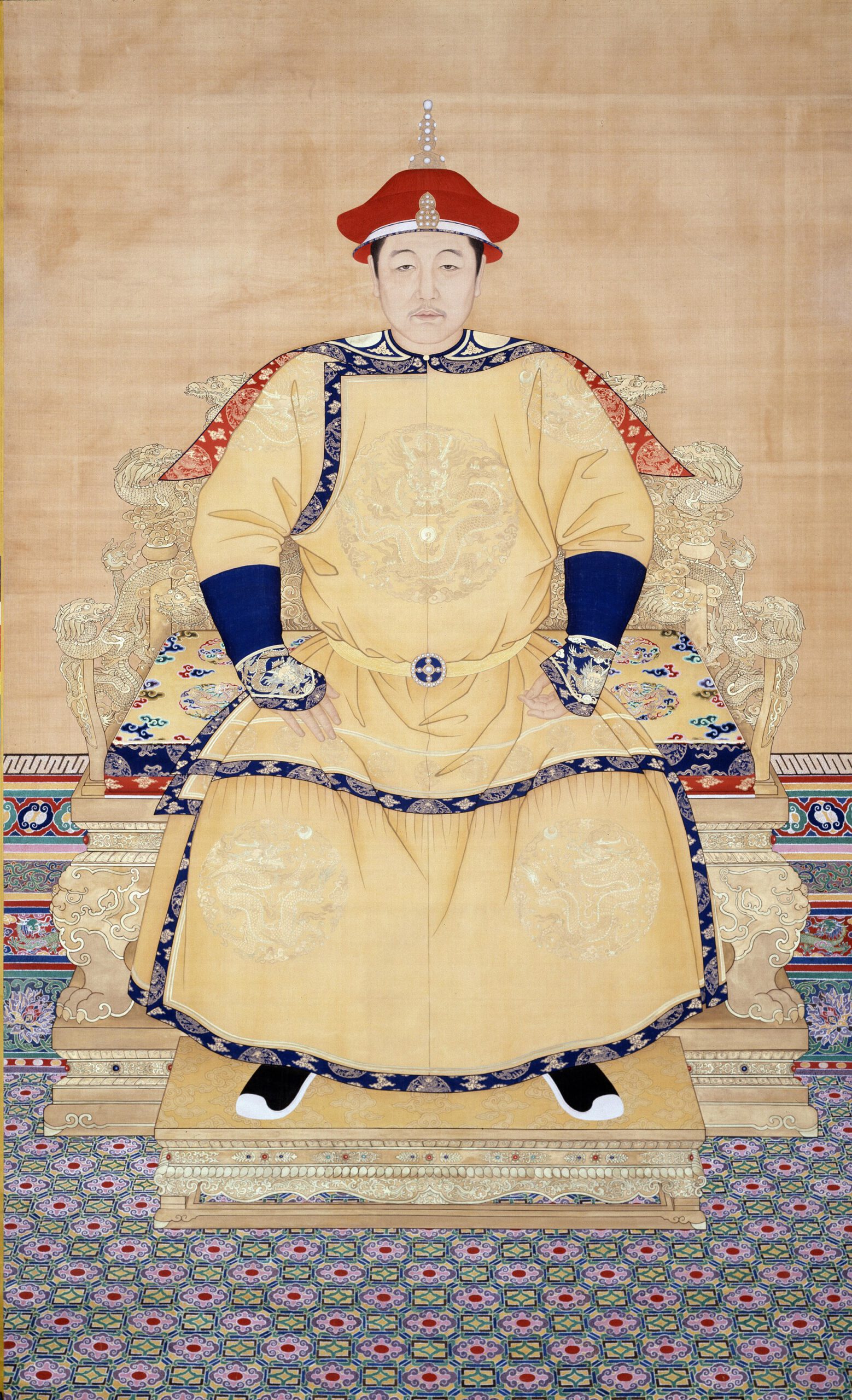
Shunzhi was emperor of Manchuria between Oct. 8, 1643-Oct. 30, 1644. Officially proclaimed emperor of China on Oct. 30, 1644. Shunzhi (March 15, 1638–February 5, 1661) was the second emperor of the Manchu Qing dynasty, and the first Qing emperor to rule over China, his reign was from 1644 to 1661.
The Transitional Period :
The roots of this unsettled period starts during the later part of Wanli`s reign (1573-1620). At the begging of his reign China was doing very well, new crops from the Americas such as peanuts, maize and sweet potatoes increased food production, while simplified taxes helped the state run smoothly. But this was not due to Wanli`s enlightened reign, but to his Mother championing a man that was to become the Ming dynasties most able minister, Zhang Zhuzheng (1525—1583). Wanli became resentful of Zhuzheng`s control but upon his death became withdrawn from court life. Between 1589 to 1615 he didn`t appear at imperial audiences, leaving a power vacuum that was filled by squabbling ministers. Mongols from the North raided as Japan invaded Korea. Wanli re-opened the silver mines and imposed new taxes but the money was lost due to corruption, as well as being frittered away by the indulgent Emperor himself . The next emperor of Ming China, Tianqi (1621-1627), was bought up in this self indulgent disorganised environment, at the very young age 15 his short reign started. He didn`t stand a chance. Tianqi made the mistake of entrusting eunuch Wei Zhongxian (1568-1627) who Anna Paludan in her excellent book "Chronicle of the Chinese Emperors" (Thames and Hudson, 1998) describes as "a gangster of the first order". Tianqi was deemed to have lost the Mandate of heaven by the Ming people. Tianqi`s younger brother, the last of the Ming Emperors, Chongzhen (1628-1644), was not able to save the situation. The systems of administration had broken down, corruption was rife and so when a sever famine broke out in 1628 nothing much could be done. Anna Paludan describes the tragic end to the great Ming Dynasty "The final drama was worthy of a Greek tragedy. The emperor called a last council in which `all were silent and many wept`, the imperial troops fled or surrendered, and the emperor, after helping his two sons escape in disguise, got drunk and rushed through the palace ordering the women to kill themselves. The empress and Tianqi`s widow committed suicide; the emperor hacked off the arm of one daughter before killing her sister and the concubines. At dawn he laid his dragon robe aside and dressed in purple and yellow, with one foot bare, climbed the hill behind the now silent palace and hanged himself on a locust tree". The Great Wall of China, started 2,000 years ago was built to protect China from the Northern barbarian hoards, it was often tested and sometimes failed. The Jin people invaded China, ruling the North between 1115 and 1234, it was their descendants the Manchus, Jurchens from south east Manchuria that took full advantage of the problems of the Ming dynasty. In 1636 they adopted a Chinese dynastic name, the `Great Qing` (Qing meaning pure). The first of the Qing emperors was Shunzhi (1644-1661) but for most of his reign his uncle ran the state. War raged on during this period and it wasn't until the second Qing emperor Kangxi (1662-1722) that true peace was achieved. Kangxi was a wise and educated man, he became a highly successful emperor bringing China a long period of wealth and stability.