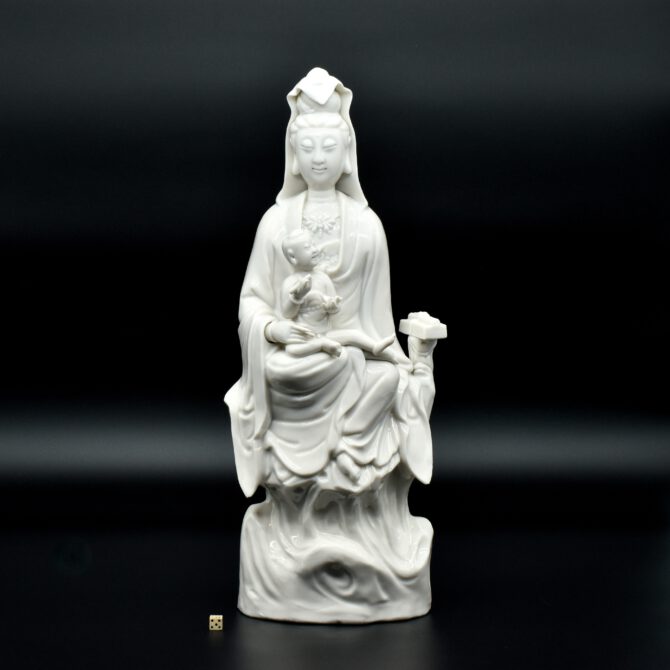
A Very Large 17th Century Blanc de Chine Porcelain Model of Guanyin.
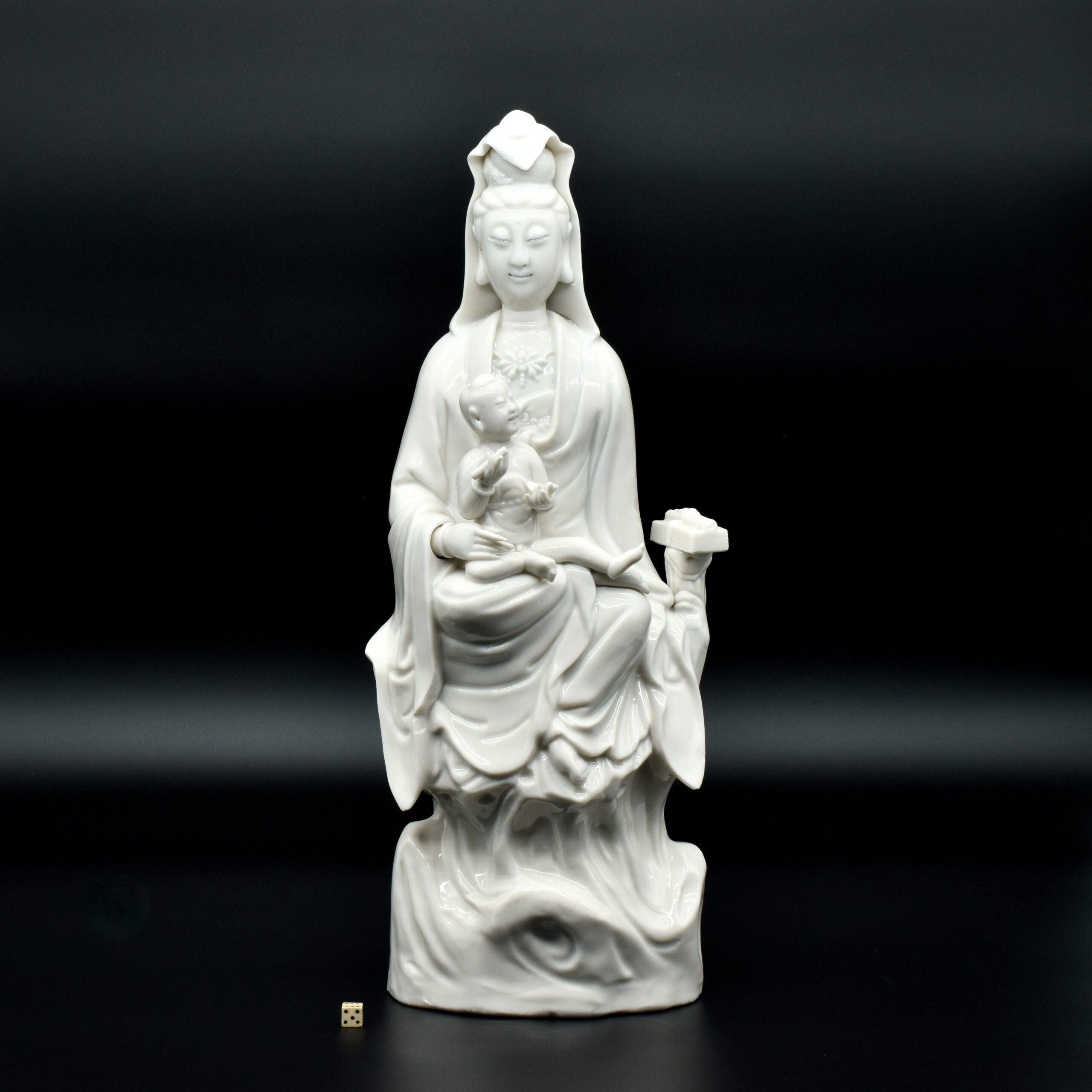
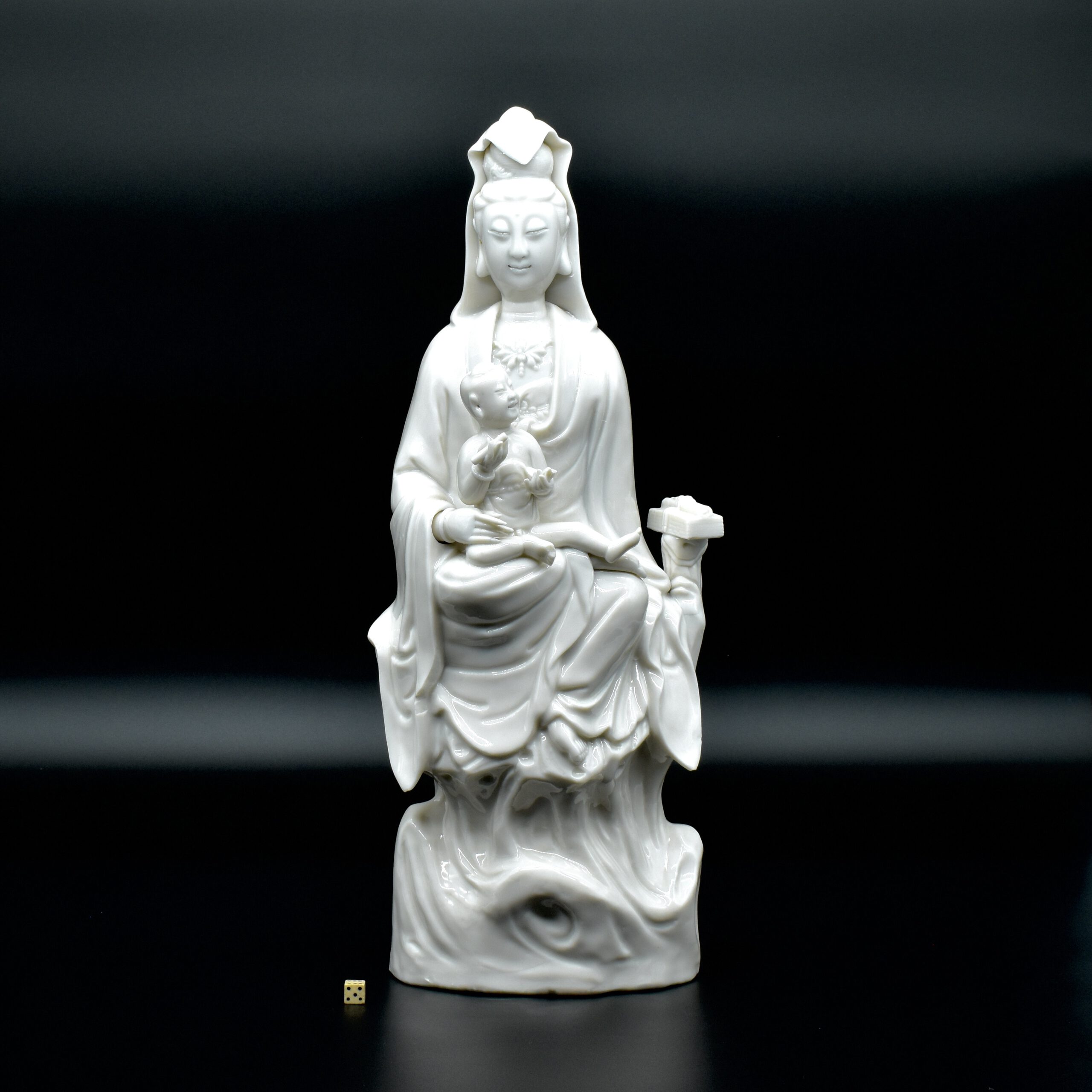
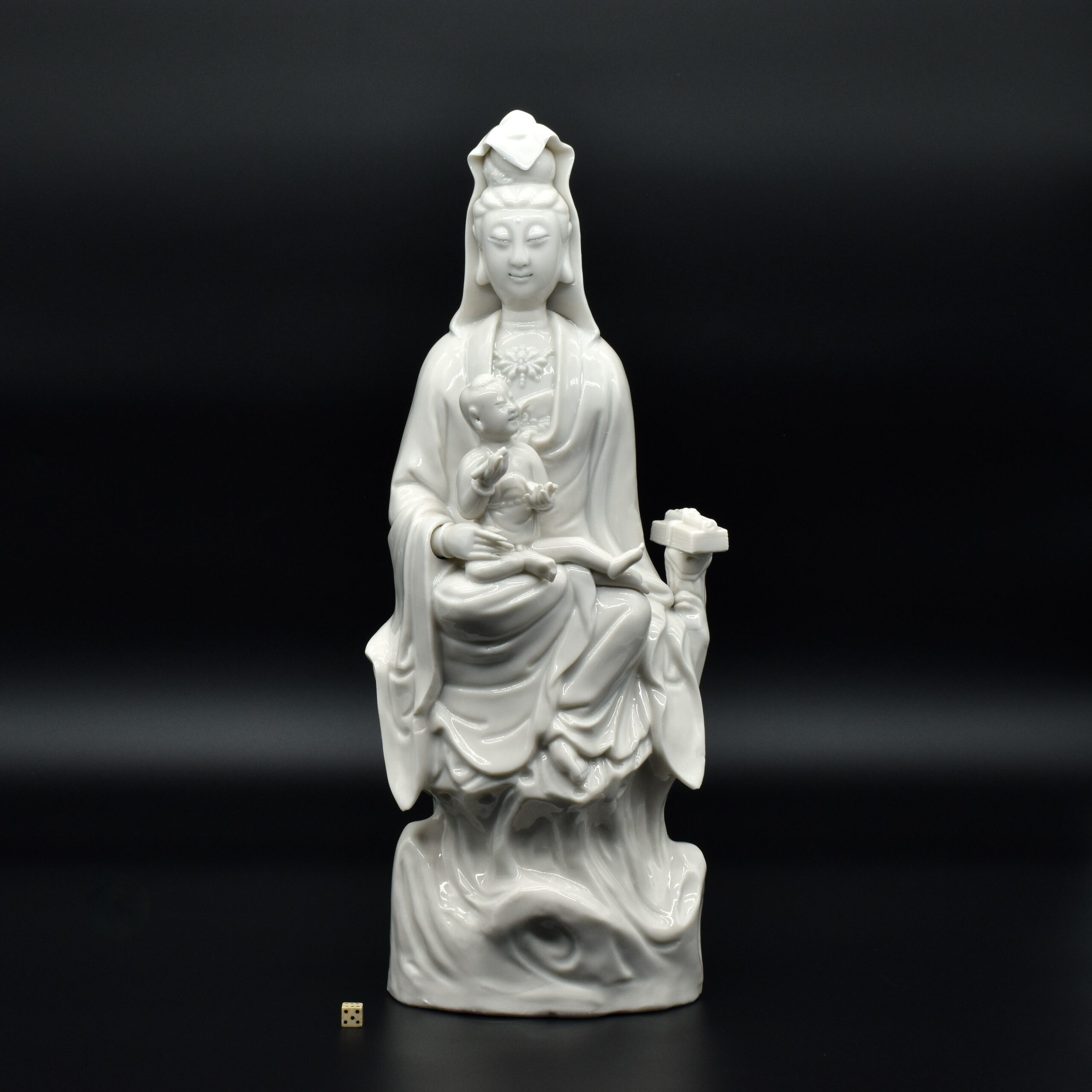
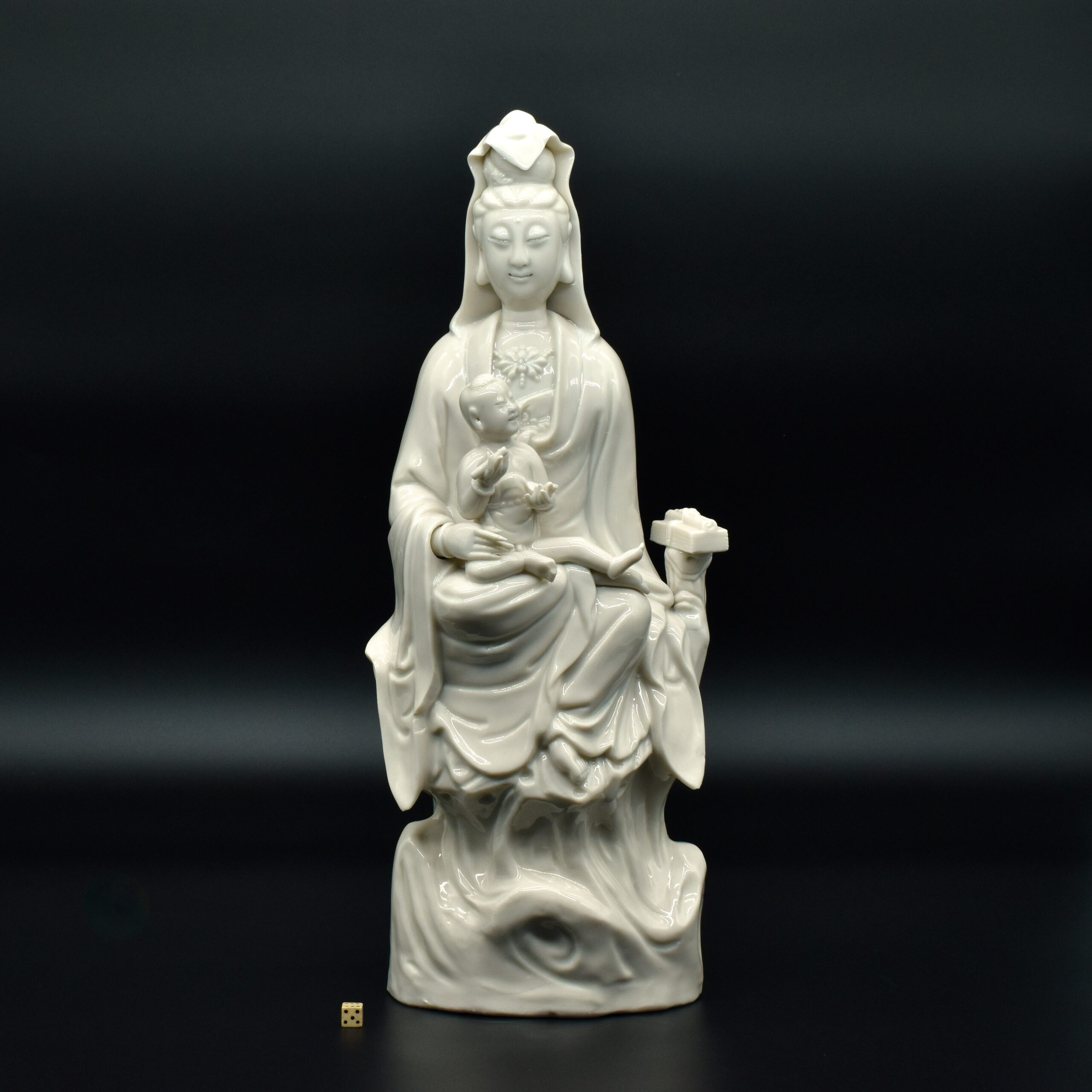
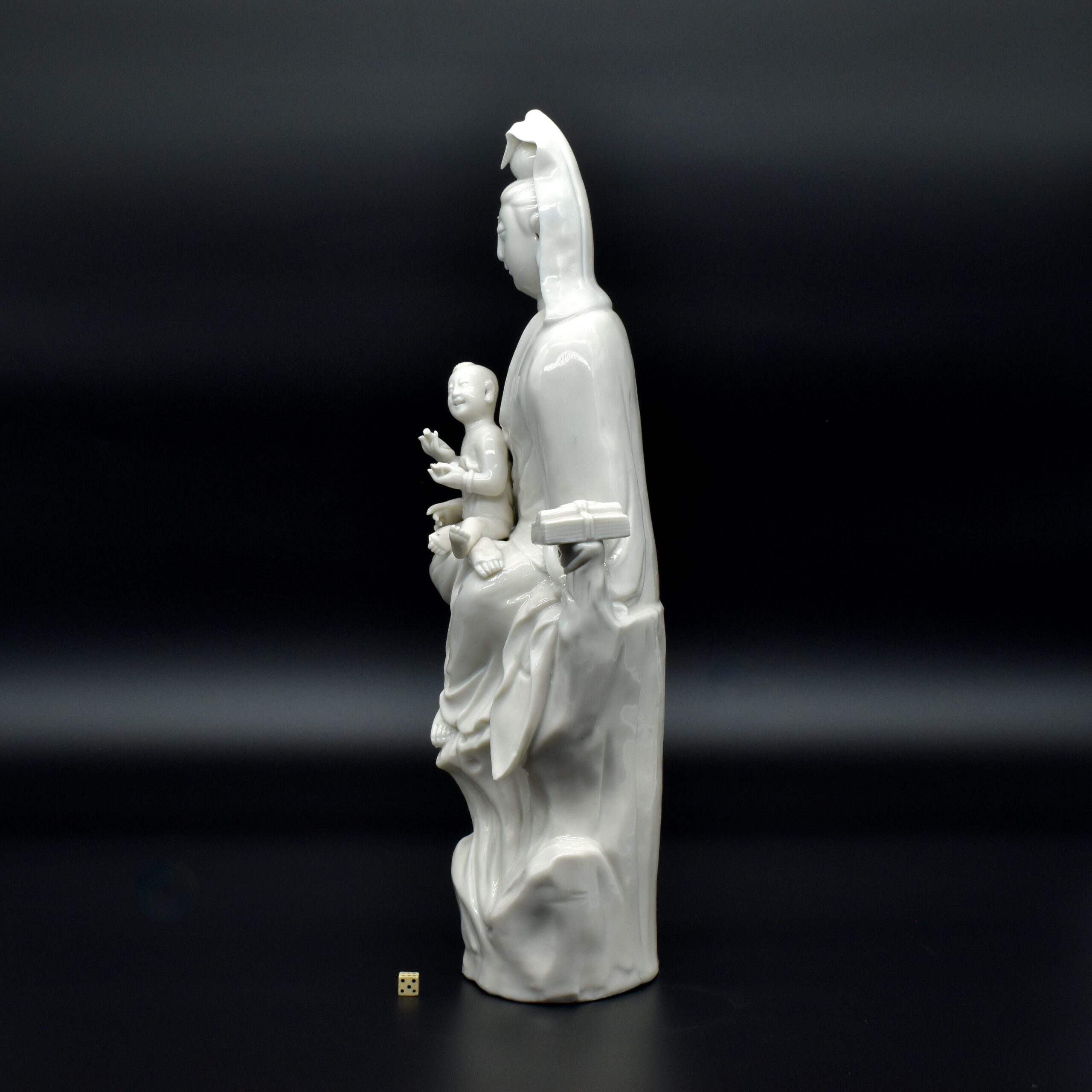
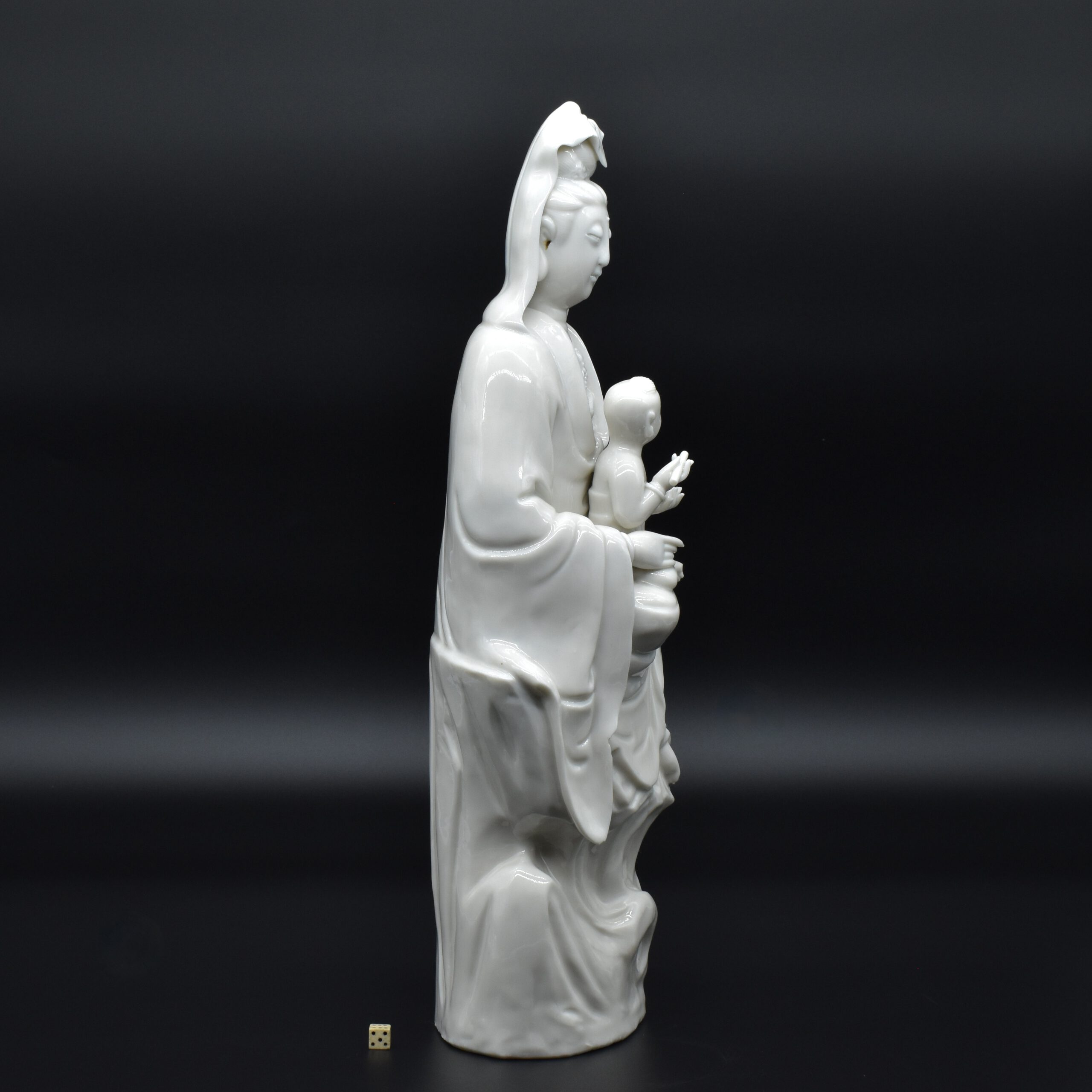
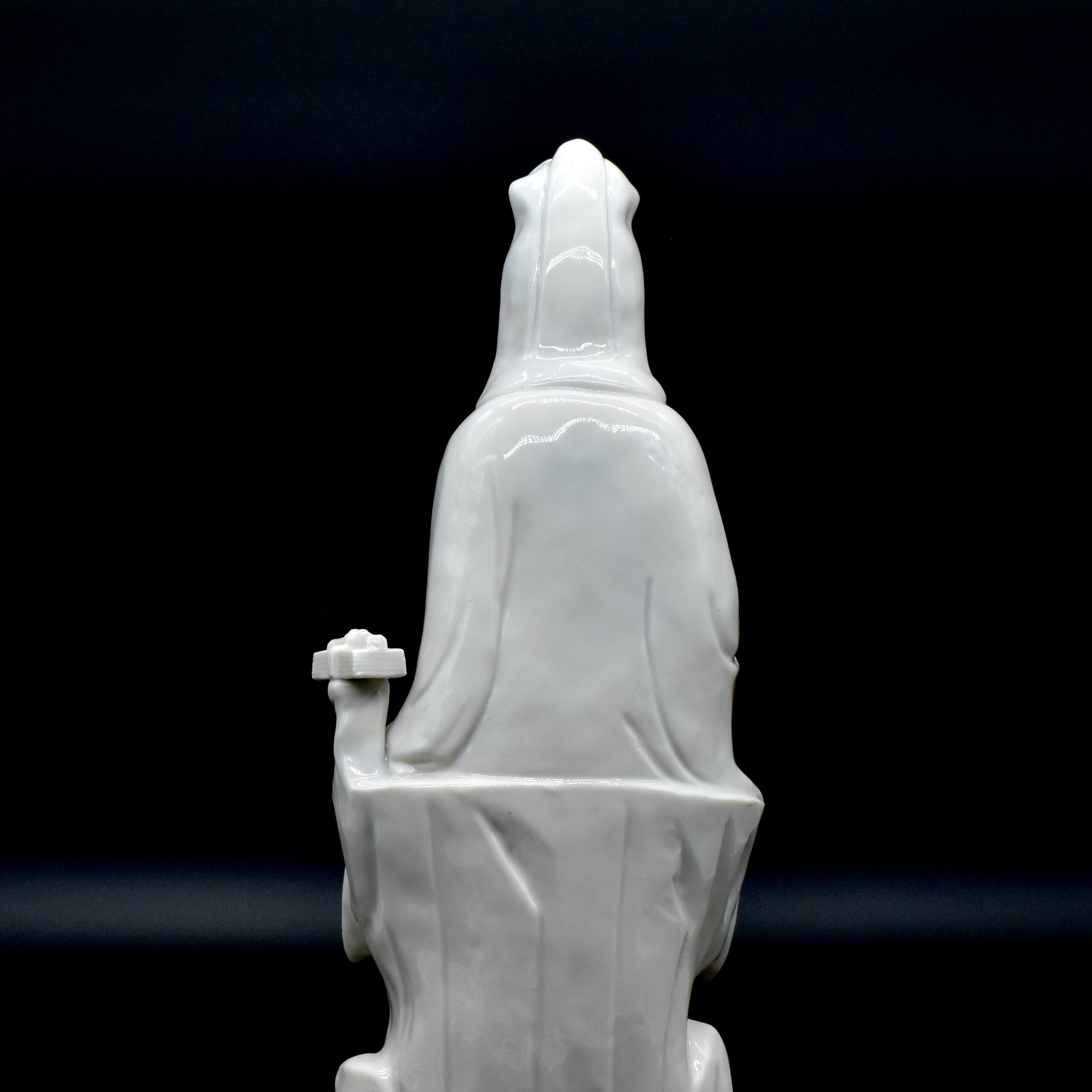
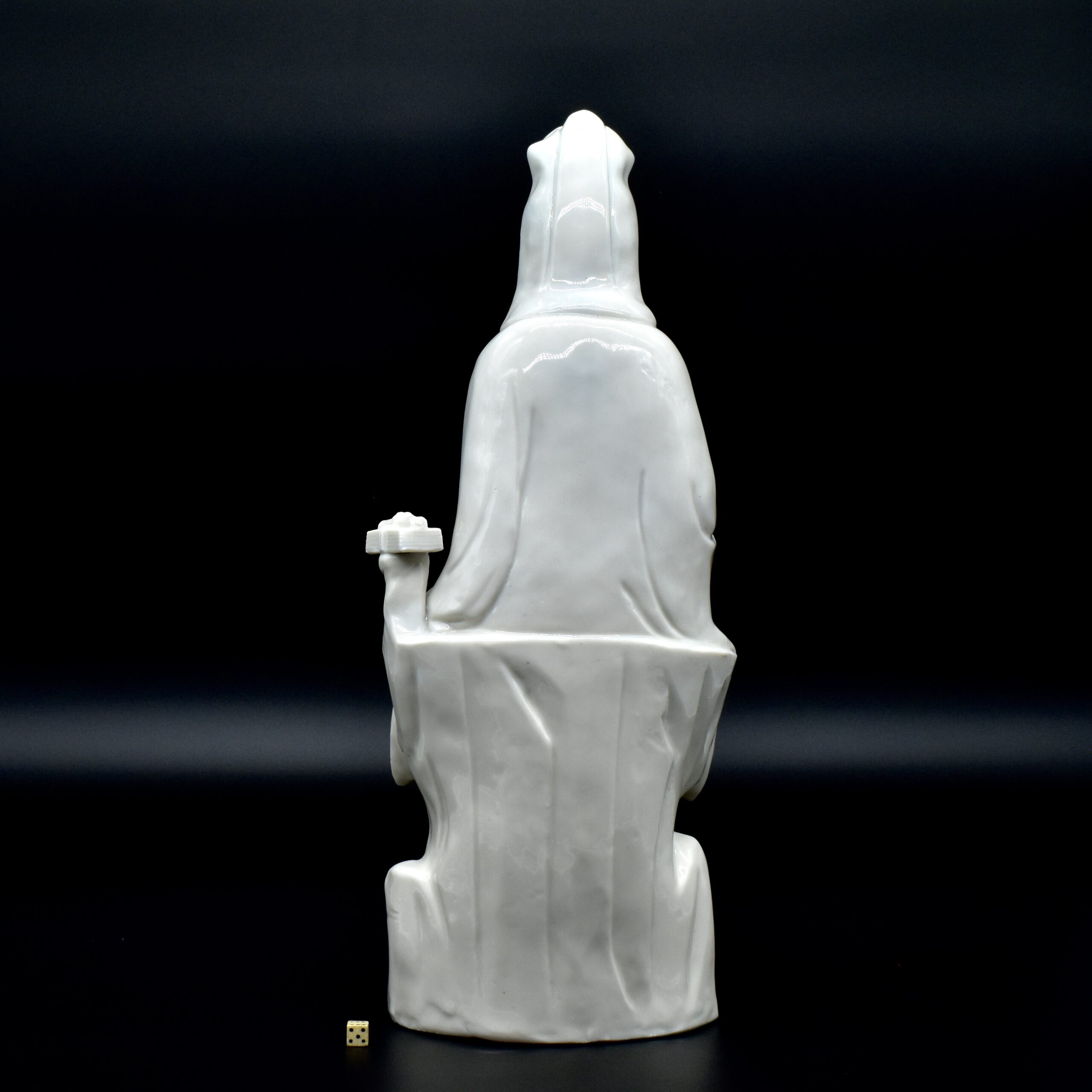
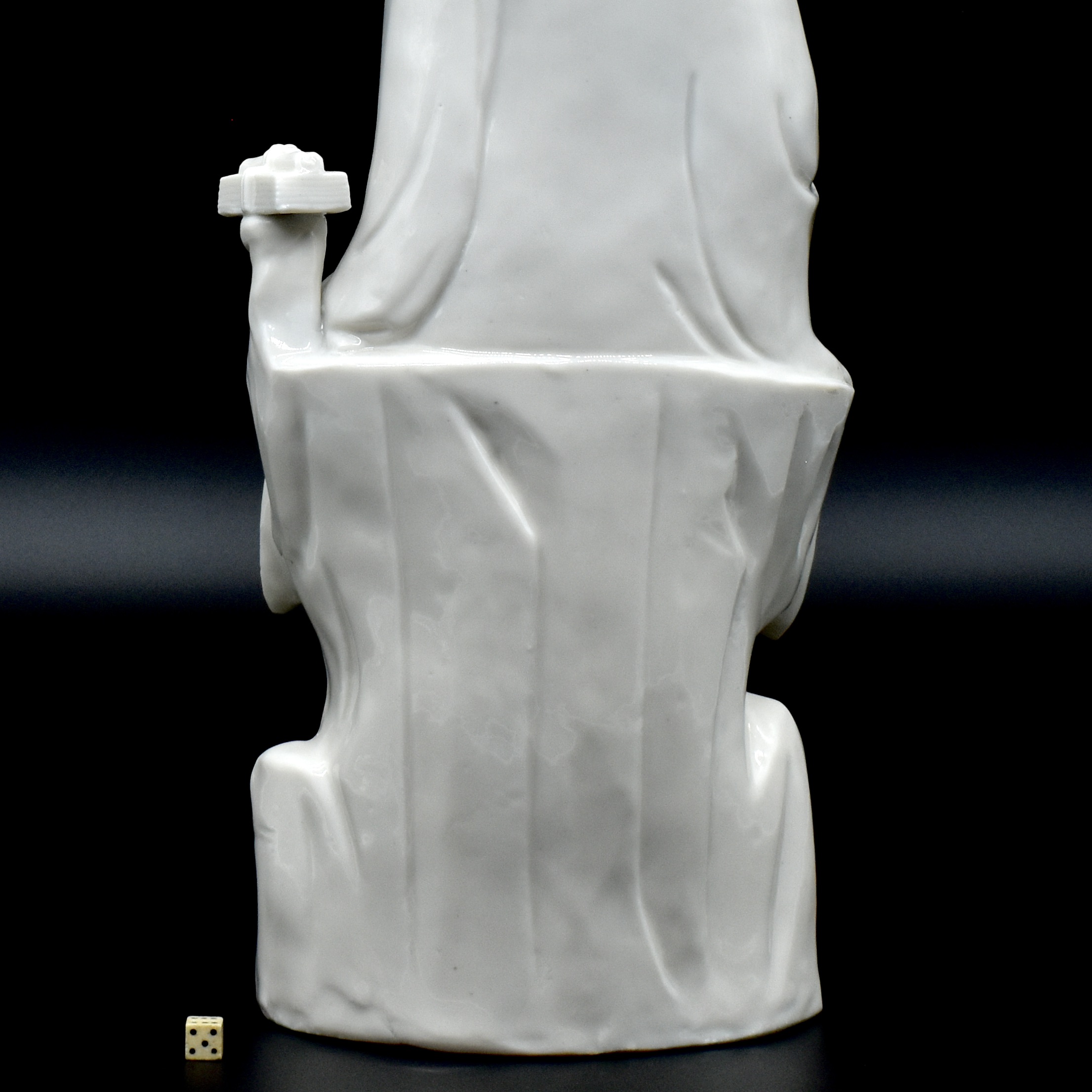
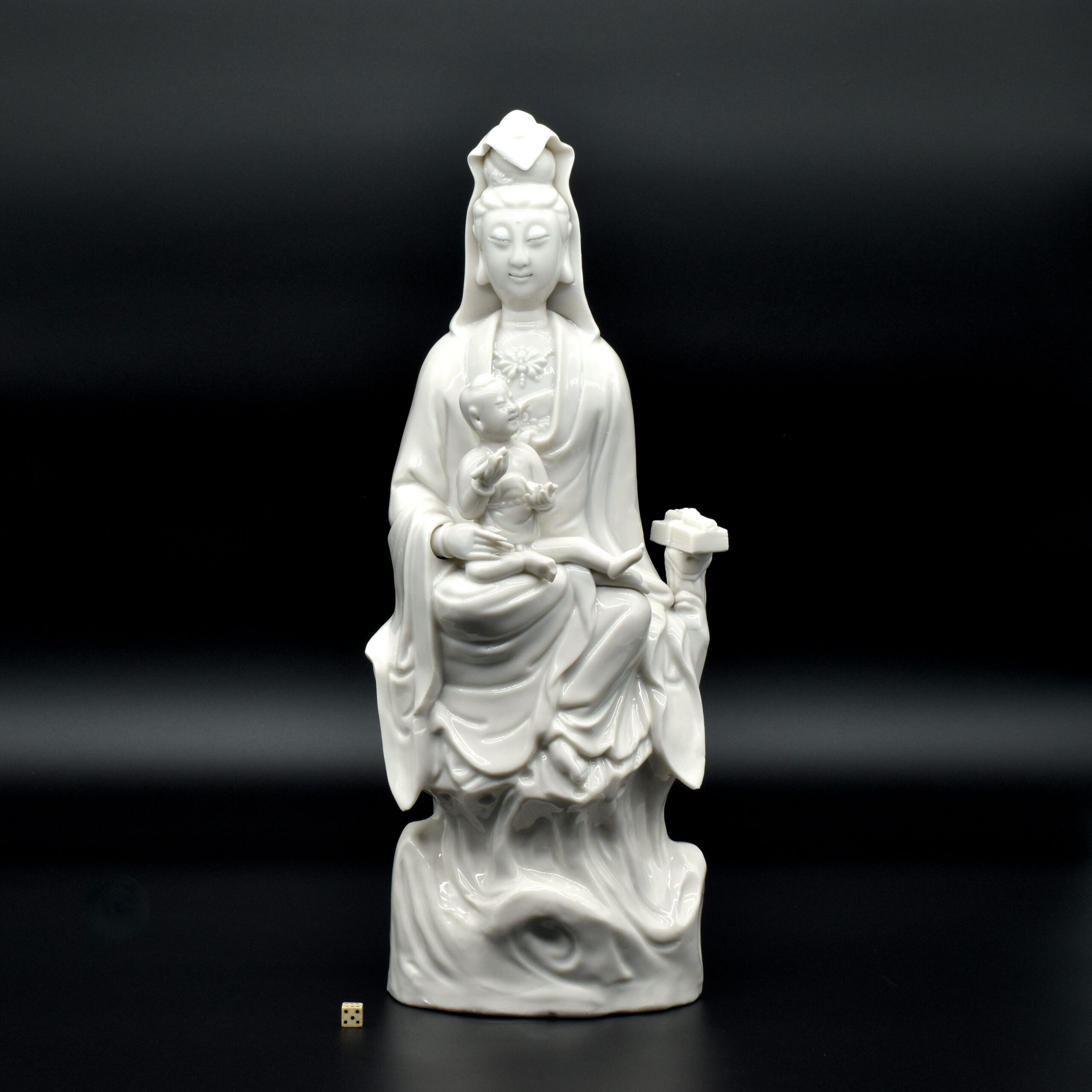
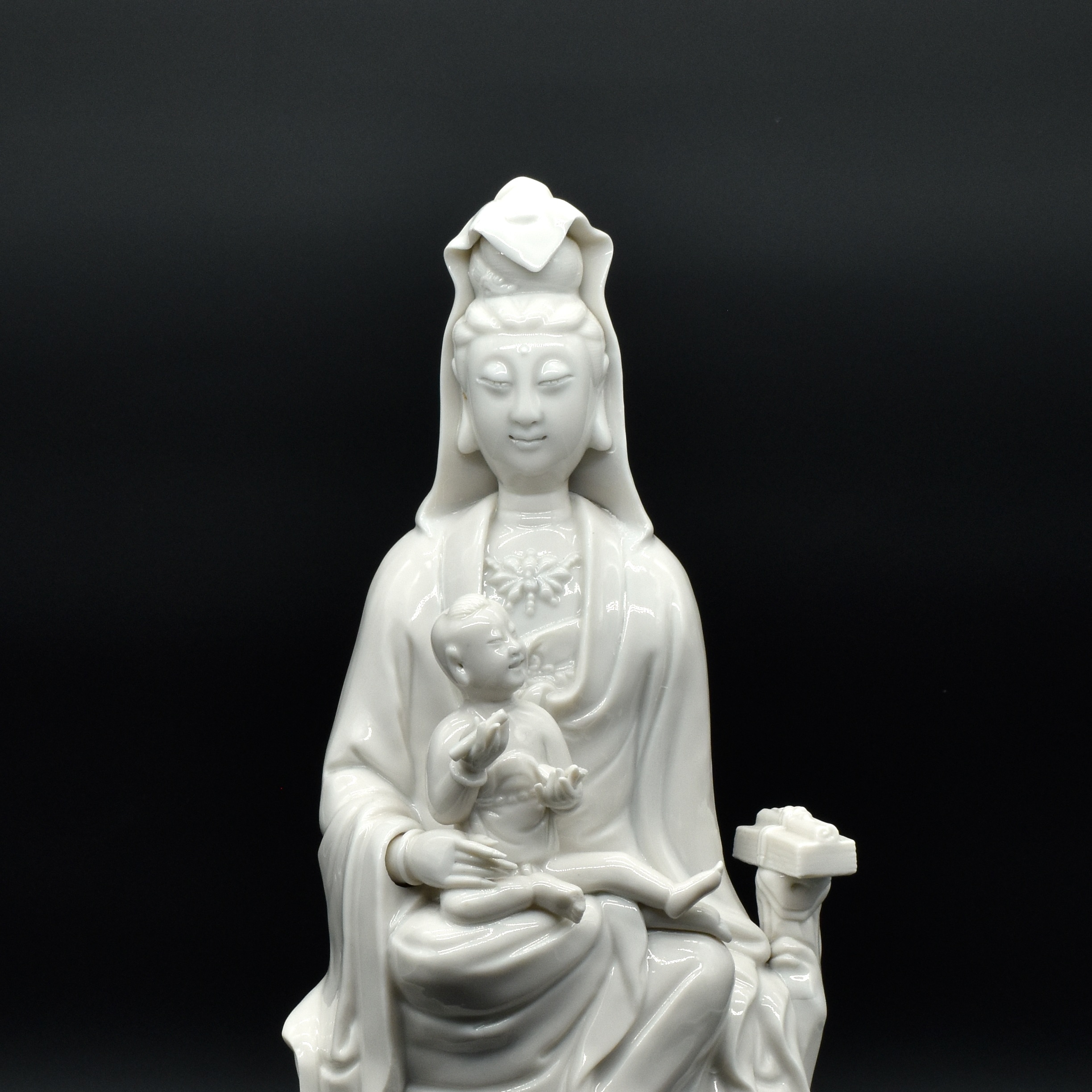
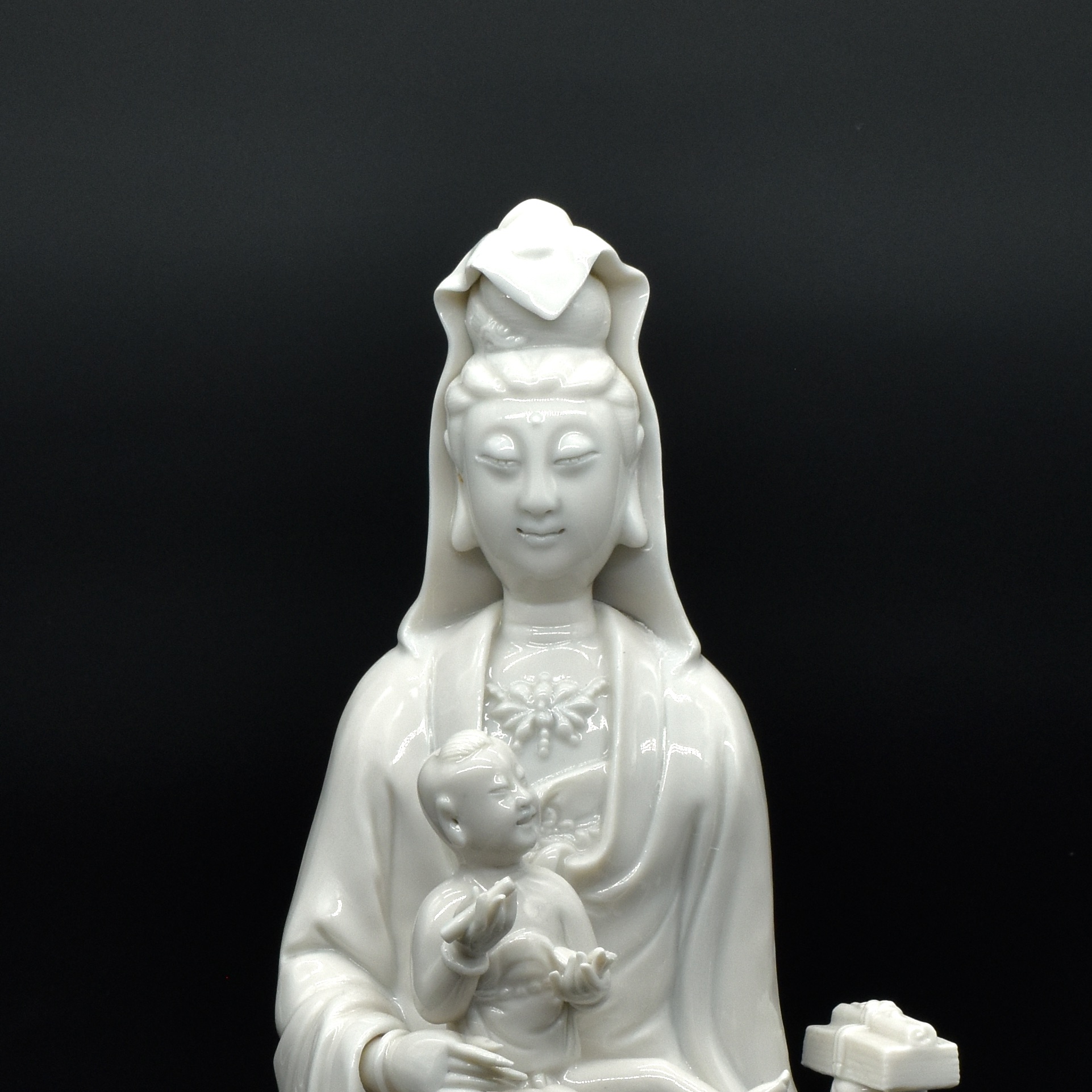
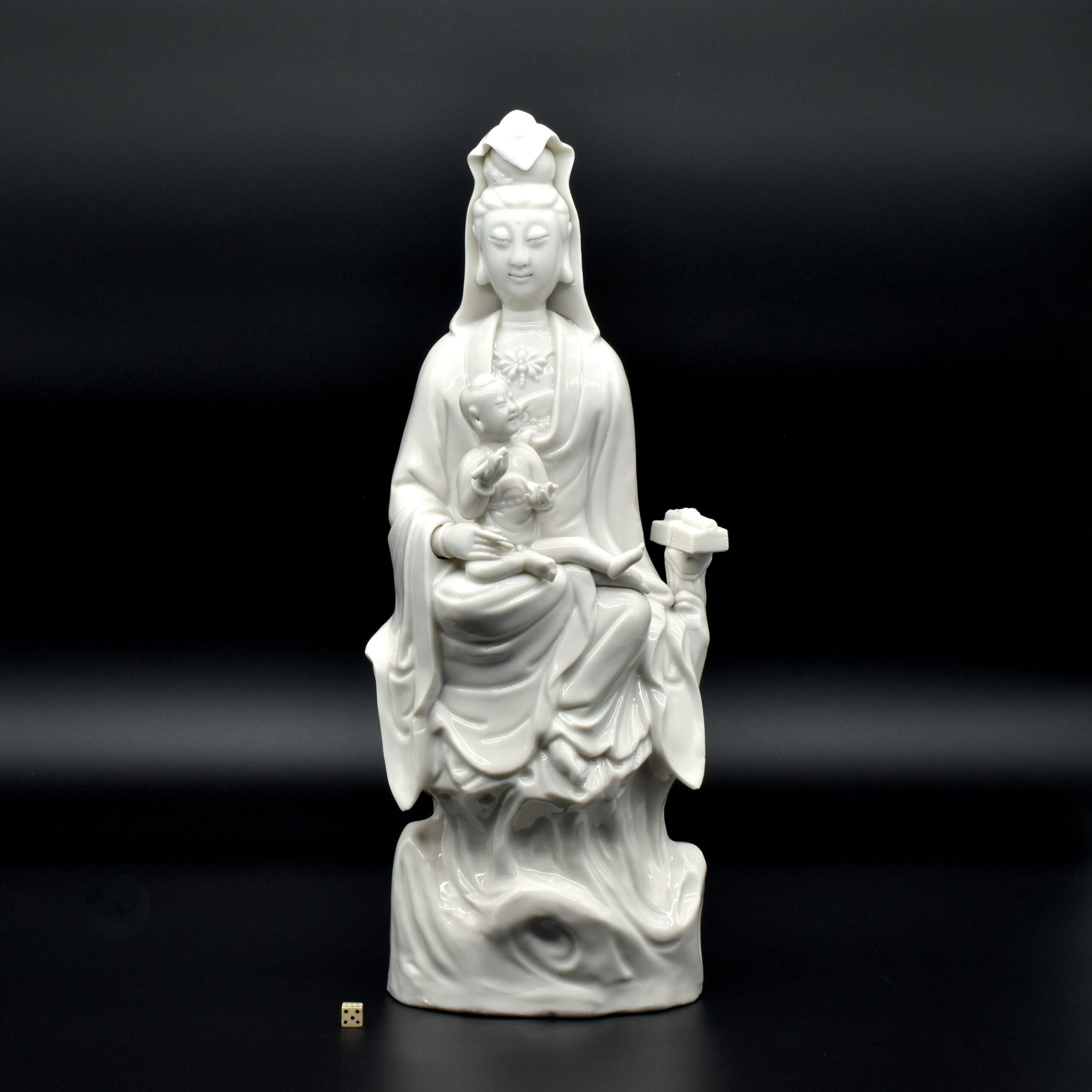
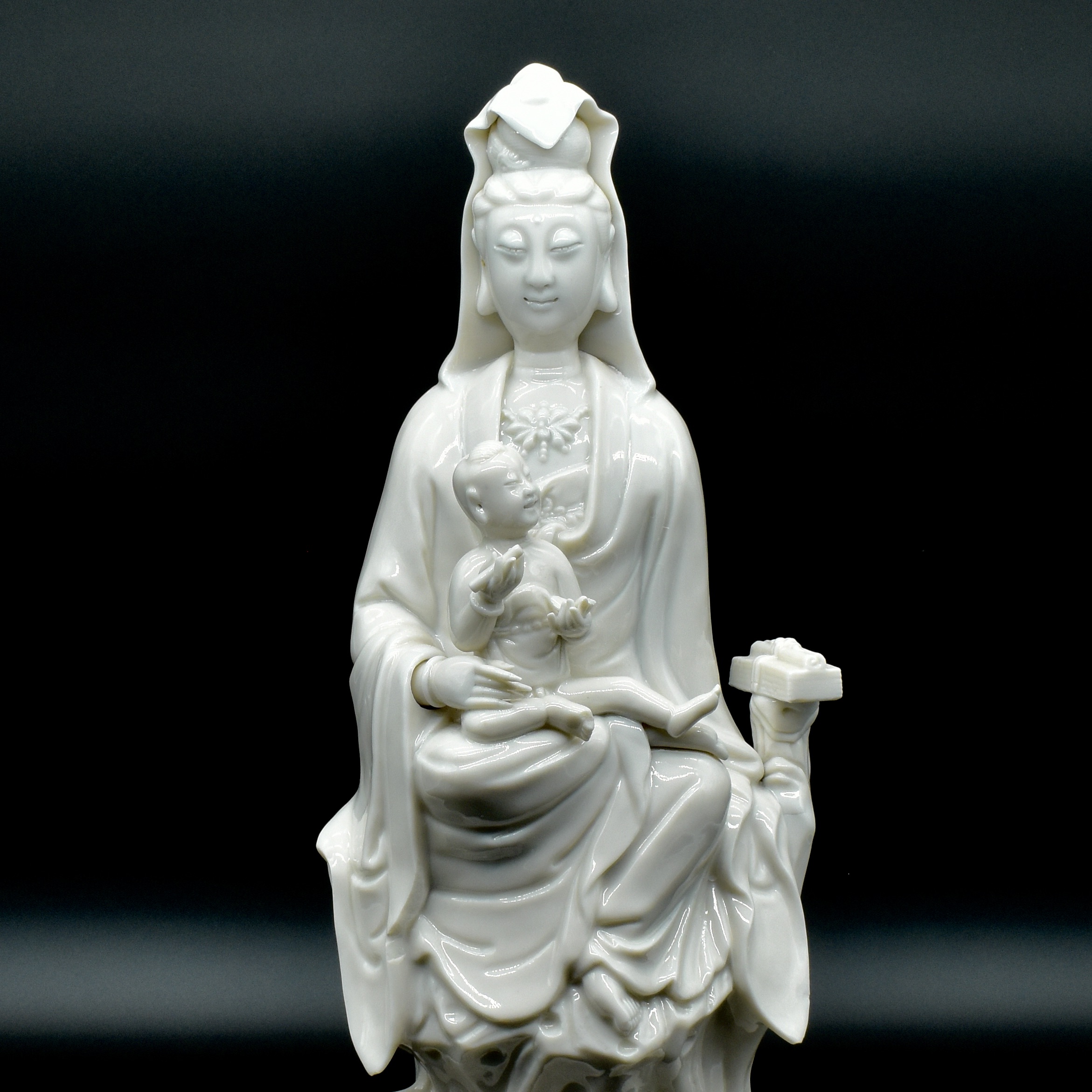
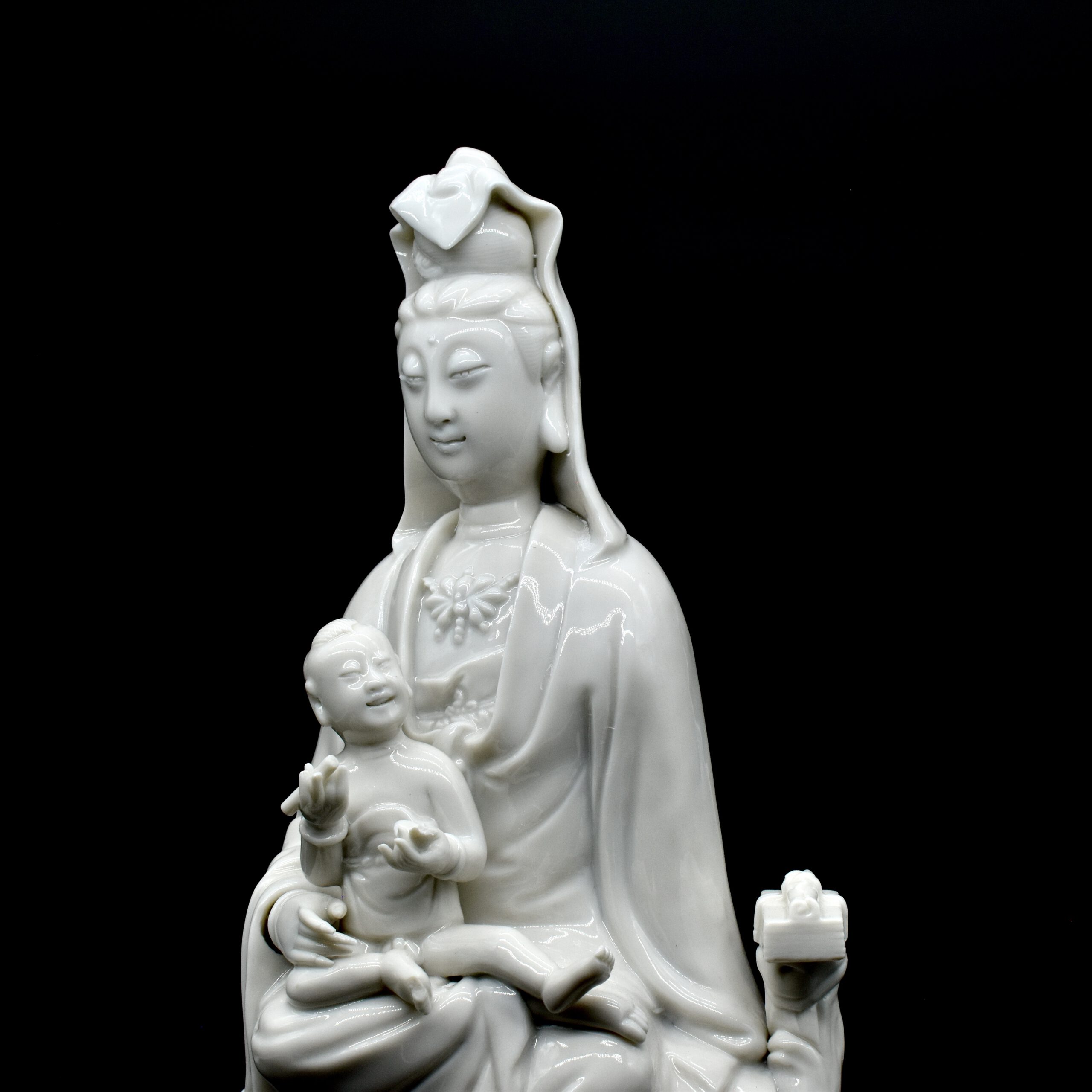
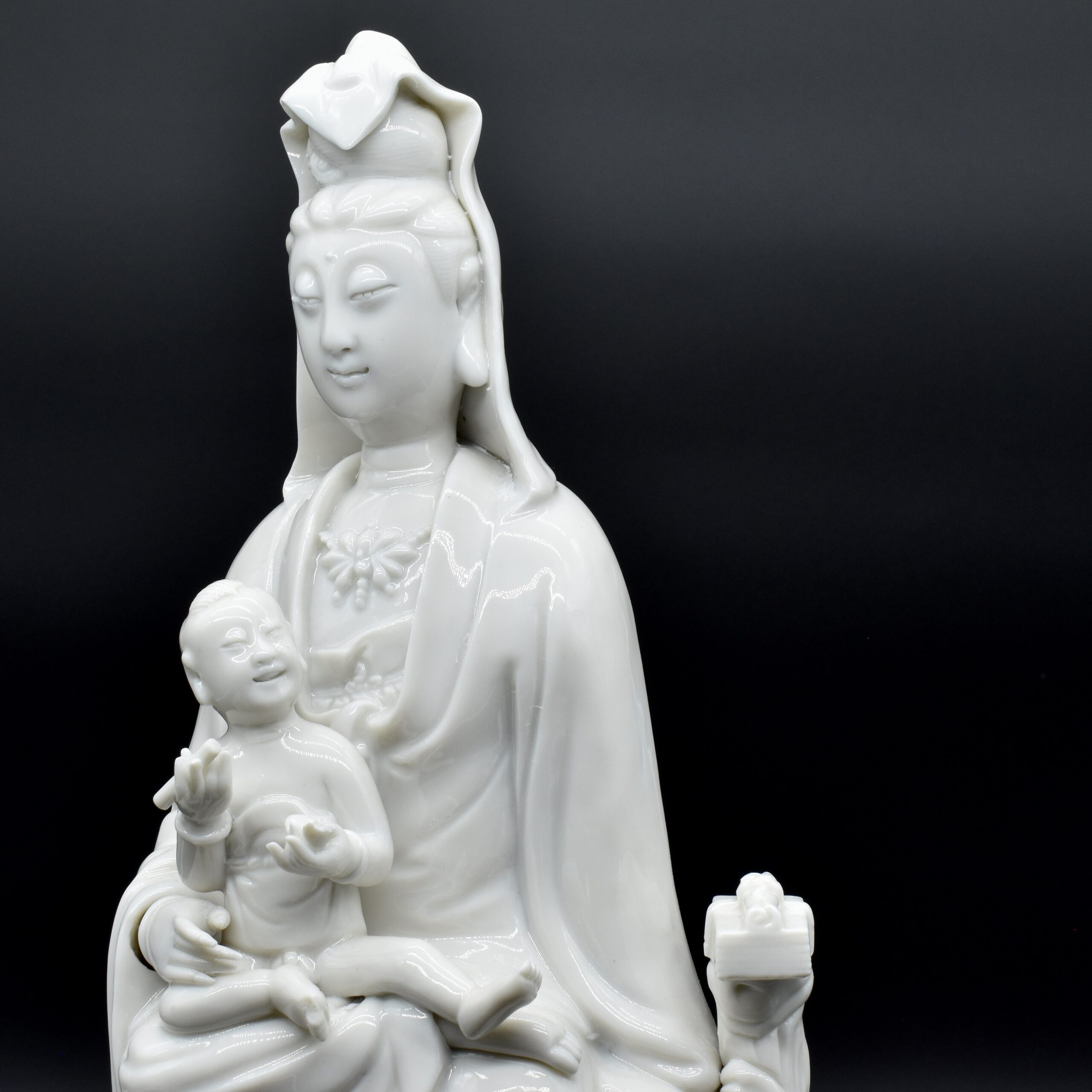
A Very Large 17th Century Blanc de Chine Porcelain Model of Guanyin, Dehua kilns, Fujian Province, China. This large and very heavy early Kangxi porcelain model of Guanyin dates to around 1660 to 1690, it is crisply moulded and the glaze is thin enough to allow the details to be clear and sharp. She is depicted seated on a rock-work throne with a young boy in her lap who is wearing a Chinese bib, called a dudou 兜肚. The boy is holding a brush and an ingot, with a scroll sitting on a book near by, alluding to the hope for a son who would become a great scholar and thereby advance the family’s standing. Guanyin was the bodhisattva of Mercy as well as the bestower of sons. A pair of very similar very Blanc de Chine porcelain Guanyin’s are at Burghley House described as “Two large white figures with children in their laps” are mentioned in the Conveyance and Schedule of Gift of 1690. This important document is whereby Elizabeth, daughter of the Third Earl of Devonshire, bequeathed the contents of her chamber and closet to her daughter Anne, Countess of Exeter. See ‘Information’ below our Photograph Gallery for a photograph and link to the Burghley House Collections. All sorts versions of Guanyin have been made at the Dehua kilns from the late Ming dynasty to the present day.
See Below For More Photographs and Information
SOLD
- Condition
- It is difficult to see the damage, like most large models of Guanyin there is some damage ; there is a long thin chip to the sleeve, the boys right toe is missing.There is a flake chip to the edge of Guanyin's robe under where the book is balancing. The lower extremities of her robe have very minor chips. There is a very small chip to the ingot.
- Size
- Height 46 cm (18.11 inches)
- Provenance
- From an English collection of Blanc de Chine porcelain.
- Stock number
- 25654
- References
- A pair of very similar but small 17th Century Blanc de Chine Guanyin's are at Burghley House described as "Two large white figures with children in their laps" are mentioned in the Conveyance and Schedule of Gift of 1690. This important document is whereby Elizabeth, daughter of the Third Earl of Devonshire, bequeathed the contents of her chamber and closet to her daughter Anne, Countess of Exeter. See 'Information' below our Photograph Gallery for a photograph and link to the Burghley House Collections. A very similar Kangxi Blanc de Chine Guanyin is illustrated in : 'Blanc de Chine' an exhibition catalogue with an introduction by John Ayres (S.Marchant & Son, 2006. ISBN 0-9554009-0-2) page 51, plate 29.
Photos
Information
A Very Similar, but Smaller 17th Century Blanc de Chine Porcelain Guanyin is at Burghley House.
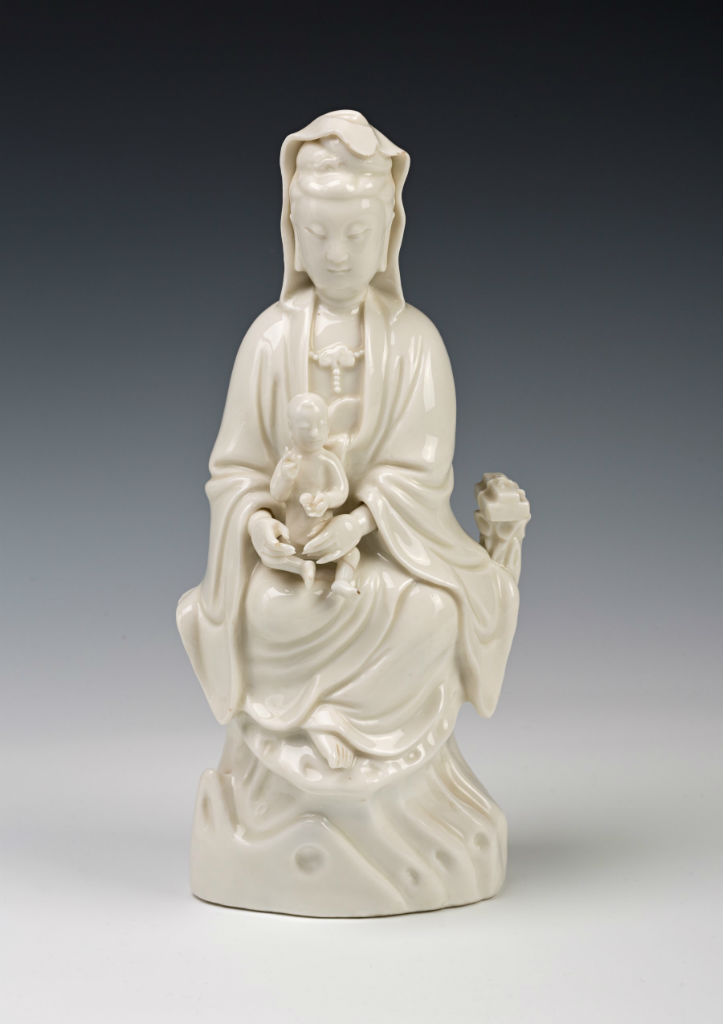
Each robed figure has a small child seated in her lap, with auspicious objects to one side, 29.5cm.
A granter of benefits and mercies and a helper on the path to Enlightenment, Guanyin appears here as the giver of children.
The figures appear in the 1690 Devonshire Schedule, an inventory itemising an extraordinary bequest from Elizabeth, Countess of Devonshire (1619-1689), to her daughter Anne, Countess of Exeter (1649-1700).
They are listed as: ‘two large white Ffigures with children in their lapps.’
In the West, figures of Guanyin, Bodhisattva of Compassion, were perhaps the most popular of all the products from the Dehua kilns.
REFERENCE: CER0087
Guanyin :
Figures of Guanyin are by far the most common of all Blanc de Chine figures and indeed one of the most common images in Chinese figurative art. Guanyin was the Goddess of mercy, She was especially revered in the area where this figure was produced ; Dehua in Fujian Province. But her origins stem from Tibetan Buddhism, she was originally the patron saint of Tibetan Buddhism 'Avalokitesvara'. Guanyin is actually the shorter form of the name Guan shi yin, which means “one who observes the voices of the world.” True to her name, Guanyin listens to and understands the worries that plague man`s existence. Because of her mercy and generosity, Guanyin is the most-loved of China`s divinities. the one people turn to for assistance in their everyday lives. Guanyin is specially venerated by those who are hoping to have children or those who are about to set out for sea. Guanyin is usually portrayed wearing a white cape. In her right hand, she holds a dish that has holy water. On her head is a crown in the style of the Amitabha-buddha. She is shown meditating in a seated position. Guanyin has been given the same qualities as the Virgin Mary of Catholic theology, which is why she is sometimes portrayed holding a child in her arms. While the worship of Guanyin in could be traced historically from India, she is the star of countless legends and folk tales in China. Guanyin`s home on earth was the Putuo mountains, located on an island on China`s eastern coast to the south of Shanghai. In China, Putuo-shan is one of the most sacred places in Buddhism and the temple dedicated to Guanyin on the mountain is one of the most important pilgrimage site for Buddhists and non-Buddhists alike. Guanyin`s birth is celebrated on the 19th day of February, and her enlightenment is celebrated on the 19th of September. On those days, the pilgrims flock to Putuo mountain.
Blanc de Chine Porcelain :
The porcelain known in the West as Blanc de Chine was produced 300 miles south of the main Chinese kiln complex of Jingdezhen. The term refers to the fine grain white porcelain made at the kilns situated near Dehua in the coastal province of Fujian, these kilns also produced other types of porcelain. A rather freely painted blue and white ware, porcelain with brightly coloured `Swatow` type enamels as well as pieces with a brown iron-rich glaze. However it is the white blanc de Chine wares that have made these kilns famous. The quality and colour achieved by the Dehua potters was partly due to the local porcelain stone, it was unusually pure and was used without kaolin being added. This, combined with a low iron content and other chemical factors within the body as well as the glaze, enabled the potters to produce superb ivory-white porcelain.
Blanc de Chine Figures of Guanyin :
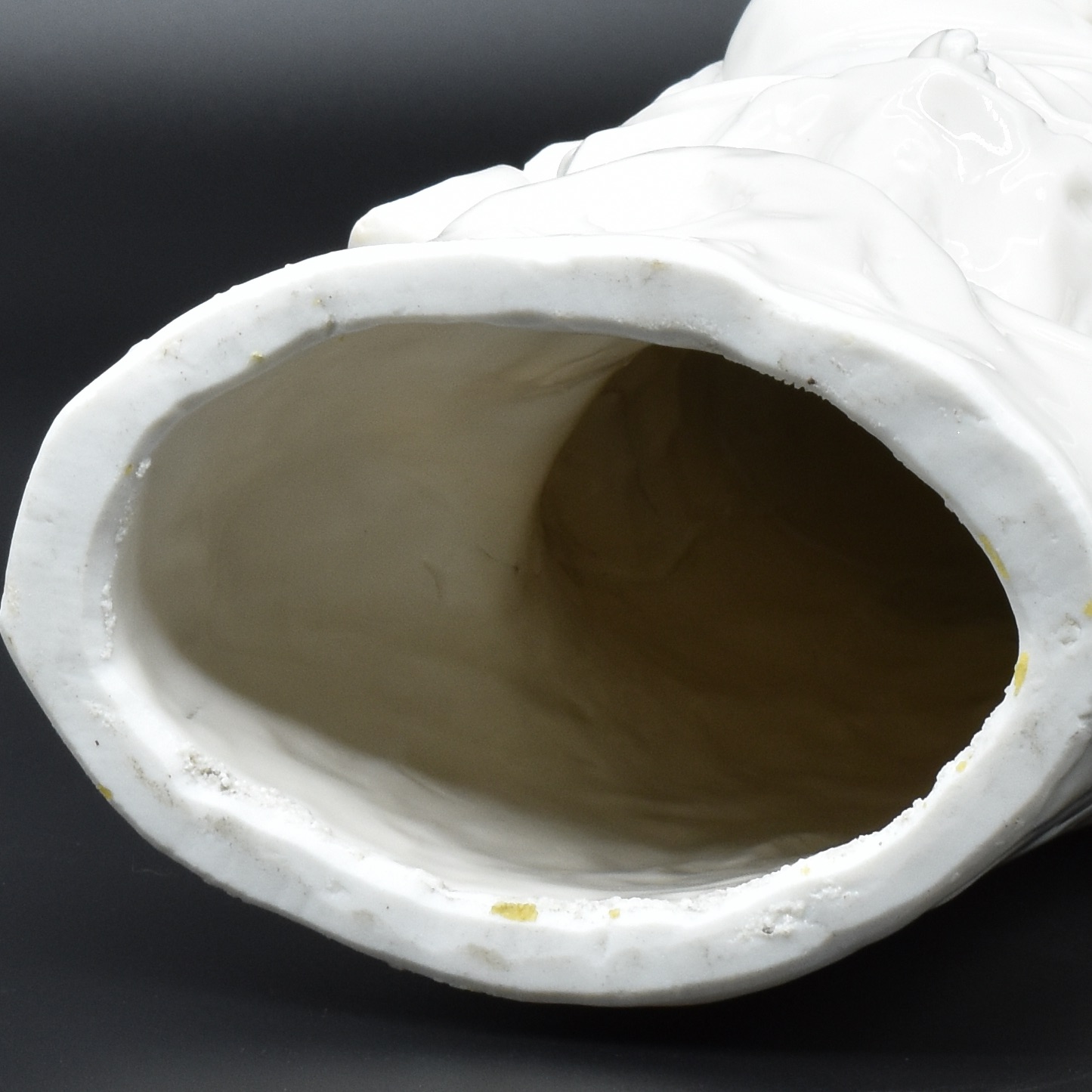
Figures of Guanyin are by far the most common of all Blanc de Chine figures and indeed one of the most common images in Chinese figurative art. Guanyin was the Goddess of mercy, She was especially revered in the area where this figure was produced ; Dehua in Fujian Province. But her origins stem from Tibetan Buddhism, she was originally the patron saint of Tibetan Buddhism 'Avalokitesvara'. Blanc de chine figures like the present example were constructed of separate pieces put together, this was a standard technique at the Blanc de Chine kilns in Dehua, it explains the huge variation of seemingly similar objects produced at the kilns. Figures from the Ming dynasty show a far greater degree of hand-modelling, with folds of material, the face, as well as fingers cut by hand. The potting tends to be thicker too, the interior space often shows cutting marks where the excess leather-hard clay was removed. The models of Guanyin from the Kangxi period (1662-1722) appear much more obviously mould-made, the modelling is normally more shallow with less definition and less hand-tooling. The interior wall often shows numerous small finger marks where the potter has pushed the clay into the mould. These figures, especially the taller ones frequently have ridges of porcelain supporting the interior moulded walls, they are pinched to form a ridge which is triangular in cross-section. Blanc de Chine Guanyin Figures : Figures of Guanyin are by far the most common of all Blanc de Chine figures and indeed one of the most common images in Chinese figurative art. Guanyin was the Goddess of mercy, She was especially revered in the area where this figure was produced ; Dehua in Fujian Province. But her origins stem from Tibetan Buddhism, she was originally the patron saint of Tibetan Buddhism 'Avalokitesvara'. Blanc de chine figures like the present example were constructed of separate pieces put together, this was a standard technique at the Blanc de Chine kilns in Dehua, it explains the huge variation of seemingly similar objects produced at the kilns. Figures from the Ming dynasty show a far greater degree of hand-modelling, with folds of material, the face, as well as fingers cut by hand. The potting tends to be thicker too, the interior space often shows cutting marks where the excess leather-hard clay was removed. The models of Guanyin from the Kangxi period (1662-1722) appear much more obviously mould-made, the modelling is normally more shallow with less definition and less hand-tooling. The interior wall often shows numerous small finger marks where the potter has pushed the clay into the mould. These figures, especially the taller ones frequently have ridges of porcelain supporting the interior moulded walls, they are pinched to form a ridge which is triangular in cross-section.