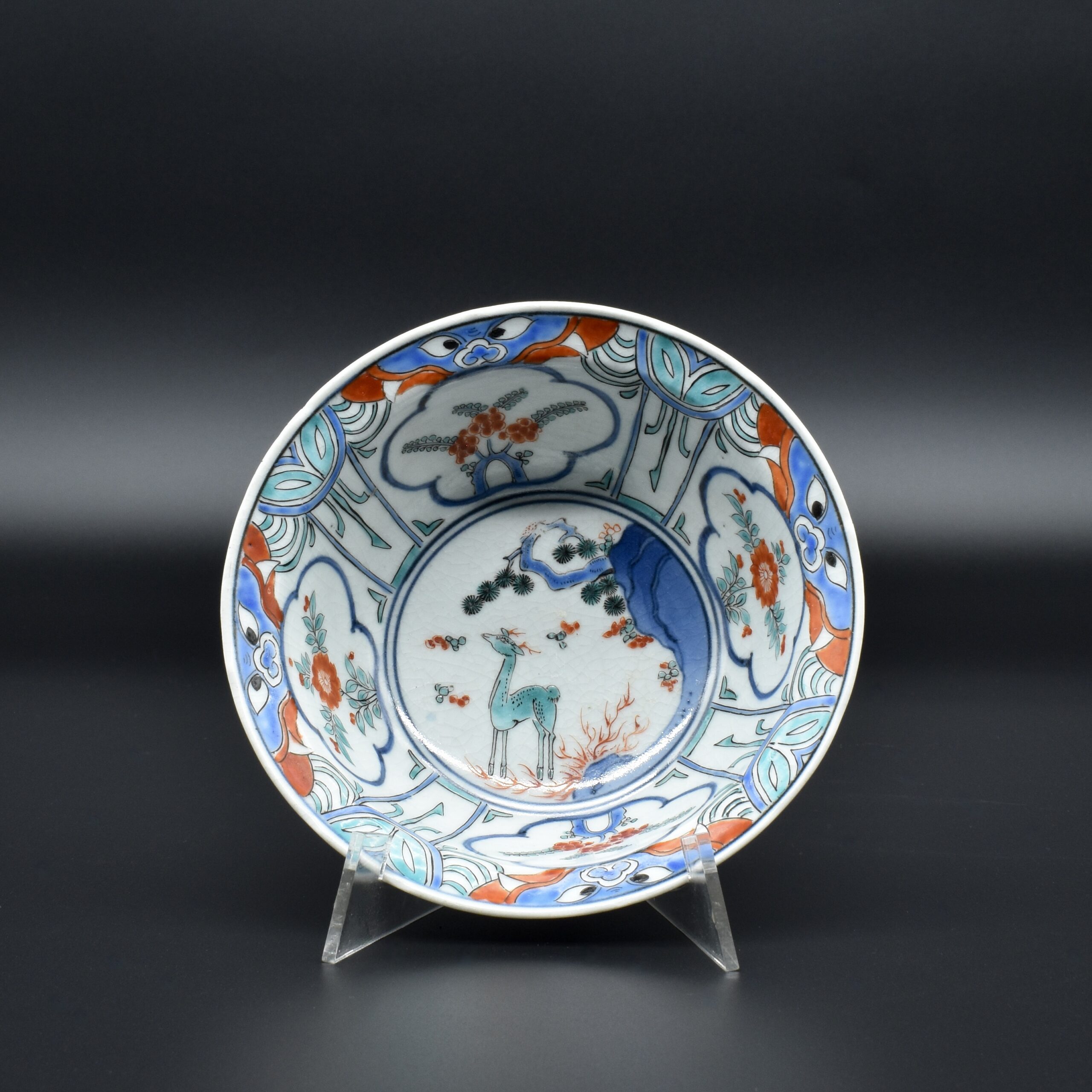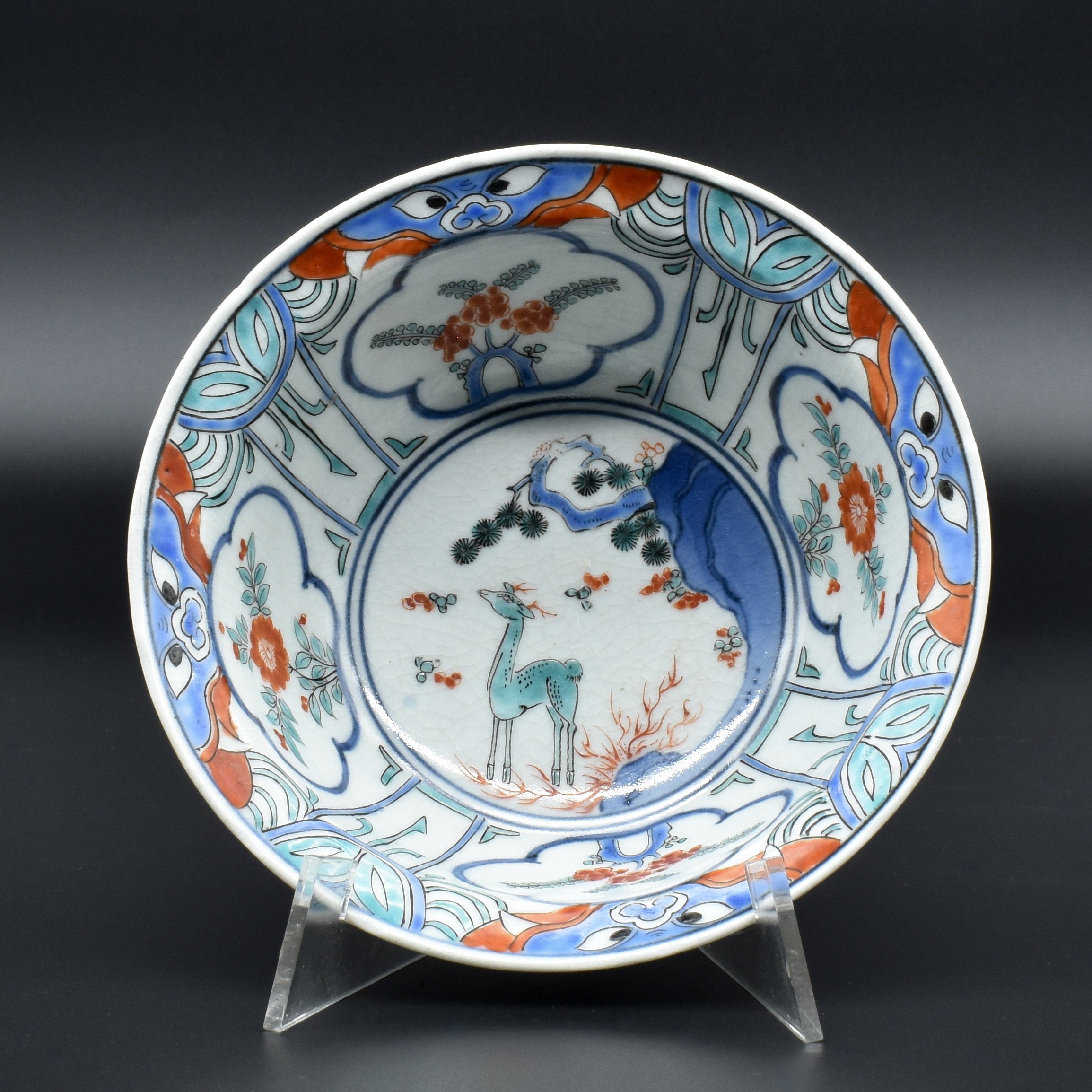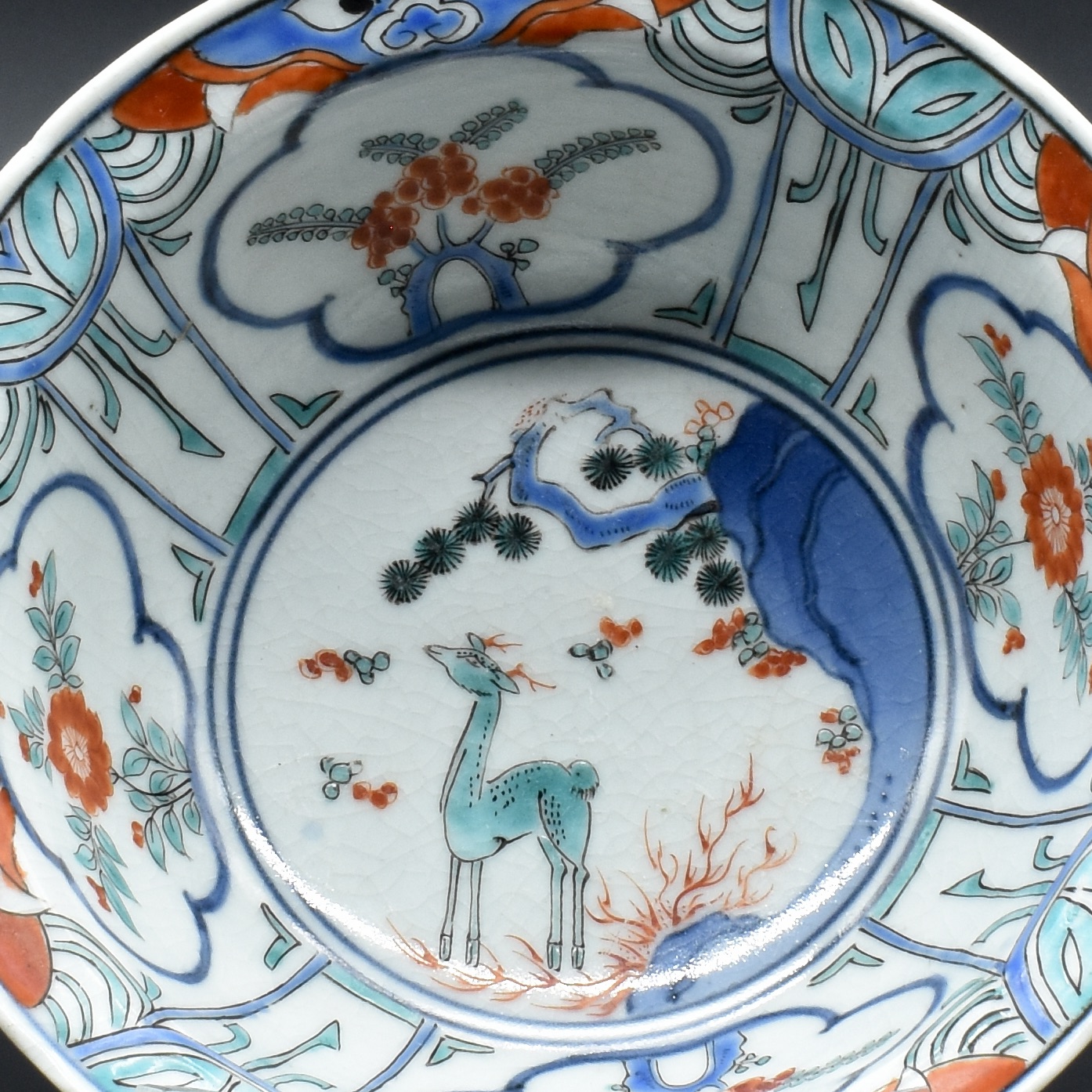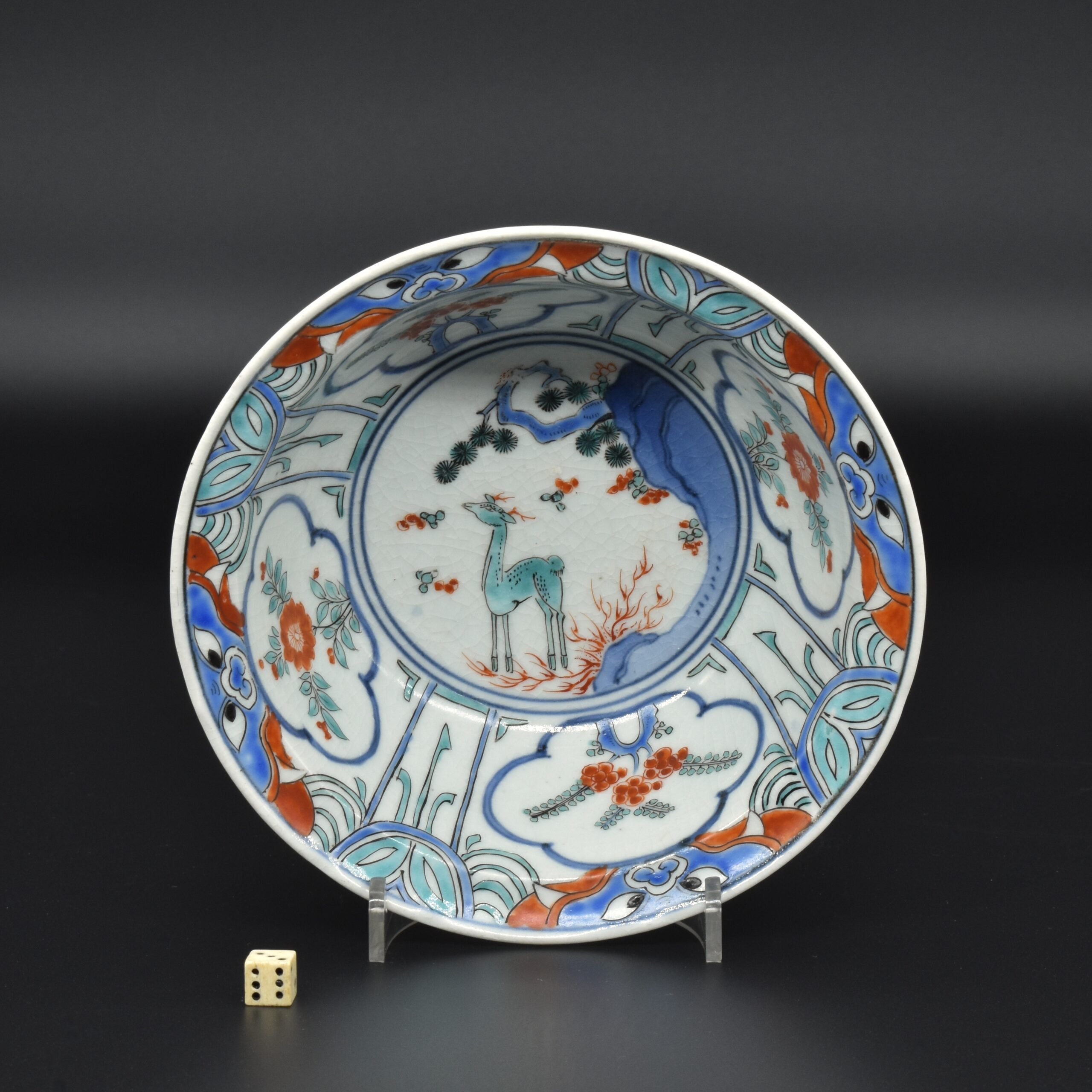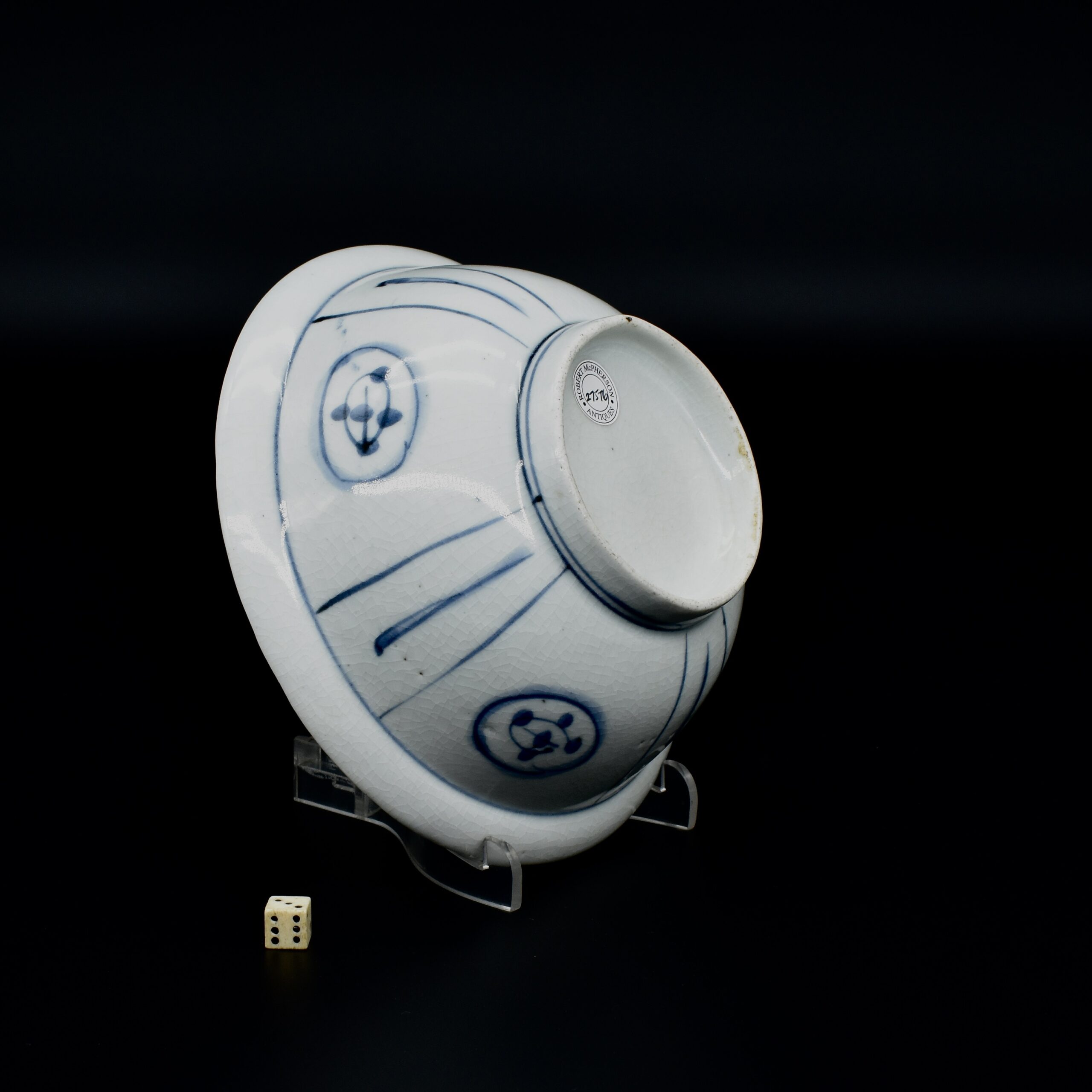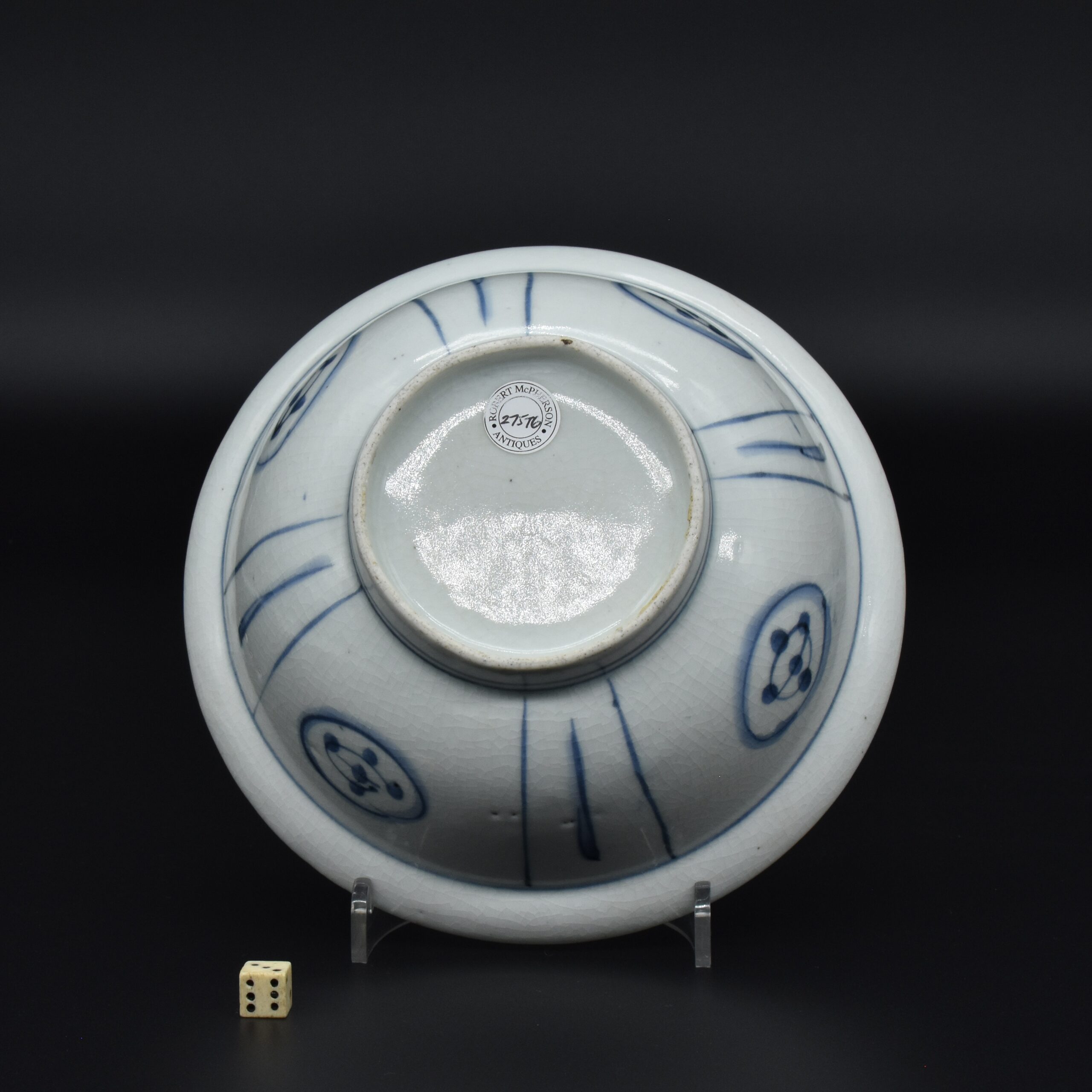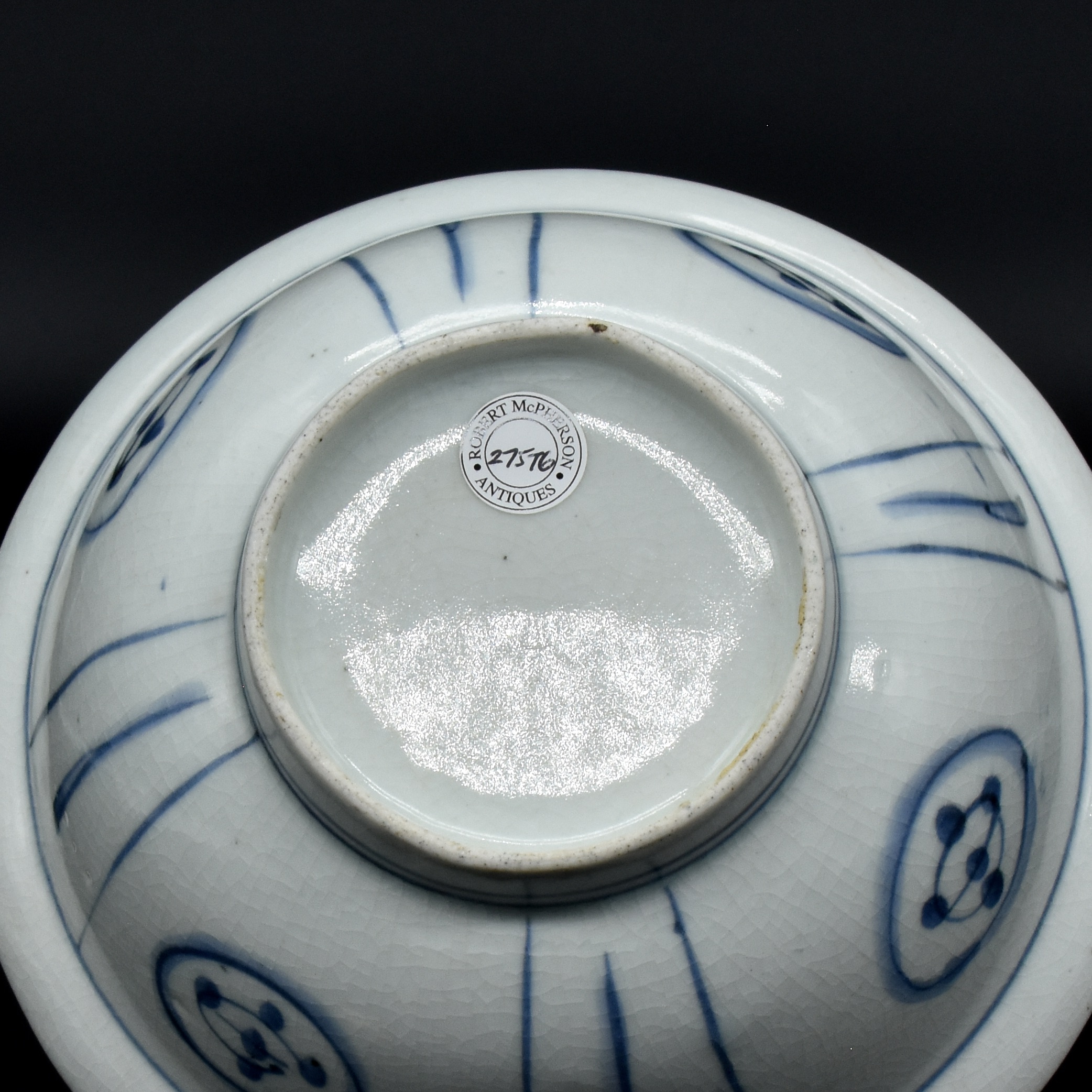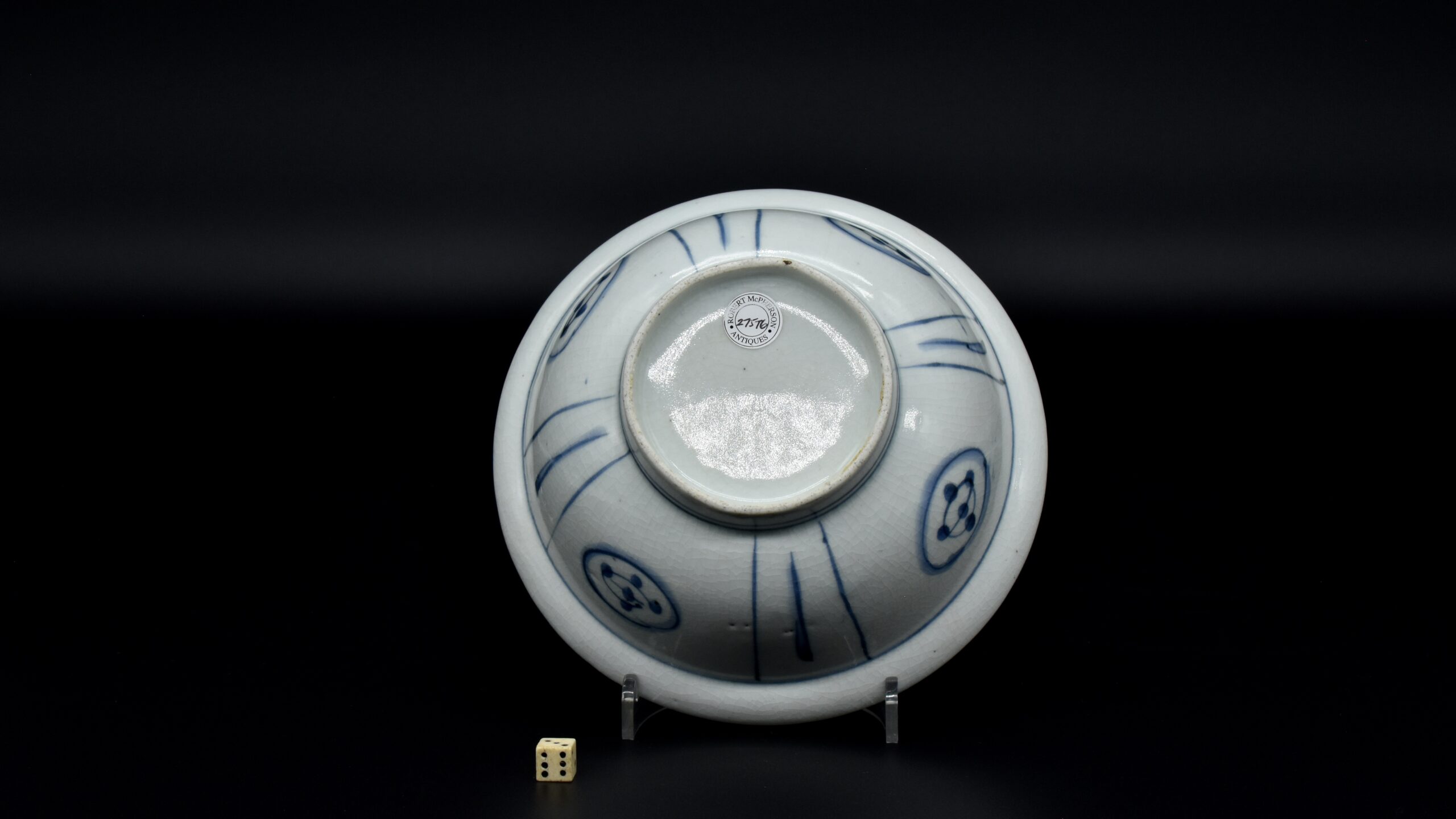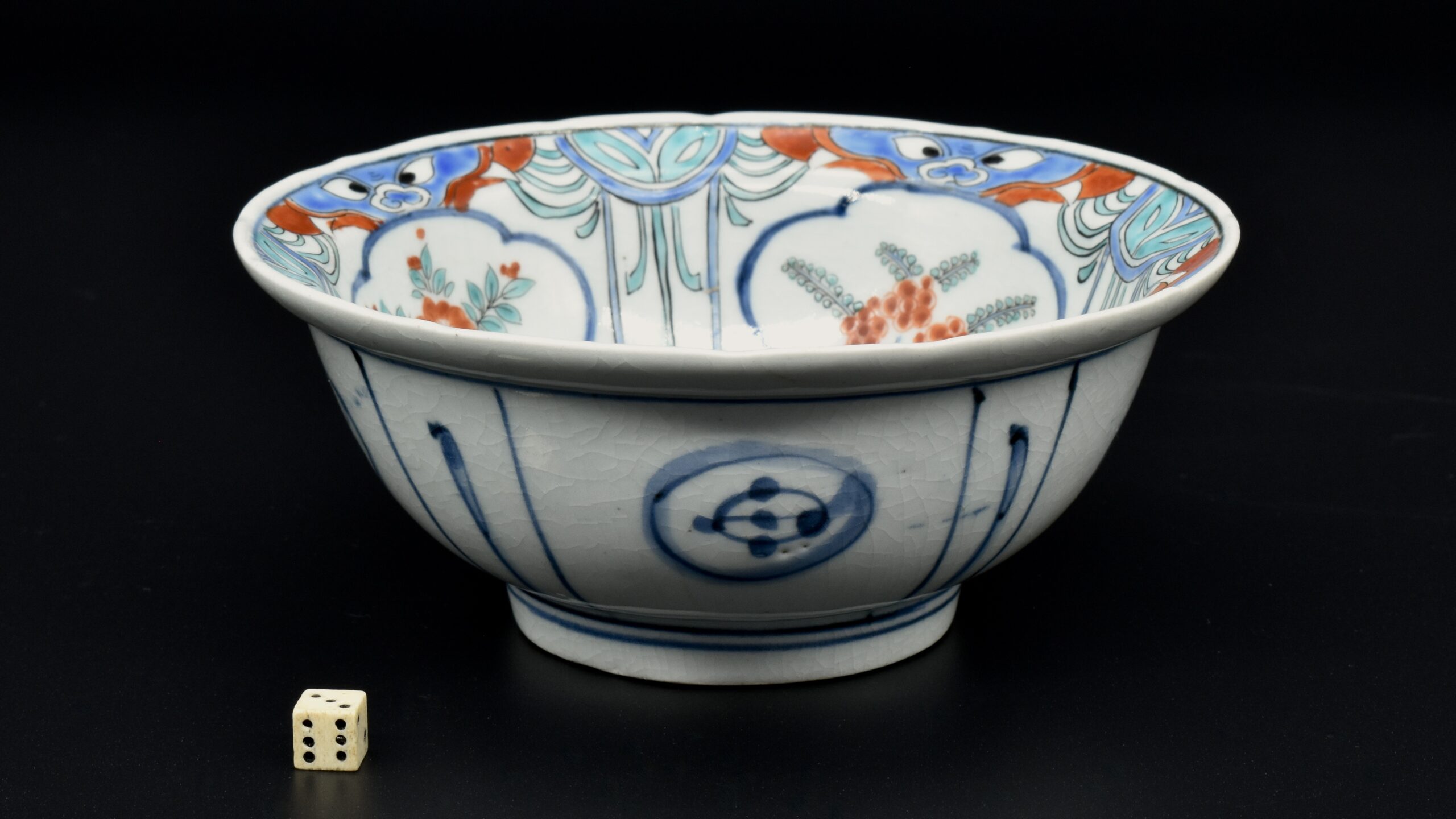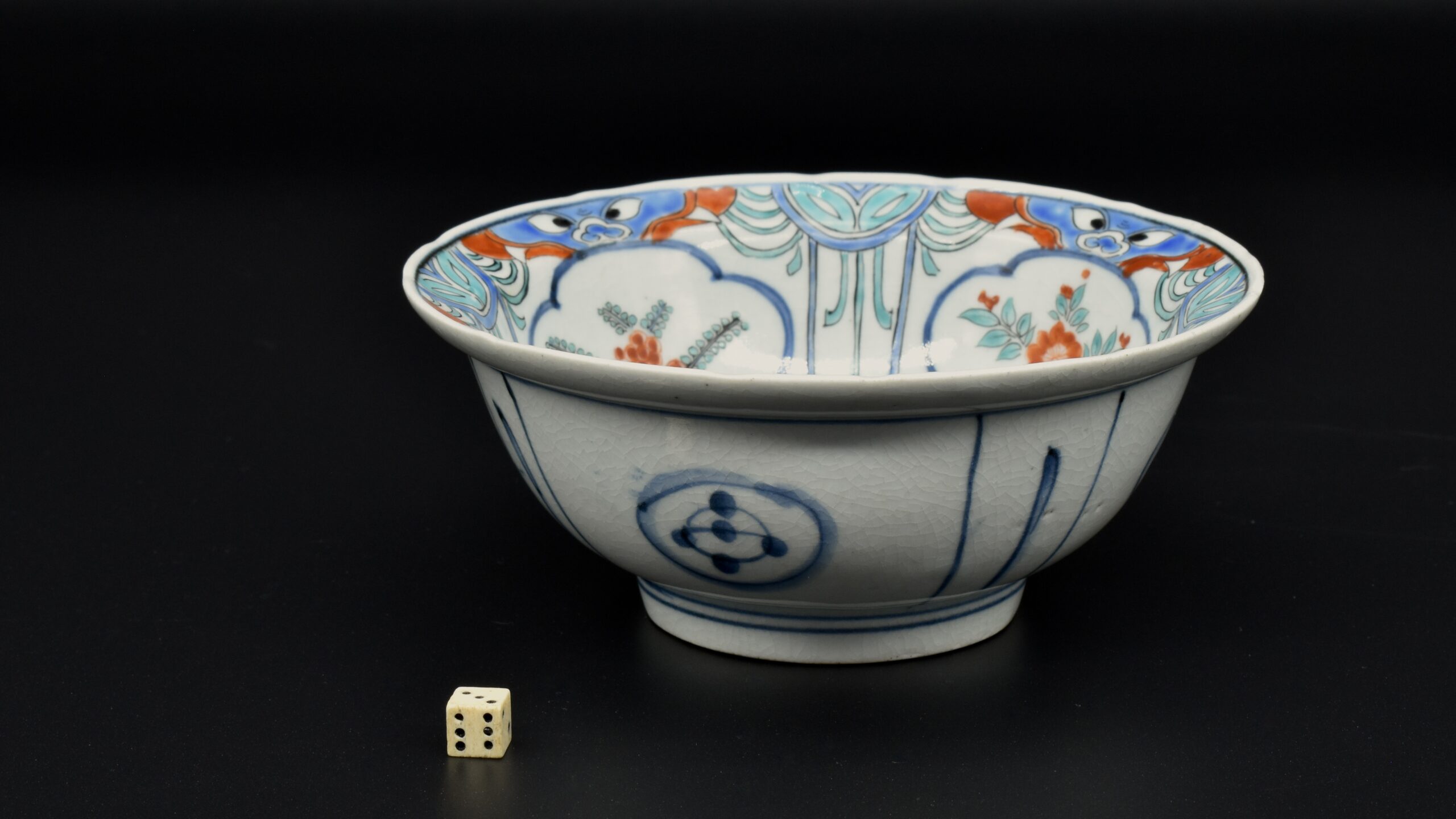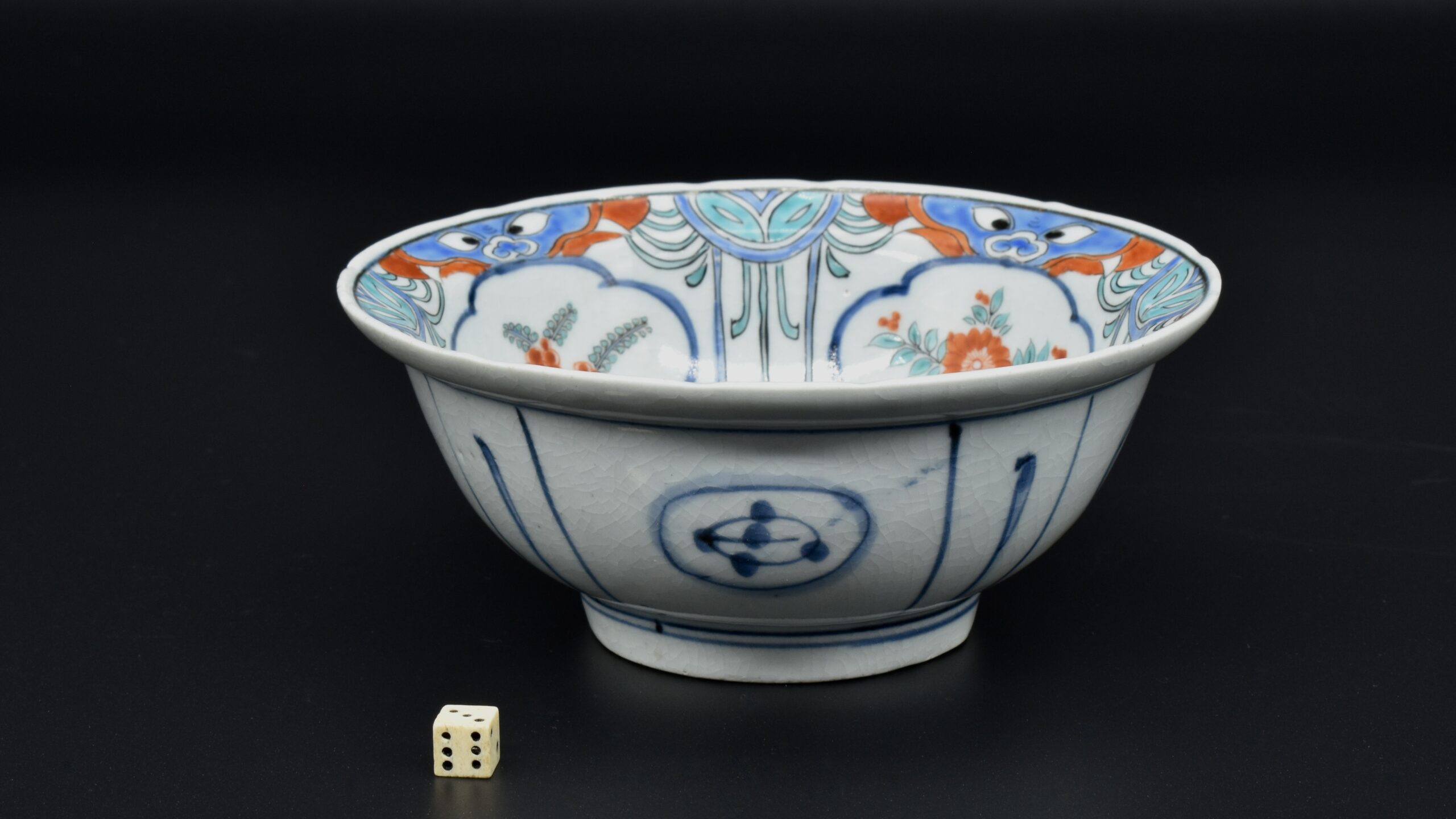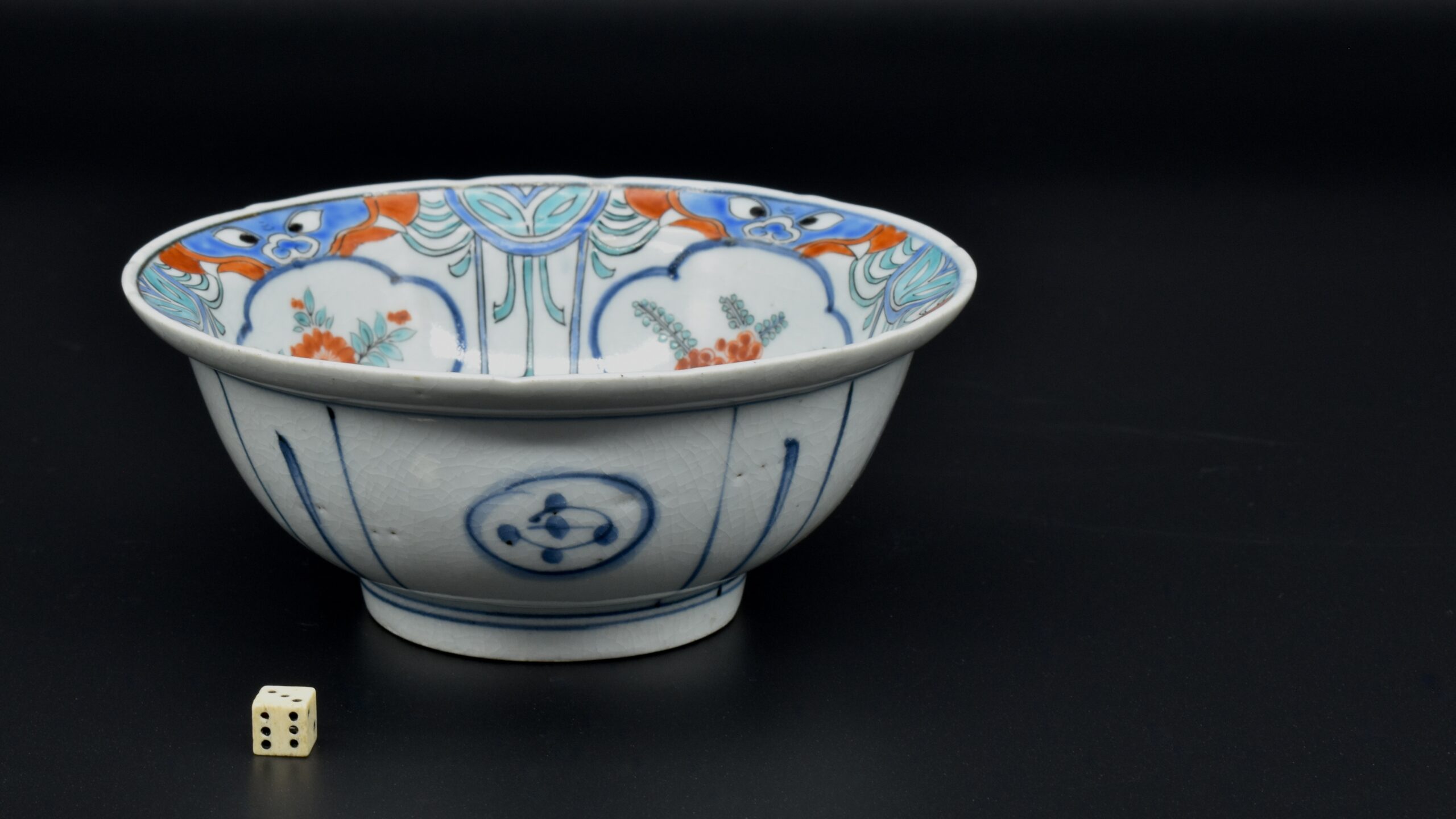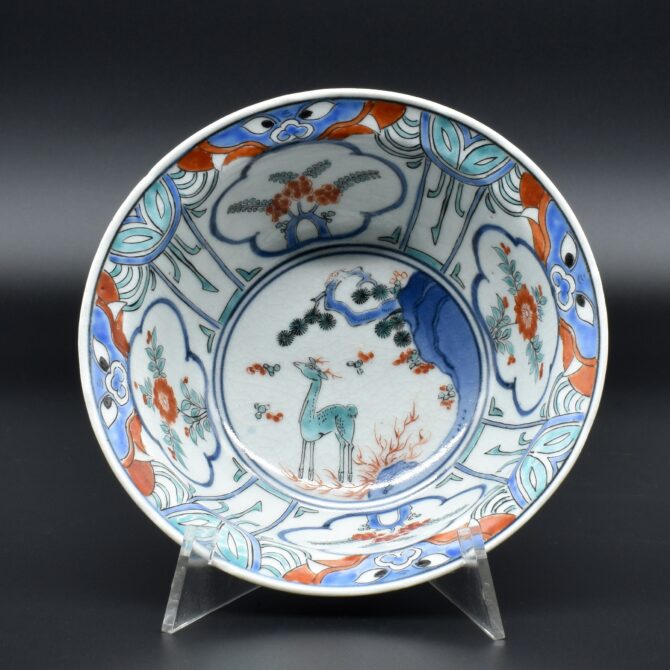
A Late 17th Century Kraak Style Porcelain Bowl, Arita or Kakiemon Kilns.

c.1680-1700.

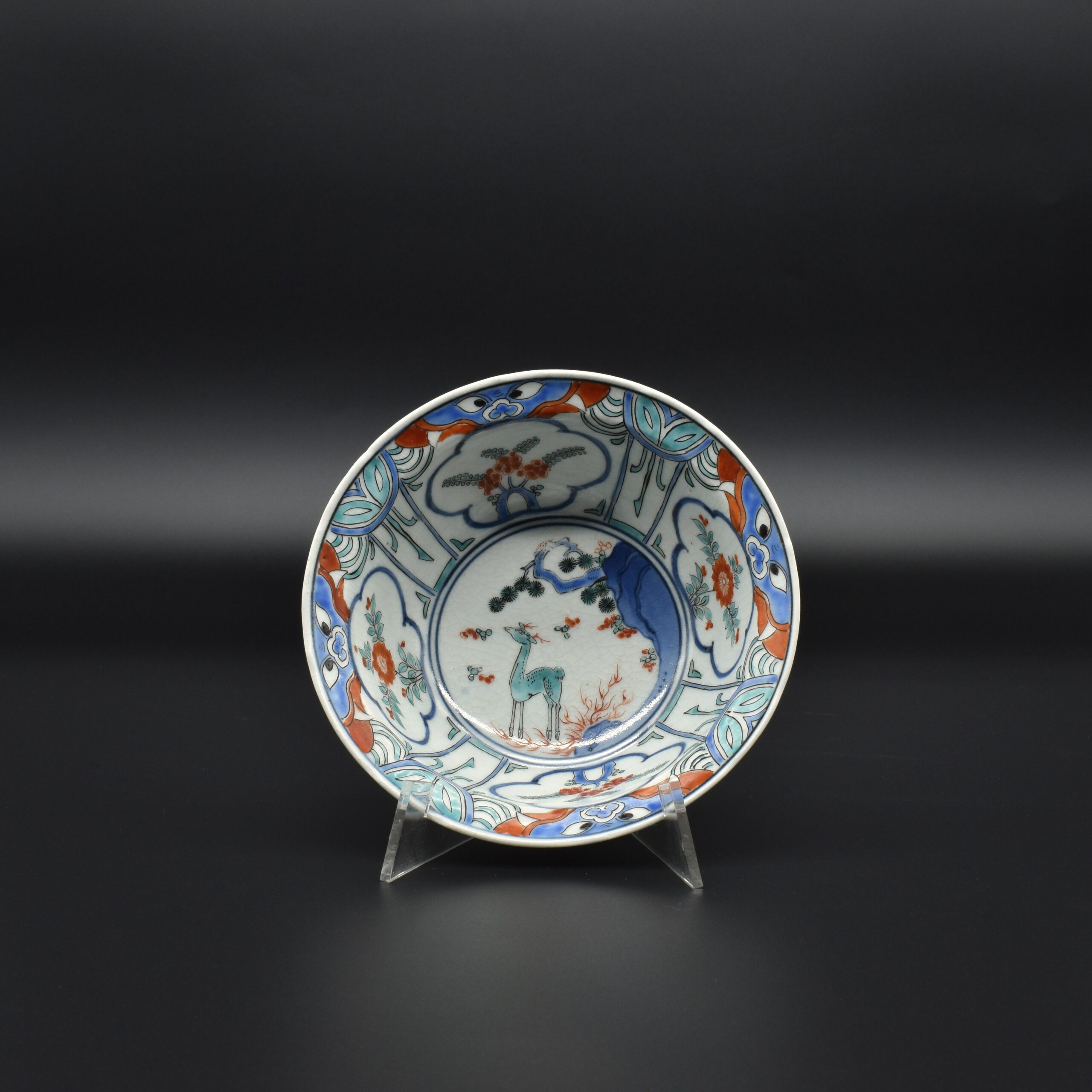
A Late 17th Century Kraak Style Bowl, Kakiemon or Arita Kilns c.1680-1700. This Japanese porcelain bowl with indented rim is in the form of a Chinese export porcelain Kraak ware bowl from the late Ming dynasty. It is low-fired, with underglaze cobalt blue decoration, unlike nearly all Chinese kraak ware there additional enamels. The enamel decoration is in the Japanese Kakiemon palette, however the design is a fusion of Chinese kraak porcelain and Kakiemon elements. The everted rim is painted with crosse eyed Taotie mask is a stylised zoomorphic monster face frequently cast on ancient Chinese ritual bronze vessels and craved jade from the Shang and Zhou dynasties 1600 to 256 B.C. These masks often occur on Chinese Kraak porcelain bowls of this shape. The well of the bowl is very much in the Japanese Kakiemon style. This small bowl might well be from the Kakiemon kilns, even though the porcelain isn’t the bright white colour used on enamelled Kakiemon. Kakiemon porcelain with underglaze blue is quite different, it is thicker, a little bit of a blue grey colour and is quite often crazed like the present example. For a Kakiemon dish with underglaze blue as well as over-glazed enamels see below. There is a dish in the catalogue of the Ashmolean Museum where Dr. Oliver Impey was curator, the notes to the O.C.S. exhibition state that sherds of dishes similar to this have been found at the Kakiemon kiln site, this information probably come from Dr.Impey who was a regular visitor to Japan.


RESERVED

See Below For More Photographs and Information.


Condition
In excellent condition, no damage, very minor wear to the blue enamel in the well of the bowl, light crazing to the glaze.
Size
Diameter 14.6 cm (5 3/4 inches). Depth 6.2 cm (2.4 inches).
Provenance
N/A
Stock number
27567
References
An almost identical Kakiemon bowl from David Glick, friends from when we were 12, was bought by me many years ago c.2010-2013. David is a dealer in antique English glass at Portobello road. The bowl is in a private Australian collection and is illustrated in the exhibition catalogue : Kakiemon in Australia (Daniel McOwan and Patricia Begg, Sovereign Press. 2014. 978-0-9595414-1-0) page 34, plate 42, dated to 1690-1710. For another Kakiemon bowl of this shape and design see : Japanese Export Porcelain, Catalogue of the Collection of the Ashmolean Museum, Oxford (Oliver Impey, Hotei Publishing, Amsterdam, 2002) page 125, plate 160.

Photos
Information

A 17th Century Japanese Kakiemon Porcelain Dish, Kakiemon Kilns or Arita c.1670-1690.

Robert McPherson Antiques, Sold Archive 27039.
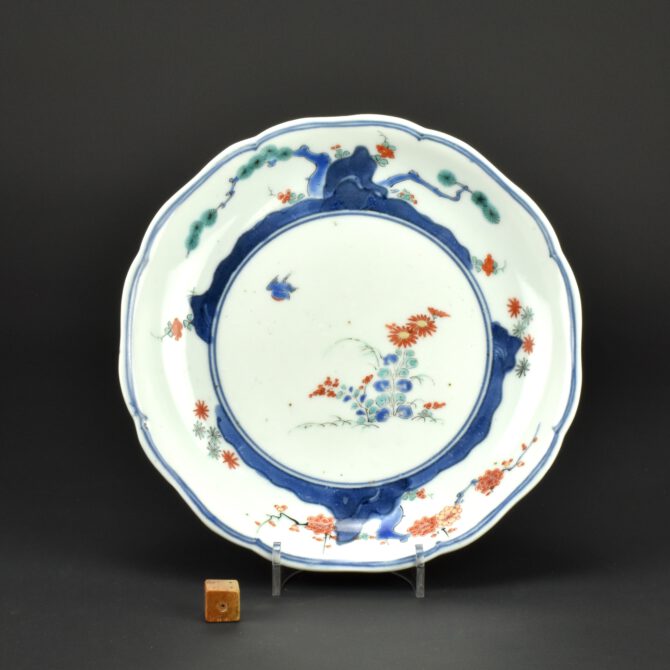
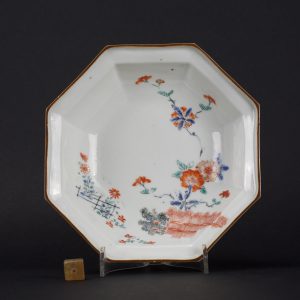
A 17th Century Japanese Kakiemon Porcelain Dish, Kakiemon Kilns or Arita c.1670-1690. This 17th Century foliate dish has underglaze blue and overglaze Kakiemon enamel colours. The design at the center of the dish is of flowering chrysanthemum in enamels. The cavetto is painted with a rocky landscape in underglaze cobalt blue with overglaze decoration of the Three Friends of Winter, Pine, Bamboo and Prunus. The base has an underglaze blue pseudo-Chenghua six-character mark (Ming dynasty 1465-1487). The outer border is in underglaze blue and is a continuous Karakusa scroll designs. A similar dish but with a blue and white landscape to the center is illustrated in the Oriental Ceramics Societie’s catalogue to the exhibition held in the British Museum ; Porcelain for Palaces, The Fashion for Japan in Europe 1650 – 1750 (Various authors, The Oriental Ceramic Society,1990. ISBN 0-903421-24-0) where it is dated to the early 18th century, recent research in Japan points to an earlier date of c.1670-1690. The dish in the catalogue is from the Ashmolean Museum where Dr. Oliver Impey was curator, the notes to the O.C.S. exhibition state that sherds of dishes similar to this have been found at the Kakiemon kiln site, this information probably come from Dr.Impey who was a regular visitor to Japan. See ‘References’.See Below For More Photographs and Information. SOLD Condition In excellent condition, very minimal wear. Size Diameter 18.4 cm (7 1/4 inches). Provenance N/A Stock number 27039 References Complete Catalogue of Shibata Collection (Contributors Saga Kenritsu Kyūshū Tōji Bunkakan. Published by the Kyushu Ceramic Museum, 2019) page 204, plate 1621 for a Kakiemon dish of this type with a phoenix and chrysanthemum to the center. For another Kakiemon dish of this type see Porcelain for Palaces, The Fashion for Japan in Europe 1650 - 1750 (Various authors, The Oriental Ceramic Society,1990. ISBN 0-903421-24-0) page 143, plate 107.
A 17th Century Japanese Kakiemon Porcelain Dish, Kakiemon Kilns or Arita c.1670-1690. This 17th Century foliate dish has underglaze blue and overglaze Kakiemon enamel colours. The design at the center of the dish is of flowering chrysanthemum in enamels. The cavetto is painted with a rocky landscape in underglaze cobalt blue with overglaze decoration of the Three Friends of Winter, Pine, Bamboo and Prunus. The base has an underglaze blue pseudo-Chenghua six-character mark (Ming dynasty 1465-1487). The outer border is in underglaze blue and is a continuous Karakusa scroll designs. A similar dish but with a blue and white landscape to the center is illustrated in the Oriental Ceramics Societie’s catalogue to the exhibition held in the British Museum ; Porcelain for Palaces, The Fashion for Japan in Europe 1650 – 1750 (Various authors, The Oriental Ceramic Society,1990. ISBN 0-903421-24-0) where it is dated to the early 18th century, recent research in Japan points to an earlier date of c.1670-1690. The dish in the catalogue is from the Ashmolean Museum where Dr. Oliver Impey was curator, the notes to the O.C.S. exhibition state that sherds of dishes similar to this have been found at the Kakiemon kiln site, this information probably come from Dr.Impey who was a regular visitor to Japan. See ‘References’.
See Below For More Photographs and Information.
SOLD
Condition
In excellent condition, very minimal wear.
Size
Diameter 18.4 cm (7 1/4 inches).
Provenance
N/A
Stock number
27039
References
Complete Catalogue of Shibata Collection (Contributors Saga Kenritsu Kyūshū Tōji Bunkakan. Published by the Kyushu Ceramic Museum, 2019) page 204, plate 1621 for a Kakiemon dish of this type with a phoenix and chrysanthemum to the center. For another Kakiemon dish of this type see Porcelain for Palaces, The Fashion for Japan in Europe 1650 - 1750 (Various authors, The Oriental Ceramic Society,1990. ISBN 0-903421-24-0) page 143, plate 107.


A Bronze Taotie Mask 

At the Fitzwilliam Museum, Cambridge, England.
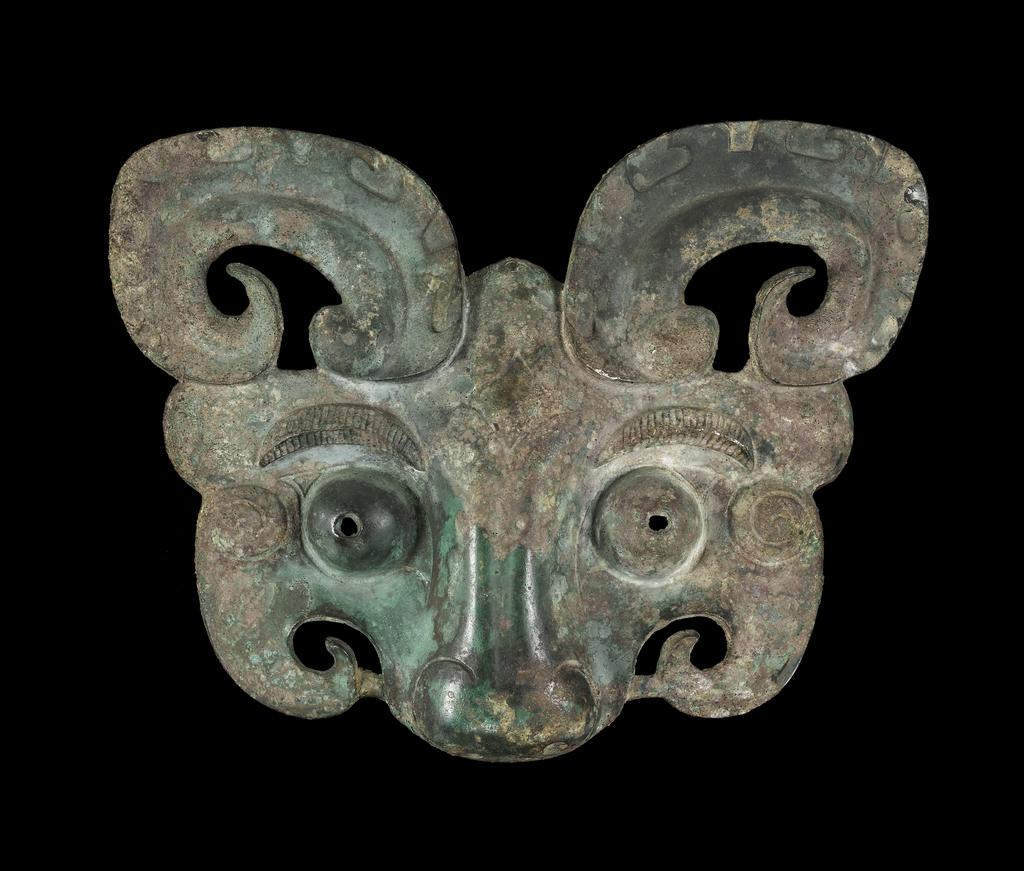
 Taotie mask is a stylised zoomorphic monster face frequently cast on ancient Chinese ritual bronze vessels and craved jade from the Shang and Zhou dynasties.
Taotie mask is a stylised zoomorphic monster face frequently cast on ancient Chinese ritual bronze vessels and craved jade from the Shang and Zhou dynasties 1600 to 256 B.C. 


Kakiemon Porcelain

While there is much debate about what was actually made at the Kakiemon kilns, and was made at Arita, it seems clear that the Nigoshide body was exclusively used at Kakiemon. There has been allot of Japanese research undertaken at the Kakiemon kilns, and fragments of porcelain as well as moulds have been recovered from the kiln sites, unfortunately I have only found this information in Japanese books (in Japanese).  Nigoshide refers to a fine milky-white porcelain body that glows with a warm tint, in Japan it is said to be reminiscent of rice-water. While white porcelain usually sports a blue tint, Nigoshide porcelain has a soft milky-white appearance. Nigoshide was invented in the 1670s as the perfect porcelain body for complimenting the brilliant polychrome overglaze enamel colours created at Kakiemon. It is notable that the Kakiemon enamel decorated pieces with underglaze blue do not use the Nigoshide body, yet fragments of this type have been recovered from the Kakiemon kiln sits. The main period of production of Kakiemon Nigoshide ware was from about 1670 to 1690. Due to lack of the right materials and economic cutbacks, Nigoshide porcelain went out of production by the mid-18th century, however there was a notable decline in production from around 1690.

Kakiemon decoration is usually of high quality, often delicate and with well-balanced asymmetric designs. The designs were normally quite sparse emphasizing the. Kakiemon porcelain was decorated with a great variety of imaginative designs which include elements such as the `banded hedge`, `flying squirrel`, and the `Quail and Millet` design in the West. The `Three Friends of Winter` were also a very popular group of designs, other subject taken from nature include flowers (especially the chrysanthemum, the national flower of Japan) as well as birds and rock-work. Figural subjects such as the so-called `Hob in the Well` were also popular. This design illustrates a Chinese folk tale where a sage saves his friend who has fallen into a large fish-bowl by throwing stones at it, breaking open the pot. Banded-Hedges were a formal device within Japanese traditional gardens, referred as brushwood hedges. Other elements incorporated in the designs, includes `The Three Friends of Winter` (Pine, Bamboo and Prunus). These three plants signify perseverance, as neither the pine nor the bamboo shed their leaves in winter and the plumb (Prunus) flowers at the very end of the winter, heralding the arrival of spring.


17th Century Kakiemon Porcelain Bowls. 

Robert McPherson Antiques - Sold Archive.
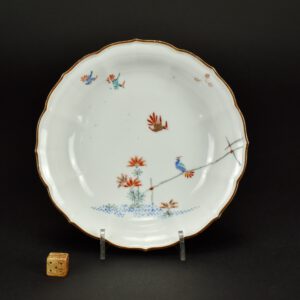
A 17th Century Japanese Kakiemon Porcelain Bowl - Robert McPherson Antiques - 26994
A 17th Century Japanese Kakiemon Porcelain Bowl - Robert McPherson Antiques - 26068
A 17th Century Japanese Kakiemon Porcelain Bowl - Robert McPherson Antiques - 26008
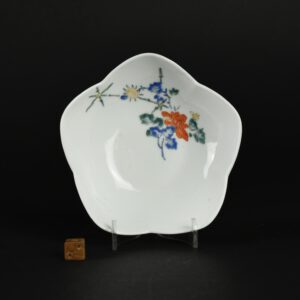
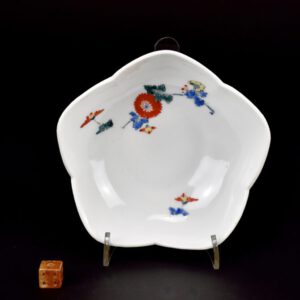
A 17th Century Japanese Kakiemon Porcelain Bowl. The shallow bellflower, called Kikyō, form has everted ‘petals’, it is painted using Kakiemon enamels with Chrysanthemum, the national flower of Japan.This understated subtle asymmetrical design is typically Japanese and is at its best on Kakiemon wares. The use of space shows off the pure white Nigoshide (milky white) porcelain to its full effect. Kakiemon decoration is usually of high quality, often delicate and with well-balanced asymmetric designs. These designs were normally quite sparse emphasizing the fine white porcelain known in Japan as Nigoshide (milky white porcelain). A Pair of Kakiemon Bowls of the Same Shape and Design, from Burghley House are illustrated in the catalogue : The Burghley Porcelains, An Exhibition from The Burghley House Collection and Based on the 1688 Inventory and 1690 Devonshire Schedule. See below the Photograph Gallery for one of the Burghley bowls and other references. The opaque white milky Nigoshide porcelain was used on the finest pieces, it appears that it was reserved for fine quality enamelled decoration and the secret of its production was guarded well. Kakiemon porcelain was decorated with a great variety of imaginative designs which include elements such many of which are well known in the West. Elements of these designs acquired European names early on. For example `banded hedge`, these are actually a brushwood fences, `flying squirrel`, these are tree shrews and the`Quail and Millet` design. The `Three Friends of Winter` were also a very popular group of designs, other subject taken from nature include flowers (especially the chrysanthemum, the national flower of Japan) as well as birds and rock-work. Figural subjects such as the `Hob in the Well` were also popular. This design illustrates a Chinese folk tale where a sage saves his friend who has fallen into a large fish-bowl by throwing stones at it, breaking open the pot. Banded-Hedges were a formal device within Japanese traditional gardens, they were often incorporated in designs, includes `The Three Friends of Winter` (Pine, Bamboo and Prunus). These three plants signify perseverance, as neither the pine nor the bamboo shed their leaves in winter and the plumb (Prunus) flowers at the very end of the winter, heralding the arrival of spring. See below for more photographs and references. SOLD Condition In perfect condition, some minute firing spects to the glaze. Size Diameter 12.6 cm (4 3/4 inches) Provenance An English private collection formed in the 1960s. Stock number 26109 References The Burghley Porcelains, An Exhibition from The Burghley House Collection and Based on the 1688 Inventory and 1690 Devonshire Schedule (Japan Society, New York, 1986. ISBN 0-913304-23-9). Page 249, item 104.
A 17th Century Japanese Kakiemon Porcelain Bowl. The shallow bellflower, called Kikyō, form has everted ‘petals’, it is painted using Kakiemon enamels with Chrysanthemum, the national flower of Japan.
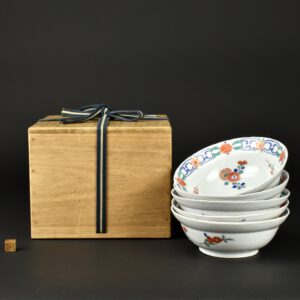
A Rare Set of Five 17th Century Japanese Kakiemon Porcelain Bowls - Robert McPherson Antiques - 27108