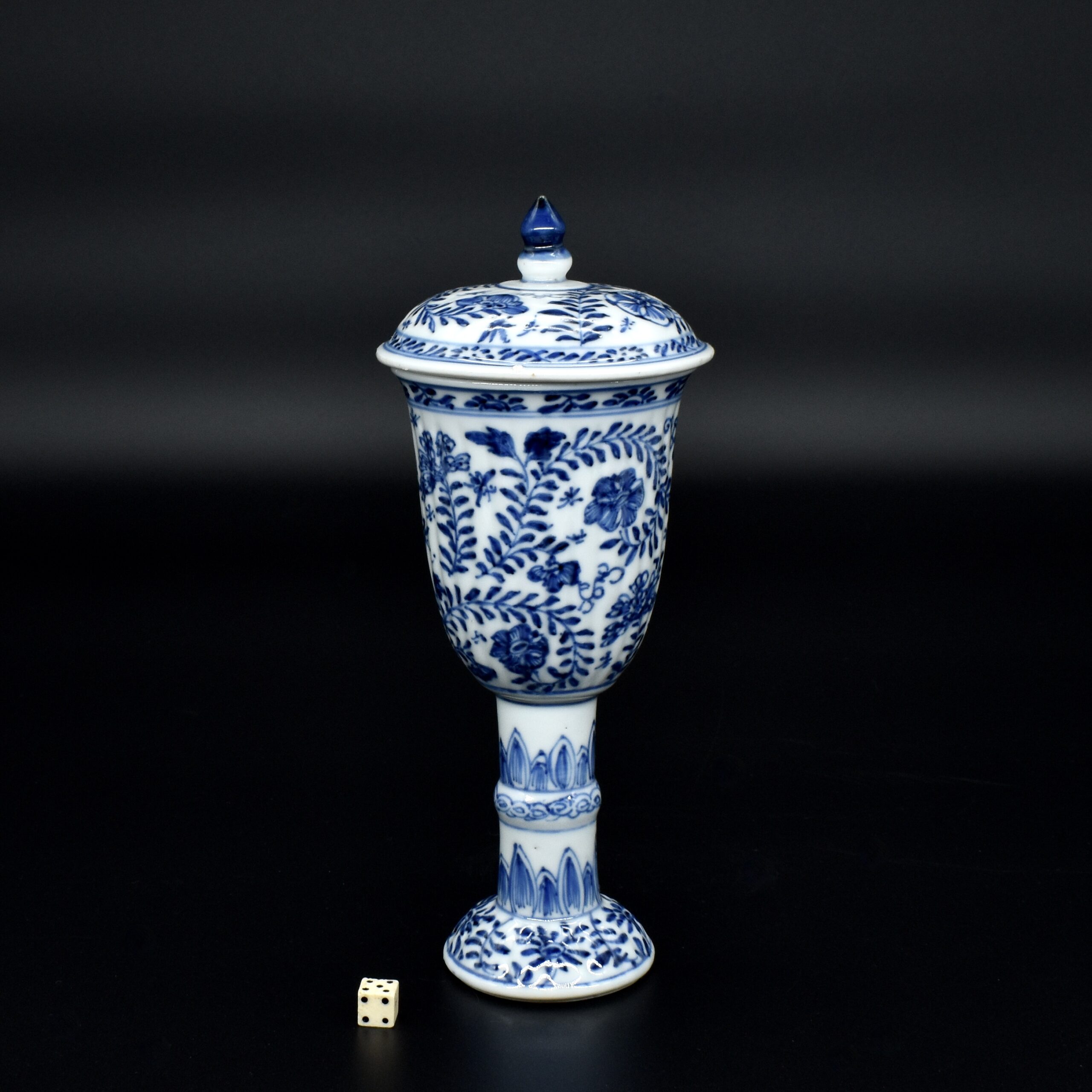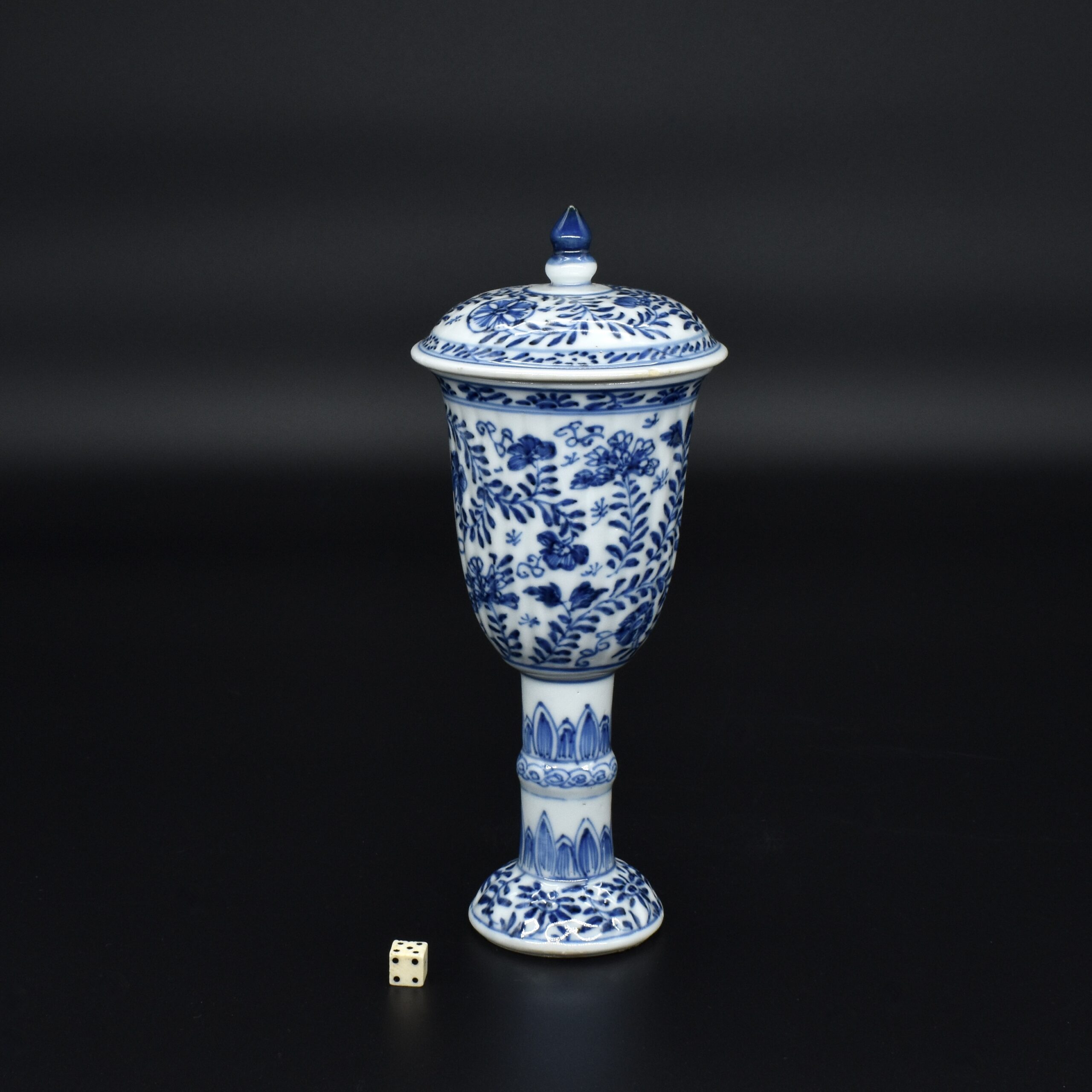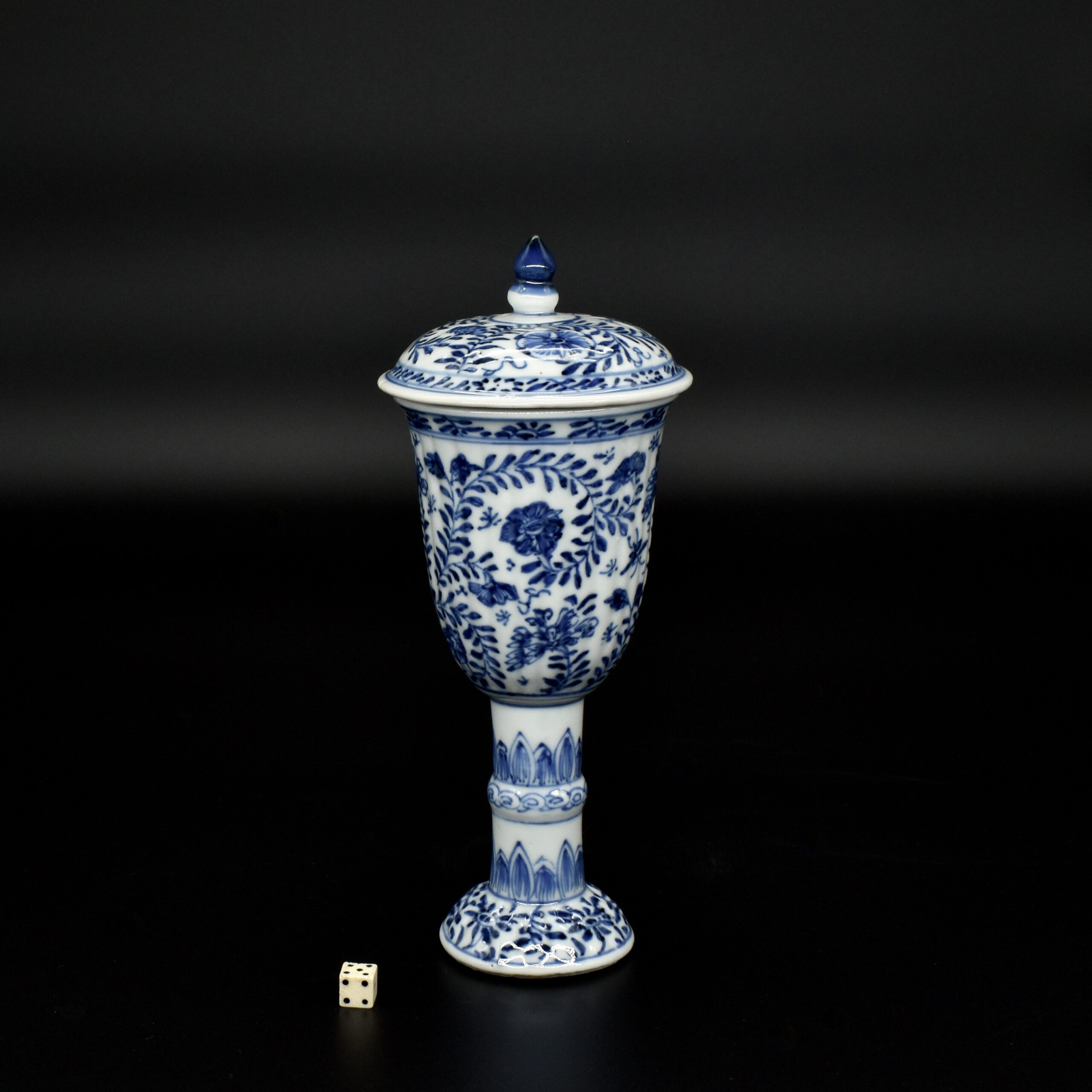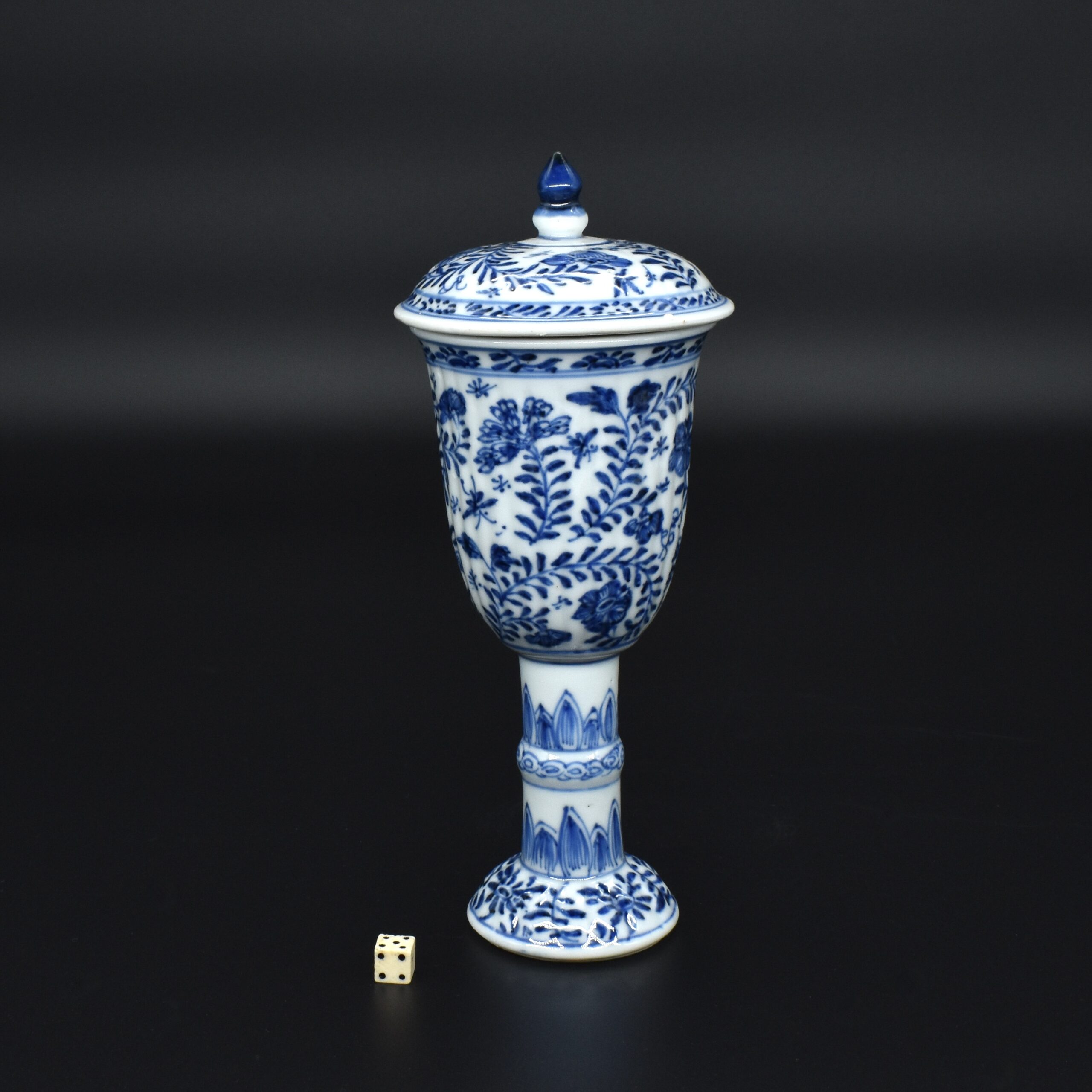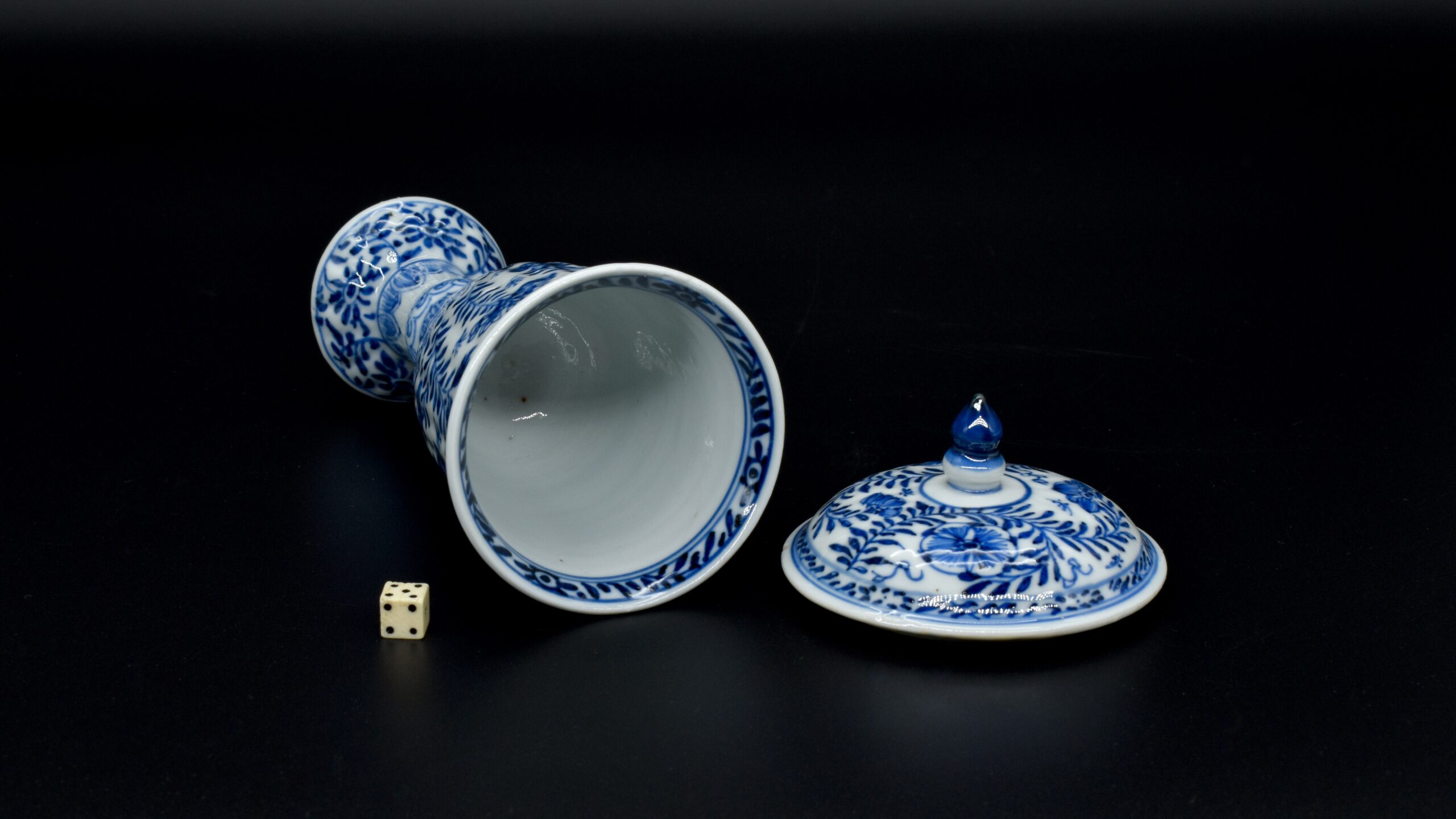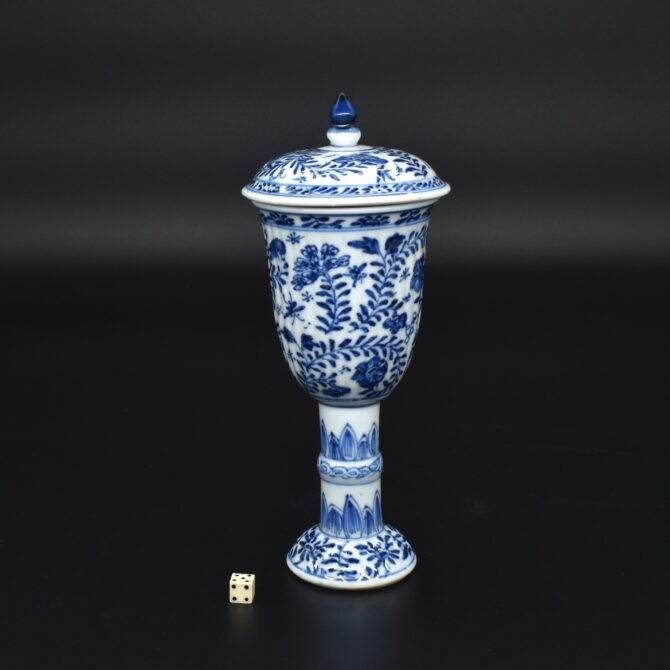
A Kangxi Blue and White Porcelain Goblet and Cover.

Kangxi 1662 - 1722

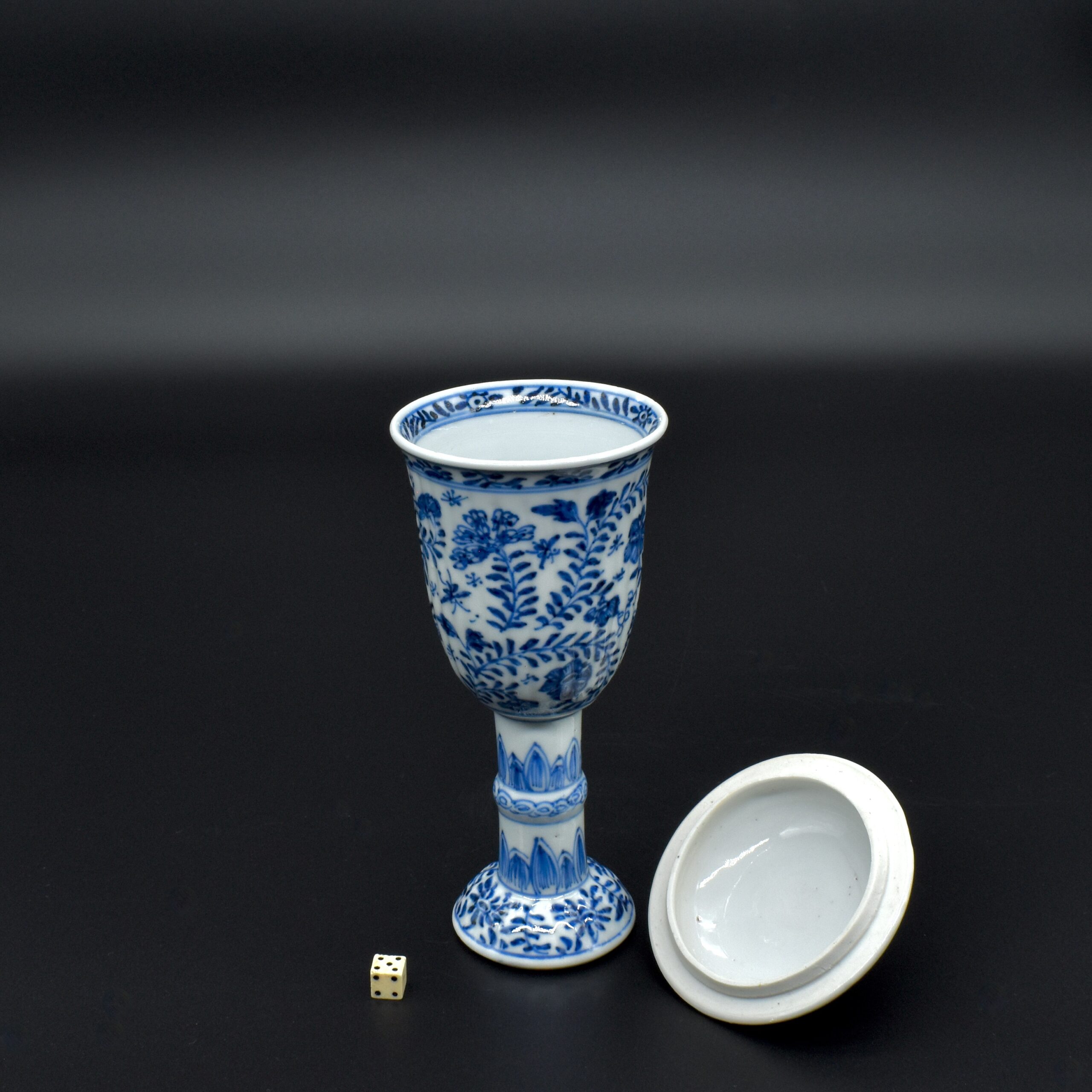
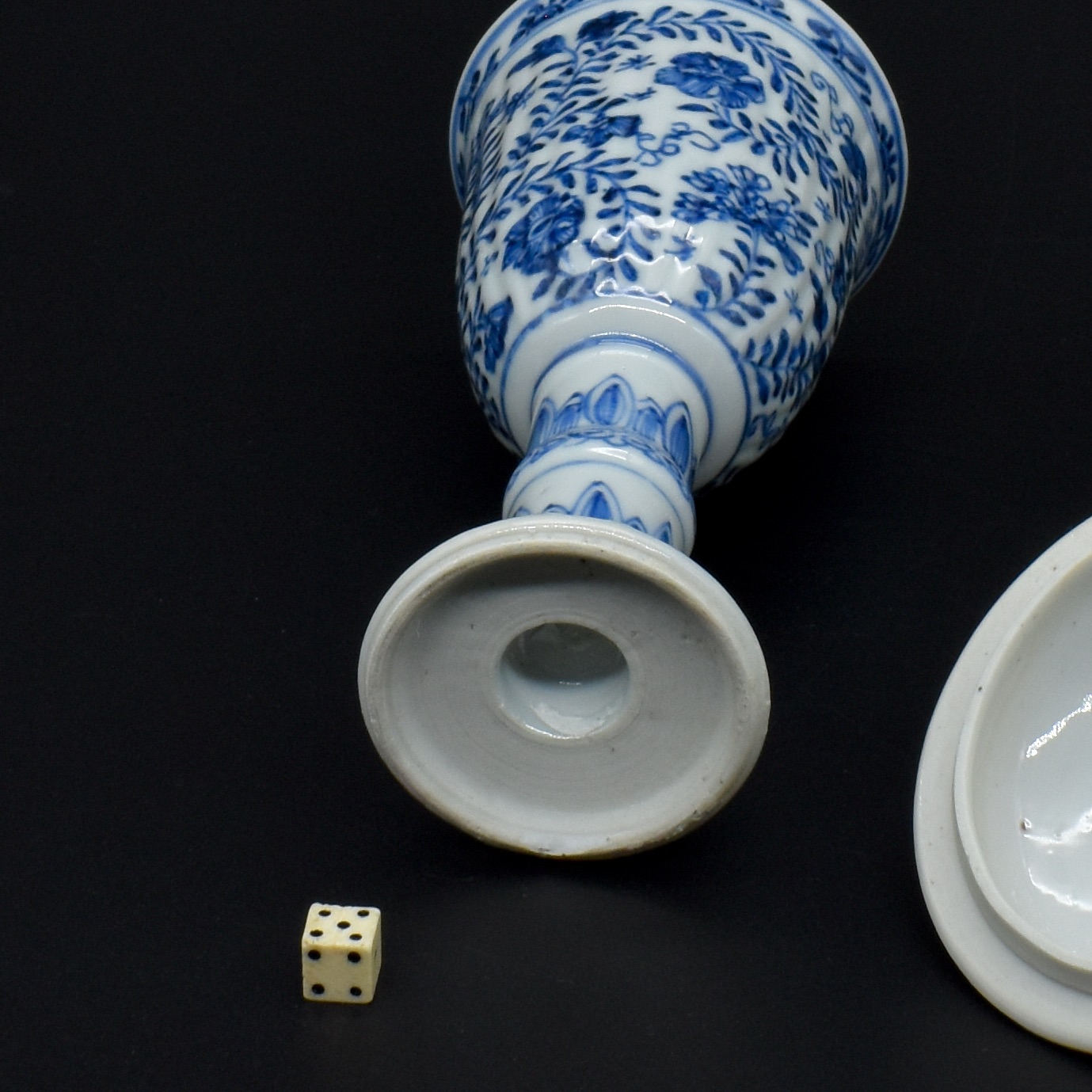
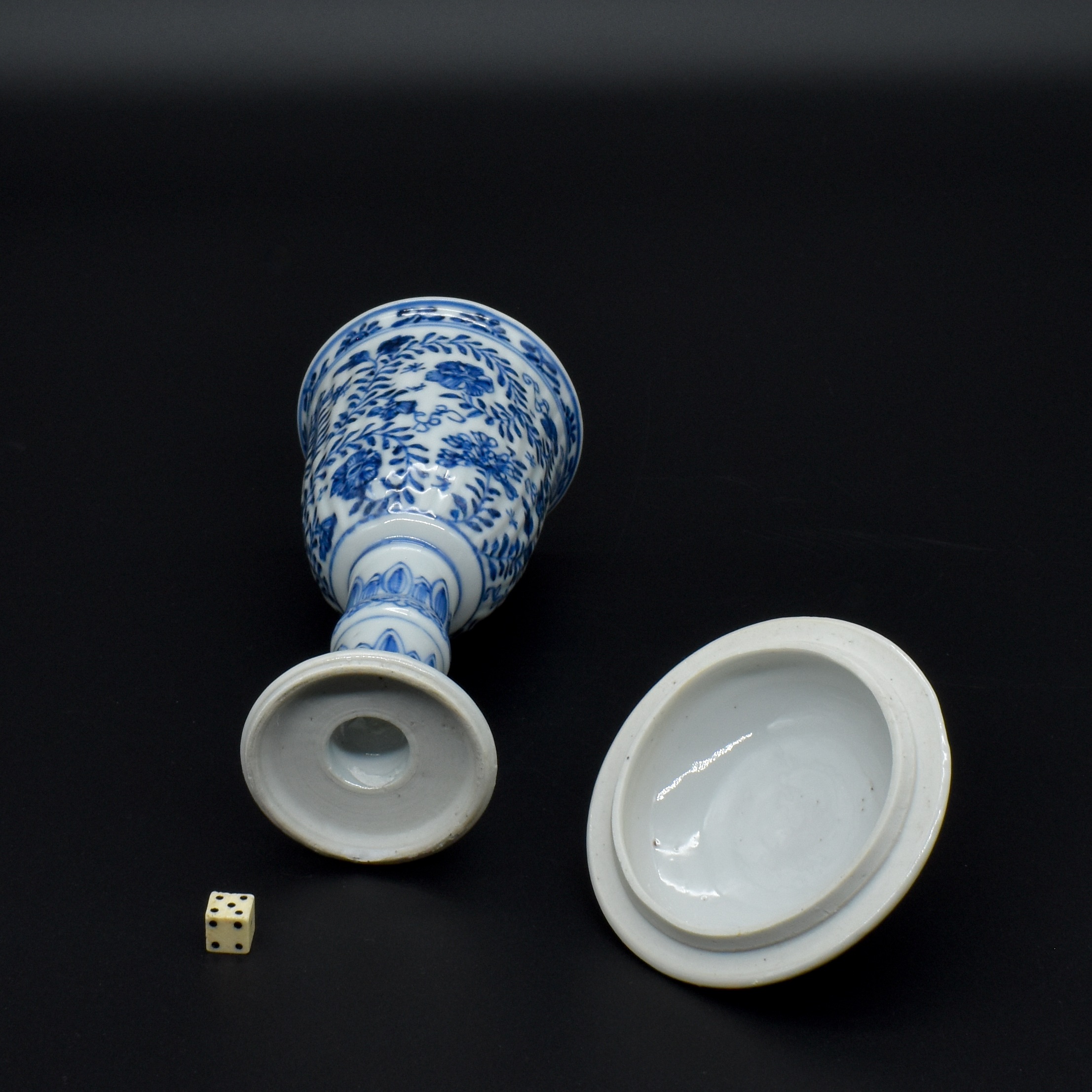
A Kangxi Blue and White Porcelain Goblet and Cover, Jingdezhen Kilns c.1690. This Kangxi porcelain goblet is based on Northern European glass forms, I say ‘forms’ rather than any specific form, because it is like that the original glass form was adapted by the potters at Jingdezhen. It’s likely that a wooden prototype was sent out and then copied. Although the scrolling flowering plant motif fits in with the Barque style that highly fashionable in Europe at this time, design is essential Chinese in spirit as well as detail. This type of form is reflected in the pieces found in Vung Tau Cargo from around 1690. However the decoration on some of those pieces was more overtly European, there were also pieces that were certainly designed for the West, like the ‘Canal House Vases’ that were specific to that wreck and specific to the Netherlands. The present piece is a well known type, however few have covers like the present example. Most have lost their covers, it’s also possible that not all of them have covers because the goblet has a glazed rim which the cover fits onto the goblet. The cover is unglazed where it is in contact with the goblet. I suspect they all had covers, but it’s perhaps surprising how many have lost them.


See Below For More Photographs and Information.

Condition
There is a shallow chip inside the foot rim (see 'Photograph Gallery' below
Size
Height 18.9 cm (7.4 inches).
Provenance
N/A
Stock number
24716
References
For a Meissen porcelain version of this beaker see : Meissen Porcelain in the Rijksmuseum (Abraham L. den Blaauwen, Waanders Publishers,2000. ISBN 90 400 9496 9) page 46 item 19. For a photograph of this piece, see Information below.
£ 1450
Change currency
  • £ GBP
  • € EUR
  • $ USD
More info

Photos

Information


A Related English Glass Example c.1690

At the Fitzwilliam Museum, Cambridge, England.

Museum reference C.295 A-1961.
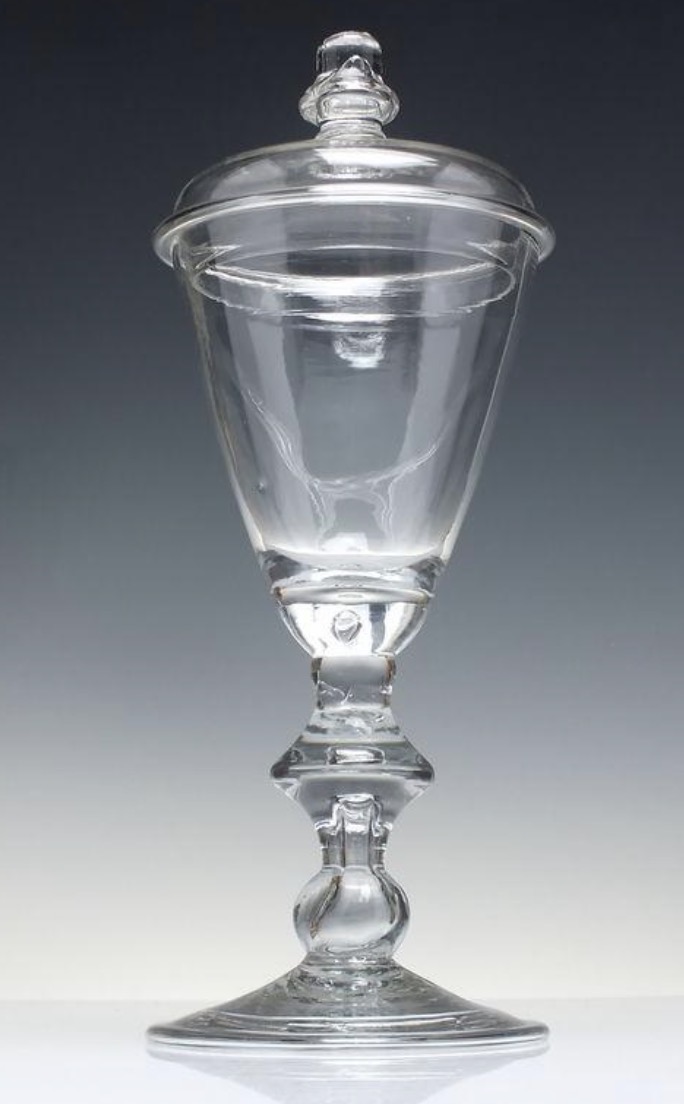
Dated to around 1690, this English lead-glass vessel has a cover, a hollow pillar stem and a folded foot. The museum suggests possible connections with glassmakers George Ravenscroft or Hawley Bishopp, though the attribution is uncertain.


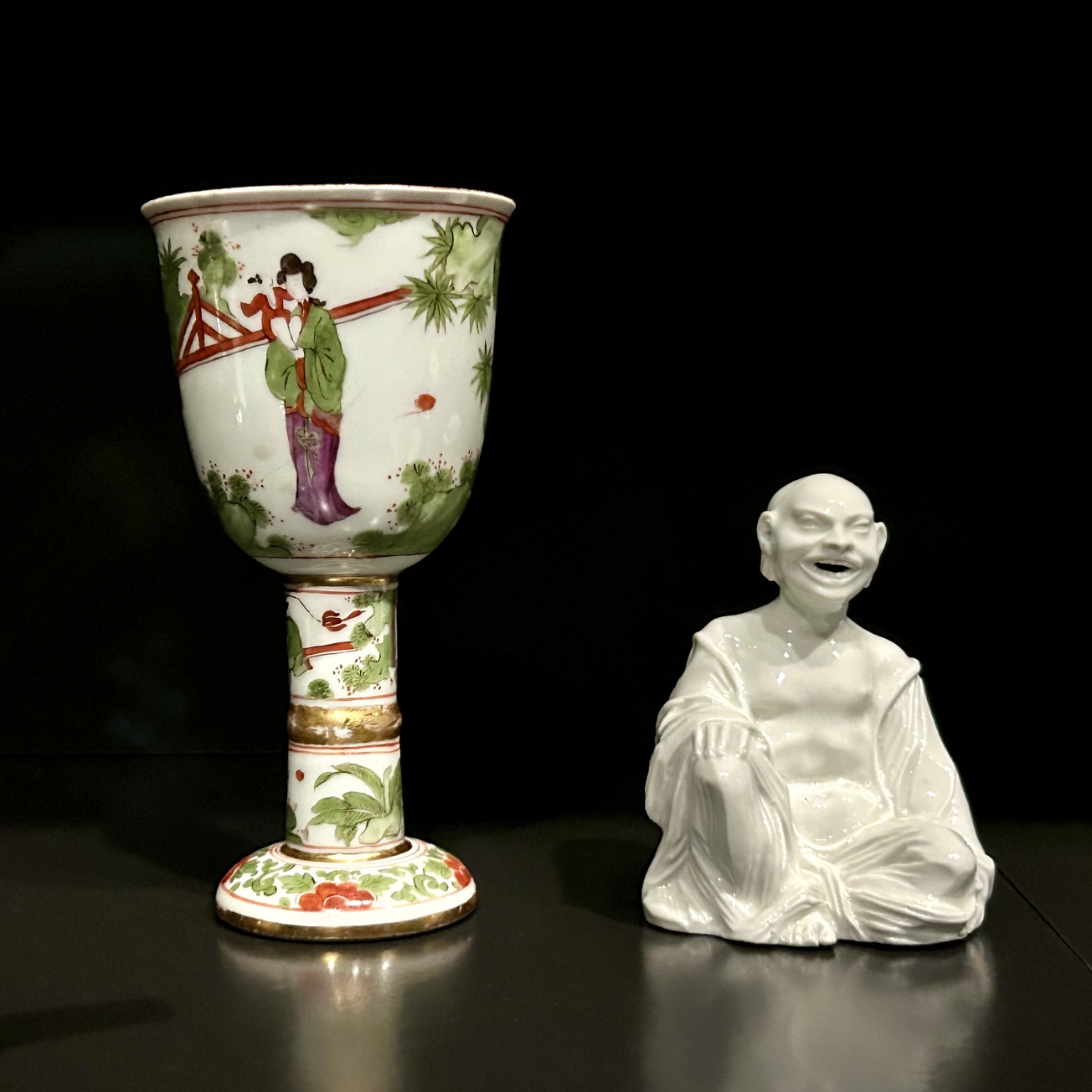
A Meissen Porcelain Goblet in the Chinese Style c.1725 at The Rijksmuseum Amsterdam.

A photograph I took in at the Rijksmuseum in late September 2026.

This early Meissen goblet is decorated with ladies in a Chinese garden. I this is probably an adaptation, the original Kangxi goblets are decorated designs similar to the present blue and white example we have for sale.


c. 1725H. 15.3 cm, diam. 8.2 cm Marks: none Inv. BK-17338-A/B The goblets have a bell-shaped bowl, a long cylindrical stem and a domed, round foot. In the middle of the stem there is a node that is not very marked. The painting is in red, green, yellow, black, mother-of-pearl lustre and gold. On the bowl are two Chinese women standing in front of a wall and a standing woman with a child on her arm in a garden with a fence, flowers and rocks. The wall behind the two women is painted in mother-of-pearl lus-tre and is joined to a similar wall by windows in yellow and red. On the stem a boy is shown playing with a sort of kite among rocks and flowers. The foot and the inside of the rim are decorated with half rosettes in red and foliate scrolls in green. The inside of the rim, the node, the upper and lower parts of the stem and the edge of the foot are gilded. There are single or double red lines at various points, including around the mouth. Beaker A has large restored cracks and the node has lost its gold. A small part of the rim of beaker B has been restored. Prov. Margarete and Franz Oppenheimer coll, Berlin (nos 76 and 77 in black) - Dr. Fritz Mannheimer coll., Amster- dam Lit. Schnorr von Carolsfeld 1927, nos 76-7, pl. 26 - Den Blaauwen 1962, fig. 15 - Jedding 1971 and 1979, fig. 61 - Meister/Reber 1980, fig. 8 The form comes from China (Kangxi period, see among others Hartog 1990, no. 56, ill.); the decoration is derived from Chinese porcelain of the Transitional Period. An example with the same form and decoration is in the PS in Dresden (Handt/Rakebrand 1956, pl. 18 - Walcha 1973, pl. 46). The very rare decoration is also seen on two teapots, one in the Blohm coll. (Schmidt 1953, no. 21, pl. 6 - sale 1960-1, lot 136, pl. XIII; formerly in the Erich von Goldschmidt-Rothschild coll., sale 1931, lot 483, pl. 93) and one in the CGA in Jacksonville (Wark coll., cat. no. 105, col. pl. 7; formerly in the Von Klemperer coll., cat. no. 107, pl. 21).
A Meissen Porcelain Goblet in the Chinese Style.                    c. 1725 H. 15.3 cm, diam. 8.2 cm Marks: none Inv. BK-17338-A/B The goblets have a bell-shaped bowl, a long cylindrical stem and a domed, round foot. In the middle of the stem there is a node that is not very marked. The painting is in red, green, yellow, black, mother-of-pearl lustre and gold. On the bowl are two Chinese women standing in front of a wall and a standing woman with a child on her arm in a garden with a fence, flowers and rocks. The wall behind the two women is painted in mother-of-pearl lus-tre and is joined to a similar wall by windows in yellow and red. On the stem a boy is shown playing with a sort of kite among rocks and flowers. The foot and the inside of the rim are decorated with half rosettes in red and foliate scrolls in green. The inside of the rim, the node, the upper and lower parts of the stem and the edge of the foot are gilded. There are single or double red lines at various points, including around the mouth. Beaker A has large restored cracks and the node has lost its gold. A small part of the rim of beaker B has been restored. Prov. Margarete and Franz Oppenheimer coll, Berlin (nos 76 and 77 in black) - Dr. Fritz Mannheimer coll., Amster- dam Lit. Schnorr von Carolsfeld 1927, nos 76-7, pl. 26 - Den Blaauwen 1962, fig. 15 - Jedding 1971 and 1979, fig. 61 - Meister/Reber 1980, fig. 8 The form comes from China (Kangxi period, see among others Hartog 1990, no. 56, ill.); the decoration is derived from Chinese porcelain of the Transitional Period. An example with the same form and decoration is in the PS in Dresden (Handt/Rakebrand 1956, pl. 18 - Walcha 1973, pl. 46). The very rare decoration is also seen on two teapots, one in the Blohm coll. (Schmidt 1953, no. 21, pl. 6 - sale 1960-1, lot 136, pl. XIII; formerly in the Erich von Goldschmidt-Rothschild coll., sale 1931, lot 483, pl. 93) and one in the CGA in Jacksonville (Wark coll., cat. no. 105, col. pl. 7; formerly in the Von Klemperer coll., cat. no. 107, pl. 21).


At The Royal Dresden Palace Collection.
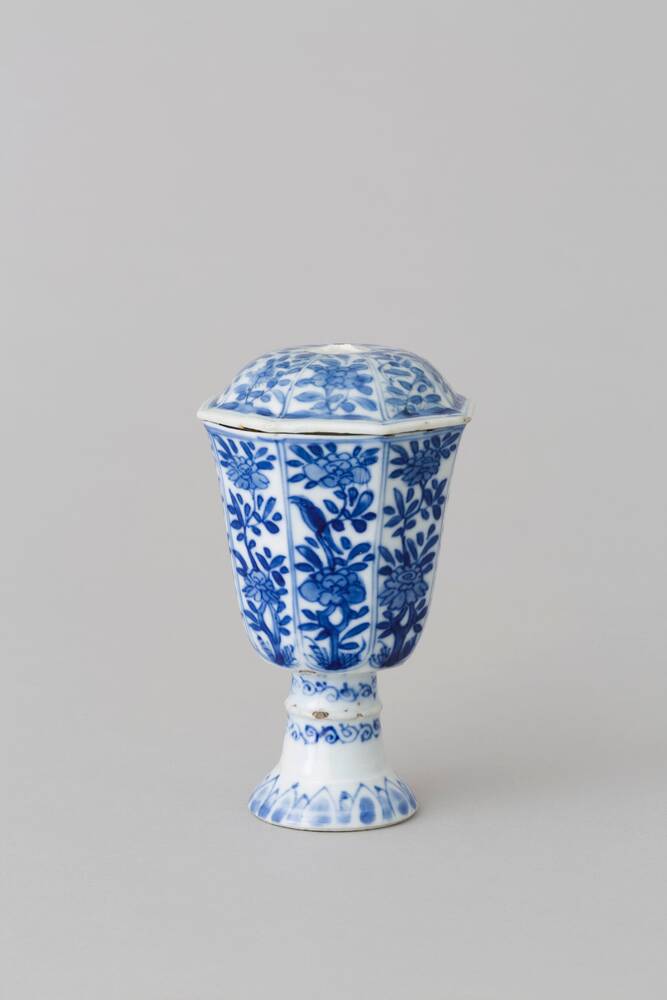
Museum Inventory NumberPO 2389 Palace Number N 45 [Zigzag line] Properties of the Palace Number painted Date Kangxi, c. 1700 Medium porcelain Dimensions h. with cover (without knob): 13,5 cm, h. without cover: 11,7 cm, diam. 7,7 cm, diam. foot: 4,9 cm Place of Production China, Jingdezhen
Museum Inventory Number
PO 2389
Palace Number
N 45 [Zigzag line]
Properties of the Palace Number
painted
Date
Kangxi, c. 1700
Medium
porcelain
Dimensions
h. with cover (without knob): 13,5 cm, h. without cover: 11,7 cm, diam. 7,7 cm, diam. foot: 4,9 cm
Place of Production
China, Jingdezhen


A Kangxi Blue and White Porcelain Goblet of European Form, Kangxi Period.

Robert McPherson Antiques Sold Archive 24299.
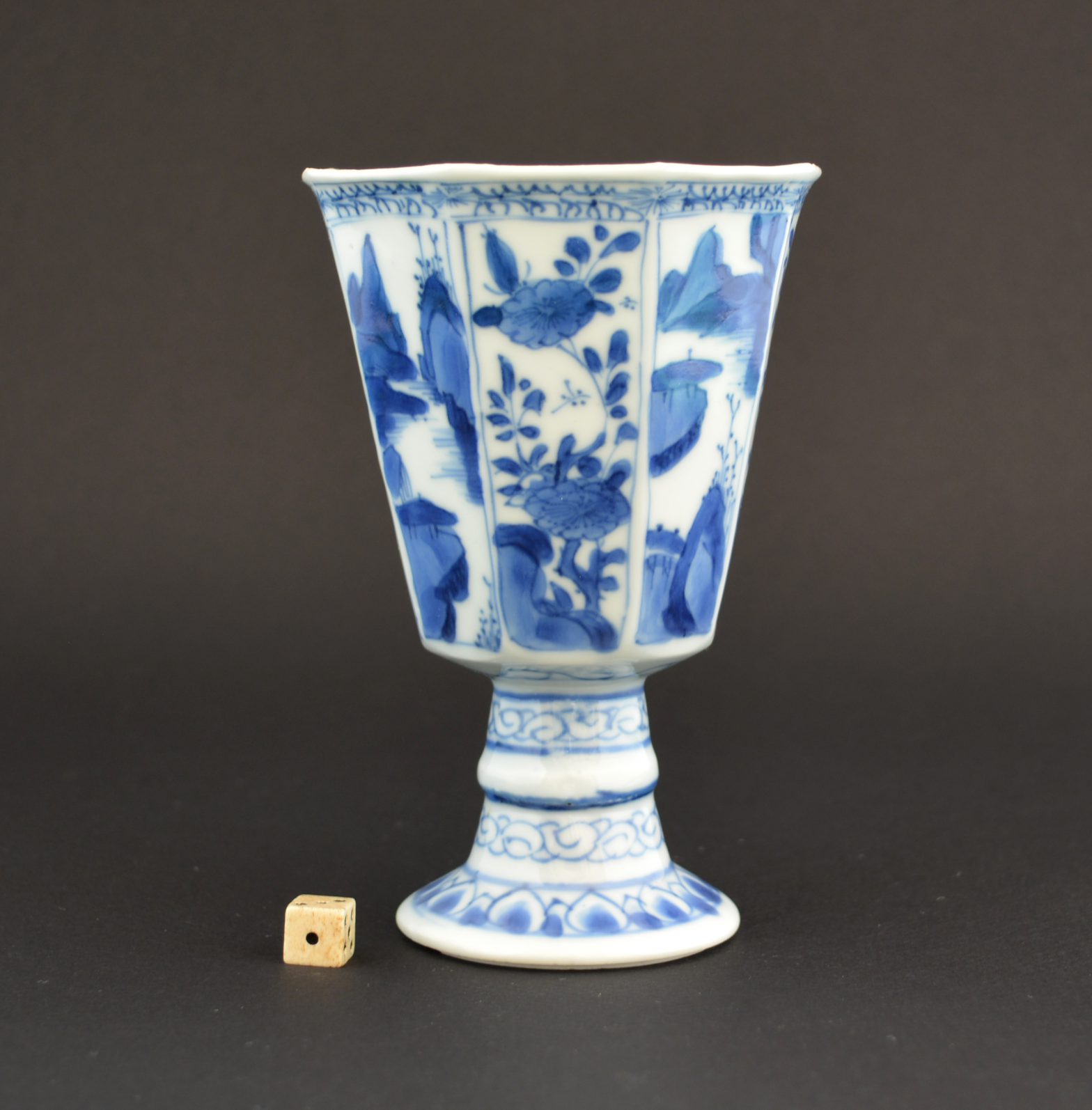
A Kangxi Porcelain Goblet of European Form, Kangxi Period c.1695-1715. This Octagonal Blue and White Porcelain Goblet is Based on a European Glass. The Decoration of the Thinly Potted Cup Consist of Alternating Landscapes with Flower Panels. The Knopped Stem is Supported by a Flaring Foot.SOLD Condition In excellent condition, a few minute glaze frits. Size Height : 12 cm (4 3/4 inches) Provenance The Gustav Leonhardt Collection from The Bartolotti House Amsterdam. Gustav Leonhardt (1928-2012) was born in `s-Graveland, North Holland and studied organ and harpsichord from 1947 to 1950 with Eduard Müller at the Schola Cantorum Basiliensis in Basel. In 1950, he made his debut as a harpsichordist in Vienna, where he studied musicology. He was professor of harpsichord at the Academy of Music from 1952 to 1955 and at the Amsterdam Conservatory from 1954. He was also a church organist. Leonhardt performed and conducted a variety of solo, chamber, orchestral, operatic, and choral music from the Renaissance, Baroque and Classical periods. The many composers whose music he recorded as a harpsichordist, organist, clavichordist, fortepianist, chamber musician or conductor. See Wikipedia for more details. Stock number 24299
A Kangxi Porcelain Goblet of European Form, Kangxi Period c.1695-1715. This Octagonal Blue and White Porcelain Goblet is Based on a European Glass. The Decoration of the Thinly Potted Cup Consist of Alternating Landscapes with Flower Panels. The Knopped Stem is Supported by a Flaring Foot.
SOLD
Condition
In excellent condition, a few minute glaze frits.
Size
Height : 12 cm (4 3/4 inches)
Provenance
The Gustav Leonhardt Collection from The Bartolotti House Amsterdam. Gustav Leonhardt (1928-2012) was born in `s-Graveland, North Holland and studied organ and harpsichord from 1947 to 1950 with Eduard Müller at the Schola Cantorum Basiliensis in Basel. In 1950, he made his debut as a harpsichordist in Vienna, where he studied musicology. He was professor of harpsichord at the Academy of Music from 1952 to 1955 and at the Amsterdam Conservatory from 1954. He was also a church organist. Leonhardt performed and conducted a variety of solo, chamber, orchestral, operatic, and choral music from the Renaissance, Baroque and Classical periods. The many composers whose music he recorded as a harpsichordist, organist, clavichordist, fortepianist, chamber musician or conductor. See Wikipedia for more details.
Stock number
24299


An Unusual Kangxi Blue and White Porcelain Tazza from the Vung Tau Cargo Shipwreck c.1690.

Robert McPherson Antiques Sold Archive Number 22363.
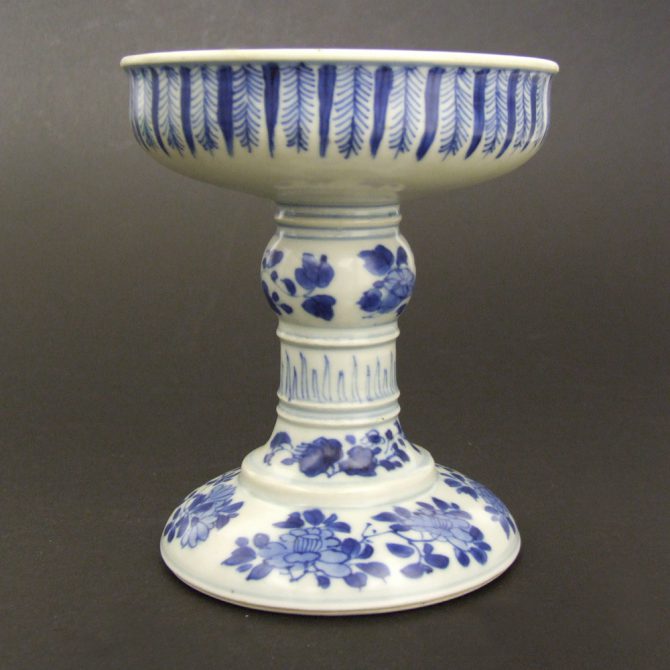
An Unusual Kangxi Blue and White Porcelain Tazza from the Vung Tau Cargo Shipwreck c.1690-1700.SOLD Condition N/A Size Height : 13.6 cm (5 1/2 inches) Provenance Christie`s Amsterdam, The Vung Tau Cargo, Chinese Export Porcelain, April 1992. Label to base lot 18. A Private English Collection of Chinese Blue and White Porcelain. Stock number 22363 References For a very similar Kangxi Porcelain tazza see : Porcelain From The Vung Tau Wreck - The Hallstrom Excavation (By Christian J.A. Jorg and Michael Fletcher.Sun Tree Publishing Ltd, U.K. ISBN 981-04-5208-X.) page 71 figure 62. See `Sold Items` stock 21493, 21490, 21492 for other Vung Tau Cargo Tazza`s.
An Unusual Kangxi Blue and White Porcelain Tazza from the Vung Tau Cargo Shipwreck c.1690-1700.
SOLD
Condition
N/A
Size
Height : 13.6 cm (5 1/2 inches)
Provenance
Christie`s Amsterdam, The Vung Tau Cargo, Chinese Export Porcelain, April 1992. Label to base lot 18. A Private English Collection of Chinese Blue and White Porcelain.
Stock number
22363
References
For a very similar Kangxi Porcelain tazza see : Porcelain From The Vung Tau Wreck - The Hallstrom Excavation (By Christian J.A. Jorg and Michael Fletcher.Sun Tree Publishing Ltd, U.K. ISBN 981-04-5208-X.) page 71 figure 62. See `Sold Items` stock 21493, 21490, 21492 for other Vung Tau Cargo Tazza`s.