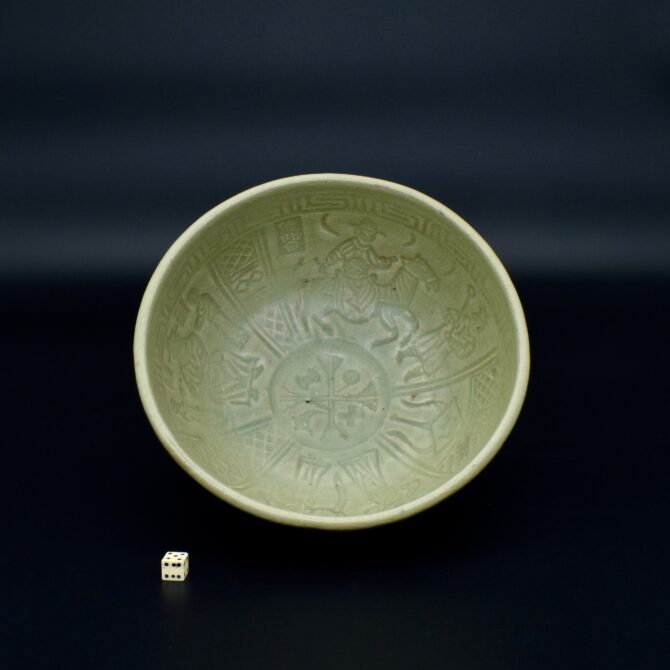
A Ming Longquan Celadon Ware Bowl with Inscriptions, 14th or 15th Century.
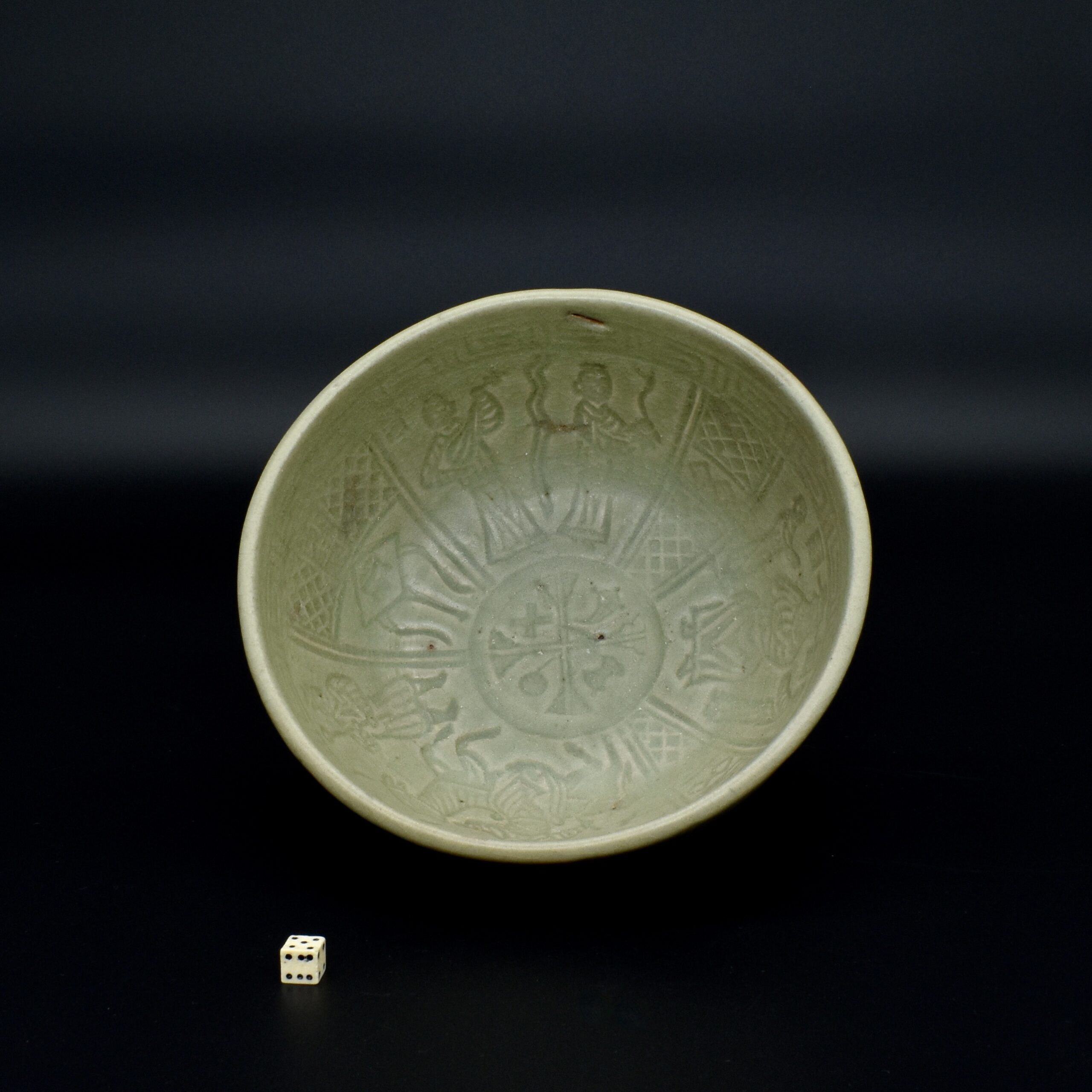
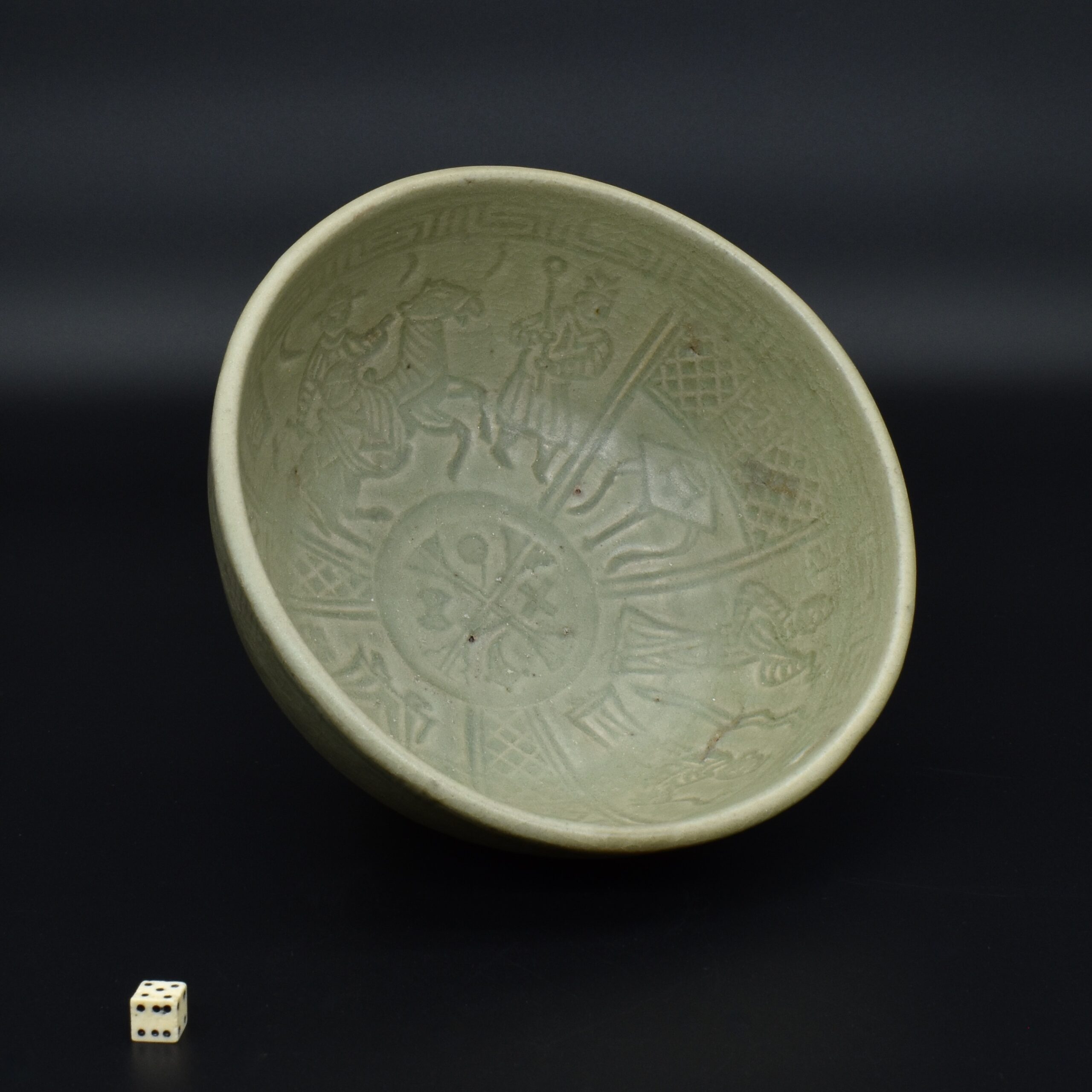
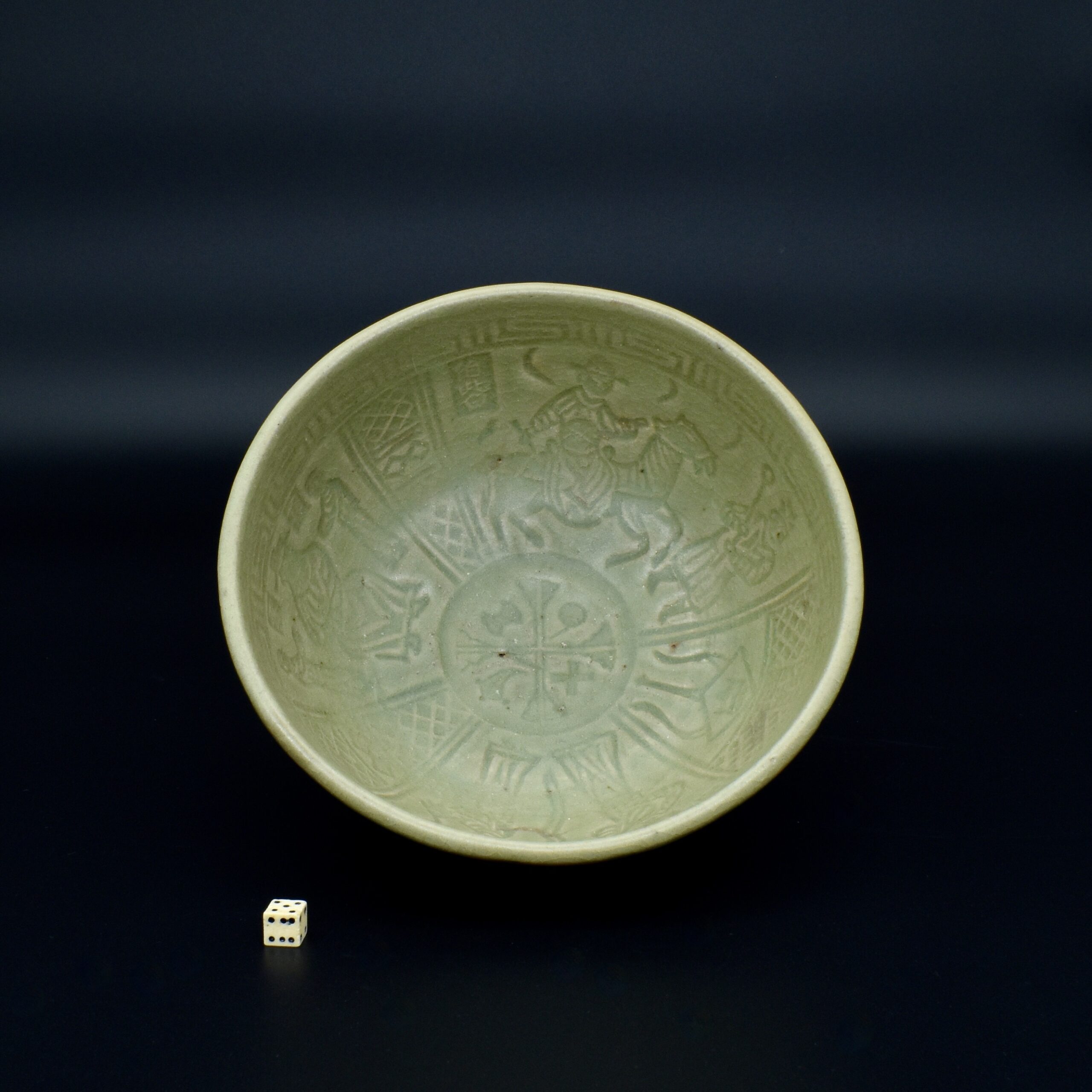
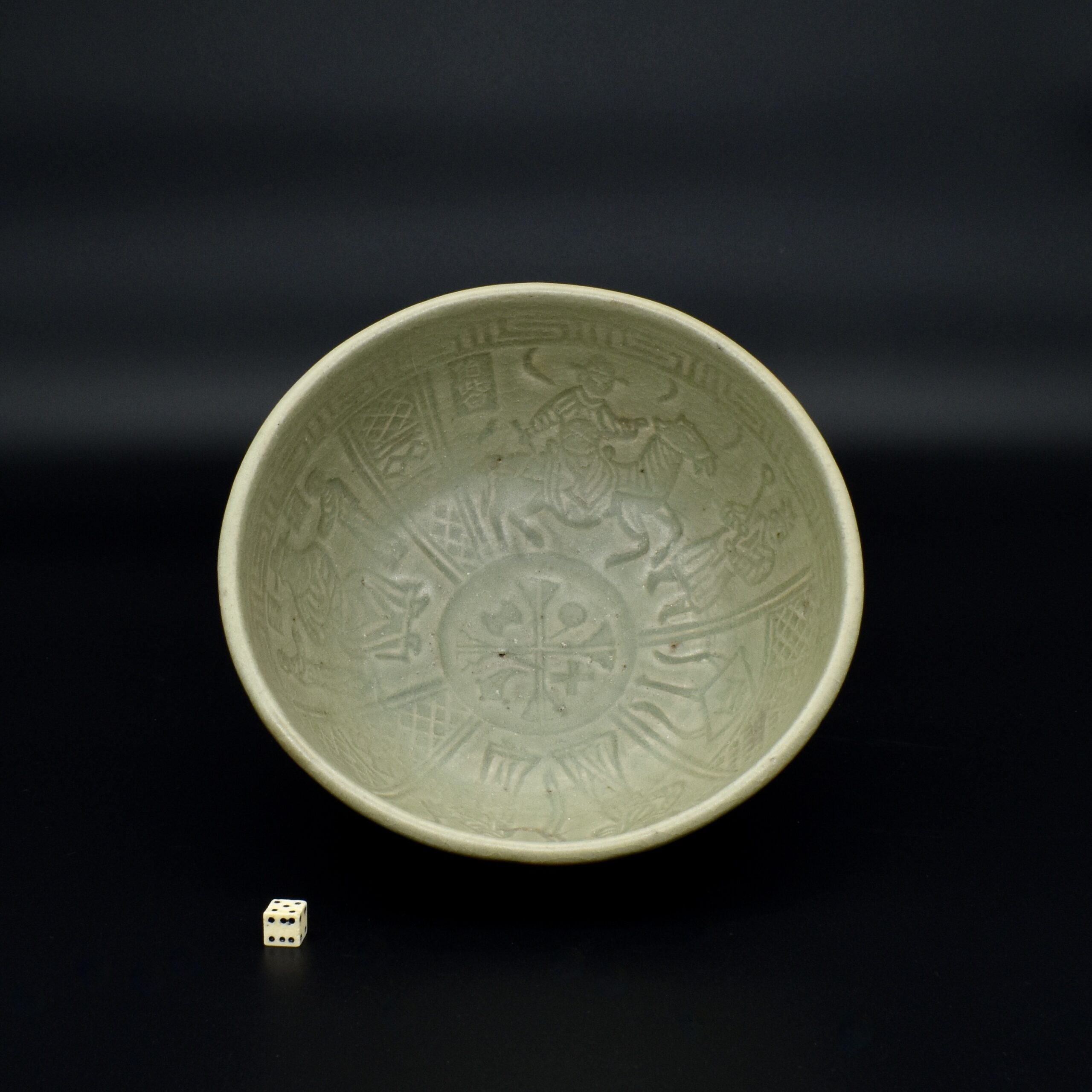
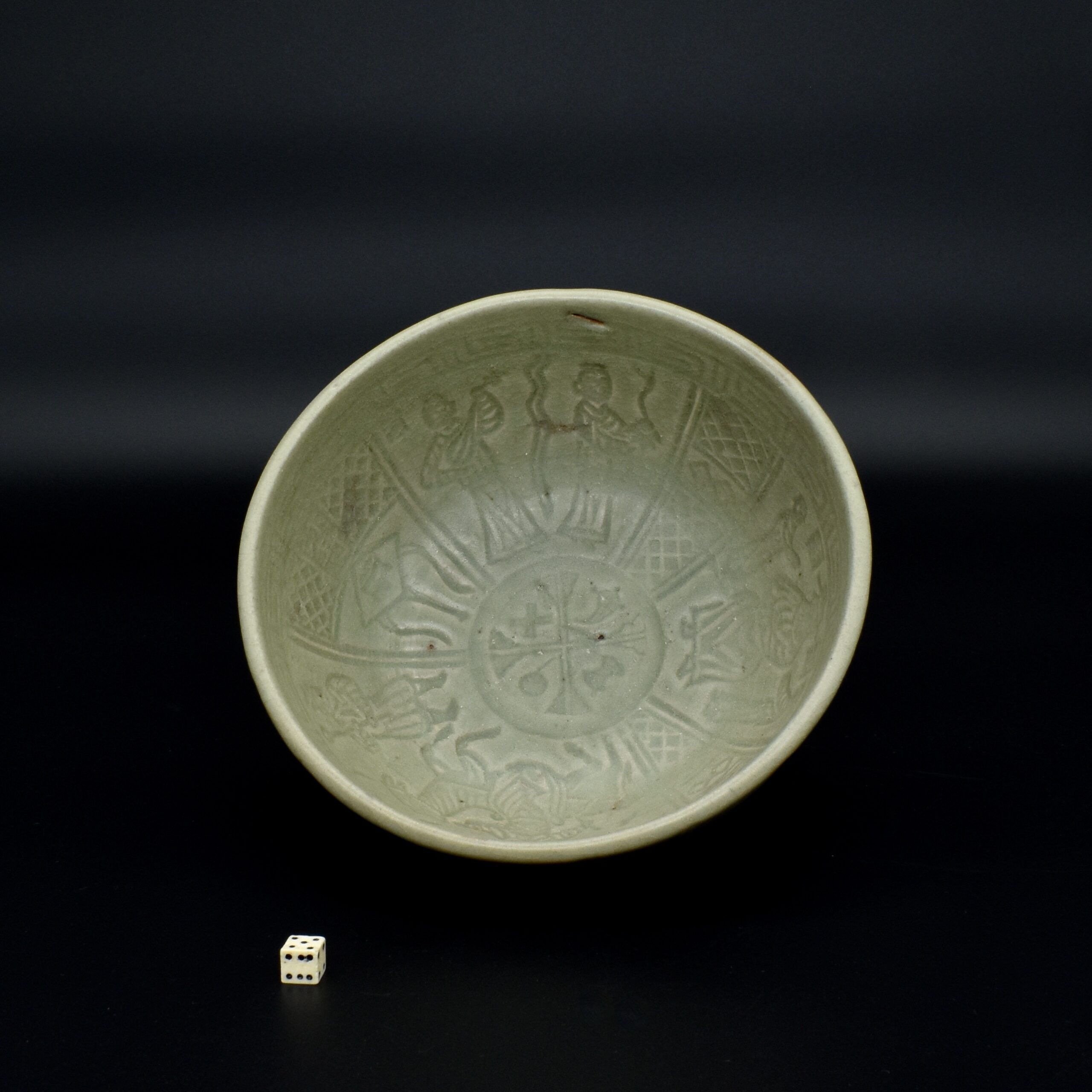
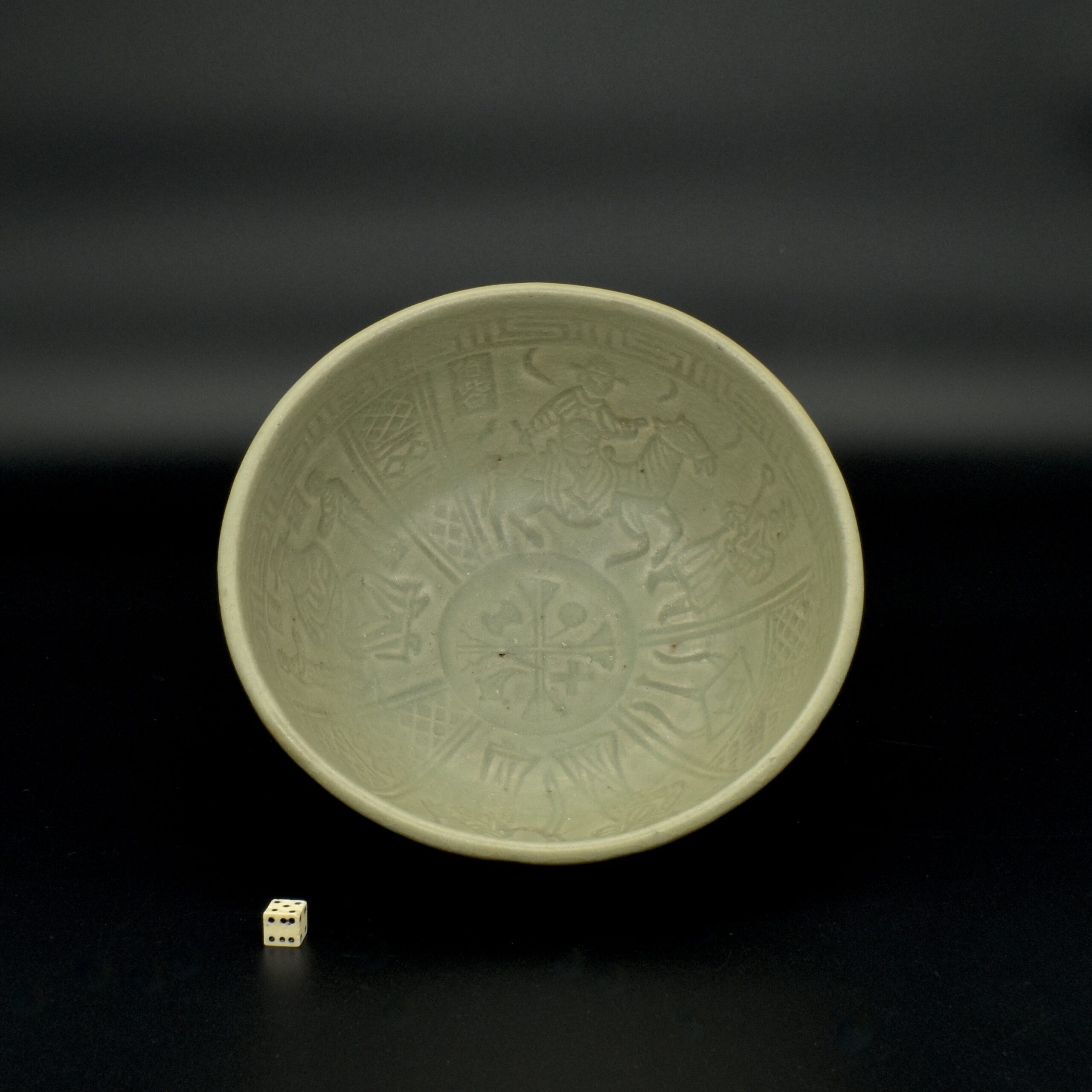
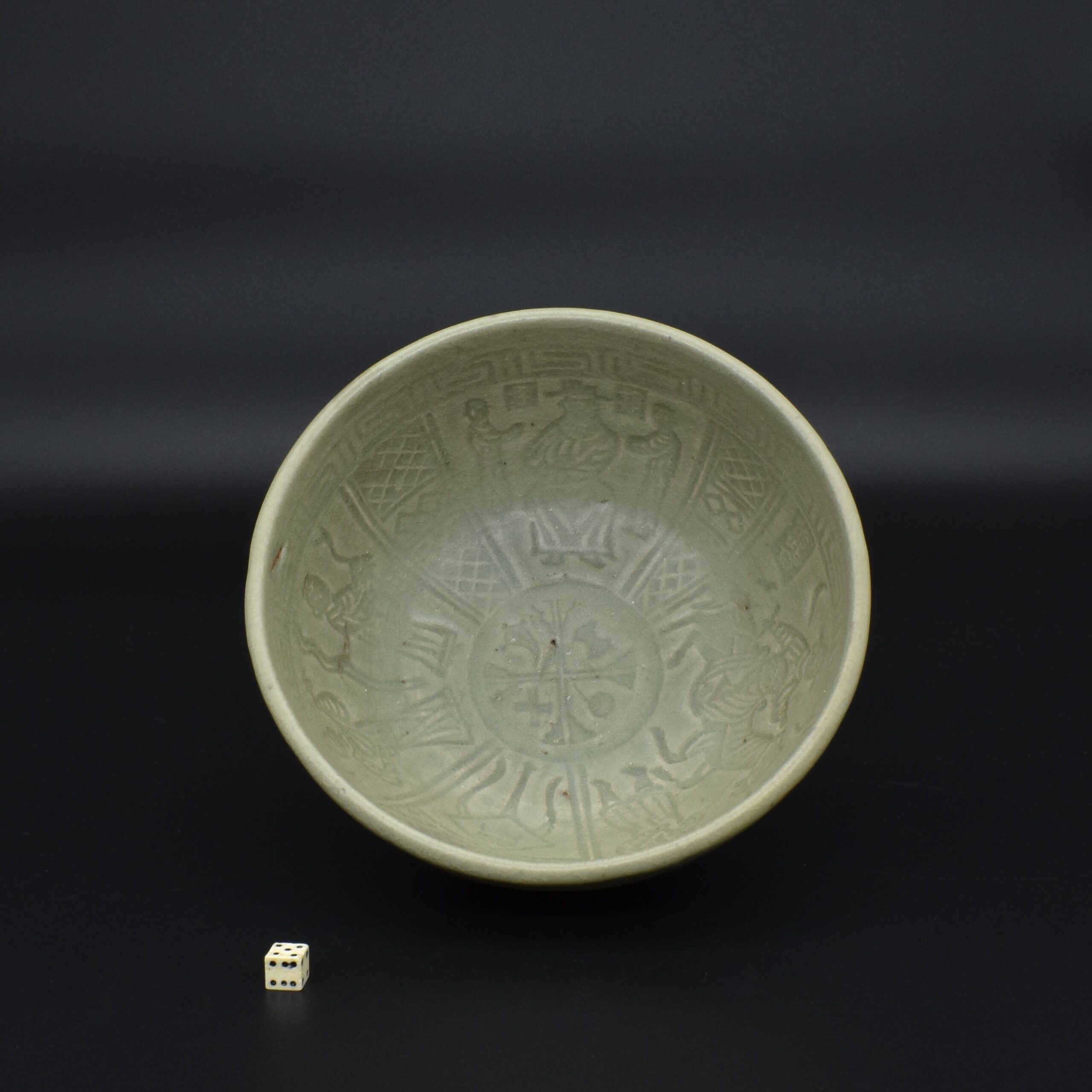
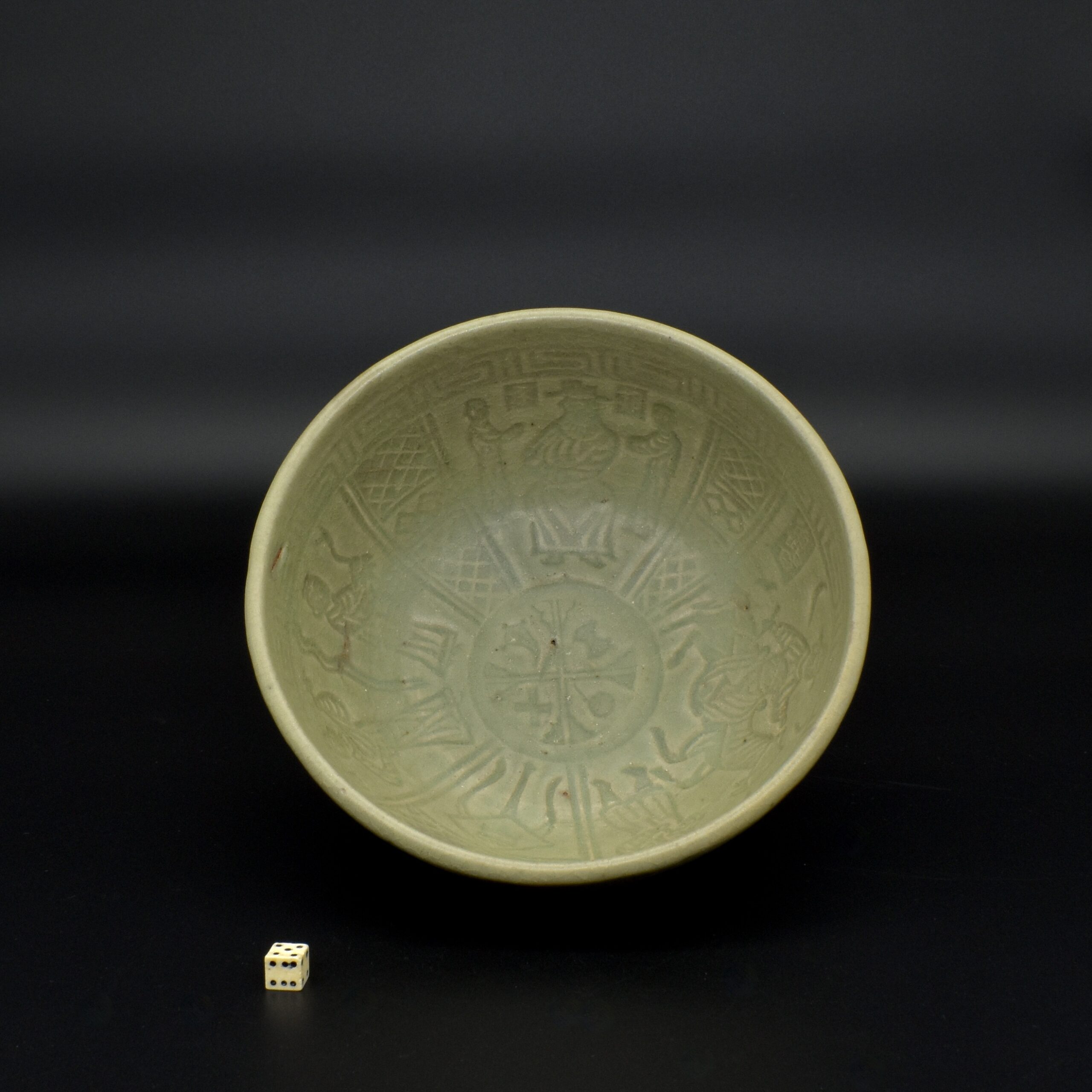
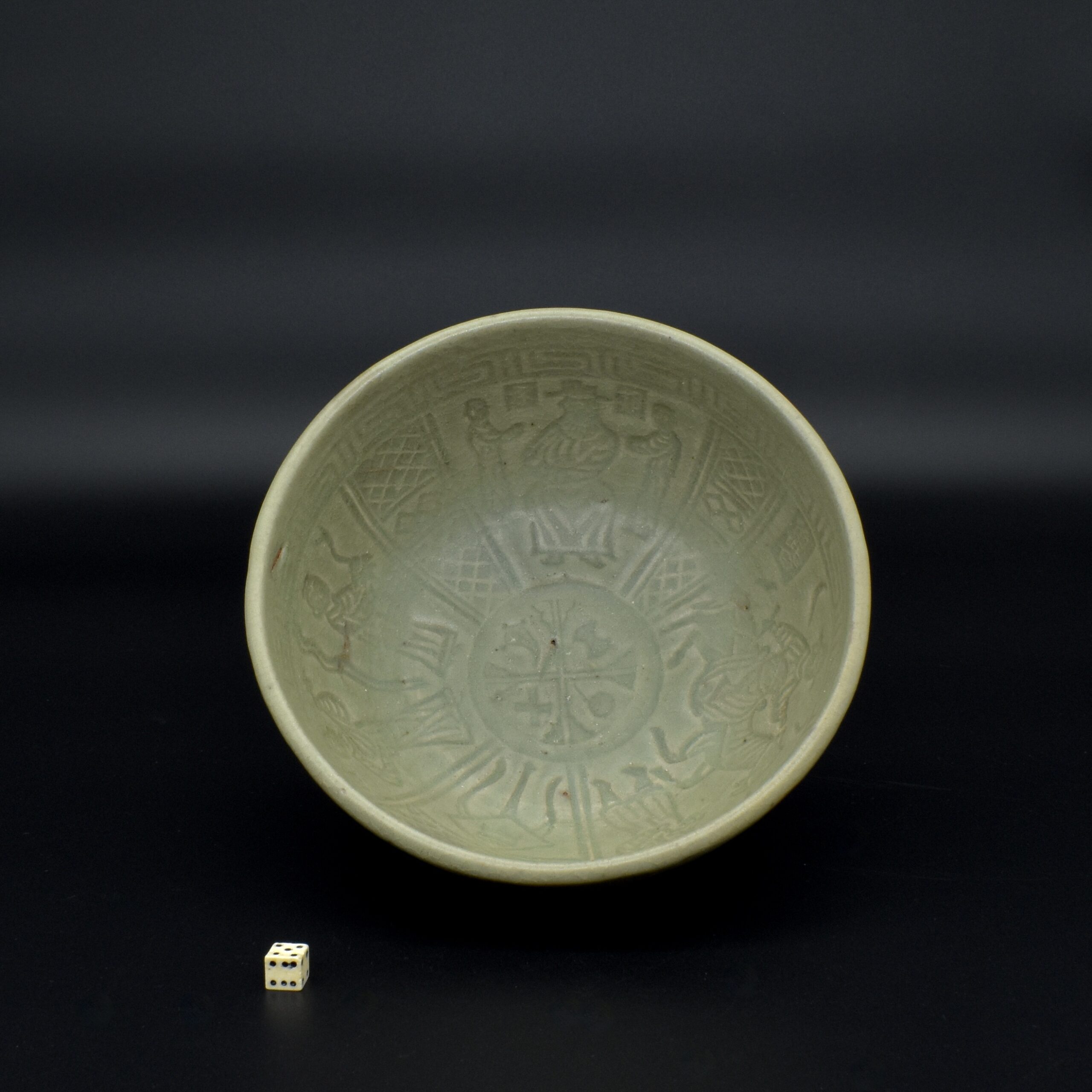
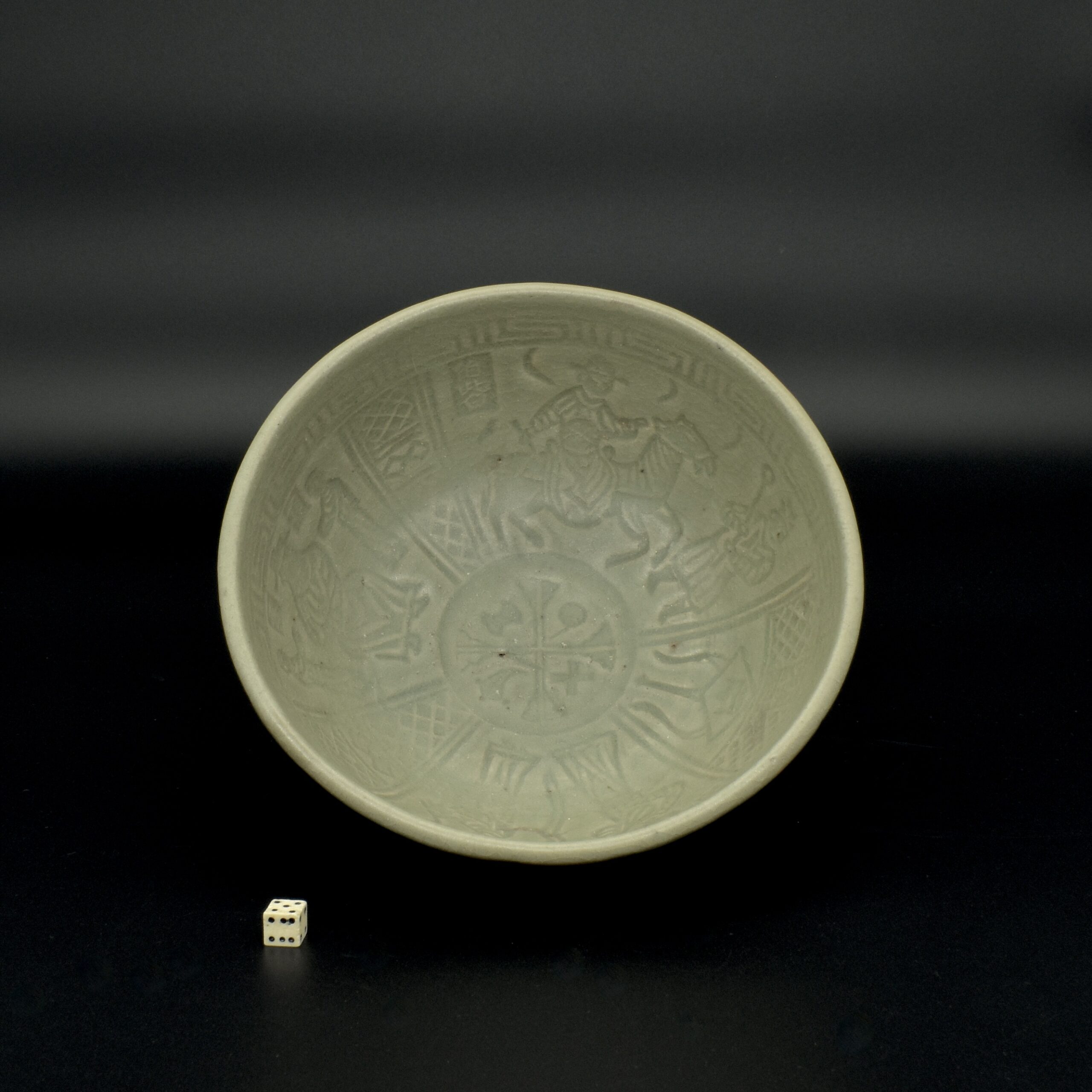
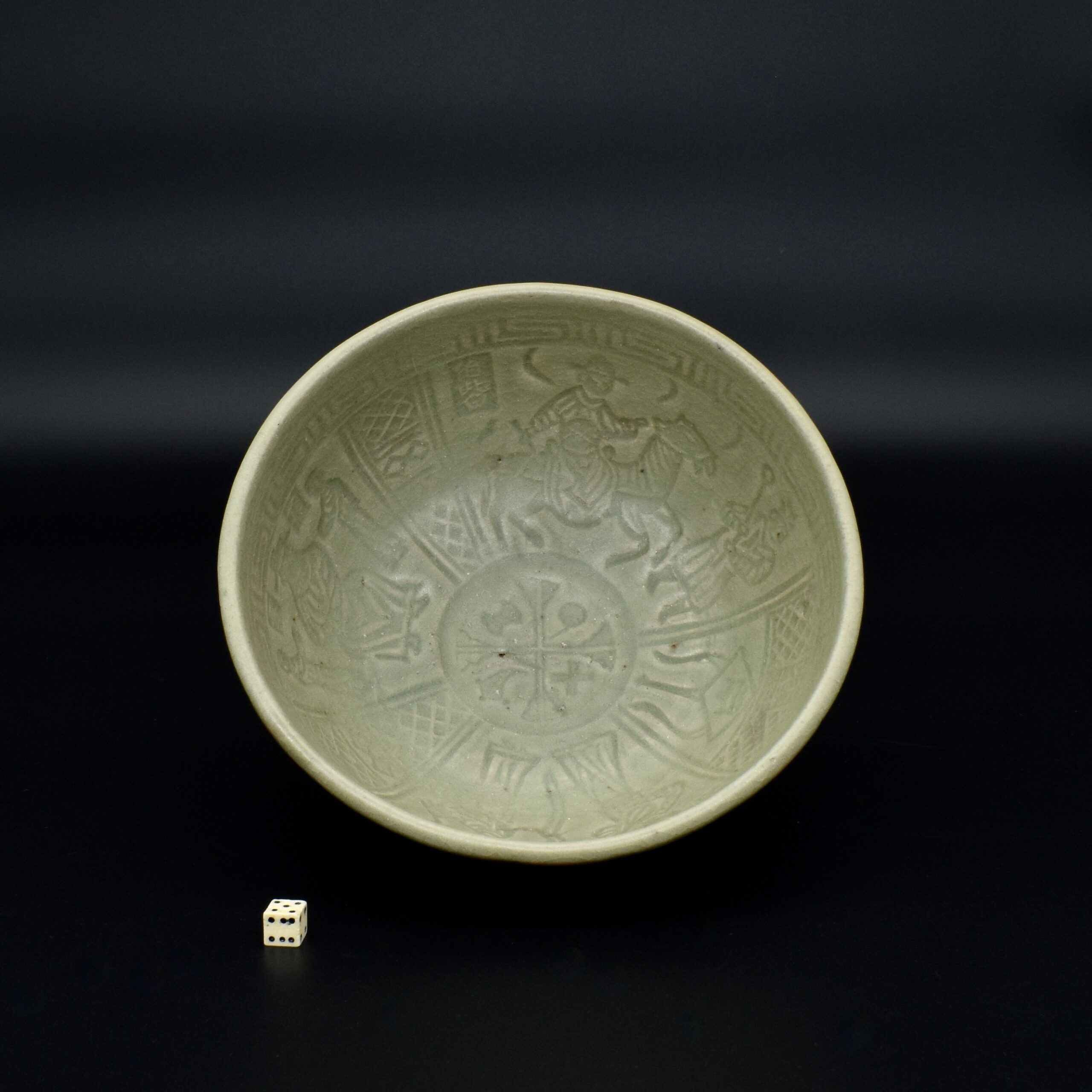
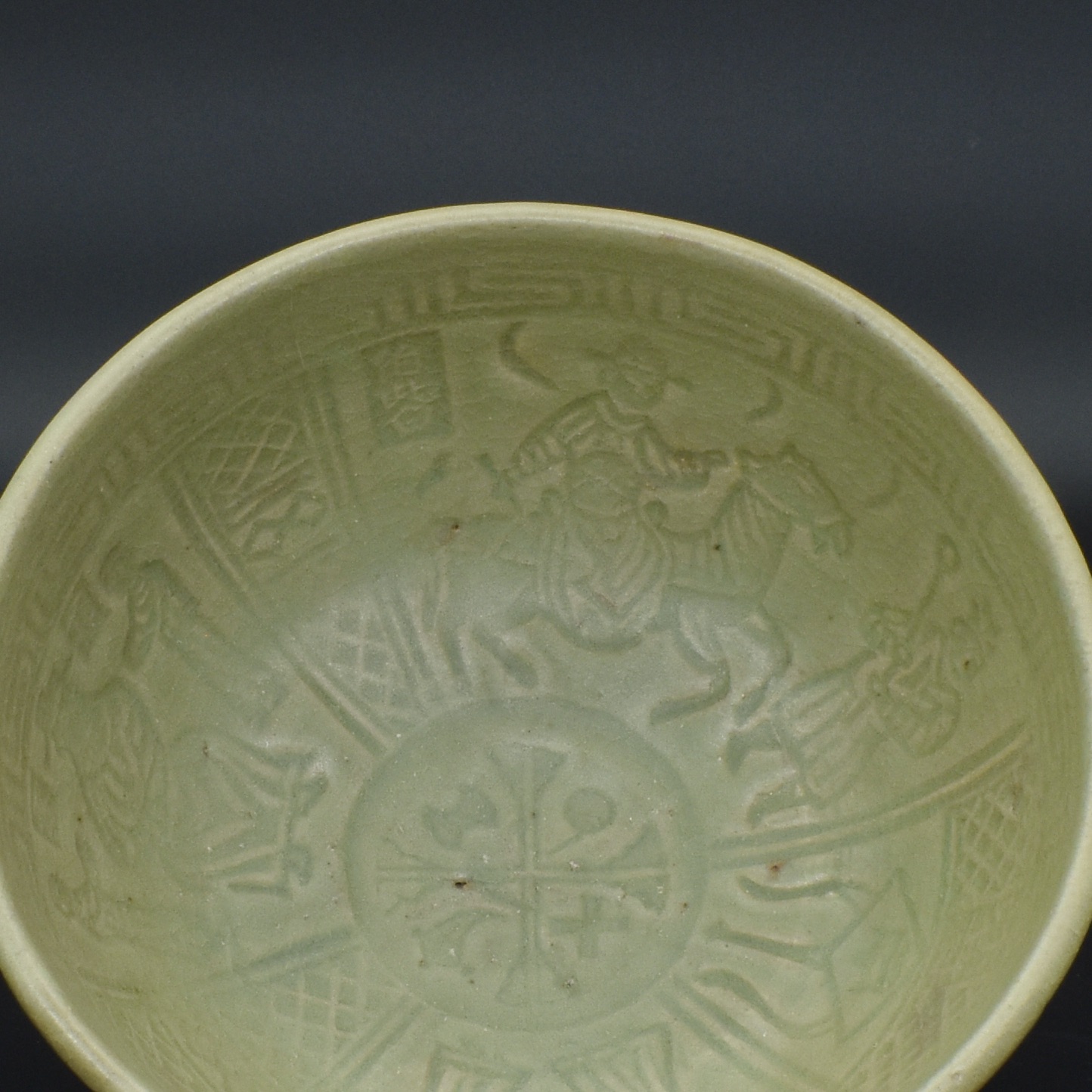
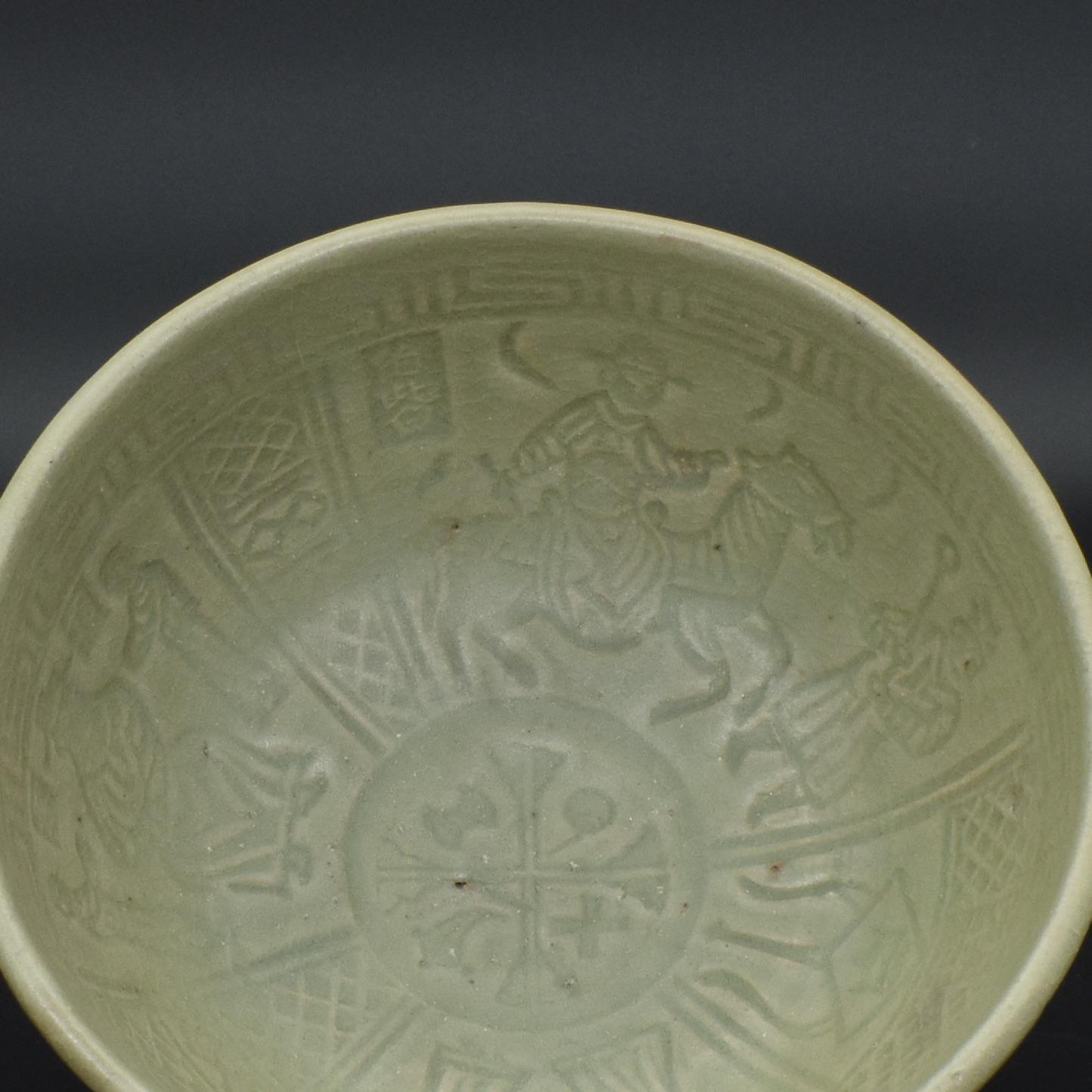
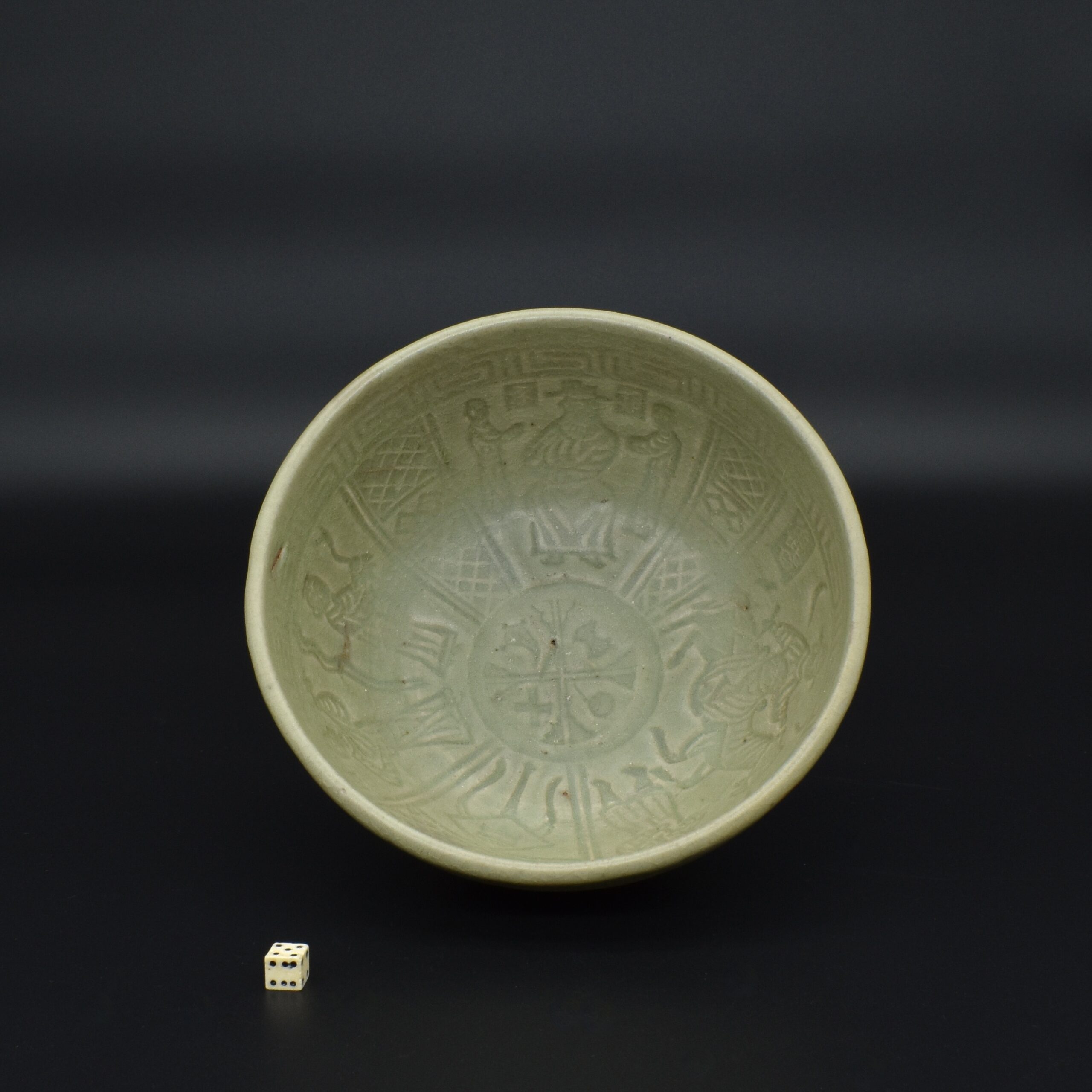
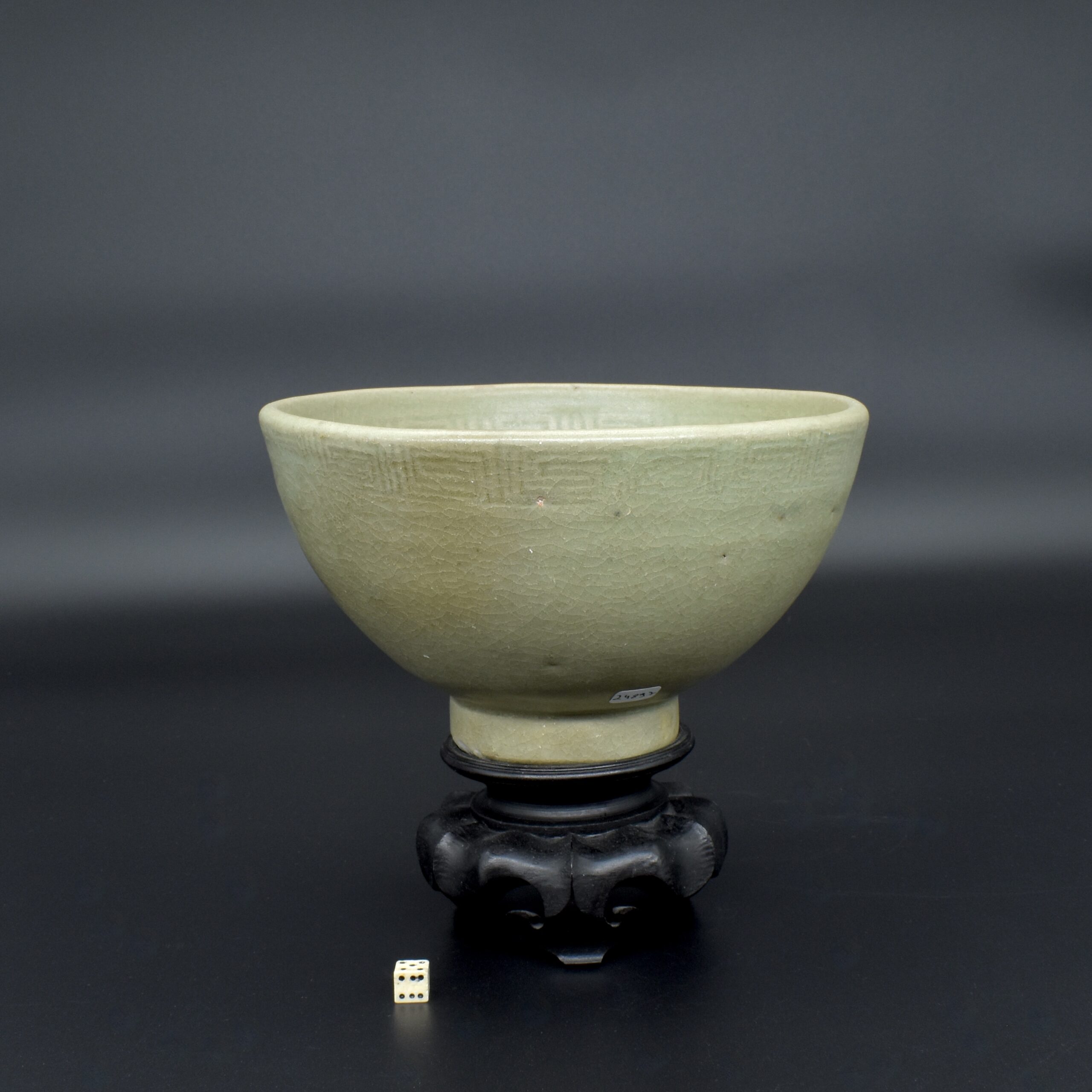
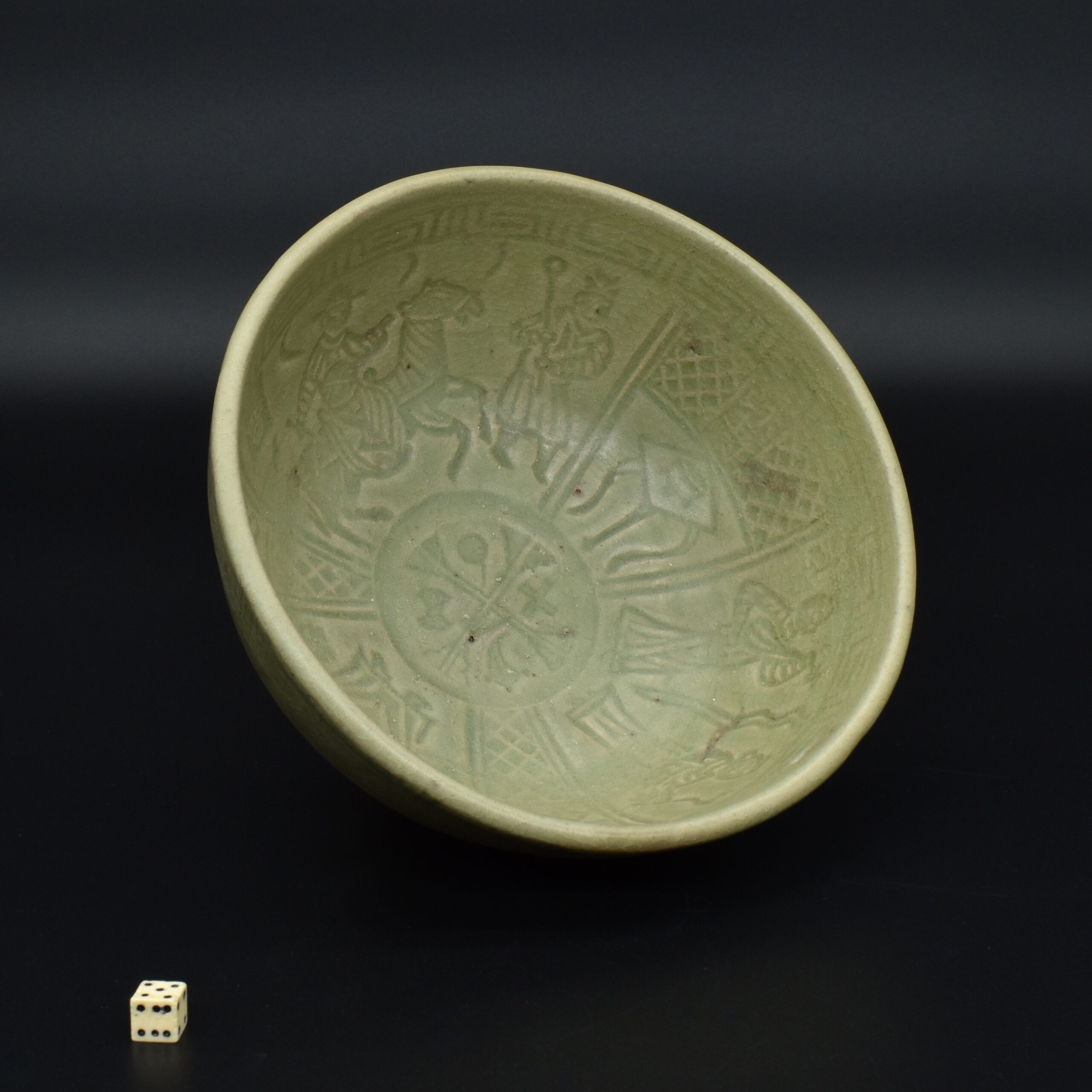
An Early Ming Celadon Bowl, Longquan Kilns, Late 14th or Early 15th Century from the Collection of Nicholas Thompson (See Provenance). The interior of this Ningyo ude celadon bowl is moulded with figures with explanatory inscriptions and a ‘Greek-Key’ type border above, the well is impressed with auspicious emblems within a cross. The border design is repeated on the exterior. The bowl is covered in a very thick rich green glaze and the detail is clear. There is a man on horseback, probably a general accompanied with an inscription in a tablet and his attendant in front. The next panel (on the right) shows an inscribed screen with a tripod table, the object on the table is perhaps an incense burner. The next panel has a musician playing a Chinese lute called a Pipa (琵琶) and a dancer, the next panel is a panel, rather like a room divide leading onto the next panel of a general or possibly other important person, flanked by two diminutive attendants with inscribed tablets above their outstretched arms. A similar Ming celadon bowl was discovered in the ruins of Saya Castle, Komatsu-Shi, Ishikawa prefecture, Japan, built in the sixteenth century, and now in the Tokyo National Museum. Such bowls are called Ningyo ude bowls in Japan because of their figural decoration. See below for more information about this group of early Ming celadon bowls and examples of kiln wasters and for an example we sold previously.
Ming Celadon Bowls with a Narrative Story :
There was a distinct group of Ming celadon bowls produced at the Longquan kilns that are thickly potted and show figures with explanatory inscriptions. Several different designs were produced in varying qualities, the size and layout are similar, maybe four or five designs were produced. They are characterised by their thickly potted rounded form and moulded designs of figures with explanatory inscriptions to the interior, they usually have a single character in the well and the border is of a key-fret band, so-called Greek-Key. A Ming bowl of this type is illustrated in : Yuegutang, A Collection of Chinese Ceramics in Berlin (Regina Krahl, G+H Verlag, Berlin, 2000) pages 280 and 280. Regina Krahl dates this bowl to the early Ming dynasty, 14th or 15th century. She states that a similar bowl was excavated from a tomb at Sunqiao, Jingshan county, Hubei province, dated to the 15th year of the Hongzhi period (1502). Regina’s description of the Ming bowl she is describing is worth quoting in full “The rounded bowl has a straight, heavy foot. The inside is decorated with moulded figure scenes and explanatory cartouches, showing a military and a civil official playing a board game under a star constellation, and the inscription zhenzi po qizhan (`the gods fighting over a chess game`) ; a scholar seated at a desk with a book and an inkstone, and the inscription Li Bo guan…juan (`Li Bo gazing at … book`) ; a man with an official’s cap standing beside a board depicting a reclining qilin (a mythical animal), and inscribed jin yu (gold and jade) ; a lady seated at a table working on a piece of cloth, and with the inscription Zhoa Jun yi yi ca (`Lady Zhoa improves her talents`) : and a man playing a qin zither and the inscription Kongzi yi Yan Hui (`Confucius remembers Yan Hui`). The center is impressed with the character gao (noble… the character on the present example is different), the outside is incised with a flower scroll and the rim with a key-fret border both inside and out. The piece is covered with an olive-green glaze except for a ring on the base which has fired brick-red.
See Below For More Photographs and Information.
- Condition
- In very good condition, two chips to the exterior of the foot. Minor staining from a firing fault in the panel with a pipa player and dancer, above this is a firing fault which was perhaps caused by a piece of organic matter (wood) that burnt off in the kiln.
- Size
- Diameter : 17 cm (7 inches). Height : 10 cm (3.9 inches).
- Provenance
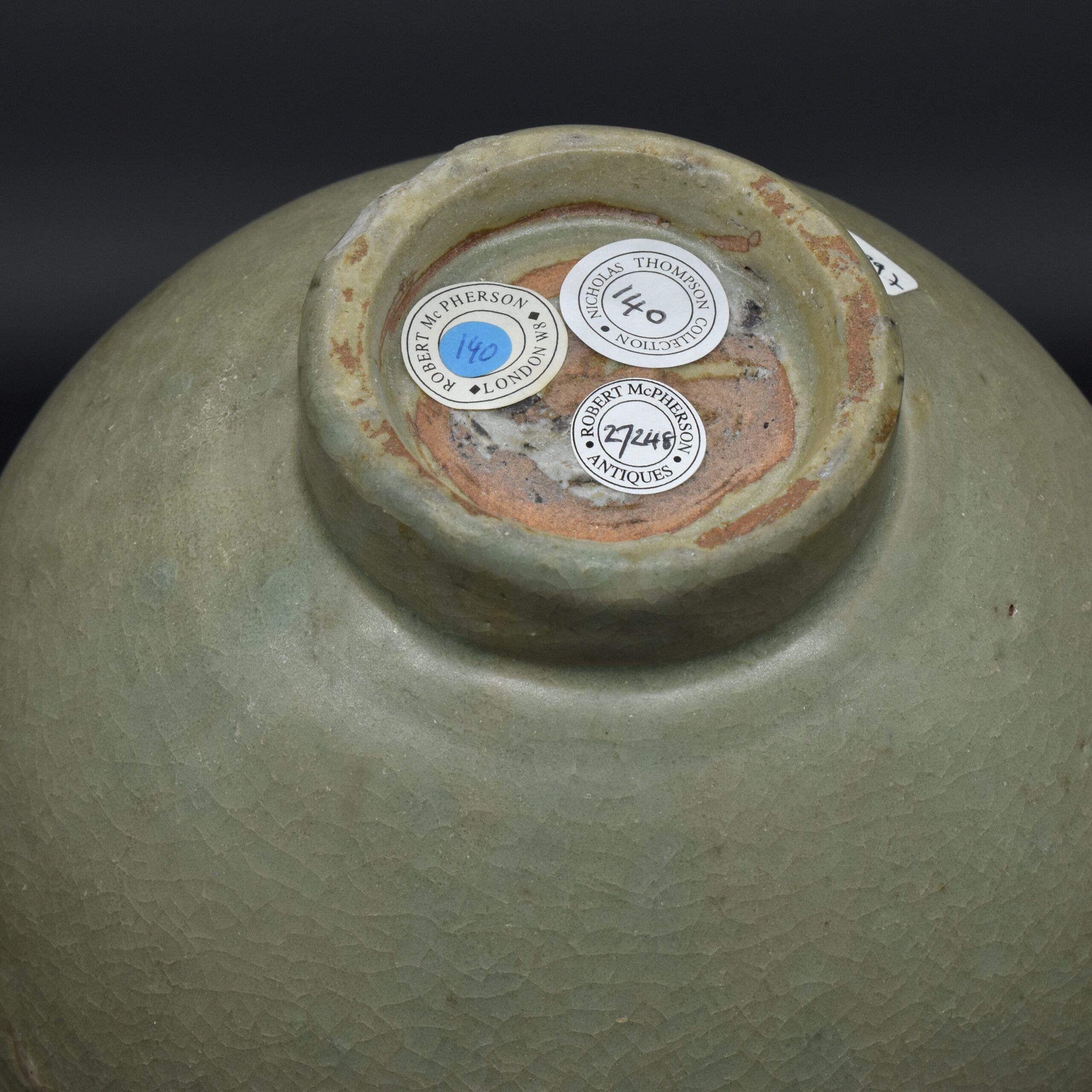
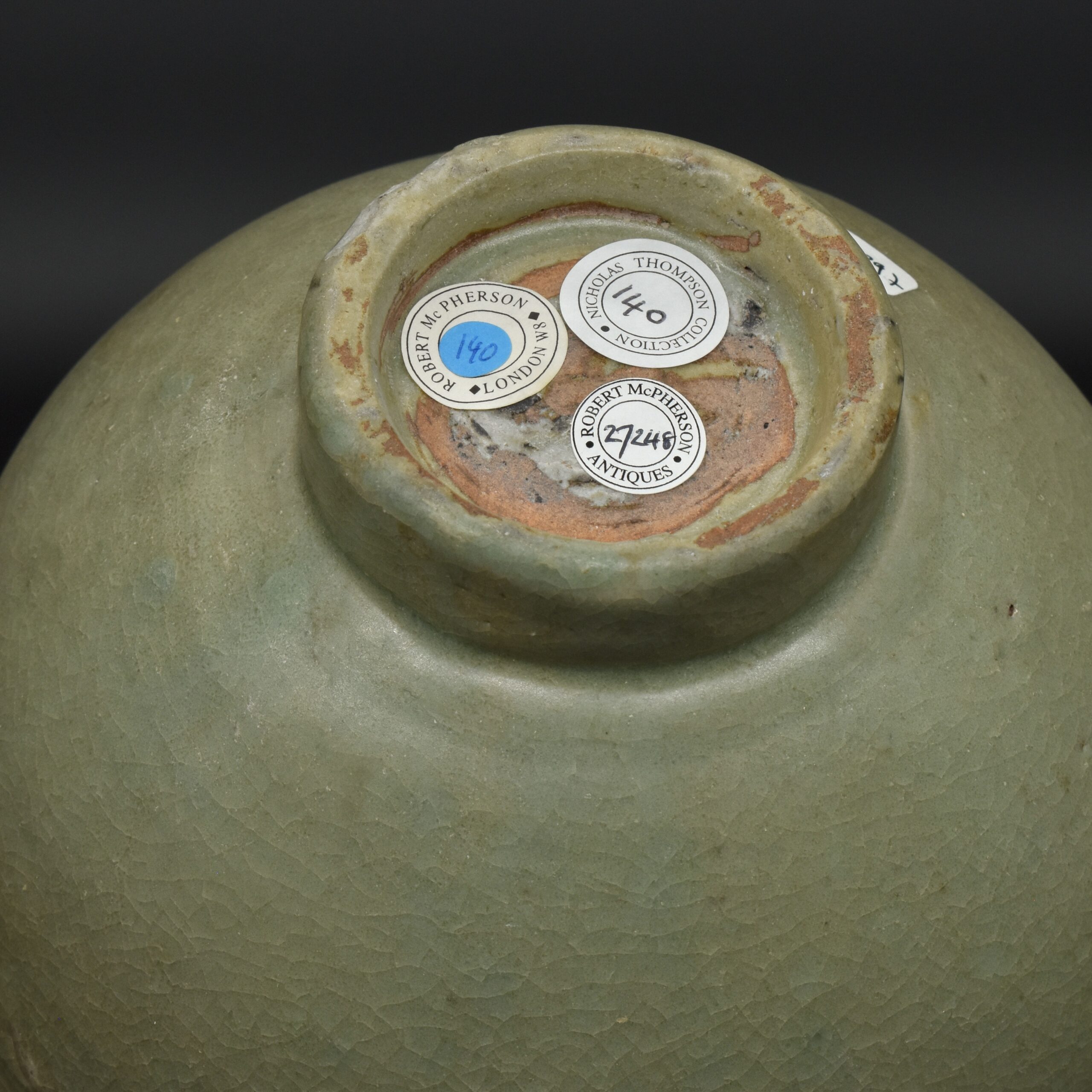
- Robert McPherson Antiques. Nicholas de la Mare Thompson (1928-2010) label to base, item 140, see 'Information' below.
- Stock number
- 27248
- References
- Several examples of this type are known. A bowl which of a good rich colour and of a different design is illustrated in : Yuegutang, A Collection of Chinese Ceramics in Berlin (Regina Krahl, G+H Verlag, Berlin, 2000) pages 280 and 280. A similar but Ming celadon bowl of this type is in the British Museum see : Ming Ceramics in the British Museum (Jessica Harrison-Hall, British Museum Press, 2001) page 482, Item 16:52. A further example of this type of Ming celadon bowl was discovered in the ruins of Saya Castle, Komatsu-Shi, Ishikawa prefecture, Japan, built in the sixteenth century, and now in the Tokyo National Museum. Such bowls are called Ningyo ude bowls in Japan because of their figural decoration". For another example of this type of Ming Celadon Bowl see : Chinese Ceramics, Bronzes and Jades in the Collection of Sir Allan and Lady Barlow (Michael Sullivan, Faber and Faber Ltd, 1963) page 99, illustration 95c ; `Chekiang Celadon, XIV-XV Century`. Also see : Chinese Ceramics, The New Standard Guide (Hi Li,Thames and Hudson,1996) pages 246 and 262, item 510, "The decoration of this bowl, combining calligraphy with human figures, reflects a new trend in Longquan (celadon) products during the Ming dynasty. In addition to the auspicious phrases and names of potters that had increasingly appeared on Longquan wares since the Yuan, historical figures provided another rich resource for decorative motifs at Daotai and Daqi (kilns at Zheijiang).
- £ GBP
- € EUR
- $ USD
Photos
Information
Nicholas de la Mare Thompson (1928-2010).
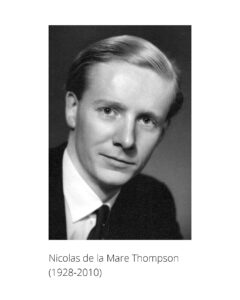
Nicholas de la Mare Thompson, the grandson of the author Walter de la Mare spent his career in publishing. He started at Nesbit where he was editor of the Janet and John series of children’s books but not all of his career was so safe. He wrestled with W.H. Smith over the content of Madonna’s raunchy Sex book on behalf of Paul Hamlyn’s Octopus Group and defeated Margaret Thatcher over Spycatcher. He could not bare dogma or hypocrisy.
It was hardly surprising that as a committee member of the O.C.S. he had his own ideas. He read and could recite great swaths of the articles of the Society, he used this not to attack but to stimulate debate. He approached the Society in the same way as he approached his understanding of Chinese ceramics, by stripping it down and starting again using clear empirical thinking. He was very concerned the Society was open to all and was run for the benefit of all members.

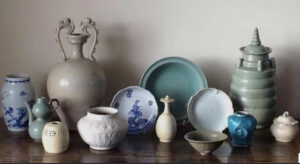
Nicholas came from a family of collectors, his love of oriental ceramics was broad but his focus was on early monochromes, especially those from the Song dynasty. He bought what he loved, what he thought had merit, not what was said to be good, and certainly not anything because it was fashionable. He didn’t have a stamp collectors’ approach, filling in the gaps of pre-existing ordered collection, rather he would react to an object, feeling it was right for his collection. Sometimes he wasn’t sure if it was right for his collection or not. He would then “borrow” pieces and live with them, other times he would ask his wife Caroline, who’s eye he trusted, if he should keep the piece or not. He was amused because I was often able to know if he would keep a piece before he did. We discussed “pots” endlessly, he loved to talk about ceramics with a wide variety of people and enjoyed the company of others on O.C.S. trips as well as in discussion groups or anywhere else. Later on he combined his love of Chinese ceramics with his love of books by extending his library to include rare early books, he used these to trace the development of collecting and scholarship in the 19th and early 20th century. He was fascinated by earlier scholarship, what was not understood but also what they understood, and we have lost. He was always reading and wanted to know more right up to the end, he didn’t see impending death as a barrier to knowledge or indeed collecting. The week before he died he questioned, if only for a second, whether it was too late to buy another pot for the collection. He concluded it was not, he was a true collector.
Nicolas died on the 25th of April 2010 at the age of 82 after living with cancer for two years. He leaves behind his energetically supportive wife Caroline and his three children. He was a kind, gentle and incredibly civilised man with a very sharp mind and dry sense of humour, he was passionate about the Society, its aims and its members. He was an incredibly supportive and thoughtful friend and will be missed very much.
Ming Celadon Bowls with a Narrative Story :
There was a distinct group of Ming celadon bowls produced at the Longquan kilns that are thickly potted and show figures with explanatory inscriptions. Several different designs were produced in varying qualities, the size and layout are similar, maybe four or five designs were produced. They are characterised by their thickly potted rounded form and moulded designs of figures with explanatory inscriptions to the interior, they usually have a single character in the well and the border is of a key-fret band, so-called Greek-Key. A Ming bowl of this type is illustrated in : Yuegutang, A Collection of Chinese Ceramics in Berlin (Regina Krahl, G+H Verlag, Berlin, 2000) pages 280 and 280. Regina Krahl dates this bowl to the early Ming dynasty, 14th or 15th century. She states a similar bowl was excavated from a tomb at Sunqiao, Jingshan county, Hubei province, dated to the 15th year of the Hongzhi period (1502). Regina`s description of this Ming bowl is worth quoting in full "The rounded bowl has a straight, heavy foot. The inside is decorated with moulded figure scenes and explanatory cartouches, showing a military and a civil official playing a board game under a star constellation, and the inscription zhenzi po qizhan (`the gods fighting over a chess game`) ; a scholar seated at a desk with a book and an inkstone, and the inscription Li Bo guan...juan (`Li Bo gazing at ... book`) ; a man with an official`s cap standing beside a board depicting a reclining qilin (a mythical animal), and inscribed jin yu (gold and jade) ; a lady seated at a table working on a piece of cloth, and with the inscription Zhoa Jun yi yi ca (`Lady Zhoa improves her talents`) : and a man playing a qin zither and the inscription Kongzi yi Yan Hui (`Confucius remembers Yan Hui`). The center is impressed with the character gao (noble... the character on the present example is different), the outside is incised with a flower scroll and the rim with a key-fret border both inside and out. The piece is covered with an olive-green glaze except for a ring on the base which has fired brick-red.
Zhenzi refers to the star gods of the Northern and Southern poles, who are determining men`s fate through their chess play. Jin yu is a general reference to riches. Zhao Jun is another name for Lady Wang Jiang, a legendary beauty at the Han court, who was married off to a `barbarian` chieftain. Yan Hui, who died young, was regarded as Confucius` most gifted disciple".
Another bowl from this group, albeit a poor quality one is in the British Museum, see : Ming Ceramics in the British Museum (Jessica Harrison-Hall, British Museum Press, 2001) page 482, Item 16:52. The Design has, like the previously mentioned example, six figures with narrative inscriptions. The bowl tells the story of Su Qin (died 317 B.C.). Jessica Harrison-Hall States in her Ming Catalogue "A bowl of this type was unearthed in 1982 in the tomb of scholar Wang Zhen (1424-1495) and his wife Mne Liu (1425-1503) in Huai`ian, Jiangxi province"........
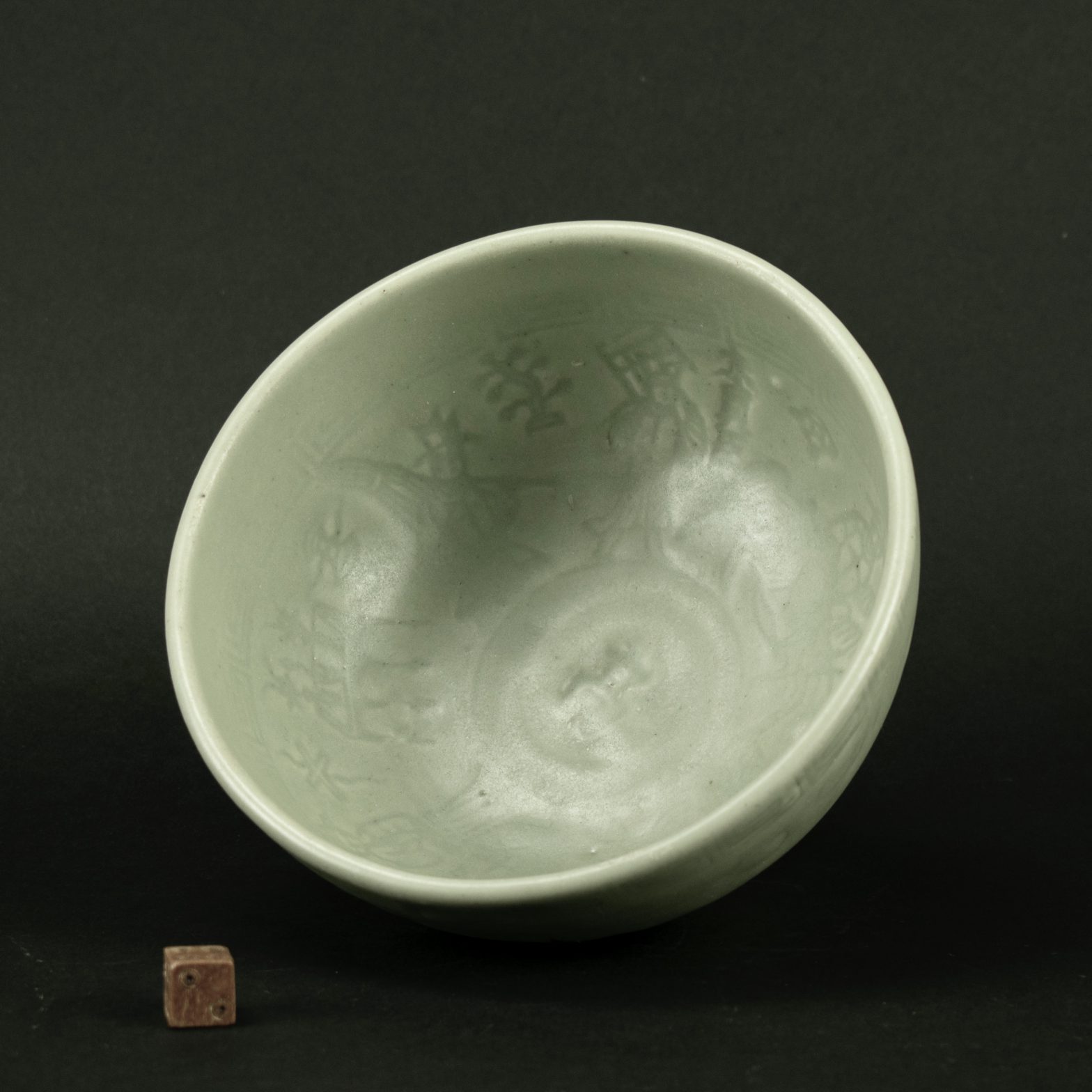
This bowl and its companion are from a Japanese collection. A similar Ming celadon bowl was discovered in the ruins of Saya Castle, Komatsu-Shi, Ishikawa prefecture, Japan, built in the sixteenth century, and now in the Tokyo National Museum. Such bowls are called Ningyo ude bowls in Japan because of their figural decoration. See below for more information about this group of early Ming celadon bowls and examples of kiln wasters.
See Below For More Photographs and References.
SOLD
Condition
In good condition, the exterior of the foot has two old glaze cracks. The glaze is slightly dry and of a semi-matt appearance.
Size
Diameter : 14.9 cm (6 inches). Height : 8.8 cm (3 1/2 inches).
Provenance
A Japanese ink inscription on the base states that this Ming bowl was one of a pair, see the other bowl, stock number 25279
Stock number
25280
References
Several examples of this type are known. A bowl which of a good rich colour and of a different design is illustrated in : Yuegutang, A Collection of Chinese Ceramics in Berlin (Regina Krahl, G+H Verlag, Berlin, 2000) pages 280 and 280. A similar but Ming celadon bowl of this type is in the British Museum see : Ming Ceramics in the British Museum (Jessica Harrison-Hall, British Museum Press, 2001) page 482, Item 16:52. A further example of this type of Ming celadon bowl was discovered in the ruins of Saya Castle, Komatsu-Shi, Ishikawa prefecture, Japan, built in the sixteenth century, and now in the Tokyo National Museum. Such bowls are called Ningyo ude bowls in Japan because of their figural decoration". For another example of this type of Ming Celadon Bowl see : Chinese Ceramics, Bronzes and Jades in the Collection of Sir Allan and Lady Barlow (Michael Sullivan, Faber and Faber Ltd, 1963) page 99, illustration 95c ; `Chekiang Celadon, XIV-XV Century`. Also see : Chinese Ceramics, The New Standard Guide (Hi Li,Thames and Hudson,1996) pages 246 and 262, item 510, "The decoration of this bowl, combining calligraphy with human figures, reflects a new trend in Longquan (celadon) products during the Ming dynasty. In addition to the auspicious phrases and names of potters that had increasingly appeared on Longquan wares since the Yuan, historical figures provided another rich resource for decorative motifs at Daotai and Daqi (kilns at Zheijiang).
Relate Ming Celadon Kiln Wasters


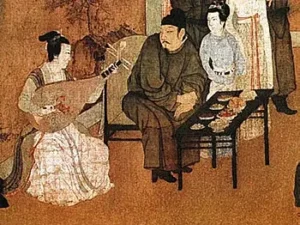
Chinese Pipa 琵琶
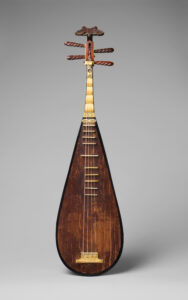
Pipa (琵琶) Chordophone-lute-plucked-fretted The spectacular back and sides of this unique Ming-dynasty instrument feature more than 110 hexagonal ivory plaques, with thinner bone plaques on the neck. Each plaque is carved with Taoist, Confucian, or Buddhist figures and symbols signifying prosperity, happiness, and good luck. These include images of various gods and immortals, such as Shou Lao, the Daoist god of longevity, who is shown with a prominent forehead on the single plaque at the very top. When the instrument is played, this expert workmanship remains unseen by the listener, as the back faces the player. The front is relatively plain but shows signs of use. The ivory string holder bears a scene featuring four figures and a bridge; an archaic cursive inscription; and, at the lip, a bat motif with leafy tendrils.