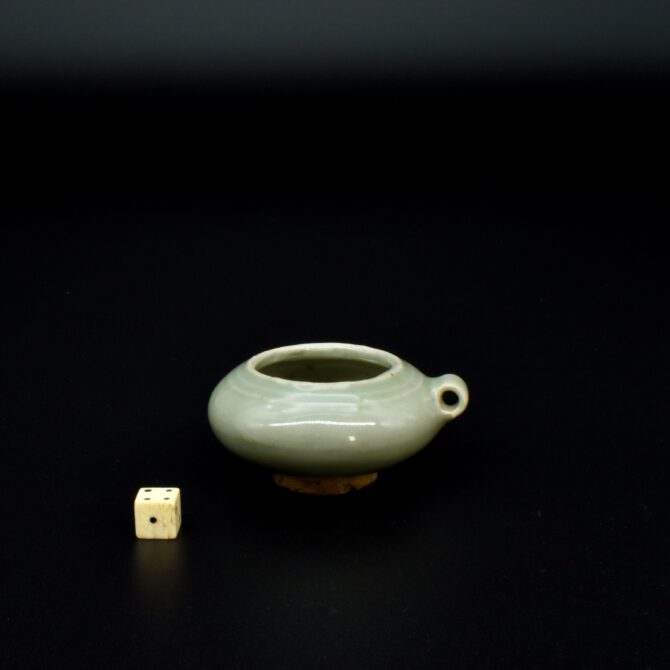
A Southern Song or Yuan Dynasty Longquan Celadon Bird Feeder
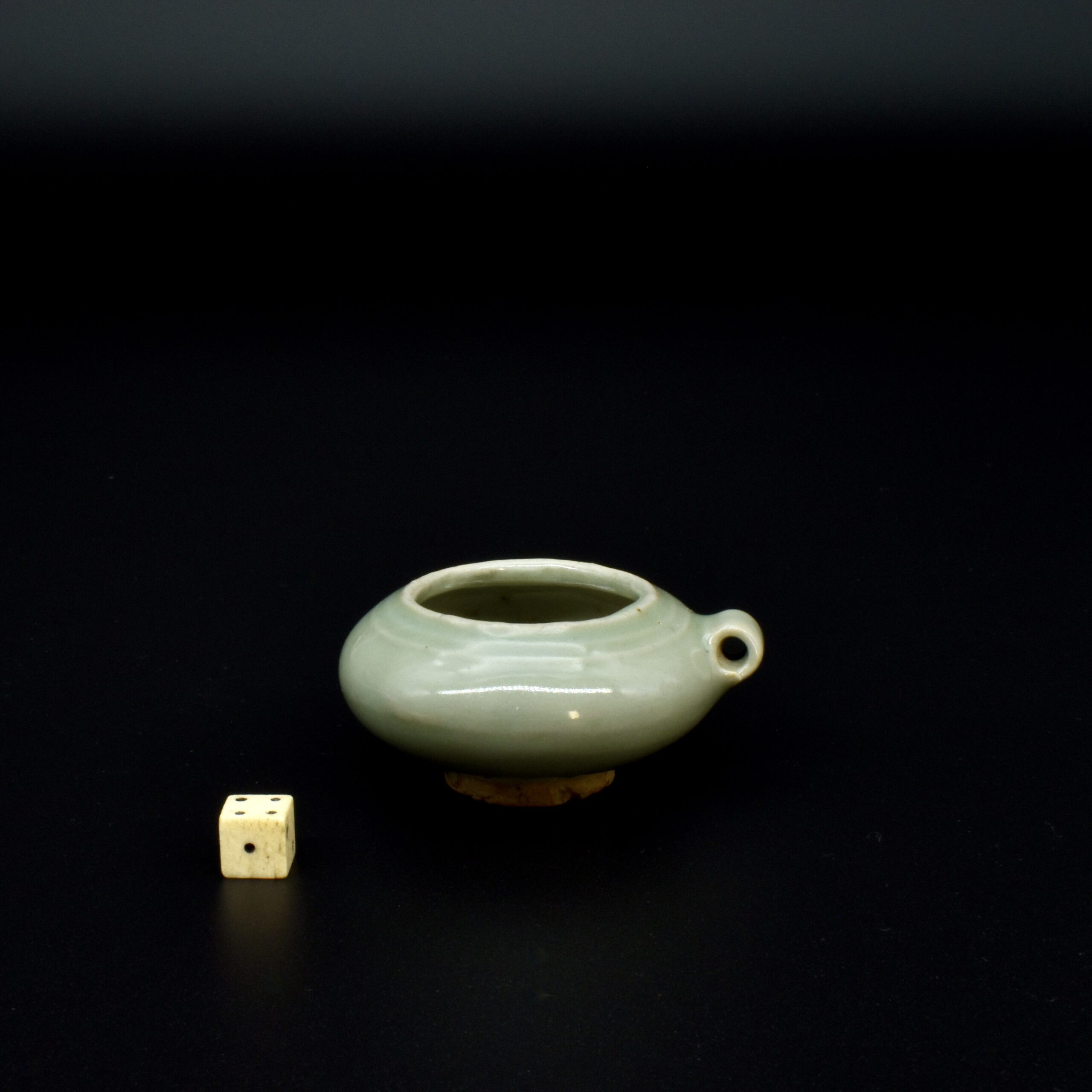
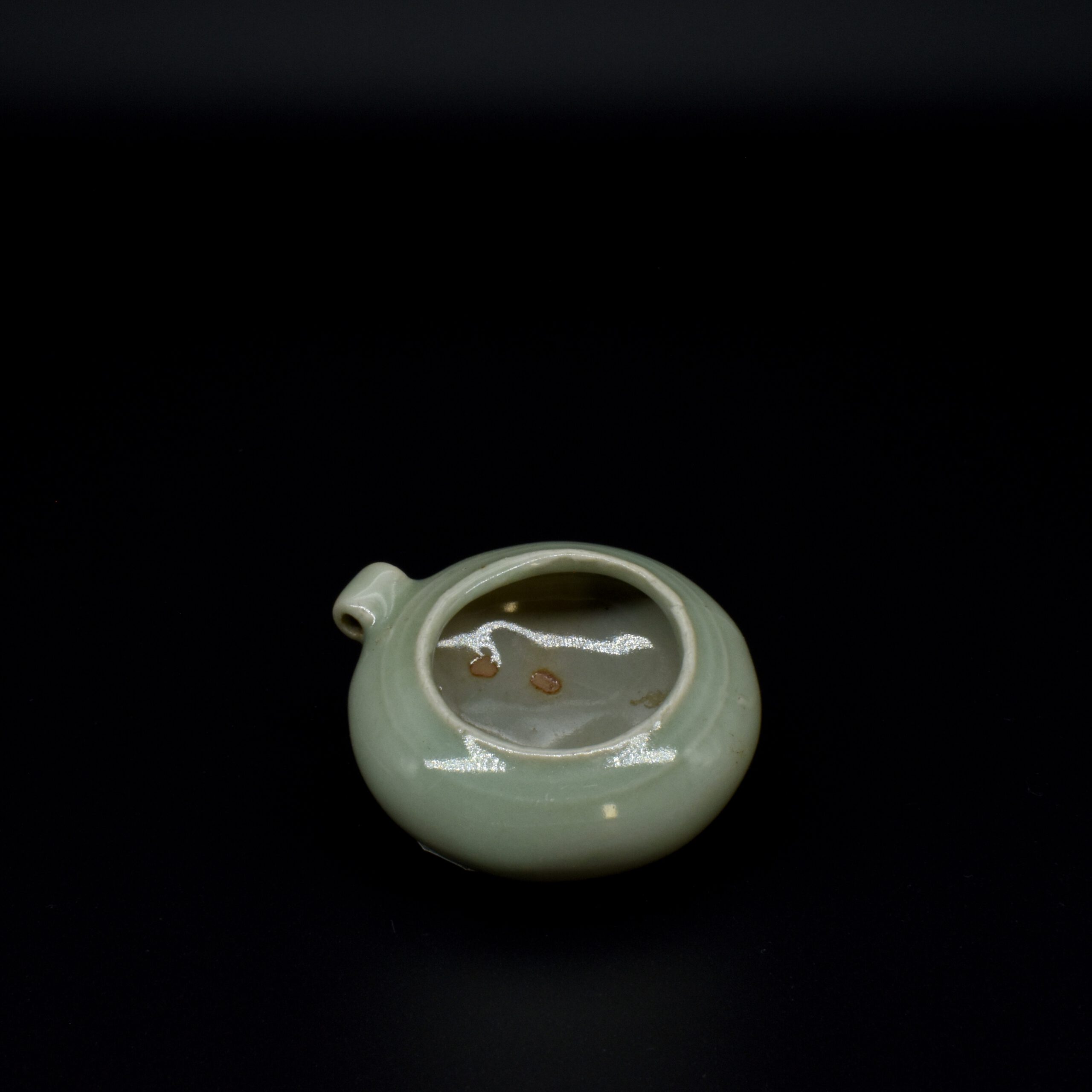
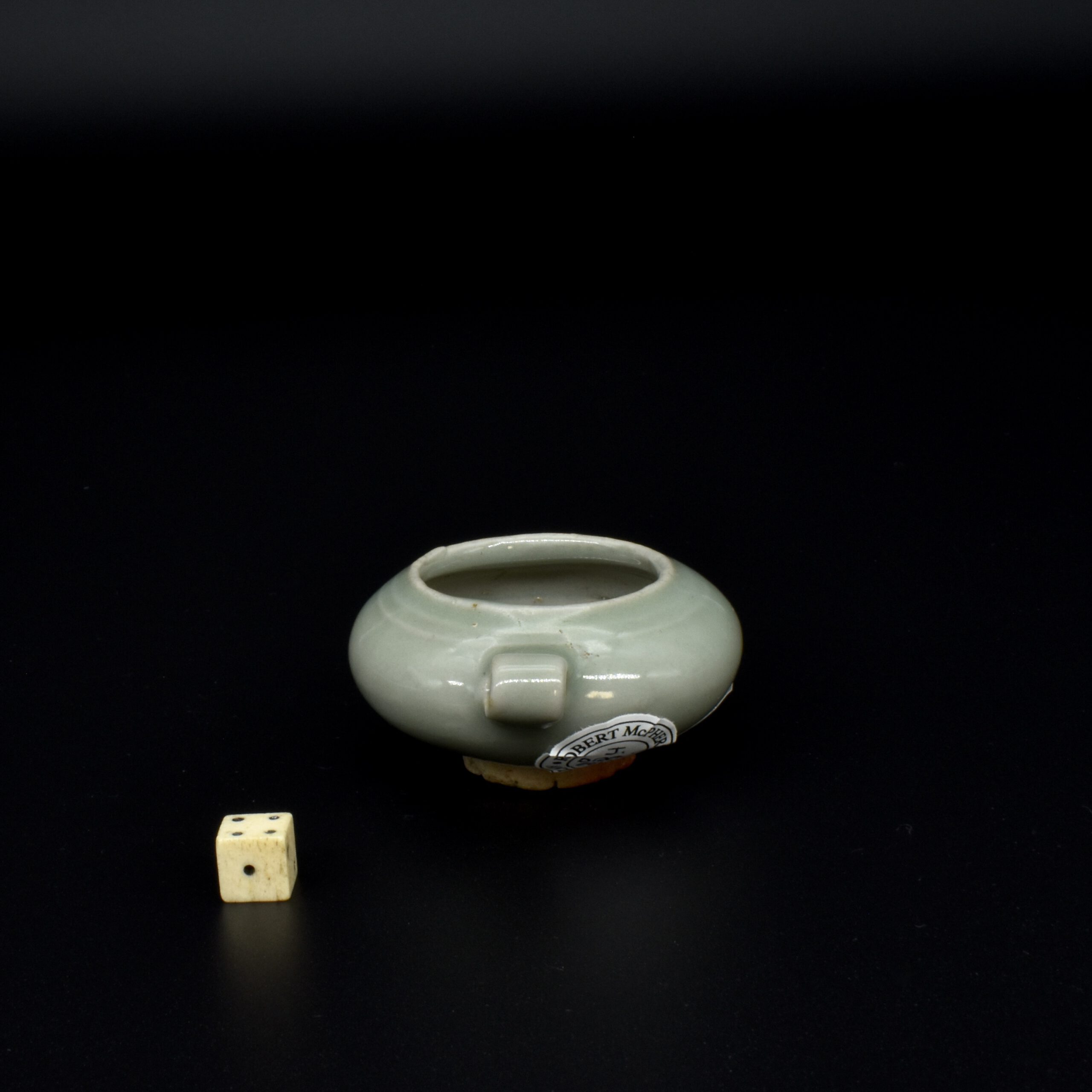
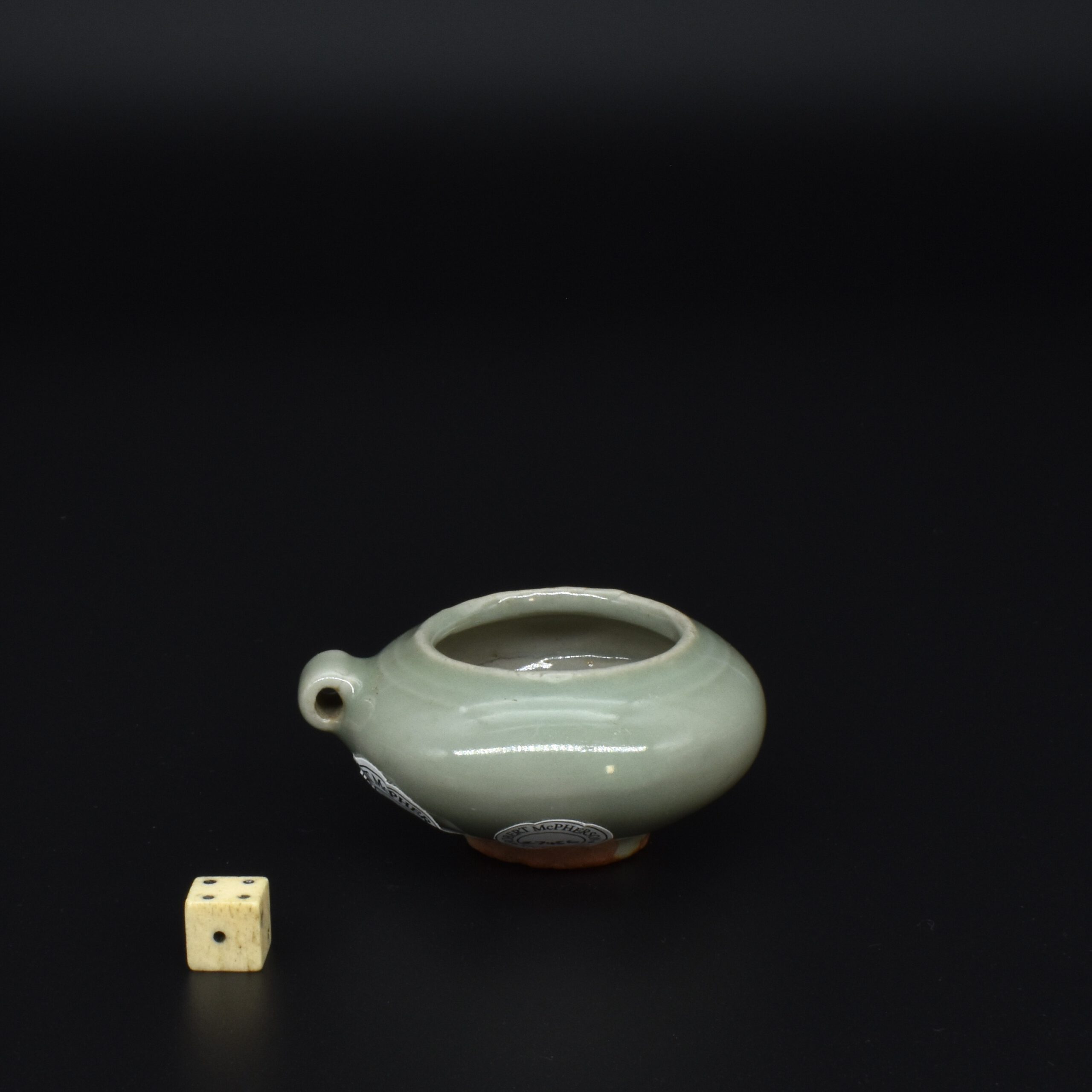
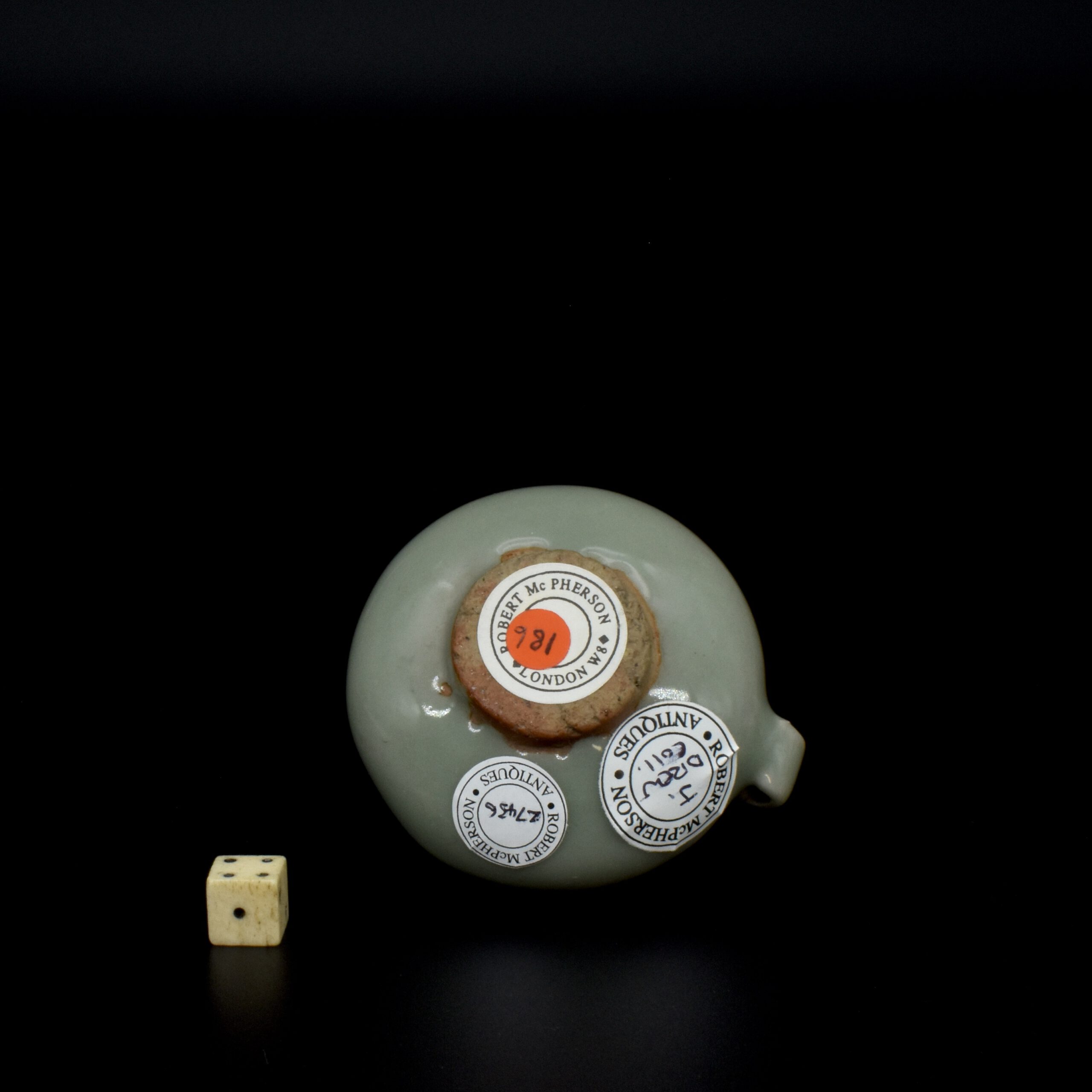
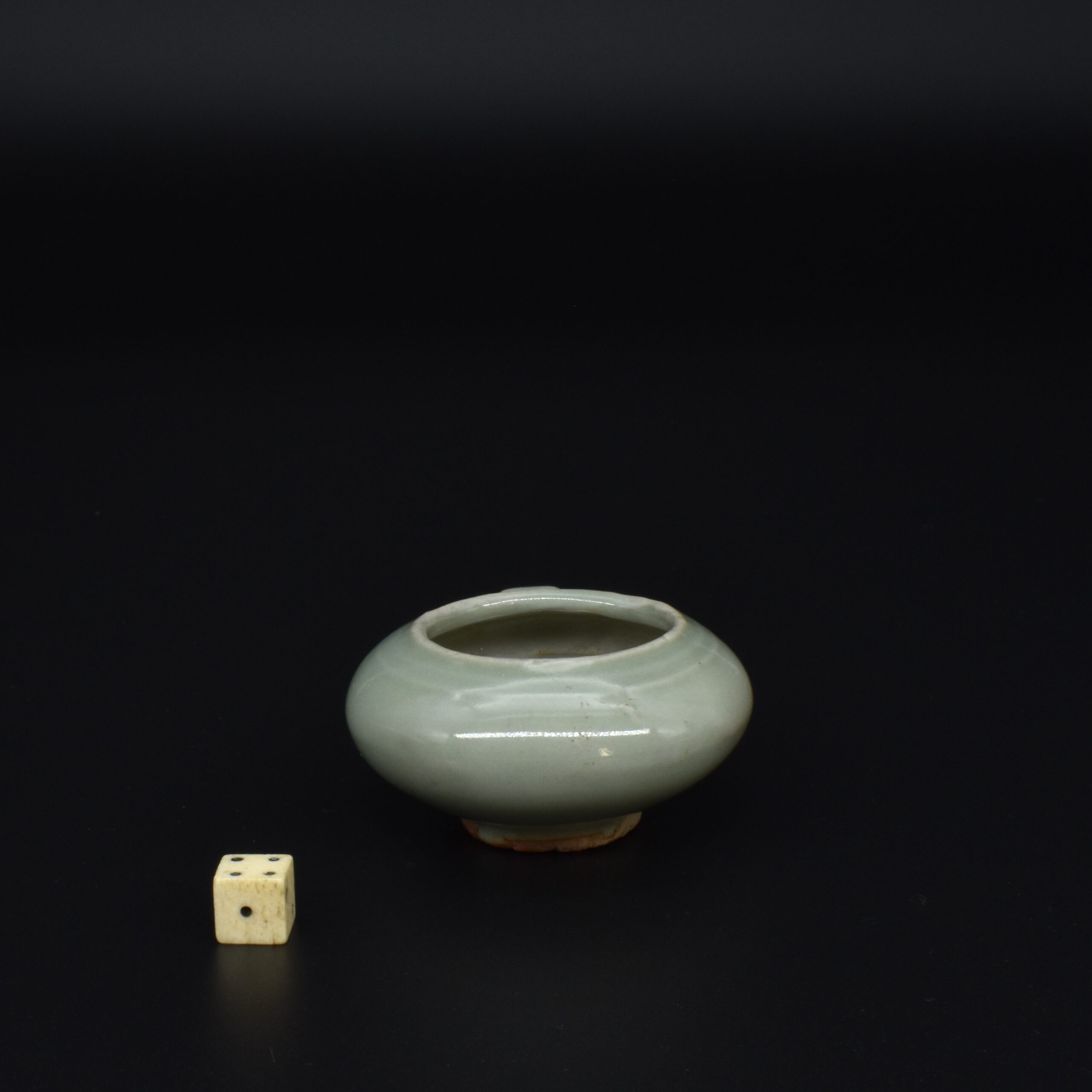
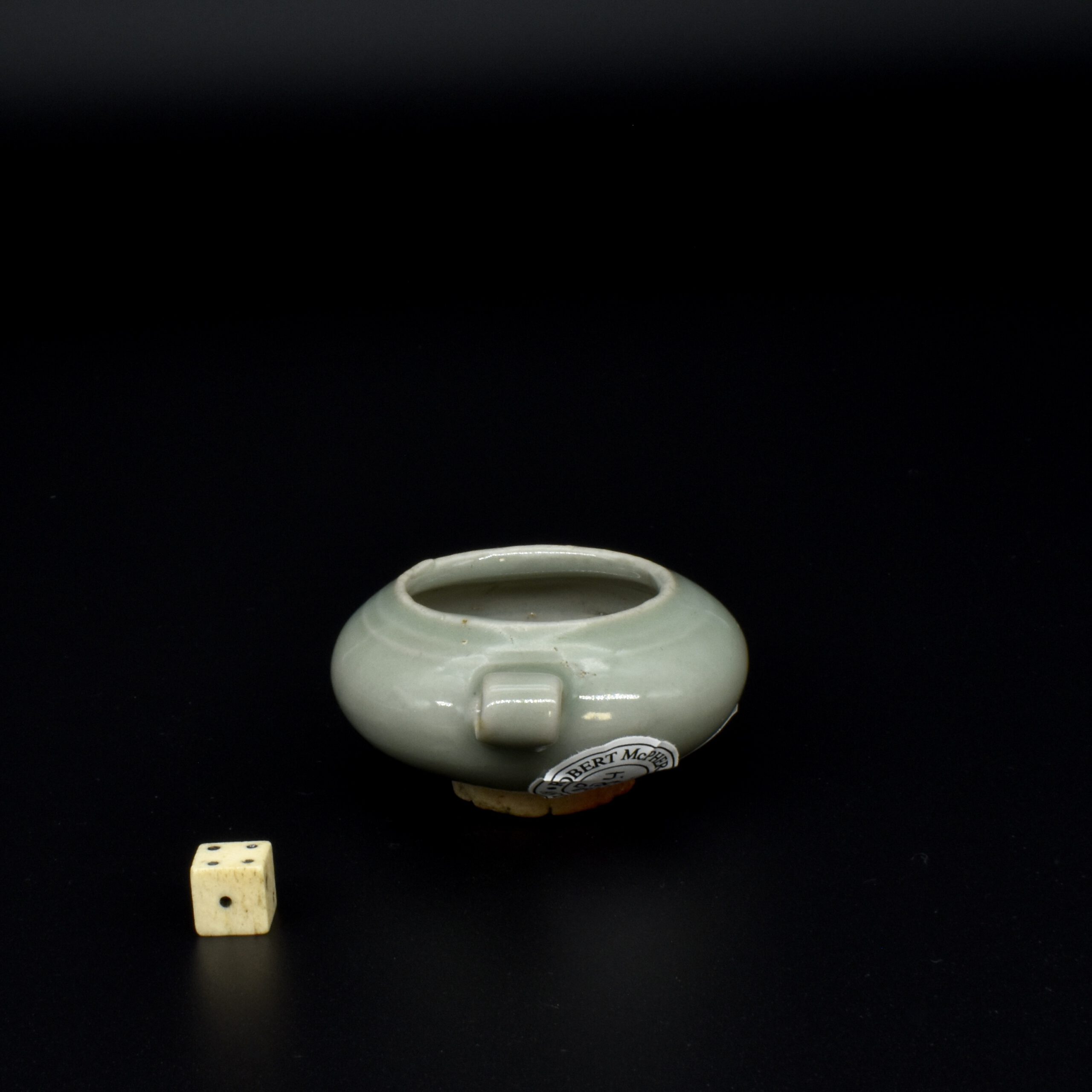
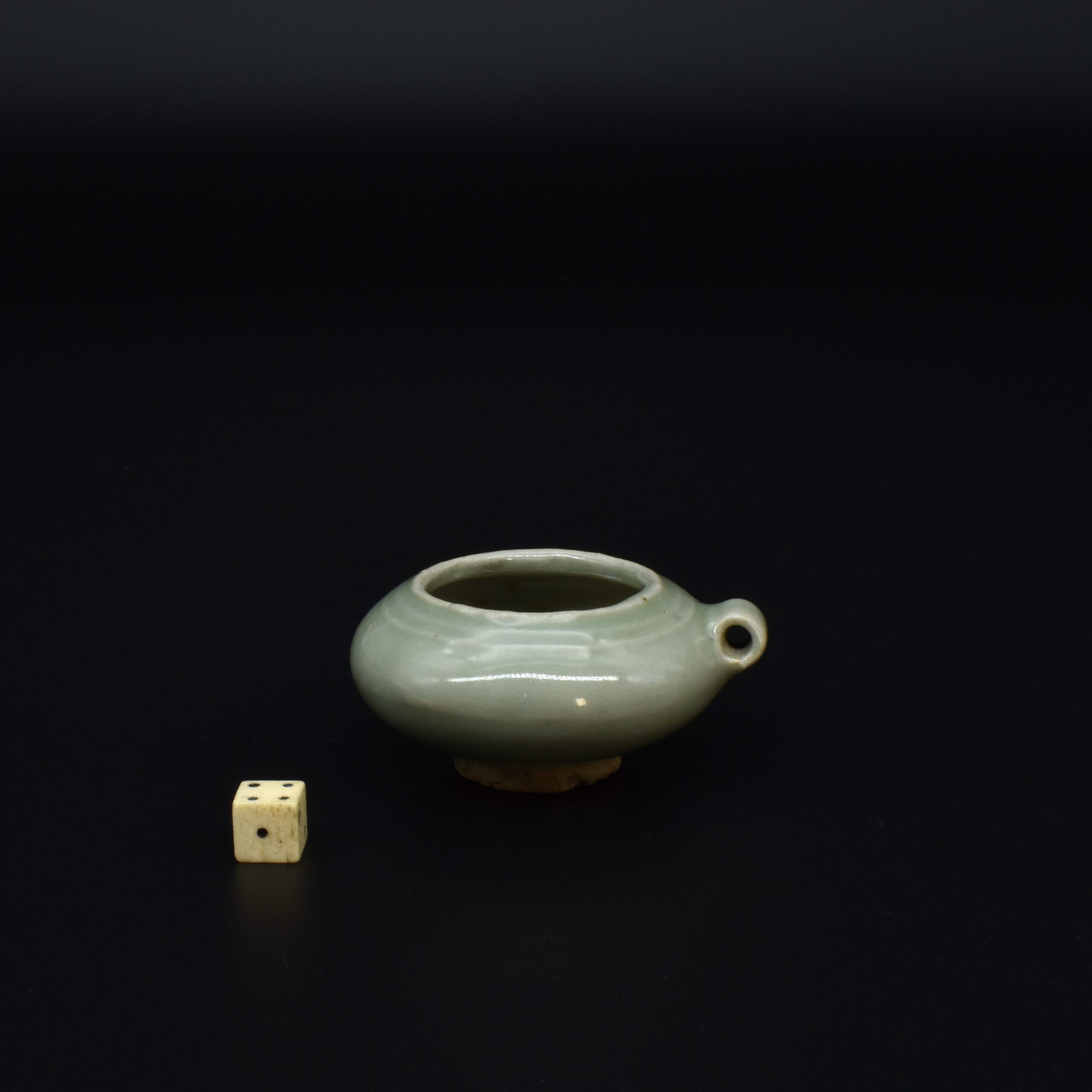
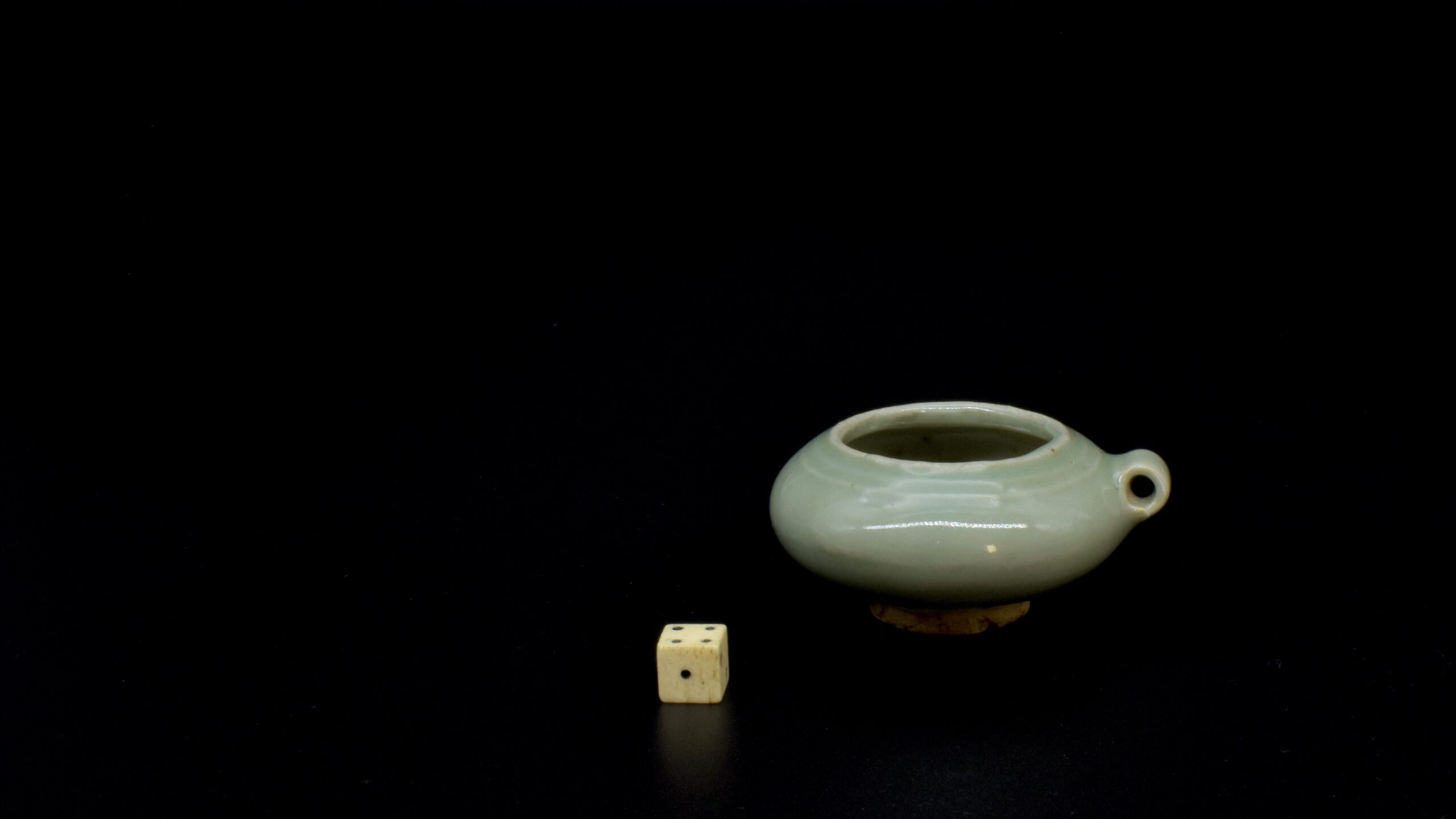
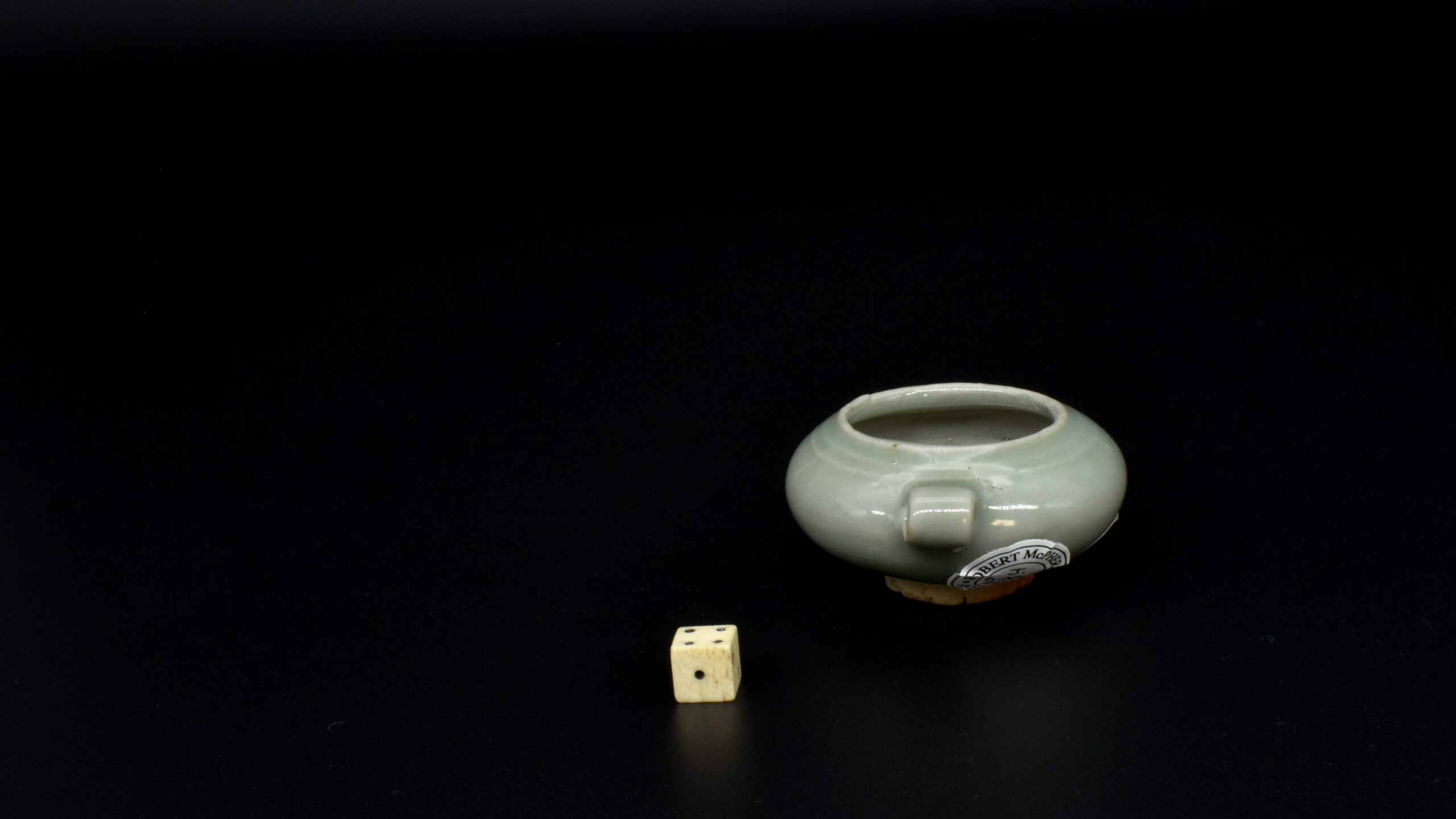
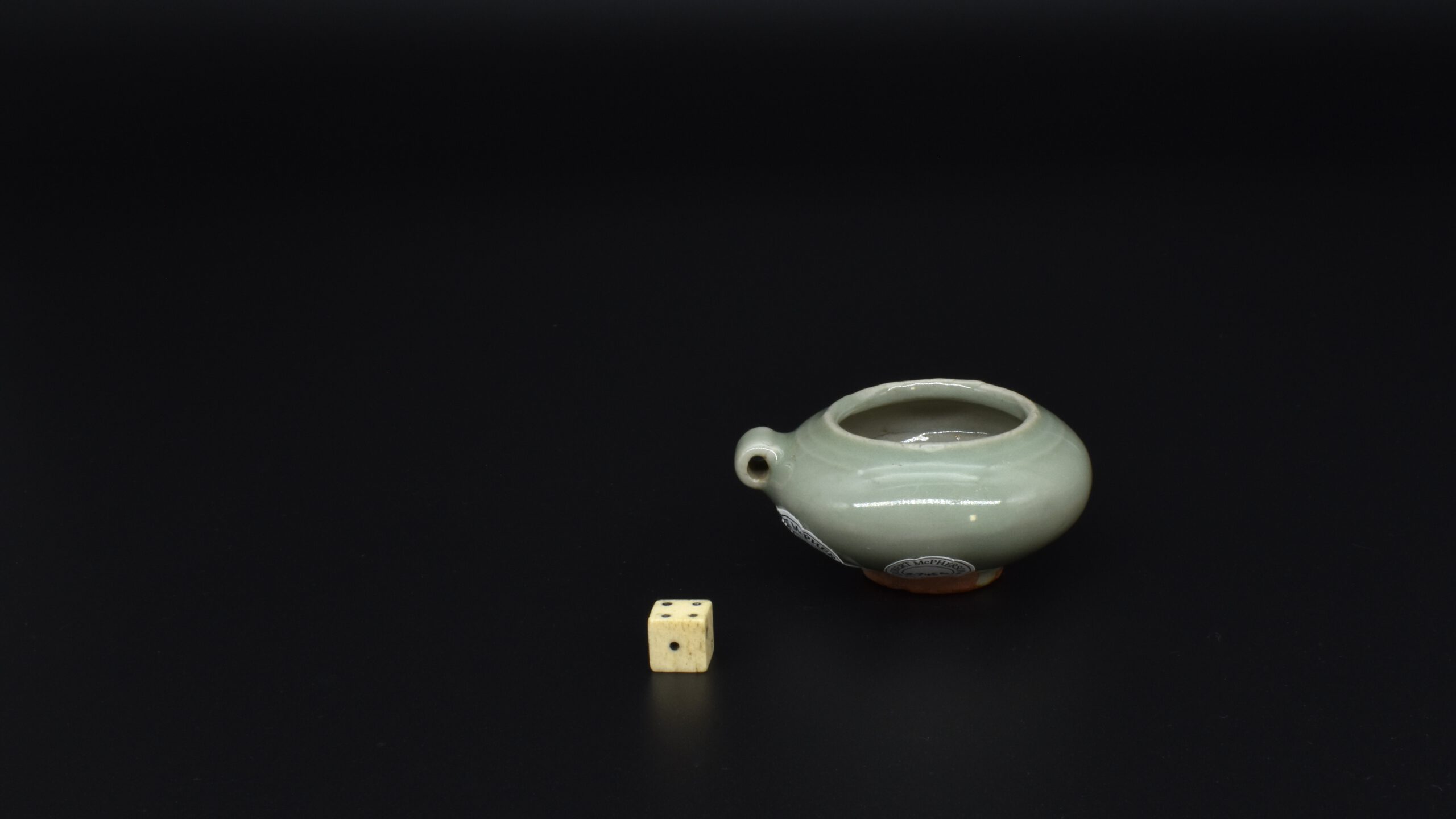
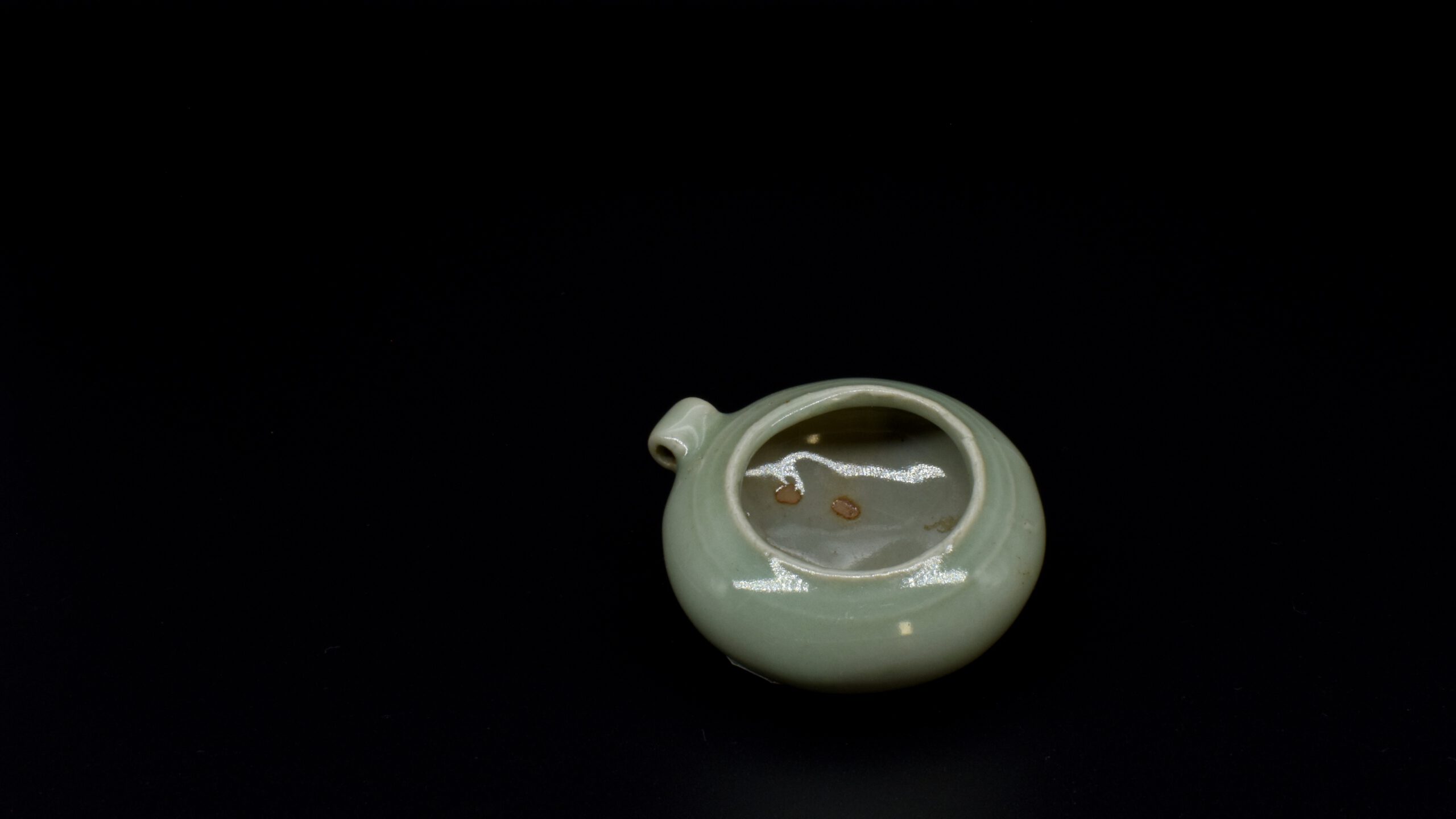
A Small Southern Song or Yuan Celadon Ware Bird Feeder, Longquan kilns, 13th or 14th century. From the Collection of John Drew (1933 – 2006). This well made Chinese celadon bird feeder is of compressed circular form with an unglazed base, it has a loop on the side to attach it to the interior of the bird cage. There are two lines in relief circling the aperture.
Celadon is a term used to describe several types of Chinese stoneware and porcelain, as well a ceramics from other countries, notably from Korea and Japan. The term is a imprecise one, applying to various types of green glazed ceramics, but not all ceramics with green glazes, there are several wares that have a green glaze that are not referred to as celadon. For example Green Jun and Ge Ware. For this reason there has been a move to try to clarify the situation by using the term `Green Ware`. But for now Celadon is a more familiar and therefore useful term. The origins of the term Celadon are not clear, one theory is that the term first appeared in France in the 17th century and that it is named after the shepherd Celadon in Honoré d`Urfé`s French pastoral romance, L`Astrée (1627), who wore pale green ribbons. (D`Urfe, in turn, borrowed his character from Ovid`s Metamorphoses.) Another theory is that the term is a corruption of the name of Saladin, the Ayyubid Sultan, who in 1171 sent forty pieces of the ceramic to Nur ad-Din, Sultan of Syria. Yet a third theory is that the word derives from the Sanskrit sila and dhara, which mean “stone” and “green” respectively. Celadon ware originated in Zhejiang Province in the Eastern Han Dynasty, however green monochrome glazes can be found on stoneware much before that date. Zhejiang is were the famous Longquan Celadons were made but Celadon wares were also produced at Jiangsu, Hubei, Hunan and Jiangxi. The production of Celadon Ware required a reducing atmosphere of around 1300 degrees C., the colouring agent was a mixture of iron oxide and titanium. The glaze was applied very thickly, and was full of tiny bubbles which defuse the light giving the appearance of richness and softness.
See Below For More Photographs and Information.
SOLD
- Condition
- In damage, very minor wear.
- Size
- Width 6 cm (2 1/3 inches).
- Provenance
- Robert McPherson Antiques. The John Drew Collection. The John Drew Collection : John Drew was born in 1933 in Tideswell, Derbyshire, where his father was curate. The family moved to Norfolk whilst he was still a baby and his father became the rector of the parish of Intwood and Keswick. He was educated at Sedbergh School and after National Service in the R.A.F. being taught Russian, he went to Queens College, Oxford to read Greats (Classics). He spent nearly all his working life in various African countries as an archivist, moving to a post at Cape Town University in 1978. He remained in Cape Town after his retirement until his death in 2006. He had a great love of the English countryside (but not the climate) and this is shown in many of the pieces he collected. His taste was varied and ranged from Neolithic right through to the 18th Century. When we sent photograph to his home in Cape Town of pieces we thought he might be interested in, he would write long funny well observed letters back, wanting to add many of the items to his growing collection. Over the years we got to know him better and better, and during the last few years it was very rare for him to not want all the pieces we offered him. We knew his taste, even though his taste was so varied. This was in no small part because he had a very good eye and it was a pleasure finding things that interested him, because they were also very interesting to us. He never got to put his collection on display, something he hoped to do while on retirement in England, so it is with a mixture of pleasure and sadness that we offer these pieces from his collection this June. Each piece has a John Drew collection label, so when the collection is split up there will be some lasting record of the love and hard work he put into his two decades of collecting.
- Stock number
- 27436
Photos
Information
A Related Song or Yuan Celadon Bird Feeder.
Robert McPherson Antiques.
Sold Archive Number 24950
Condition
In excellent condition, minor feint scratches.
Size
Length: 4.8cm (2 inches)
Provenance
A Private London Collection of Early Chinese Ceramics. Lable to the base, number 304.
References
For a very similar Chinese celadon bird feeder, dated to the Yuan dynasty from the Eric E. Geiling Collection, Exhibited at The Cologne Museum of Oriental Art, see : Chinesische Keramik Auf Den Philippinen (Die Sammlung Eric E. Geiling, Bearbeitet Von Ulrich Wiesner, Museum Fur Ostasiatische Kunst) page 90, plate 52.
Celadon Ware.
Celadon is a term used to describe several types of Chinese stoneware and porcelain, as well a ceramics from other countries, notably from Korea and Japan. The term is a imprecise one, applying to various types of green glazed ceramics, but not all ceramics with green glazes, there are several wares that have a green glaze that are not refereed to as celadon. For example Green Jun and Ge Ware. For this reason there has been a move to try to clarify the situation by using the term `Green Ware`. But for now Celadon is a more familiar and therefore useful term. The origins of the term Celadon are not clear, one theory is that the term first appeared in France in the 17th century and that it is named after the shepherd Celadon in Honoré d`Urfé`s French pastoral romance, L`Astrée (1627), who wore pale green ribbons. (D`Urfe, in turn, borrowed his character from Ovid`s Metamorphoses.) Another theory is that the term is a corruption of the name of Saladin, the Ayyubid Sultan, who in 1171 sent forty pieces of the ceramic to Nur ad-Din, Sultan of Syria. Yet a third theory is that the word derives from the Sanskrit sila and dhara, which mean "stone" and "green" respectively. Celadon ware originated in Zhejiang Province in the Eastern Han Dynasty, however green monochrome glazes can be found on stoneware much before that date. Zhejiang is were the famous Longquan Celadons were made but Celadon wares were also produced at Jiangsu, Hubei, Hunan and Jiangxi. The production of Celadon Ware required a reducing atmosphere of around 1300 degrees C., the colouring agent was a mixture of iron oxide and titanium. The glaze was applied very thickly, and was full of tiny bubbles which defuse the light giving the appearance of richness and softness.
Yuan Dynasty.
Temüjin, later to be more prominently known as Genghis Khan, was officially the first in the line of Yuan Dynasty emperors. He was the son of Yesügei, the tribal chief of the Kiyad — a tribe in fragmented Mongolia under nominal control of the Jin Dynasty at the time. His father was killed in his early life by a rival tribe, the heir. This led to bitterness on the part of Senggum, Wang`s former heir, who planned to assassinate Temüjin. Temüjin learned of Senggum`s intentions however, and a large civil war broke out among the Mongols. Eventually Temüjin defeated Senggum and succeeded to the title of Wang Khan. Temüjin created a written code of laws for the Mongols called Yassa, and he demanded it to be followed very strictly. Temüjin followed with attacks on other neighboring tribes, which further increased his power. By combining diplomacy, organization, military ability, and brutality, Temüjin finally managed to unite the tribes into the single nation, a monumental feat for the Mongols, who had a long history of internecine dispute. In 1206 Temüjin successfully united the formerly fragmented tribes of what is now Mongolia. At a Khurultai (a council of Mongol chiefs), he was named the “Genghis Khan”, or the “Universal Ruler”. The birth of Mongolia marked the start of what would become the largest continuous empire in history, ruling large parts of Asia, the Middle East and parts of Europe, over the following two centuries. While his empire extended in all directions, Genghis Khan’s main interest was always with the rest of China, specifically Western Xia, Jin Dynasty and southern Song Dynasty.