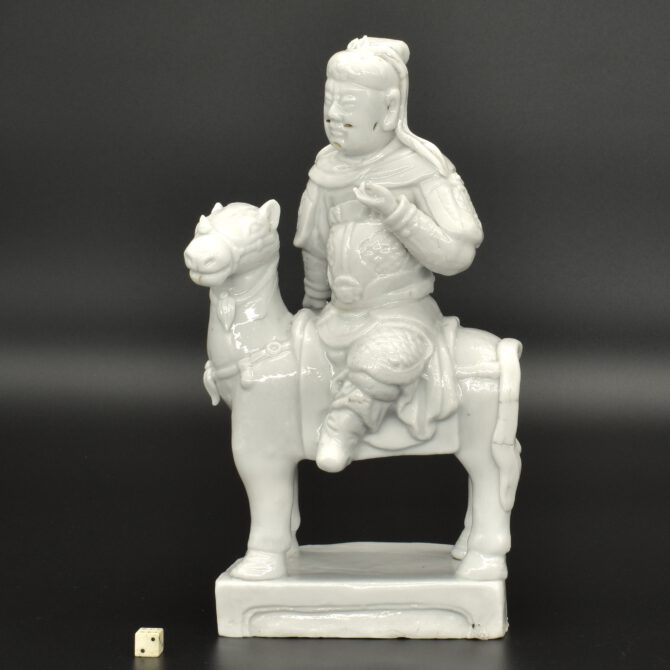
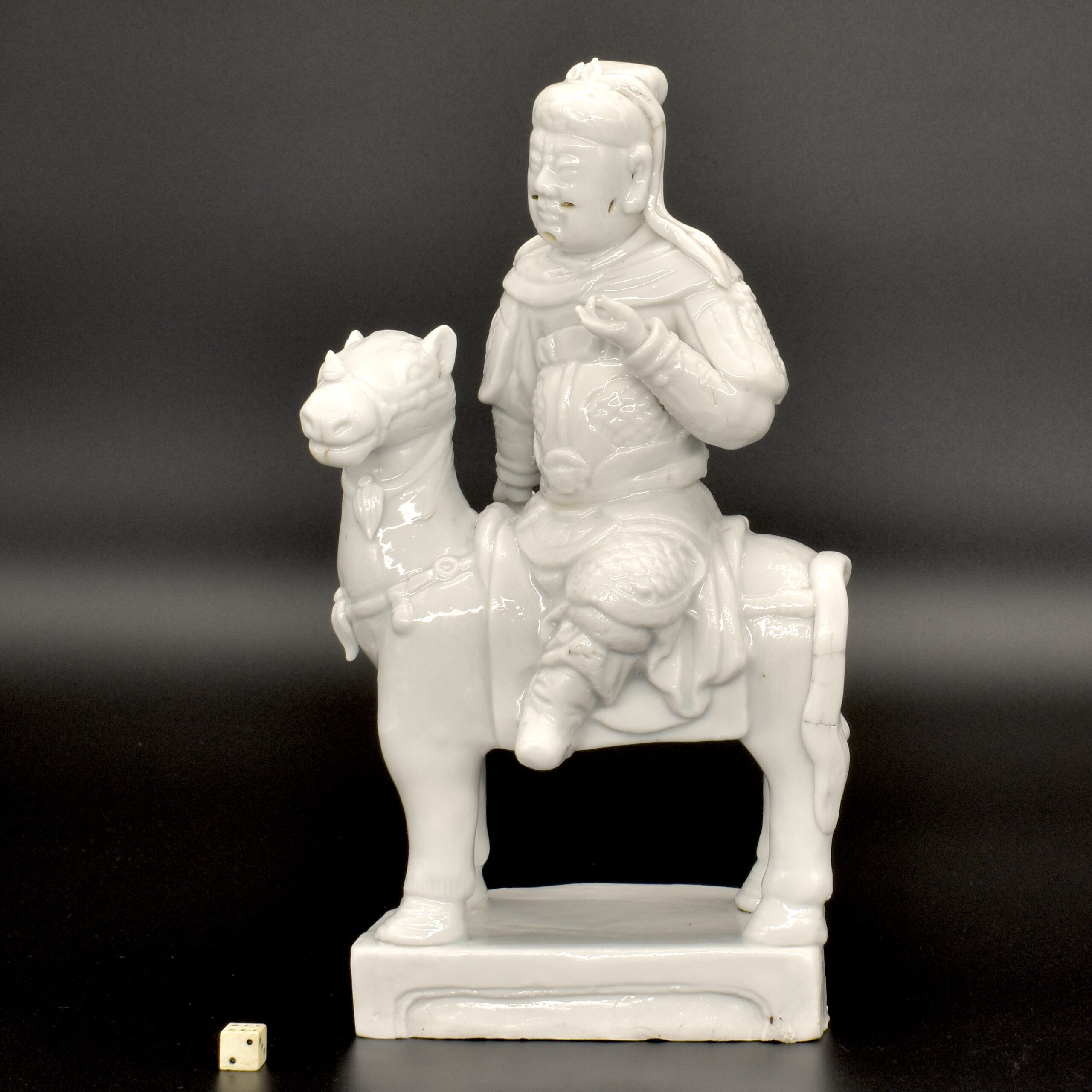
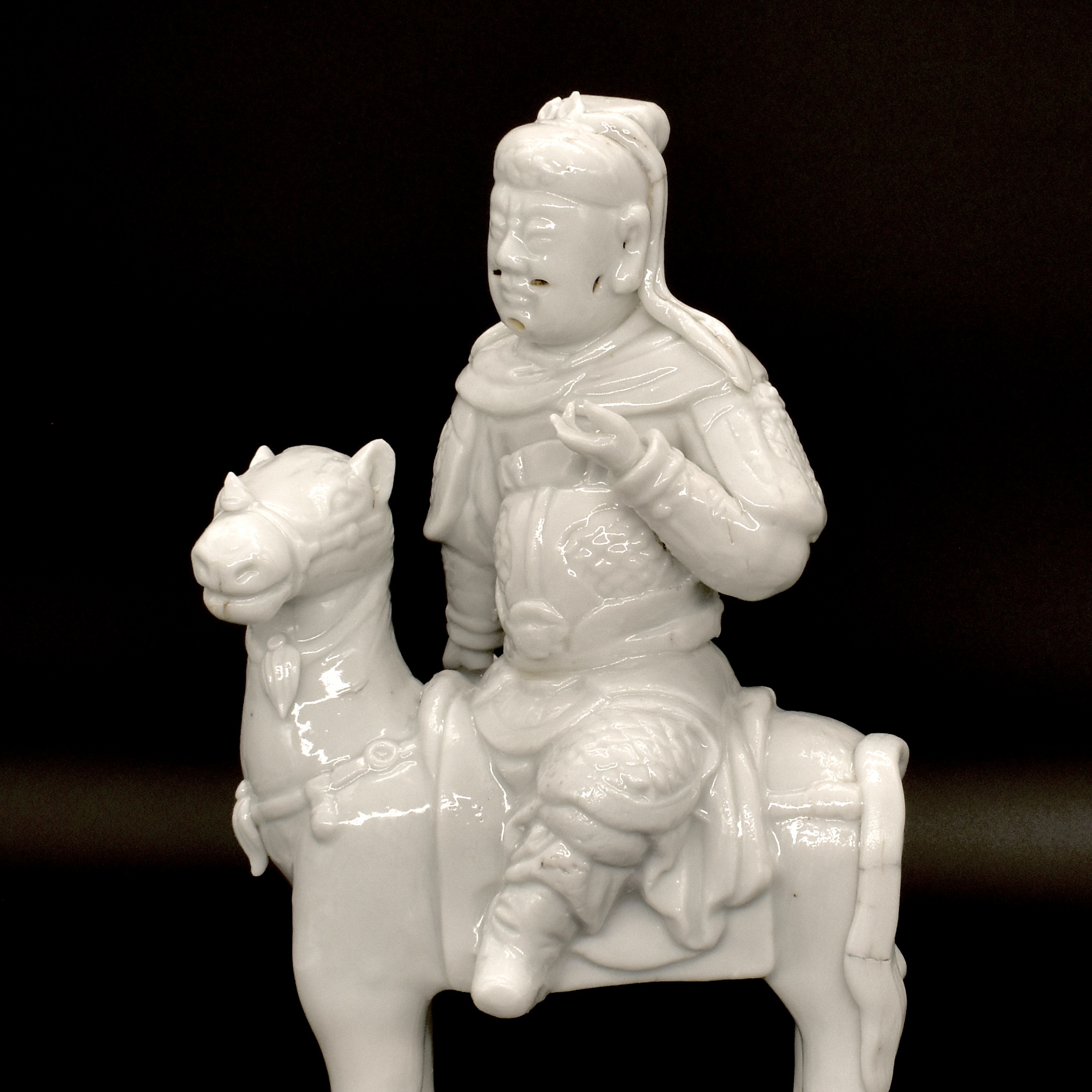
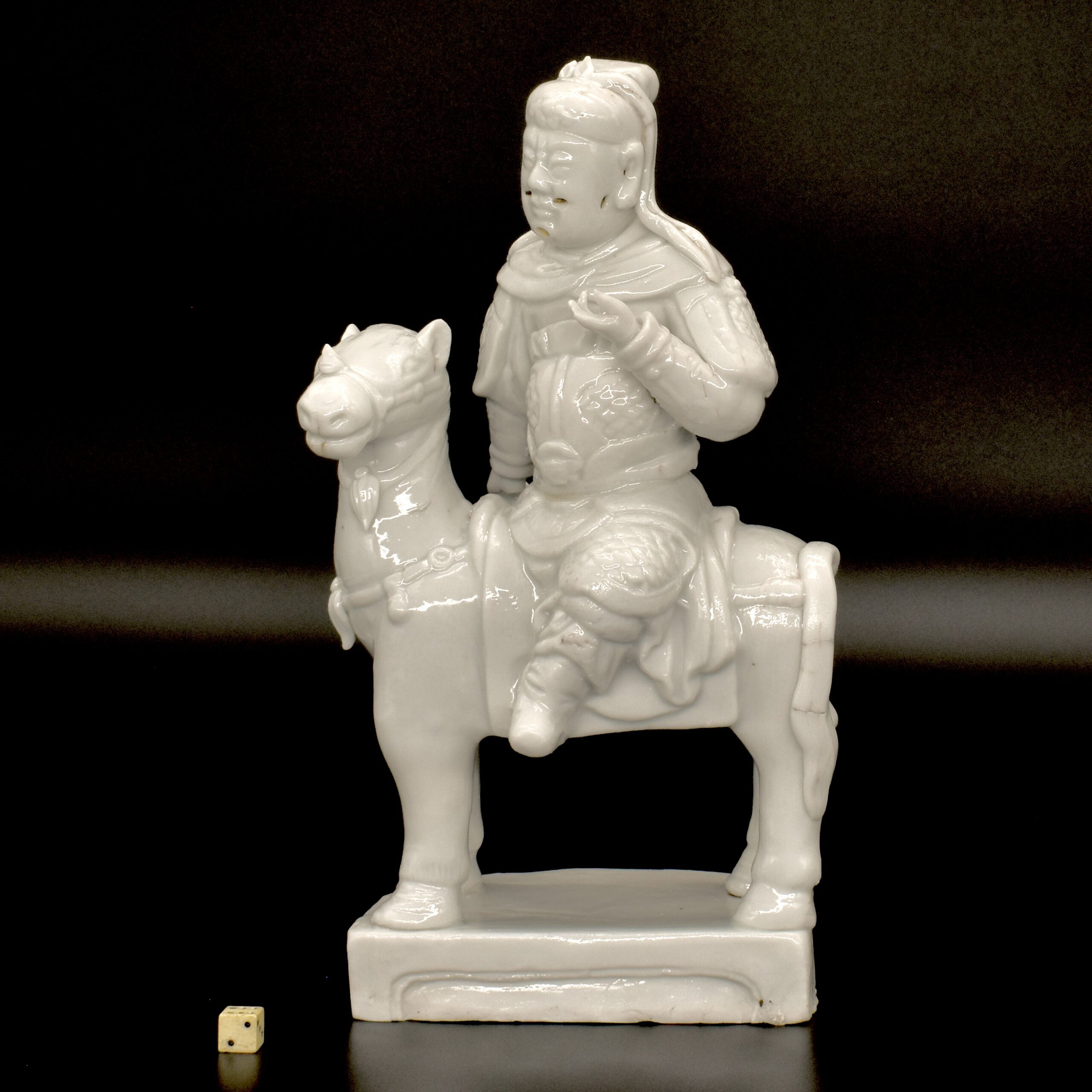
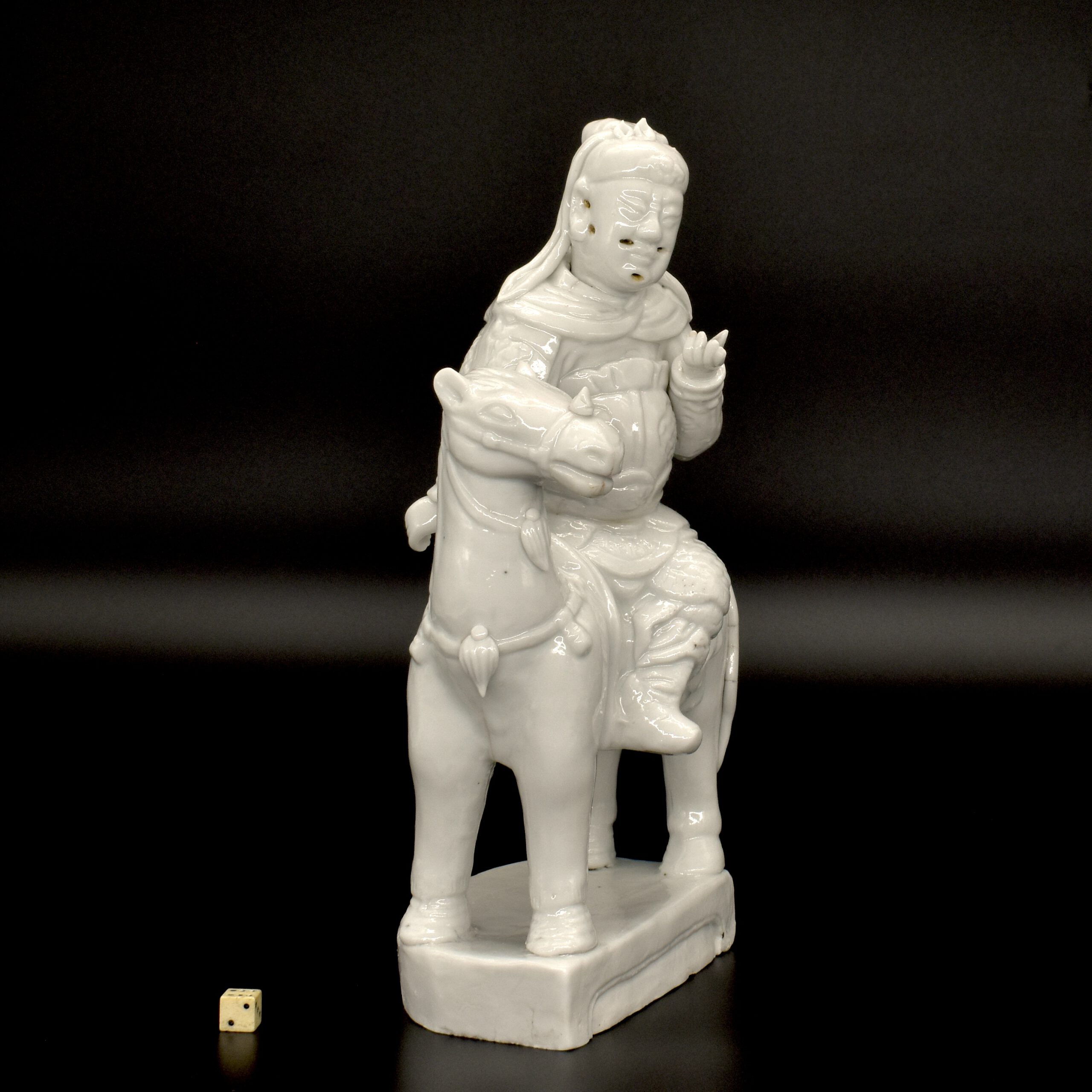
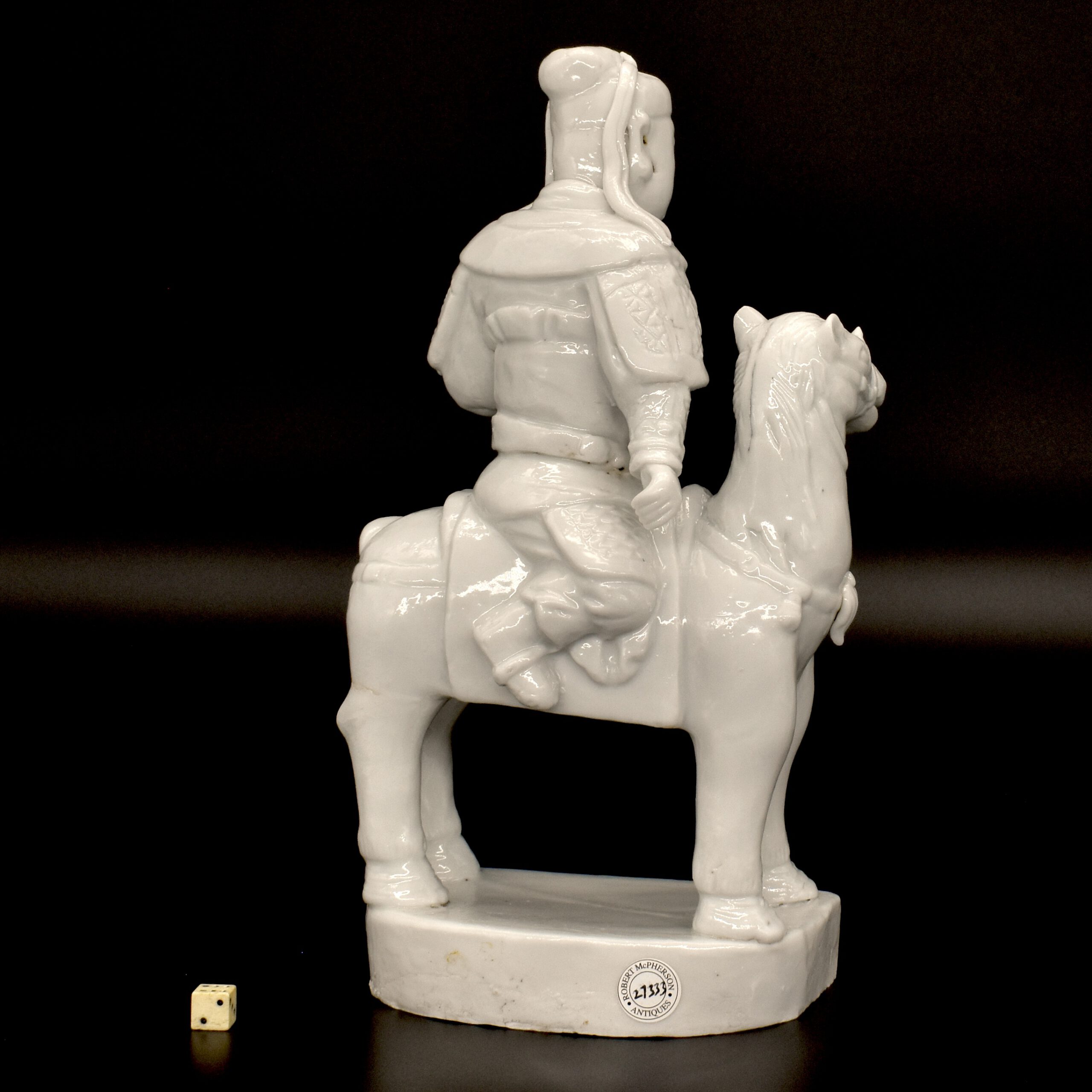
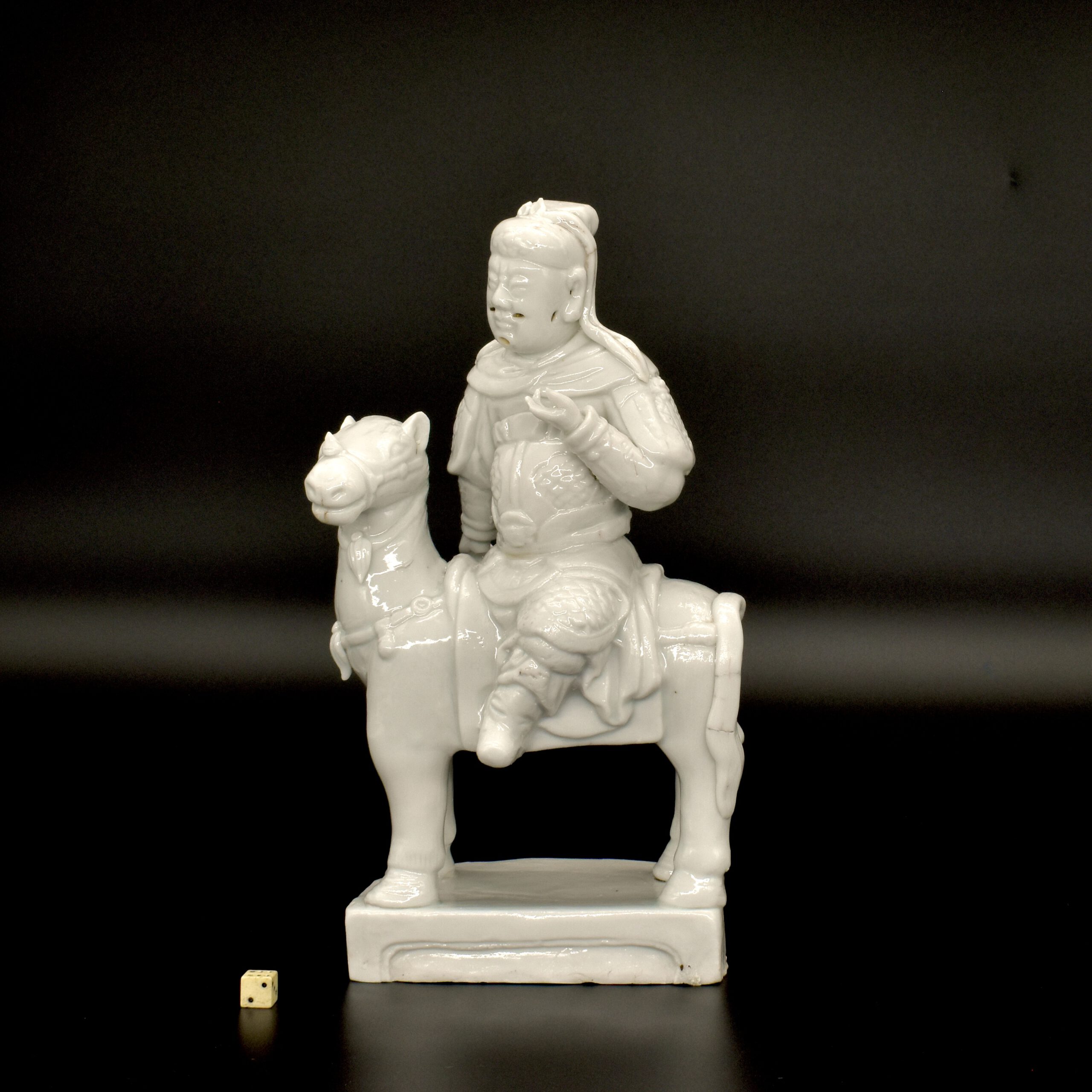
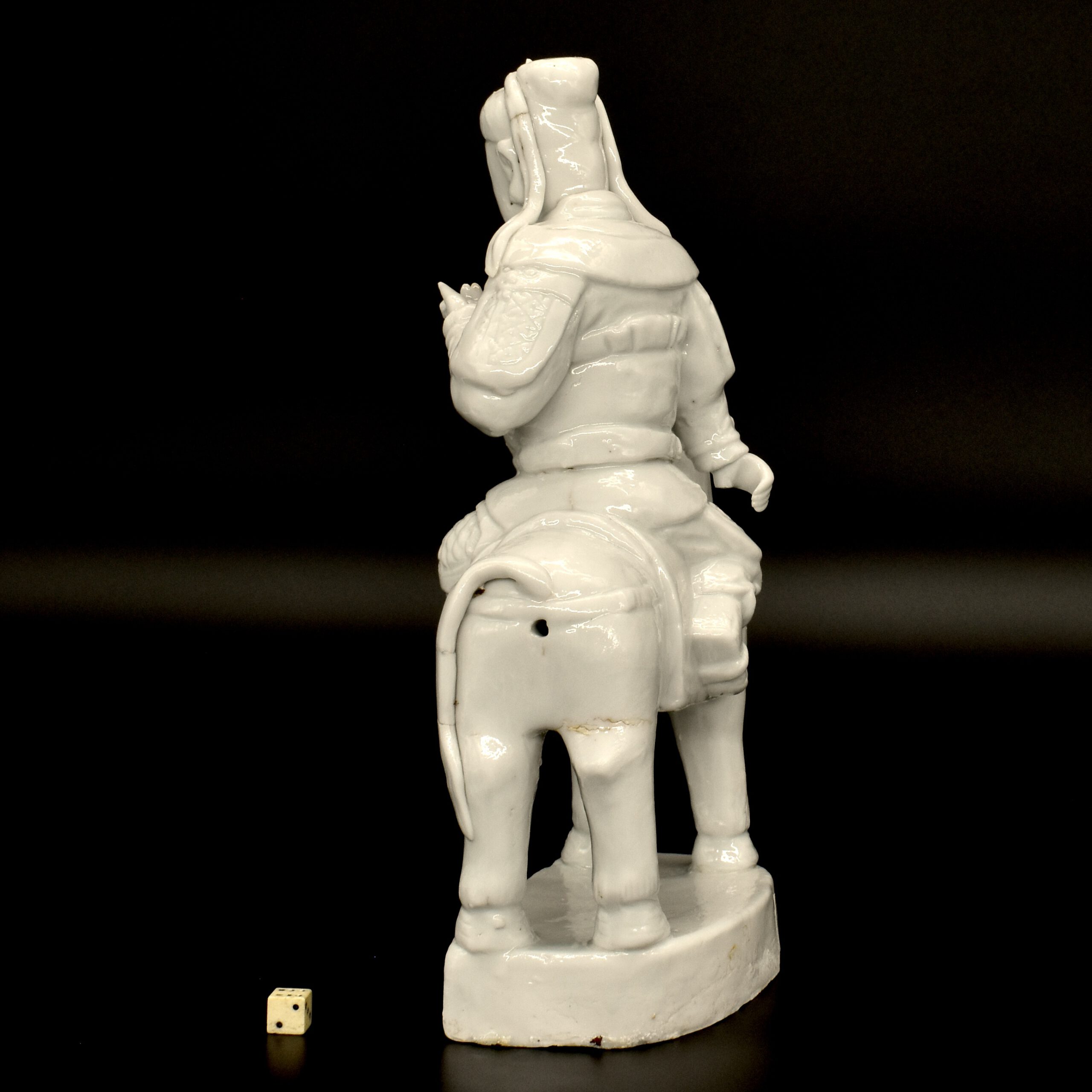
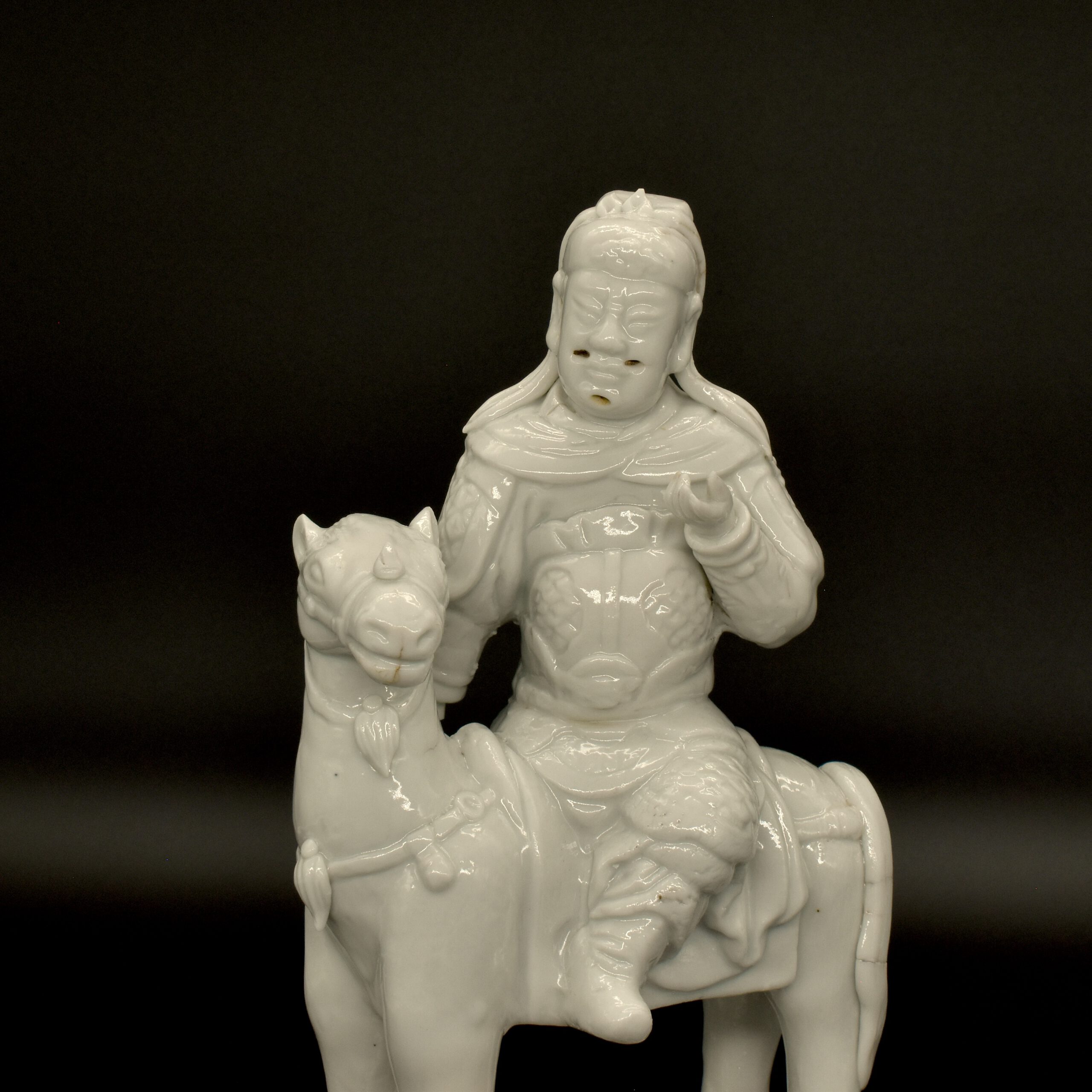
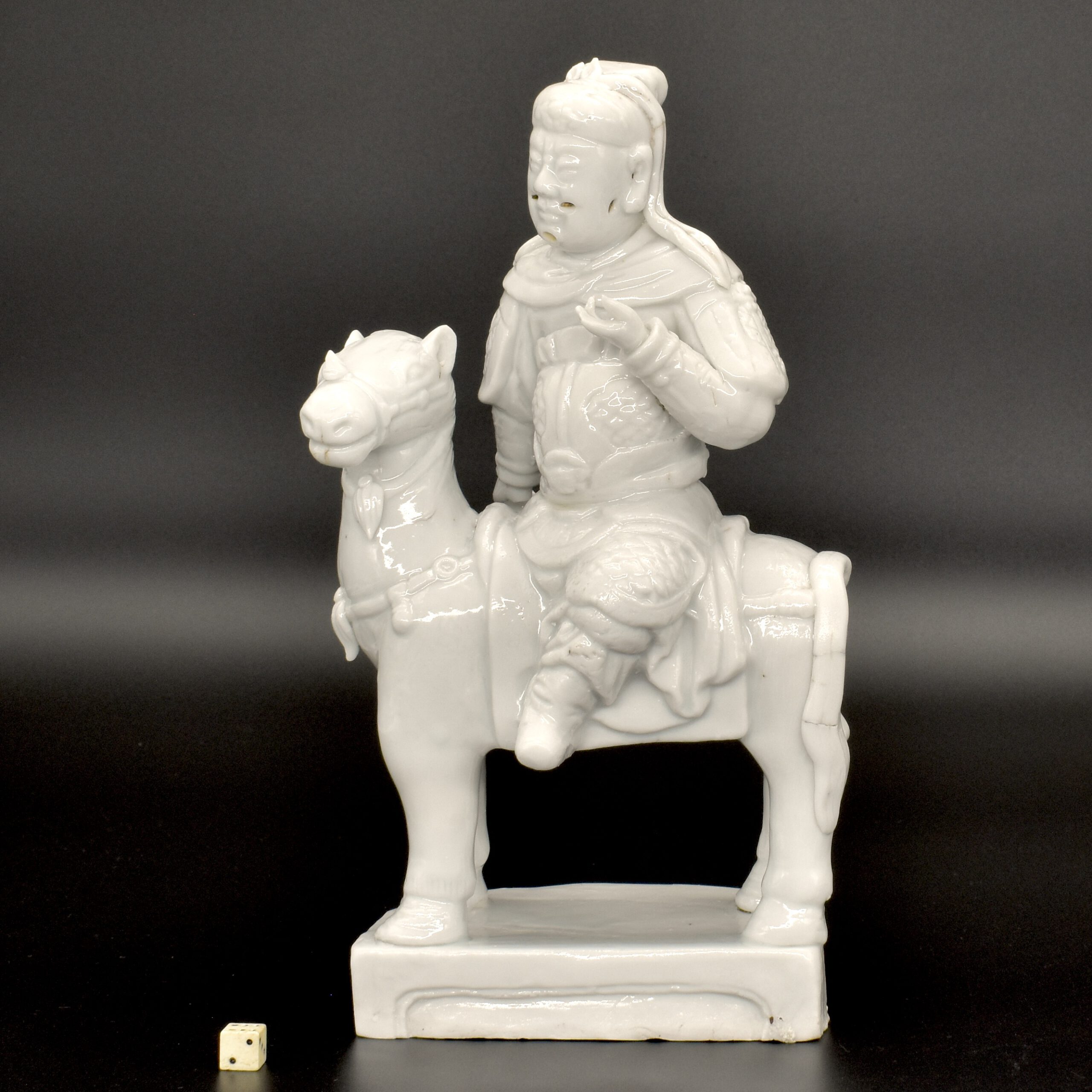
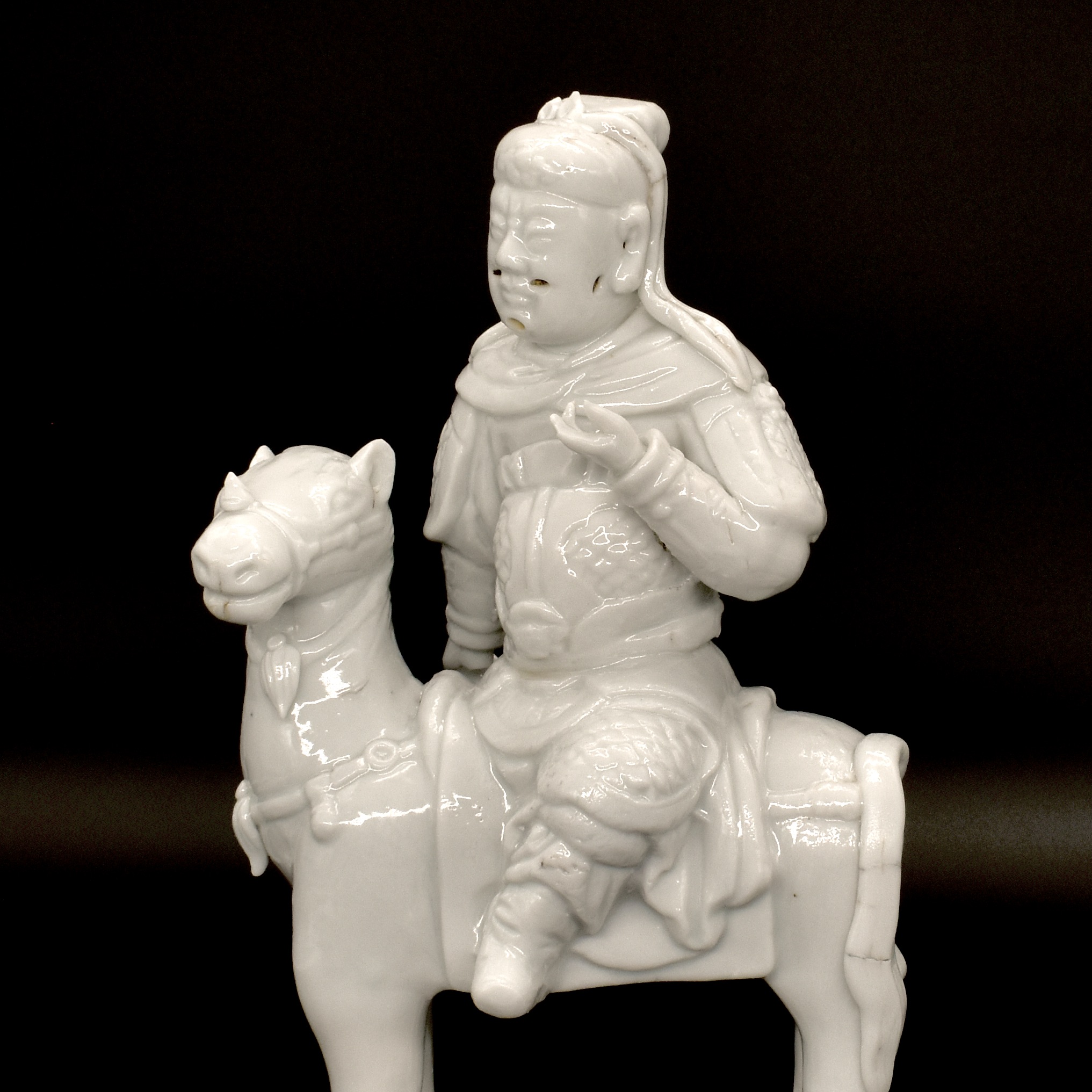
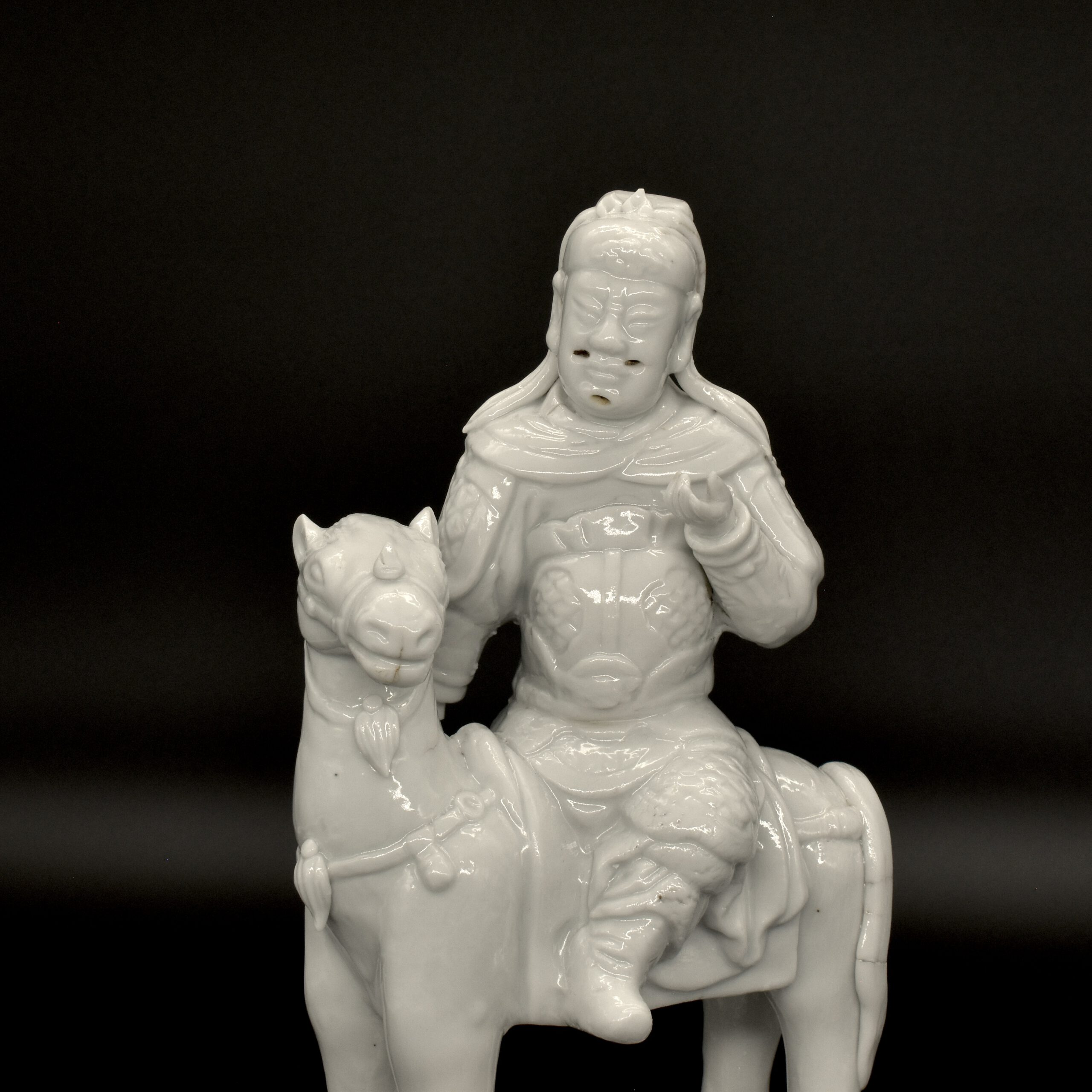
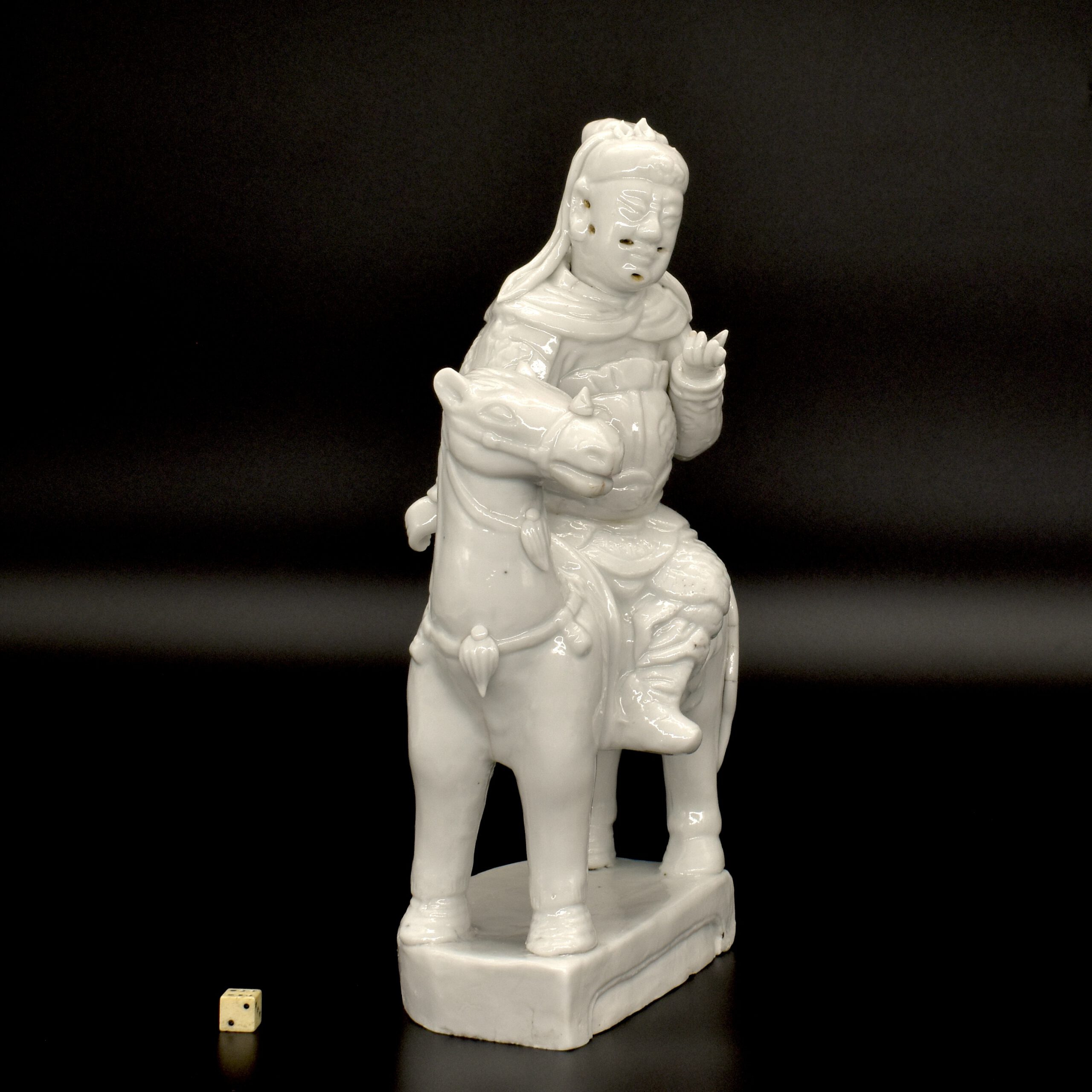
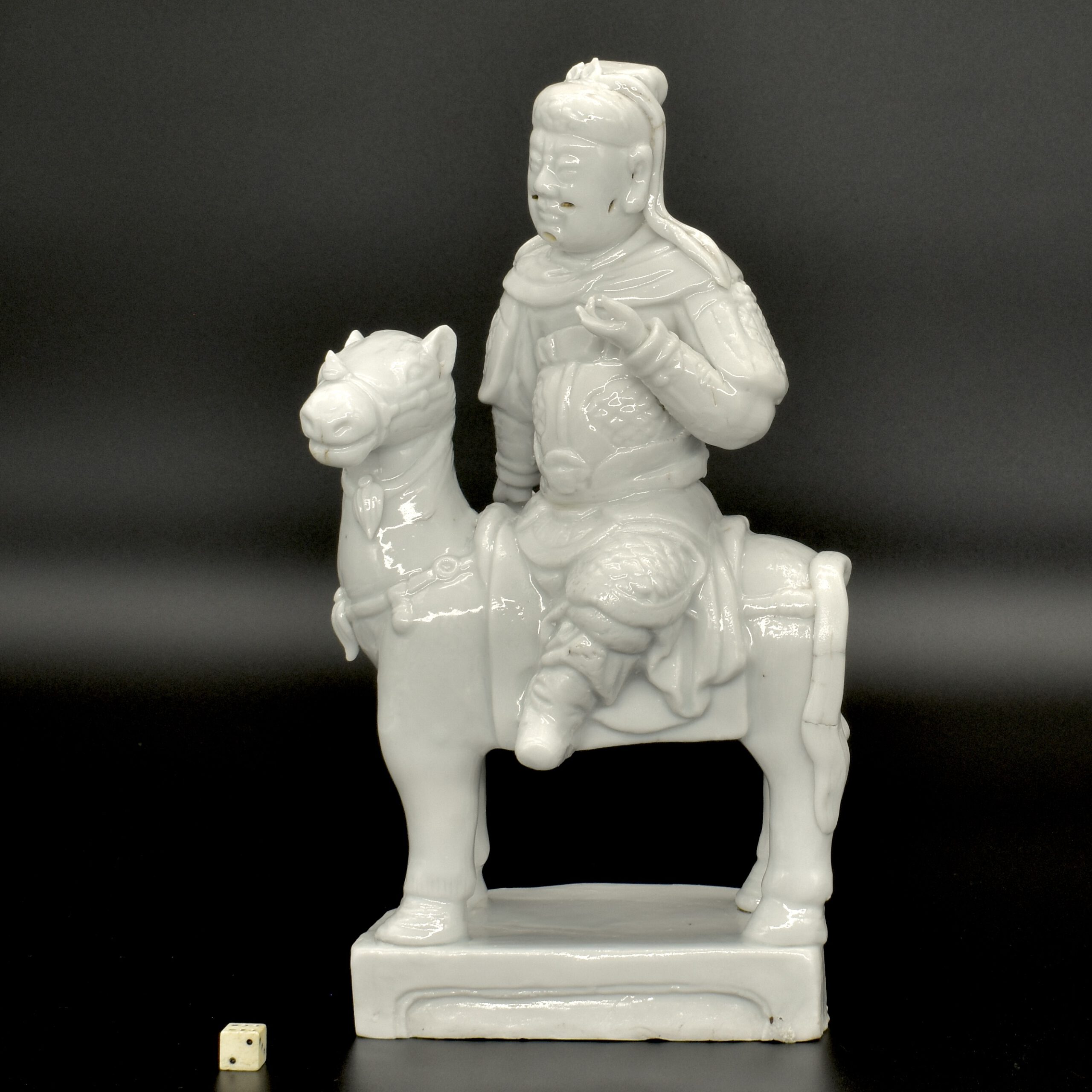
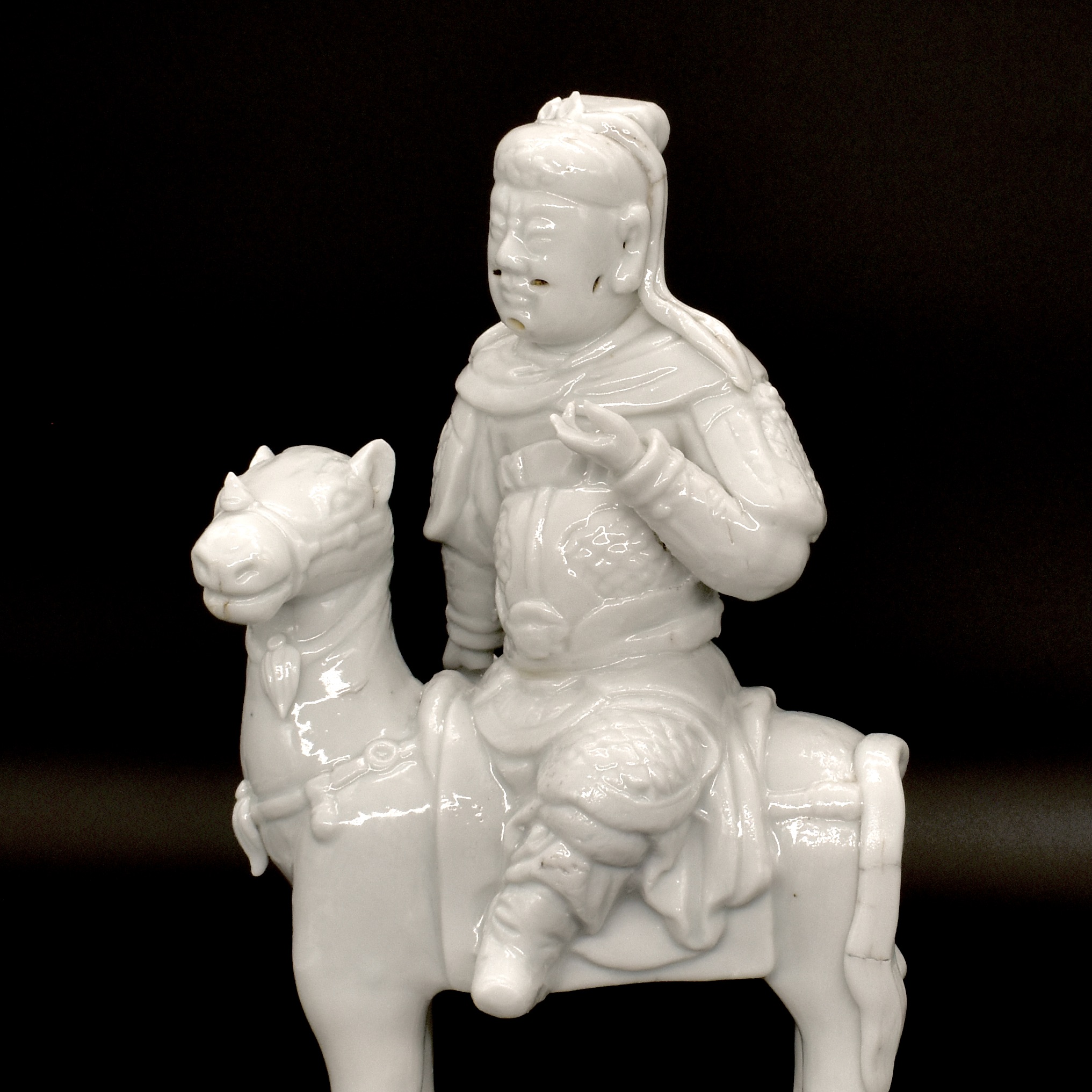
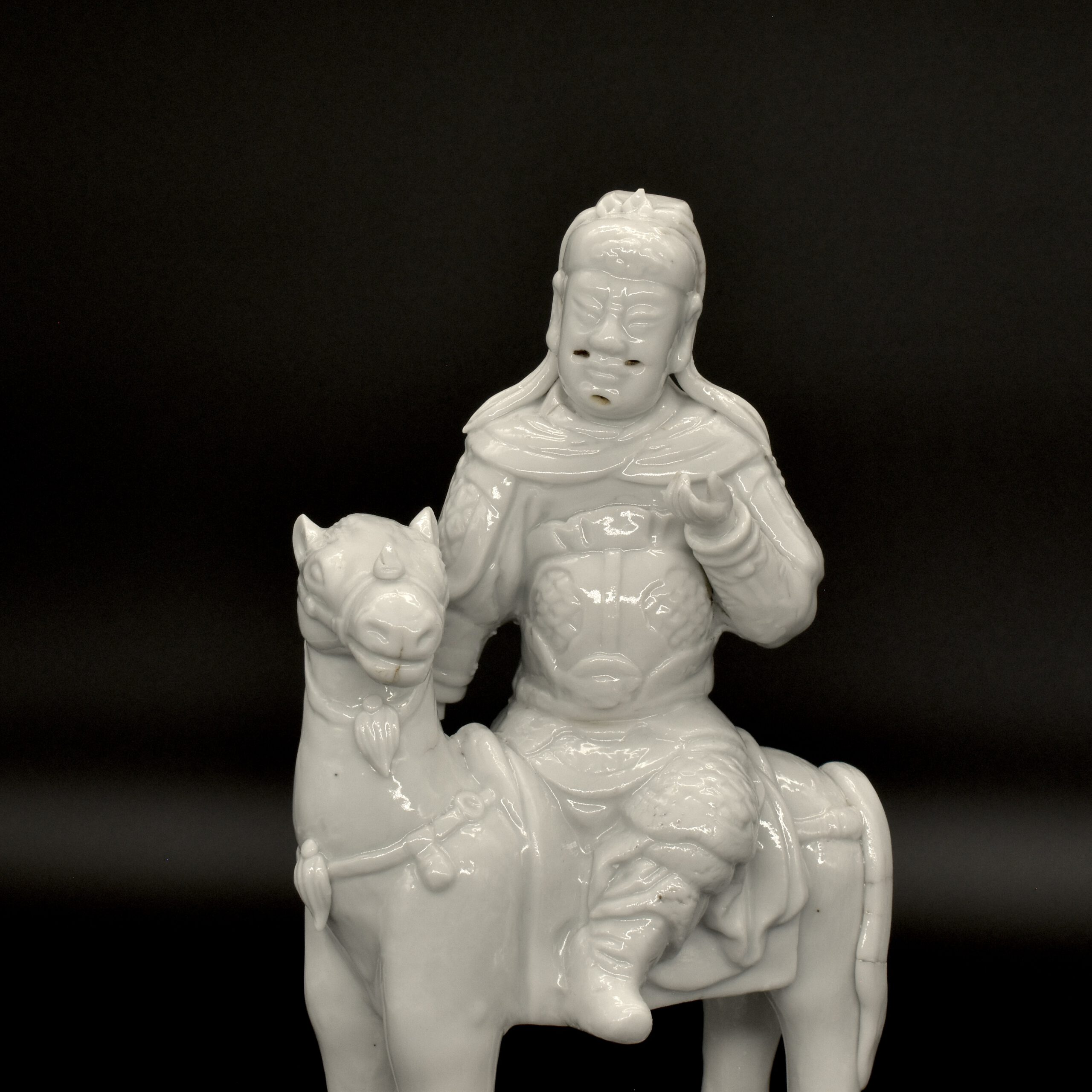
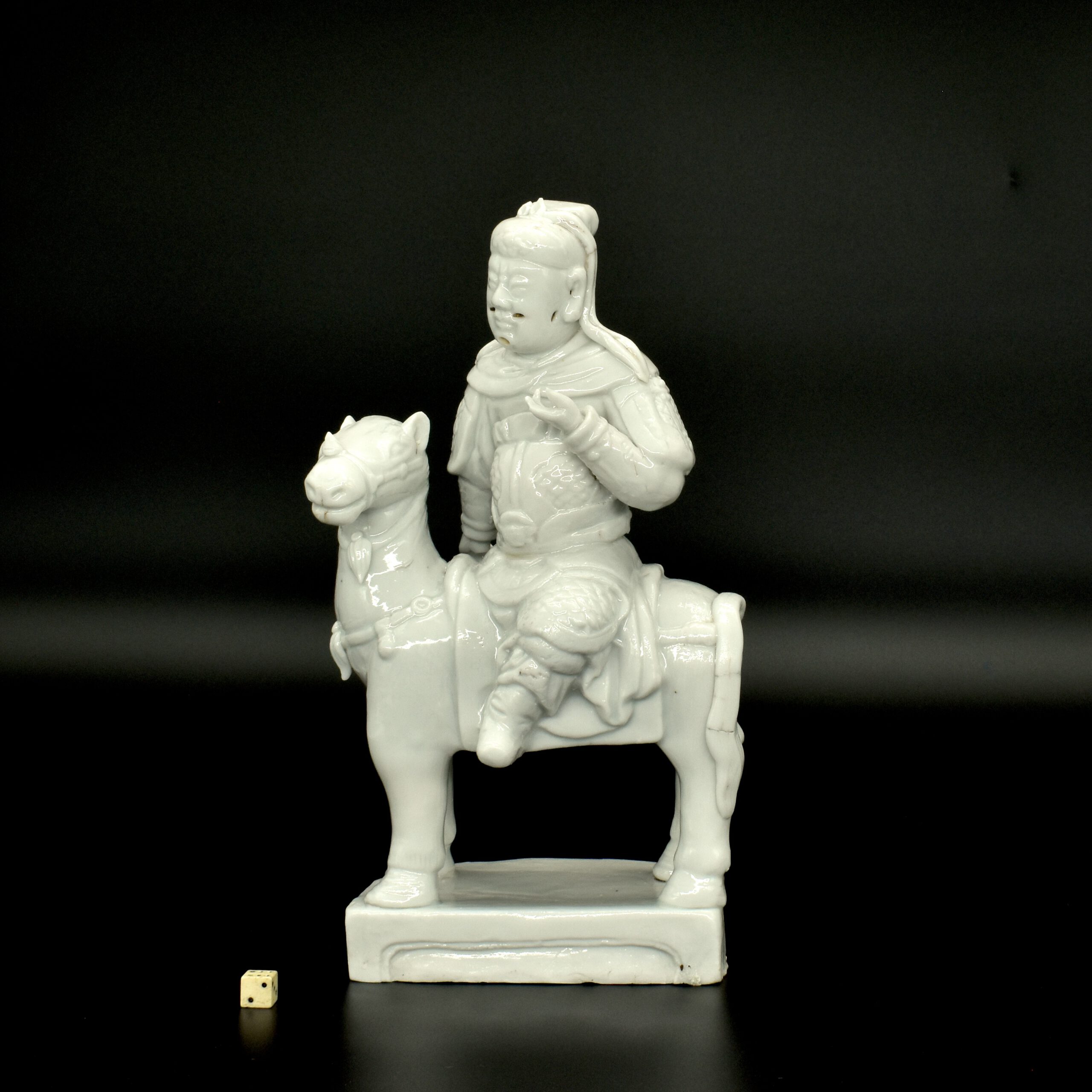
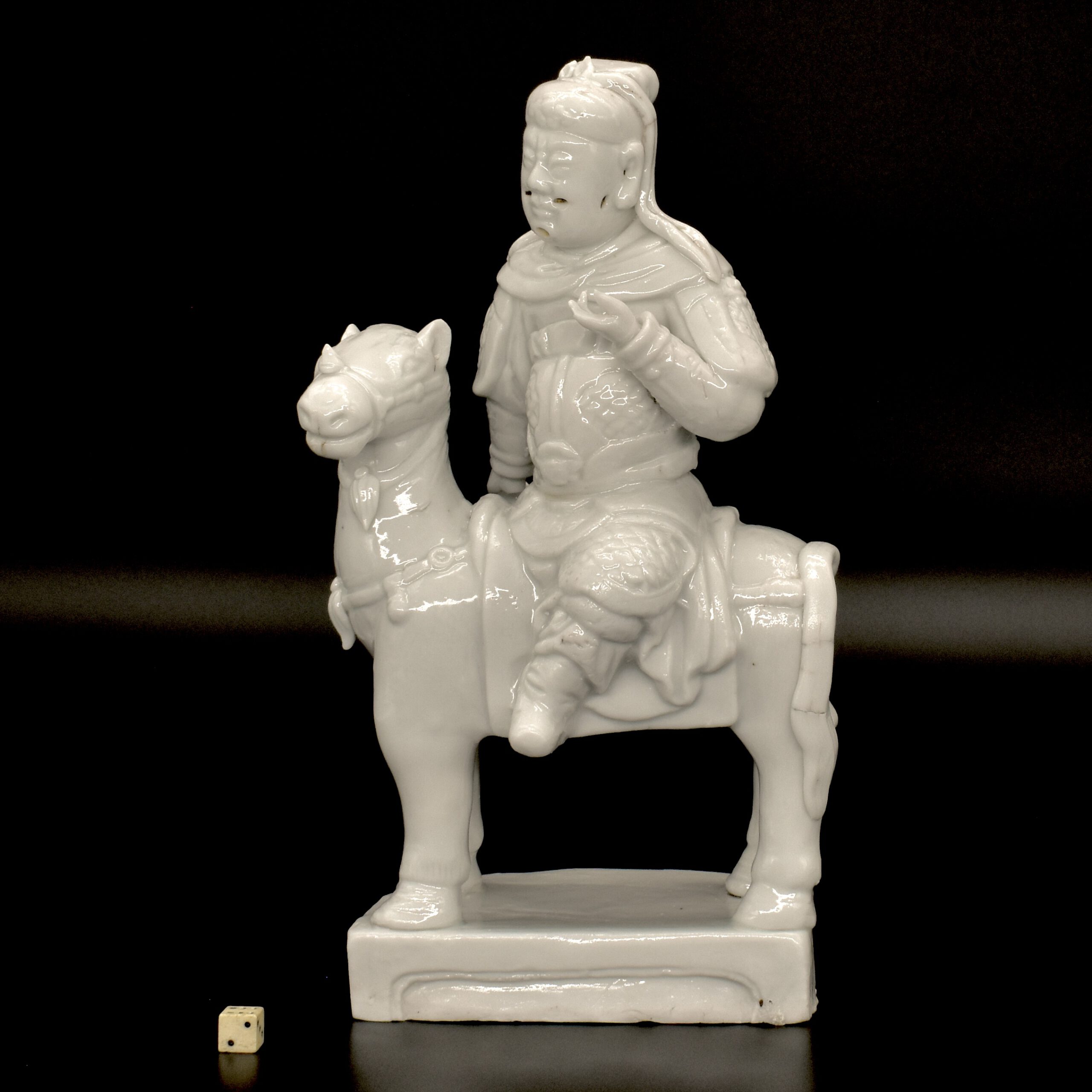
A Kangxi Blanc de Chine Model of Guan Yu Ridding his Horse.
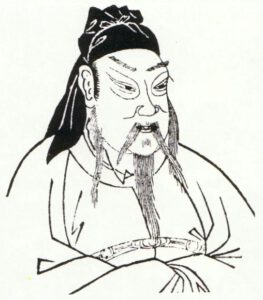
A Kangxi Blanc de Chine Model of Guan Yu, sometimes called Guandi, God of War, ridding his horse Chitu (Crimson Hare). Blanc de Chine Porcelain, made at Dehua in Fujian province, late Kangxi period c.1690-1720. This heavily potted Blanc de Chine model of the fearless God of War, was probably made for export to the West. It would not have been understood in England, except that it is a curiosity from a distant land. In China, the God of War was well known and the meaning of this group would have been understood by many people. The horse, which perhaps should be better described as a pony, with Guan Yu is a depiction of a real person. Guan Yu was a courageous fighter who died in January or February 220. His exploits during the late Han Dynasty were famous, his fame grow and grew after his death, culminating in important Chinese Classic Romance of the Three Kingdoms written in the 14th century and attributed to Luo Guanzhong.
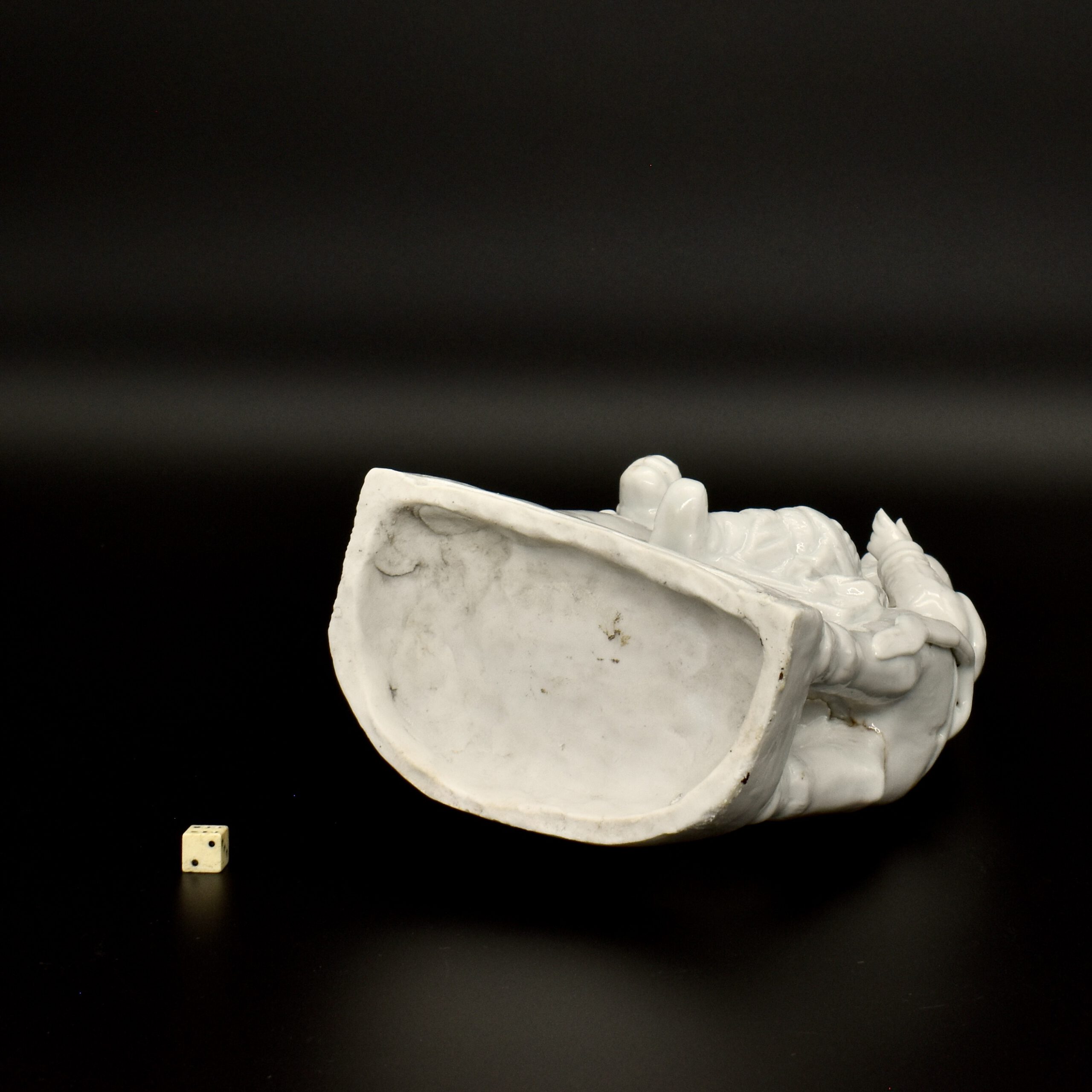
Blanc de Chine Models such as the present example were luted together from moulded sections. In 18th century England the people who carried out this process were called ‘repairers’, indeed the process is similar to repairing broken ceramics, except that you use clay as your glue. Wet clay was used to stick the leather-hard moulded sections together, the process is referred to as luting from the Latin Lutum meaning mud or clay. To help made sure the join will be as strong as possible the edges of the clay sections are scored, so the luting material really binds with the joining surfaces, especially when firm pressure is applied. The luted joins are then cleaned, smoothed down, so the piece looks seamless.
SOLD
See Below For More Photographs and Information.
- Condition
- In very good condition, one chip to a finger on his raised hand c.1 mm. The thumb of his right hand, which is extended away from the horses head is missing. Minor firing cracks. There are holes made on Guan Yu's face which would have had real hair attached.
- Size
- Height 23.4 cm (9 1/4 inches). Length 12.6 cm (5 inches).
- Provenance
- from an English private collection, West Yorkshire, formed in the 1970s and 1980s.
- Stock number
- 27333
Photos
Information
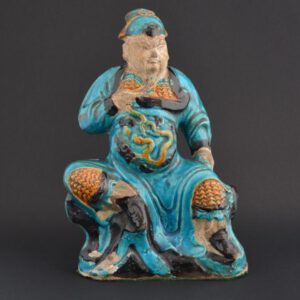
A Jiajing or Wanli Pottery Model of Guandi / Guan Yu.
Robert McPherson Antiques : Sold Archive 24347.
SOLD
Condition
n very good condition. The thin glaze has come away from the body in a few places, notably on the right side of Guandi below his raised leg. There are other smaller areas of glaze loss.
Size
Height : 28 cm (11 inches).
Stock number
24347
References
For a Ming model of Buddha on his throne of the same type of pottery but a very different model and glaze colouring dated `Wanli, 12th Year (1584), 5th Month, Auspicious Day` see our `Sold Items` number 23133.
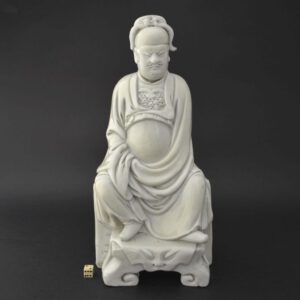
A Ming Blanc de Chine Model of Guandi / Guan Yu.
Robert McPherson Antiques : Sold Archive 24768
SOLD
Condition
The back of the figure is missing part of his throne, this has been removed and the surface polished. One side of the ribbon on his hat is missing and the two ribbon ends at the top of his hat are chipped. The back has numerous firing marks.
Size
Height : 25 cm (10 inches).
Stock number
24768
References
For a similar Ming porcelain Blanc de Chine model of Guandi dated to c.1620 -1640 see : Blanc de Chine (Introduction by John Ayers, S.Marchant & Son, 2006. ISBN 0-9554009-0-2) page 43, plate 22.
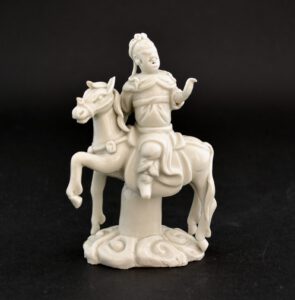
A Ming Blanc de Chine Model of Guandi / Guan Yu.
Robert McPherson Antiques : Sold Archive 24591.
SOLD
Condition
Very good, minor losses including the end of one of 'Red Hare's' ears.
Size
Height : 12 cm (4 3/4 inches)
Stock number
242591
References
For a very similar but larger (21 cm) Ming Blanc de Chine Porcelain group see : Blanc de Chine (Introduction by John Ayers, S.Marchant & Son, 2006. ISBN 0-9554009-0-2) page 42, plate 21. For another Blanc de Chine figure of this type dated to the 17th Century see : Blanc de Chine, Divine Images in Porcelain (John Ayres, China Institute Gallery, New York, 2002) page 96, plate 47.
Blanc de Chine Porcelain :
The porcelain known in the West as Blanc de Chine was produced 300 miles south of the main Chinese kiln complex of Jingdezhen. The term refers to the fine grain white porcelain made at the kilns situated near Dehua in the coastal province of Fujian, these kilns also produced other types of porcelain. A rather freely painted blue and white ware, porcelain with brightly coloured `Swatow` type enamels as well as pieces with a brown iron-rich glaze. However it is the white blanc de Chine wares that have made these kilns famous. The quality and colour achieved by the Dehua potters was partly due to the local porcelain stone, it was unusually pure and was used without kaolin being added. This, combined with a low iron content and other chemical factors within the body as well as the glaze, enabled the potters to produce superb ivory-white porcelain.
Kangxi Blanc de Chine Horse.
Robert McPherson - Sold Archive 25668.
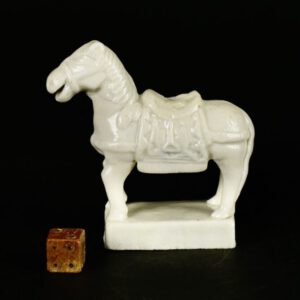
Models such as the present example were luted together from moulded sections. In 18th century England the people who carried out this process were called ‘repairers’, indeed the process is similar to repairing broken ceramics, except that you use clay as your glue. Wet clay was used to stick the leather-hard moulded sections together, the process is referred to as luting from the Latin Lutum meaning mud or clay. To help made sure the join will be as strong as possible the edges of the clay sections are scored, so the luting material really binds with the joining surfaces, especially when firm pressure is applied. The luted joins are then cleaned, smoothed down, so the piece looks seamless.
SOLD
Condition
There is a small crack to the neck of the horse.
Size
Height 8.2 cm (3 1/4 inches)
Provenance
From a Private English Collection of Blanc de Chine Porcelain.
Stock number
25668
References
For other Blanc de Chine models or 'toys' see : Oriental Export Market Porcelain and its Influence on European Wares (Geoffrey A. Godden, Granada, 1979.ISBN 0246110570) page 272, plate 200. Information from Godden`s book ; The records of the Dashwood sale in September 1703, an English Supra-cargo, include 10,800 `square toys` (seals), the other 5,400 `toys` were models of animals, `men on beasts` and the 490 `small white dogs` were priced at 1d each.
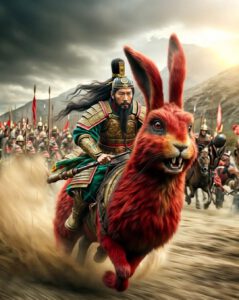
A Modern Interpretation of Guan Yu and His Horse Red Hare.
(We cannot vouch for the historical accuracy of this image).