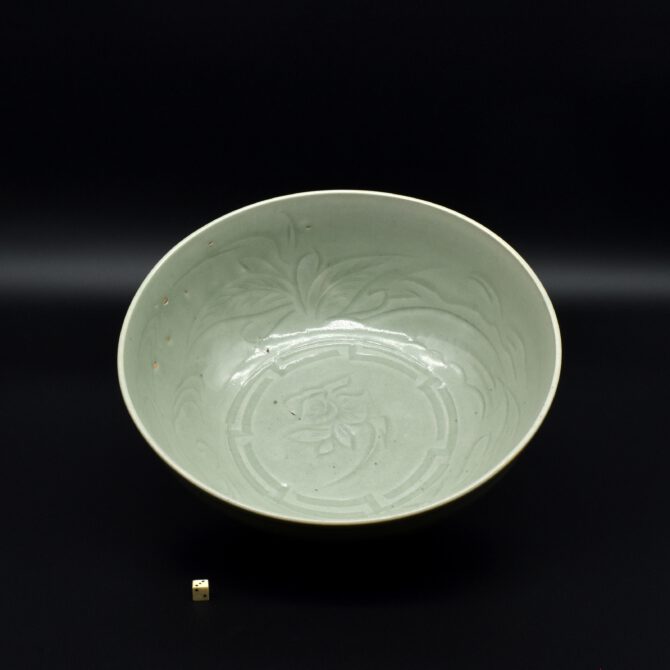
A Large Carved 17th Century Japanese Celadon Bowl.
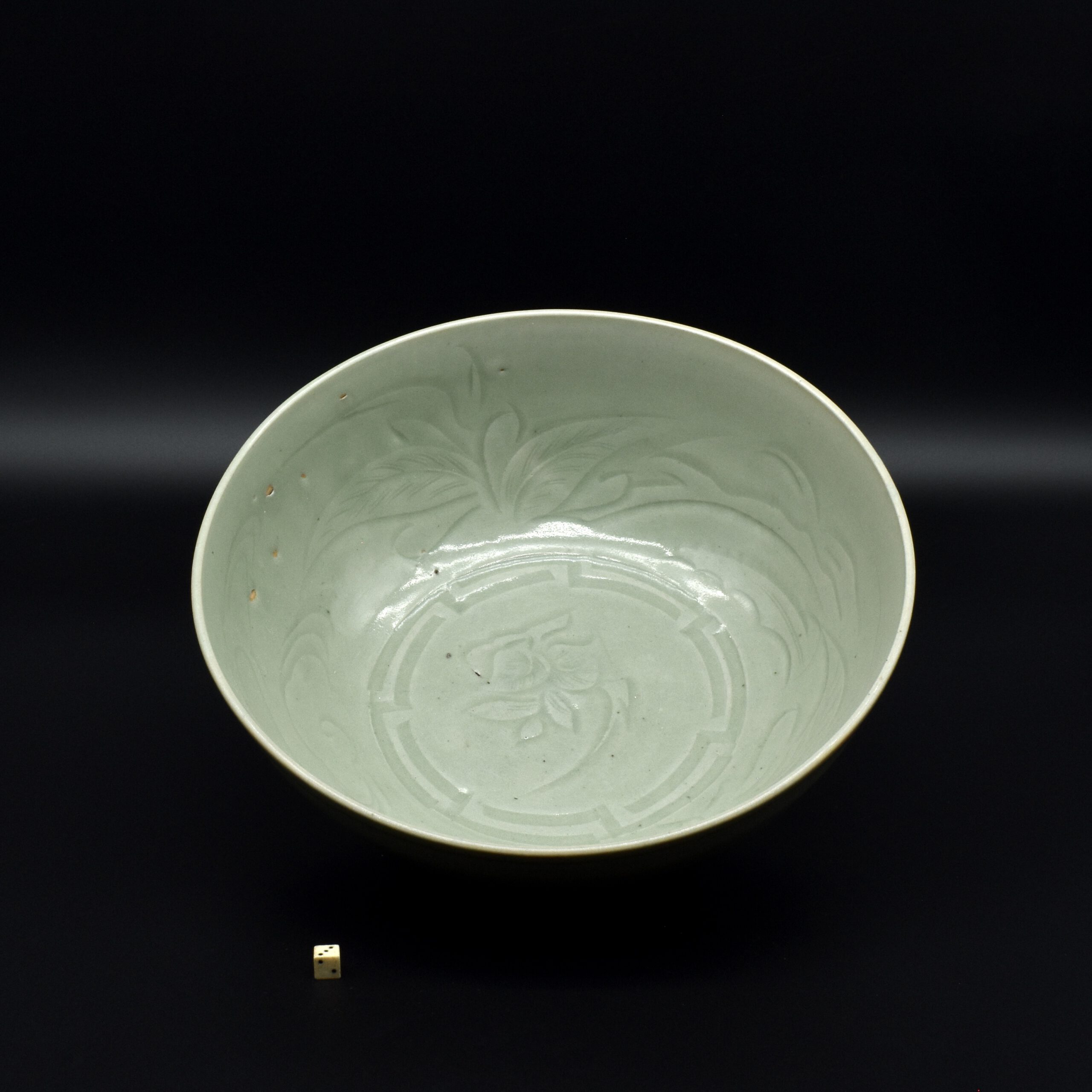
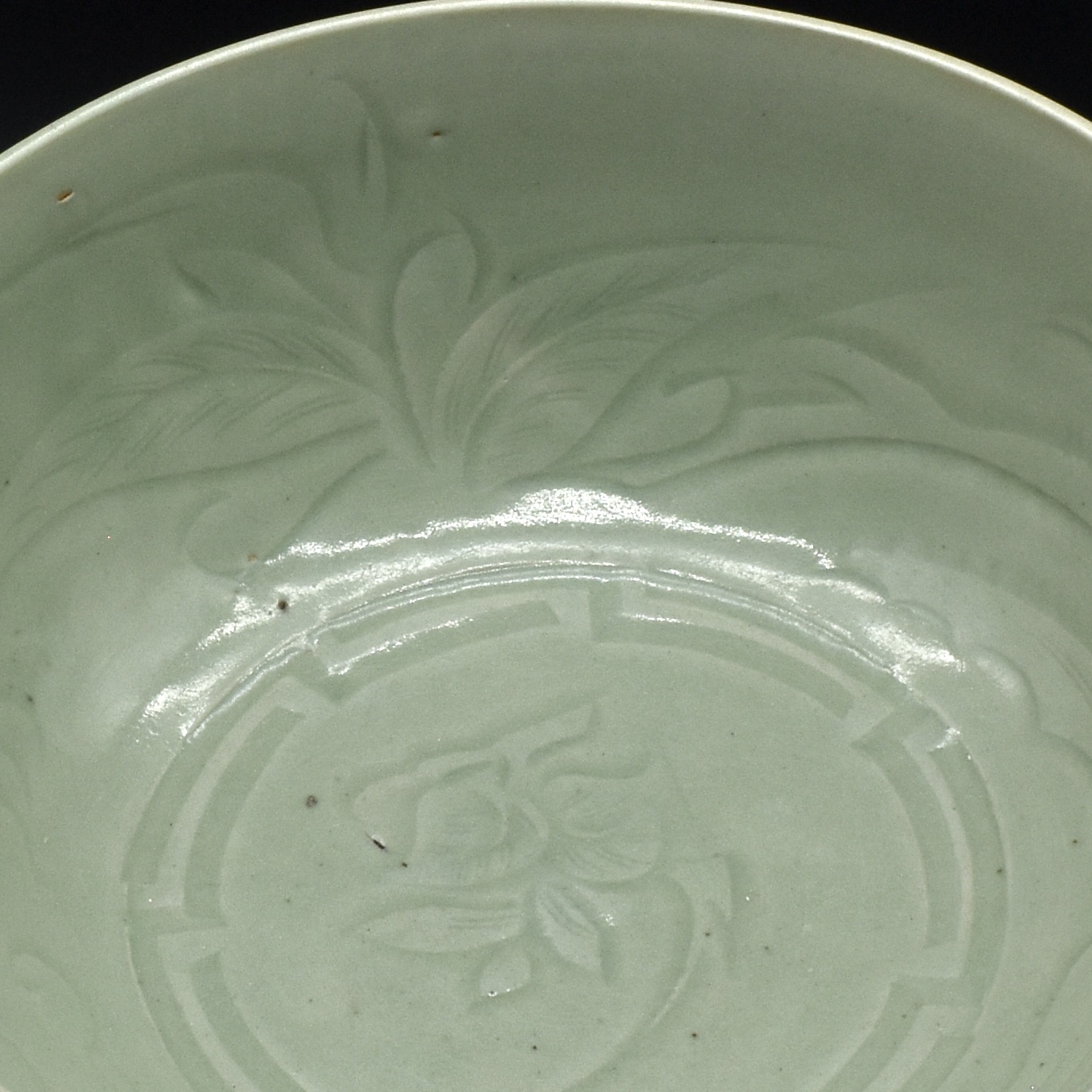
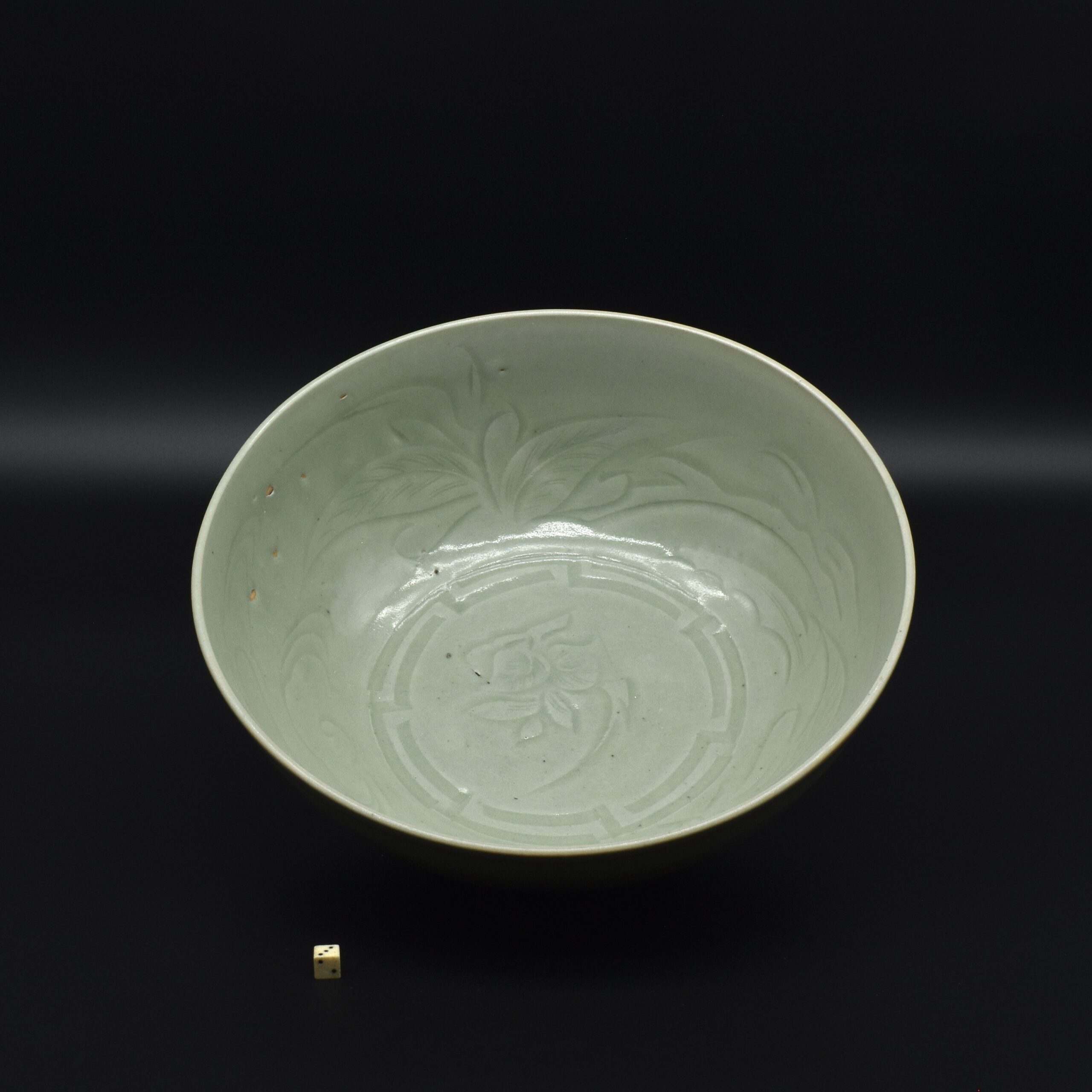
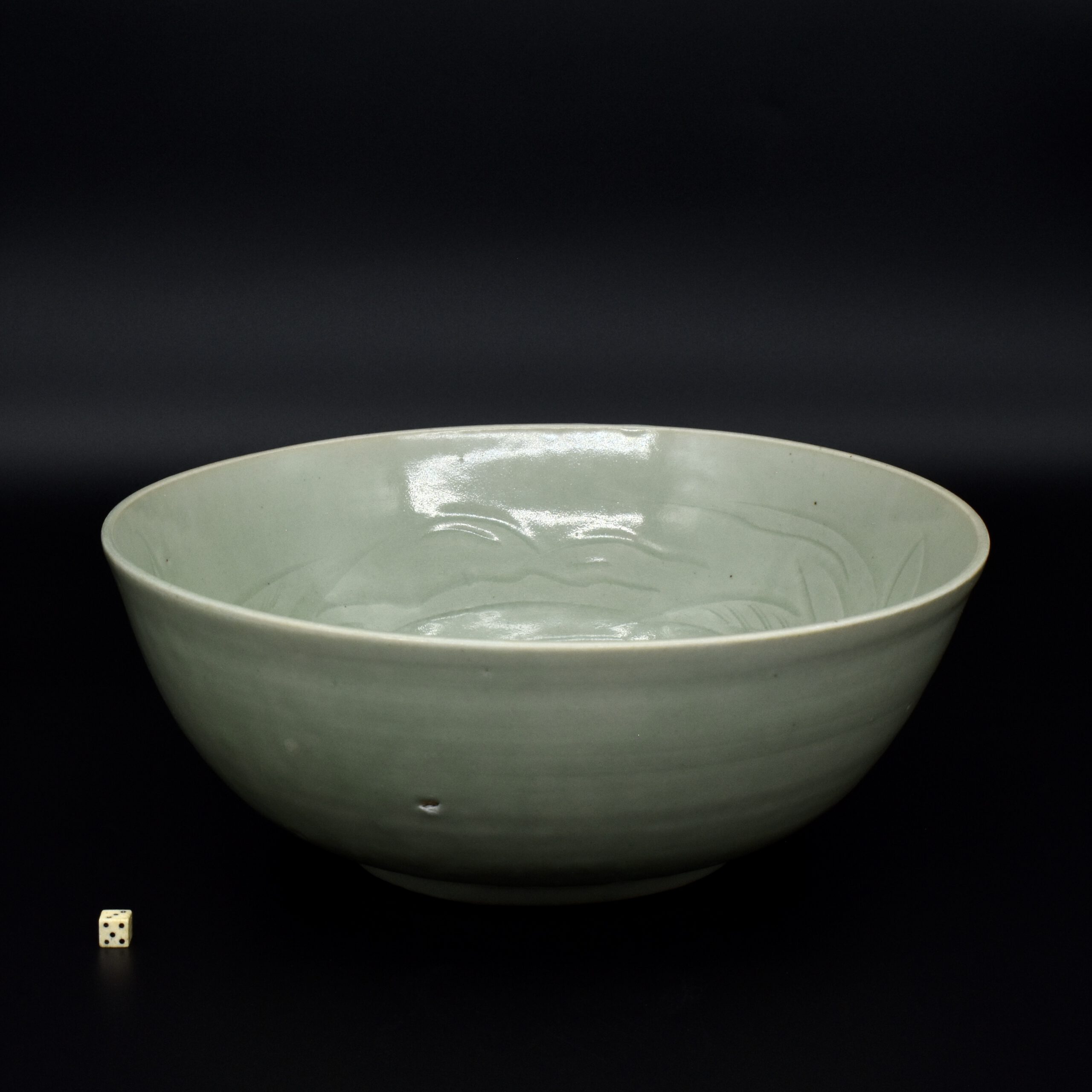
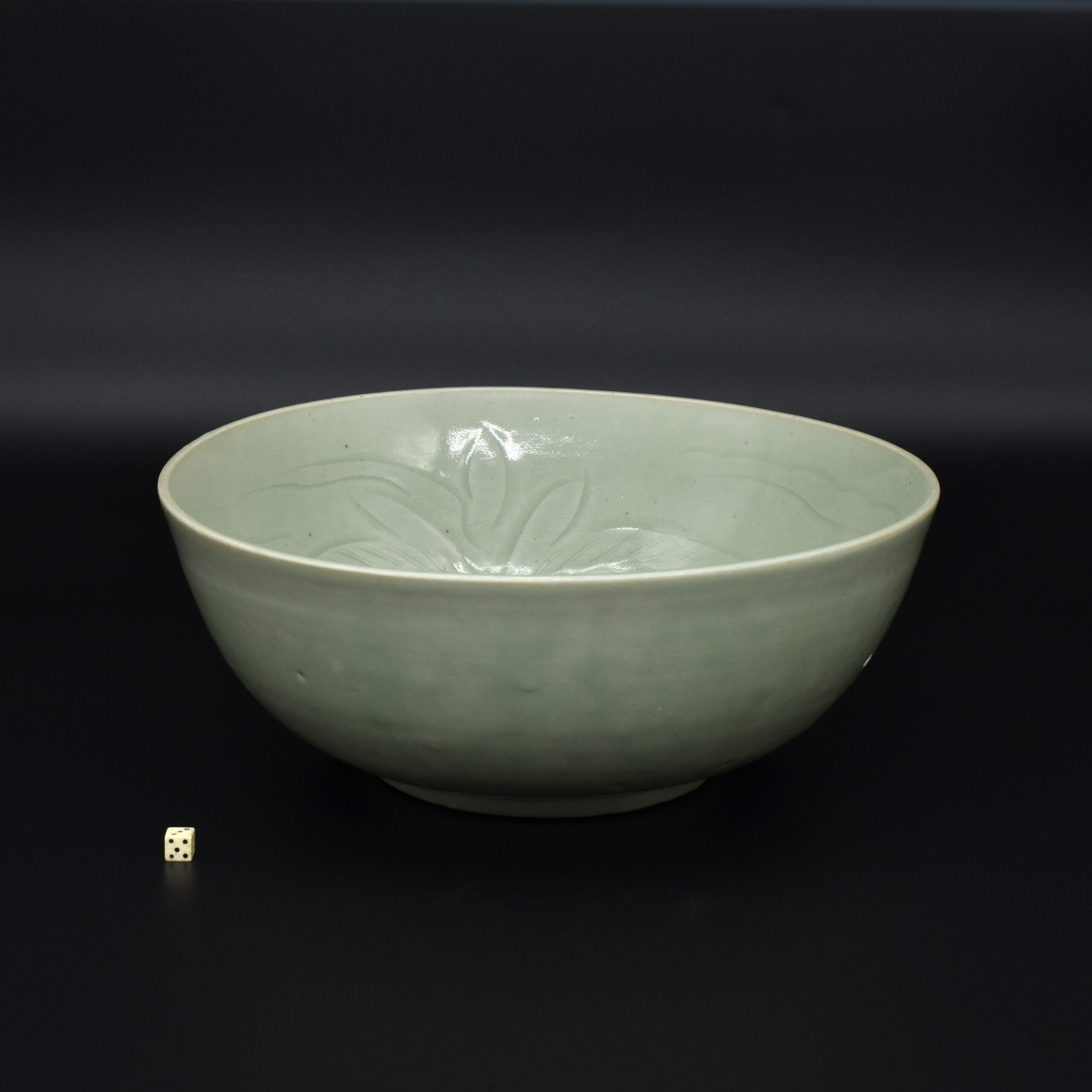
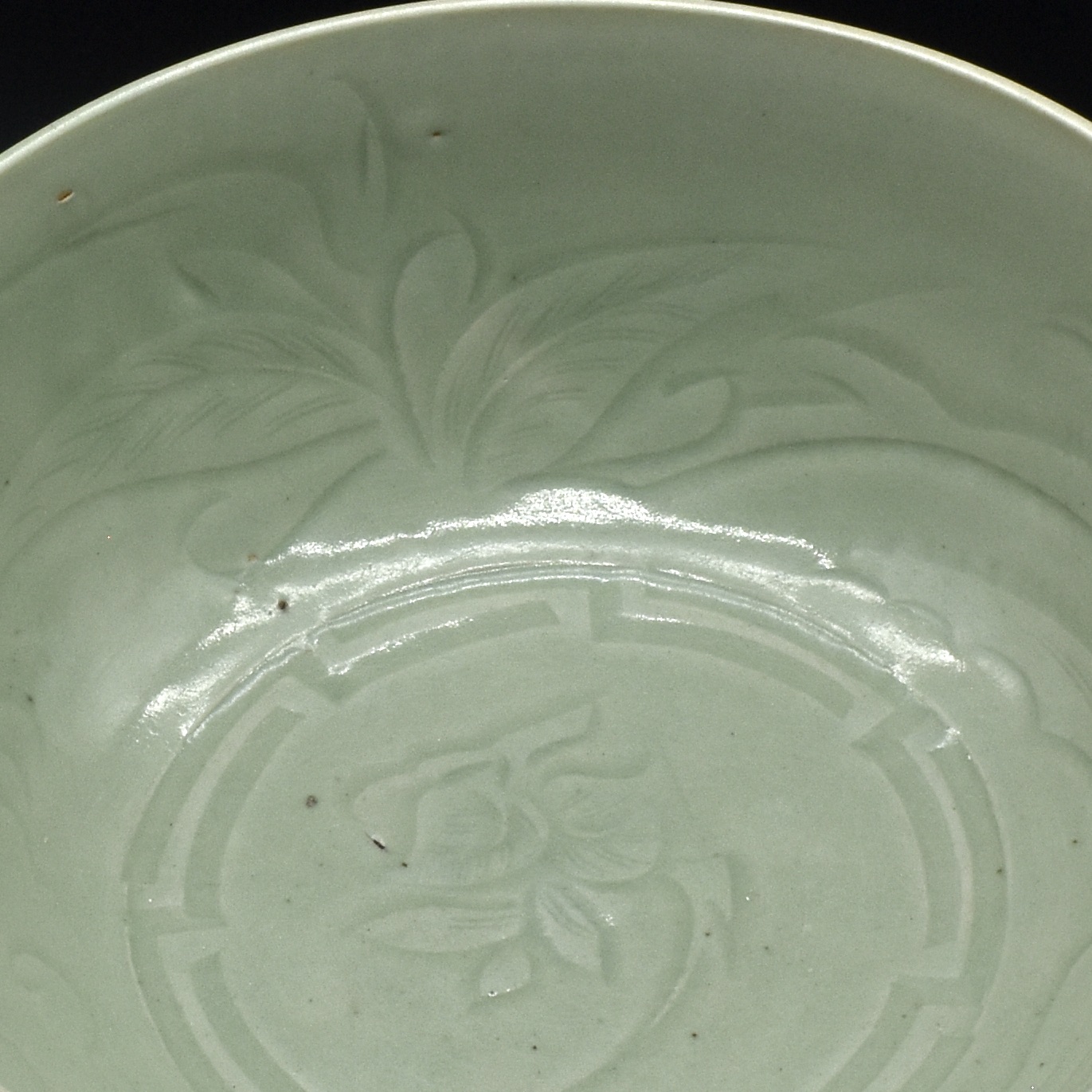
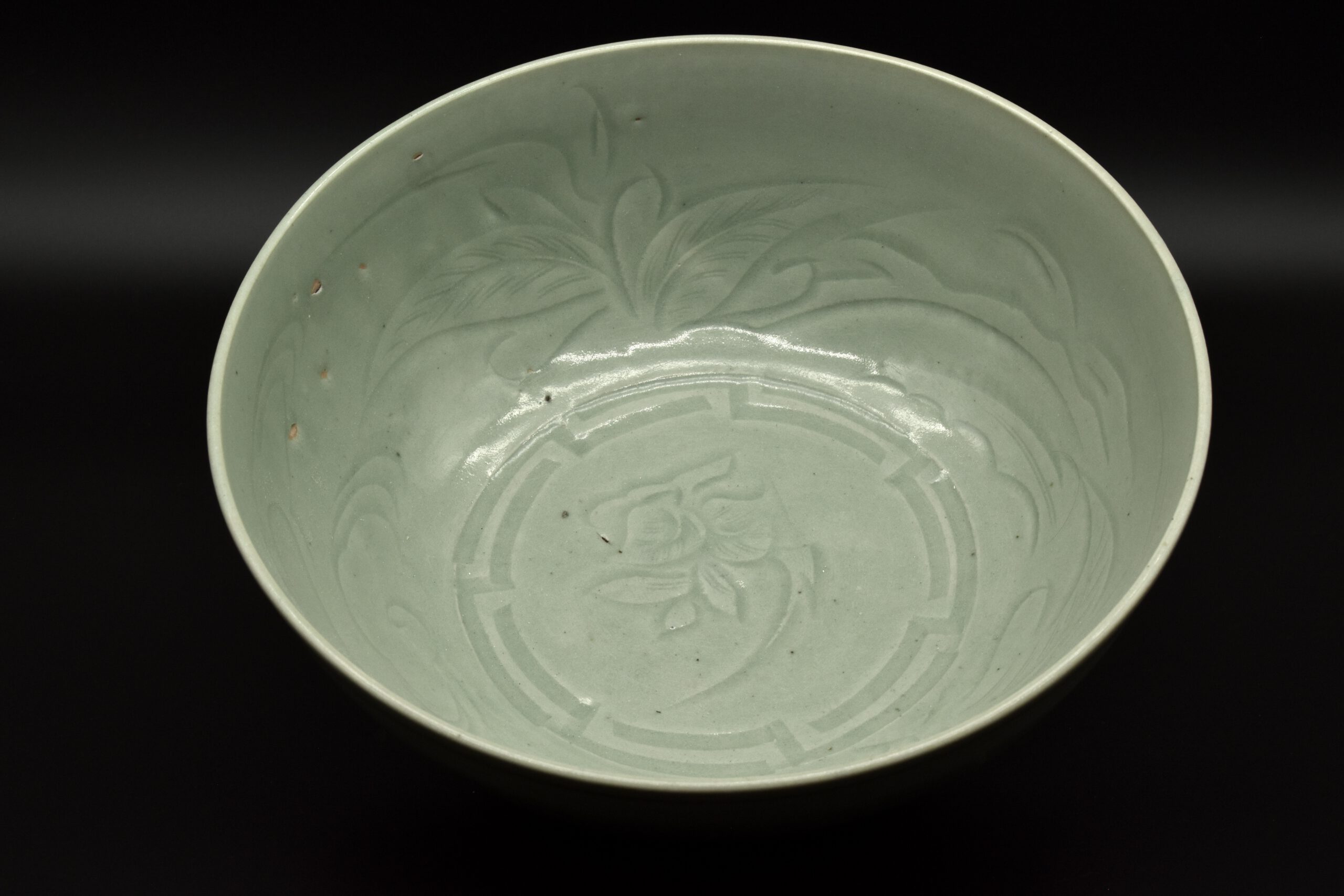
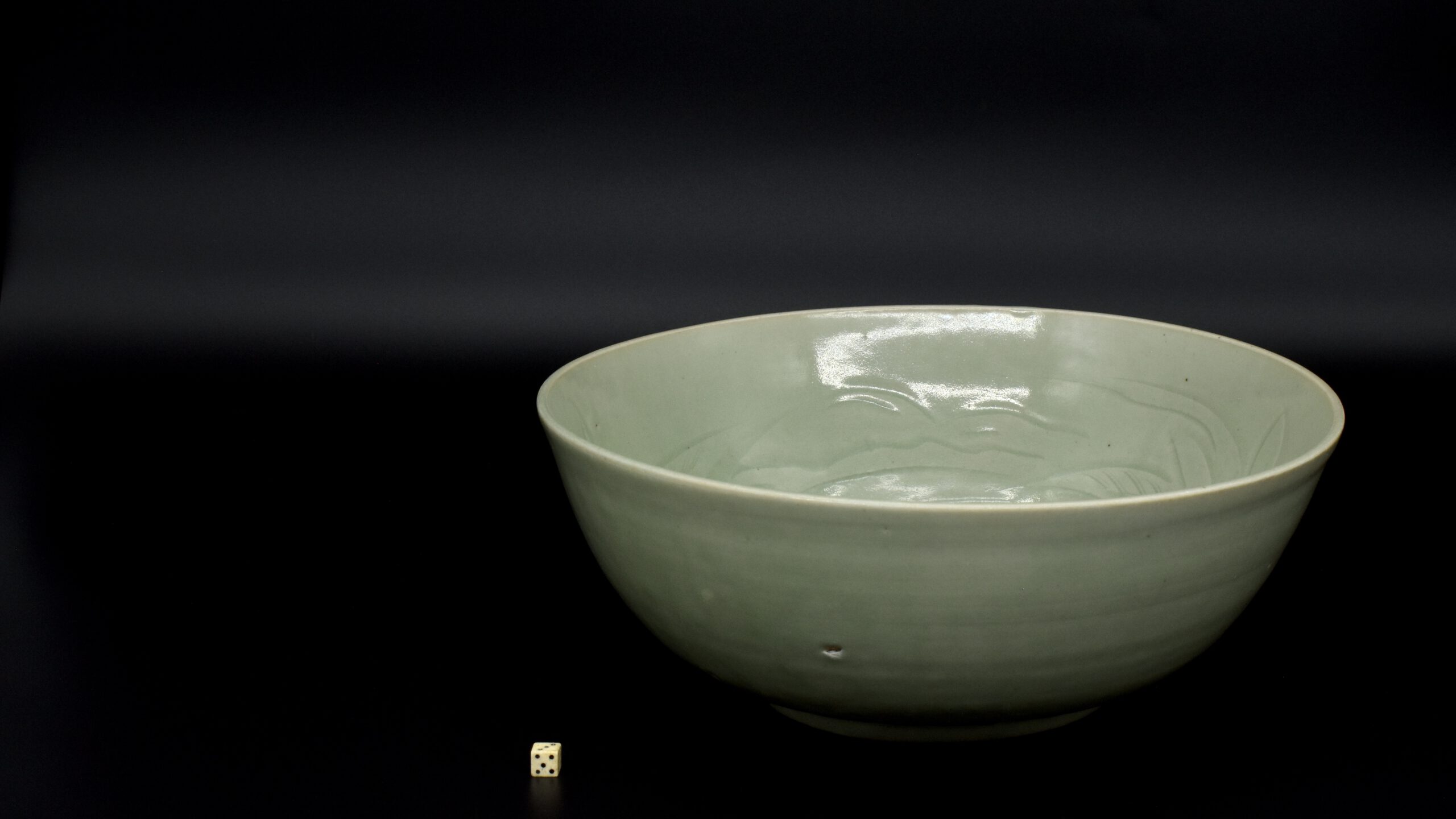
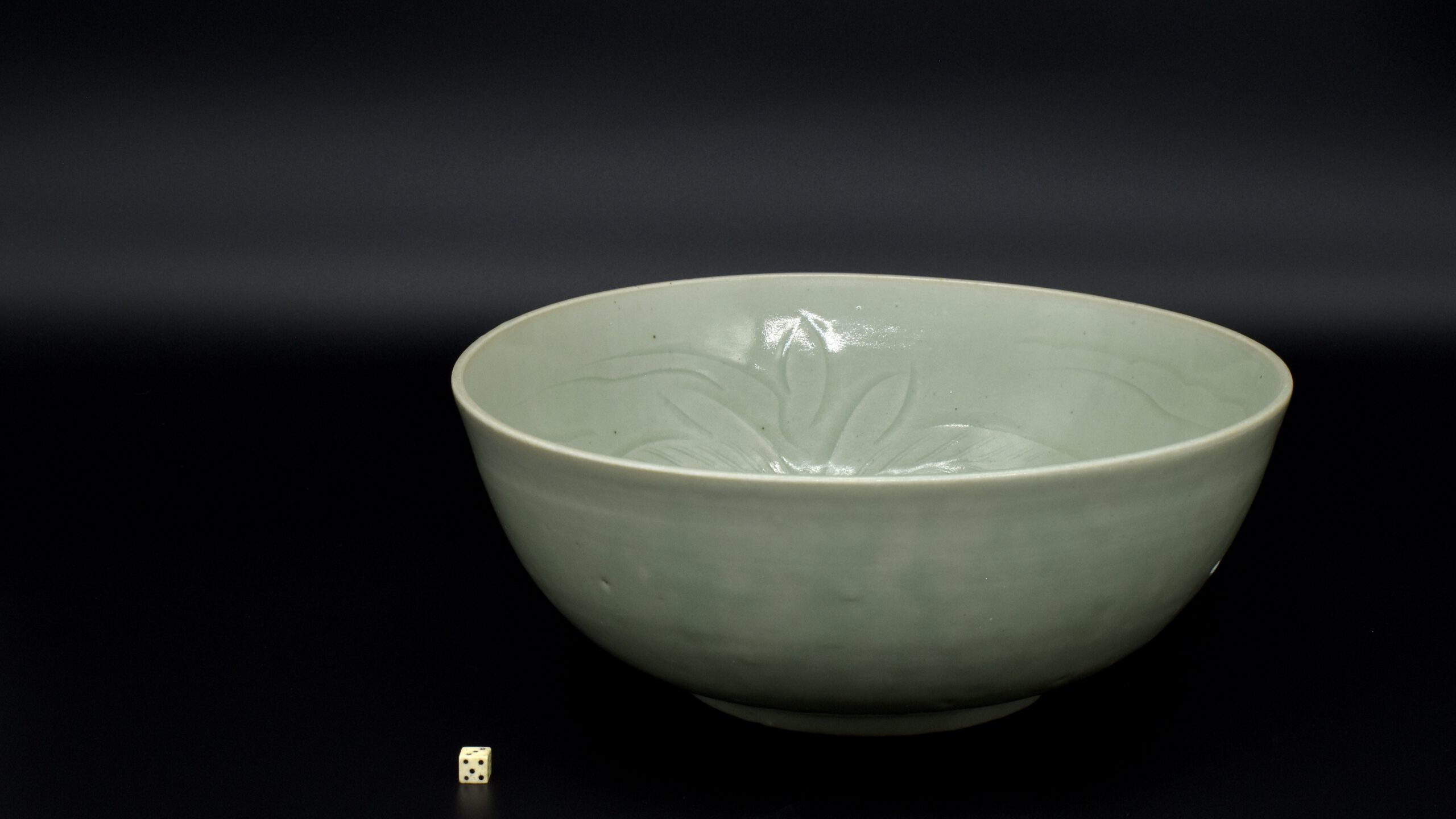
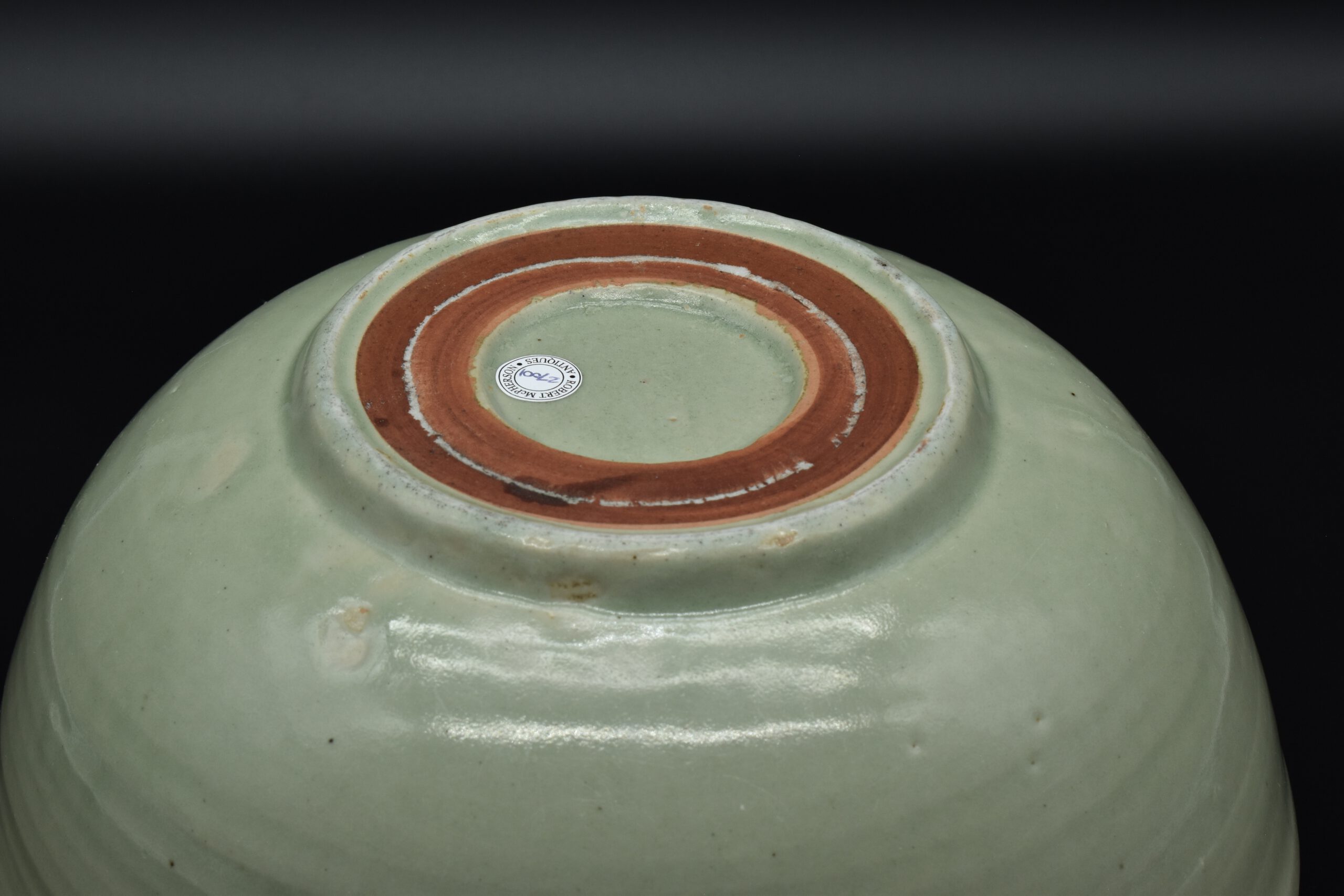
A Large Carved 17th Century Japanese Celadon or Seiji Bowl, Probably Hasami Kiln, Fudōyama kilns or Maruo kilns, Japan c.1650 – 1680. Japanese celadon ware was made at several kilns, the most well known was the Hasami Kiln, it seems that in Japan they sometimes refer to their celadon ware as ‘Hasami ware’. The present bowl has a very distinctive carved pattern to the well, this design is often found on large pieces of Japanese celadon. A large celadon porcelain dish fragment with this border was recovered from the Fudōyama kiln site. See The Early Kilns of Japan, Arita in the First Half of the Seventeenth Century in ‘References’ below. It is probable that this distinctive border was made at all three of the aforementioned Japanese celadon kilns. A very small number of Japanese celadon ware was exported to Indonesia and the Dutch Republic, but most pieces were made for the domestic market. This large deep heavy Seiji (celadon) bowl is typical of ‘Hasami ware’, however the base replicates those found on Chinese Longquan celadon. A wide circular ring is clearly visible on the base it is a rusty red-brown colour due to a thin layer of high iron-oxide (around 3 to 5%) glaze has been added. As well as being an acknowledgement, or tribute to the potters of Longquan in China, it also serves a practical function. A a thin circular kiln support was used, it is visible as a thin white line within the iron-oxide glaze wash. The carved and incised decoration shows two leafy plants, perhaps banana, in a landscape.
SOLD
See Below For More Photographs and Information
- Condition
- In excellent condition, some wear to the well, some burst bubbles.
- Size
- Diameter 27.6 cm (10.8 inches).
- Provenance
- N/A
- Stock number
- 27001
- References
- For a large celadon dish with very similar decoration see : The Early Kilns of Japan, Arita in the First Half of the Seventeenth Century in References. (Oliver Impey, Clarendon University Press Oxford 1996. ISBN 0-19-826370-8) plate 14 and for a fragment found at the Fudōyama kilns see page 61, d. For a large dish with similar decoration dated to
Photos
Information
A Japanese 17th Celadon Century kōro or Beaker c.1650-1670.
Robert McPherson Antiques, Sold Archive Number 26077.
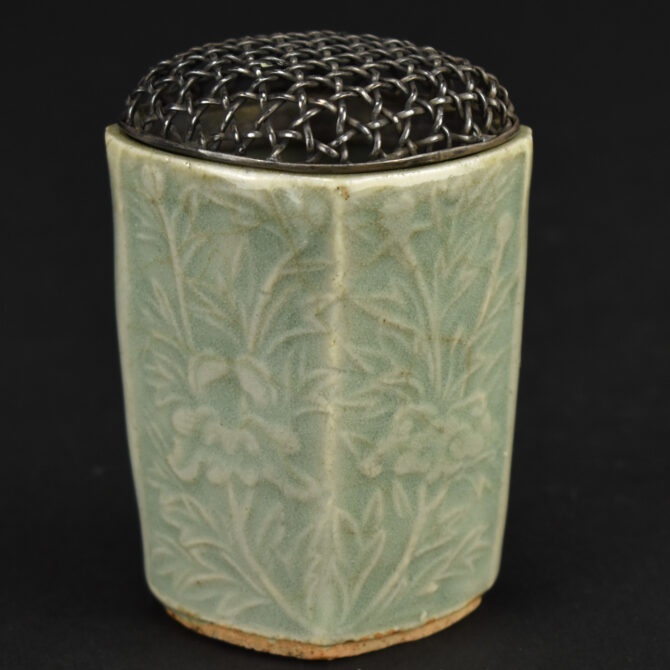
A Japanese 17th Celadon Century kōro or Beaker c.1650-1670. This small lozenge form object has four moulded panels, each depicting a flowering plant, these panels are divided in two two by broad plain ridges. The biscuit base is flat and recessed from the main glazed body. The silver coloured (unmarked silver and of a later date) basket-weave cover indicates that at some point in its life it was used as a kōro. A kōro is a Japanese censer, much used in tea ceremonies. It was purchased as being Ming celadon, early 16th century, see provenance.
- Condition Crazed, one of the crazed lines is probably a crack as it is visible on both sides.
- Size height 6.4 cm (2 1/2 inches).
- Provenance Kunsthandel Aalderink B.V. (Established in 1929) Spiegelgracht 15, Amsterdam 17th November 2018. Described on the invoice as being from China and dating to the early 16th century, sold for €4,750P.J. Stolk collection.
- Stock number 26077
- References For a almost identical example dated to c.1650-1670 see : Complete Catalogue of Shibata Collection (Contributors Saga Kenritsu Kyūshū Tōji Bunkakan. Published by the Kyushu Ceramic Museum, 1990) page 93, plate 0681.
A Rare Early Japanese Celadon Porcelain Cup Stand, perhaps Mitsunomata Kiln, Nagasaki prefecture, Hasami ware c.1630-1640.
Robert McPherson Antiques, Sold Archive Number 27372.
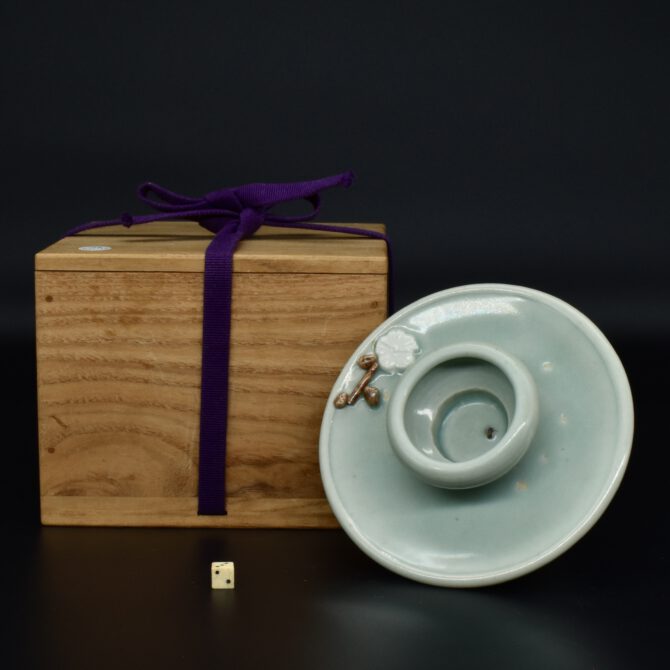
A Rare Early Japanese Celadon Porcelain Cup Stand, perhaps Mitsunomata Kiln, Nagasaki prefecture, Hasami ware c.1630-1640. A flat tripod stand which is related, but of a very different shape, is in the Kyushu Ceramic Museum (see references below). This stand has a pale celadon glaze, it’s rather unevenly applied and relatively thin. This Japanese celadon stand has a different look to Chinese celadons from the Longquan kiln, in that it lacks the fine suffused bubbles of Chinese celadons. The bubbles are often said to make the celadon look softer, as the tiny bubbles bounce back the light in a scattered way. However, this very early Japanese celadon looks soft, almost creamy due to the bright white porcelain shining through. This is cup stand, but that doesn’t necessary mean a celadon cup would have been made for this stand. Stands sometimes had different cups, I once had a Chinese Mingqi cup with stand made as one piece glazed together with the cup, the stand was brown and the cup white. Sometimes stands had cups made from different materials. That isn’t to say the present example didn’t have a Hasami ware celadon cup made for it. The present stand, has a moulded prunus flower with an iron 0xide decorated stalk and three flower buds .
- Condition There is a fine crack to the rim, see the last two photographs.
- Size Diameter 13.5 cm (5.3 inches). Height 8.7 cm (3.4 inches).
- Stock number 27372
- References : A flat stand which is closely related but of a a very different shape, is in the Kyushu Ceramic Museum, see : The Kyushu Ceramic Museum Collection (Published by The Kyushu Ceramic Museum, Printed by Seibundo Printing Co. Ltd, March 31st, 1987). Page 89, plate 111.