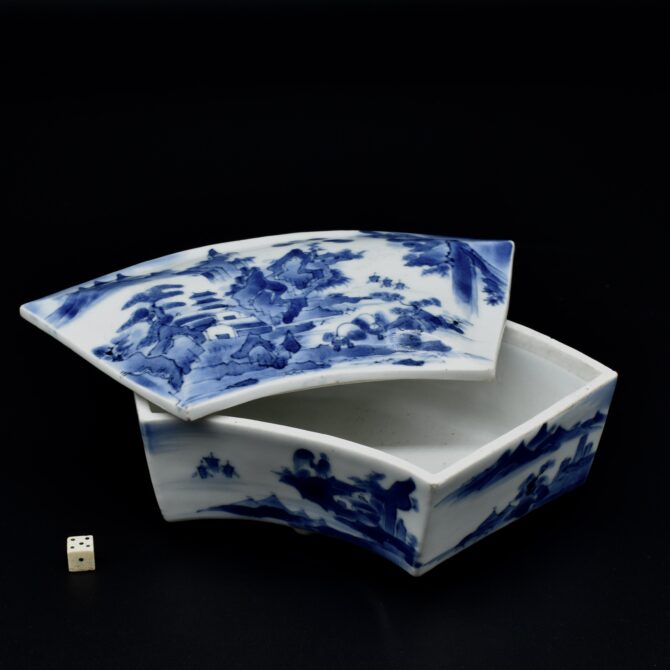
A Rare 17th Century Japanese Porcelain Fan Shaped Box and Cover, Kakiemon or Perhaps Arita.
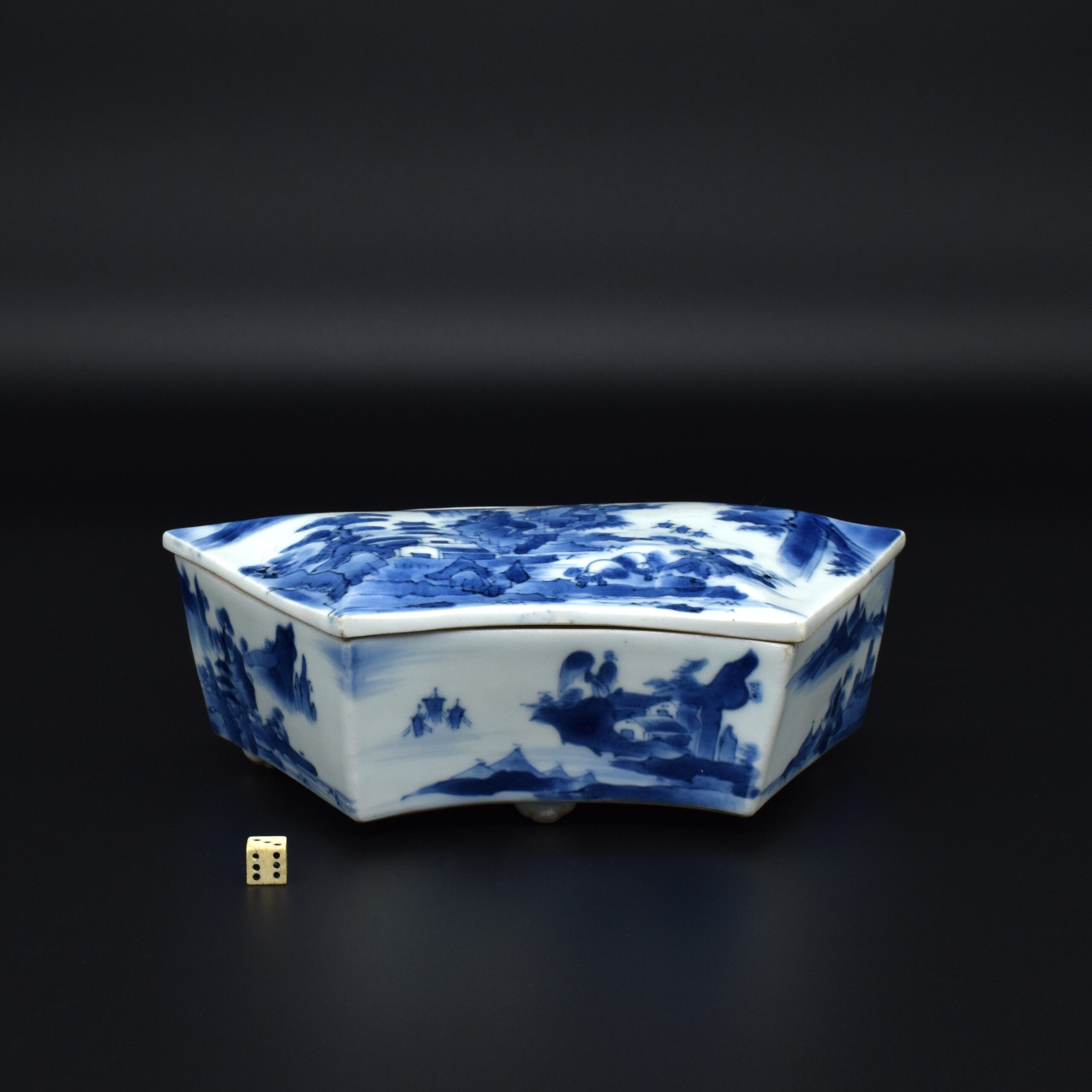
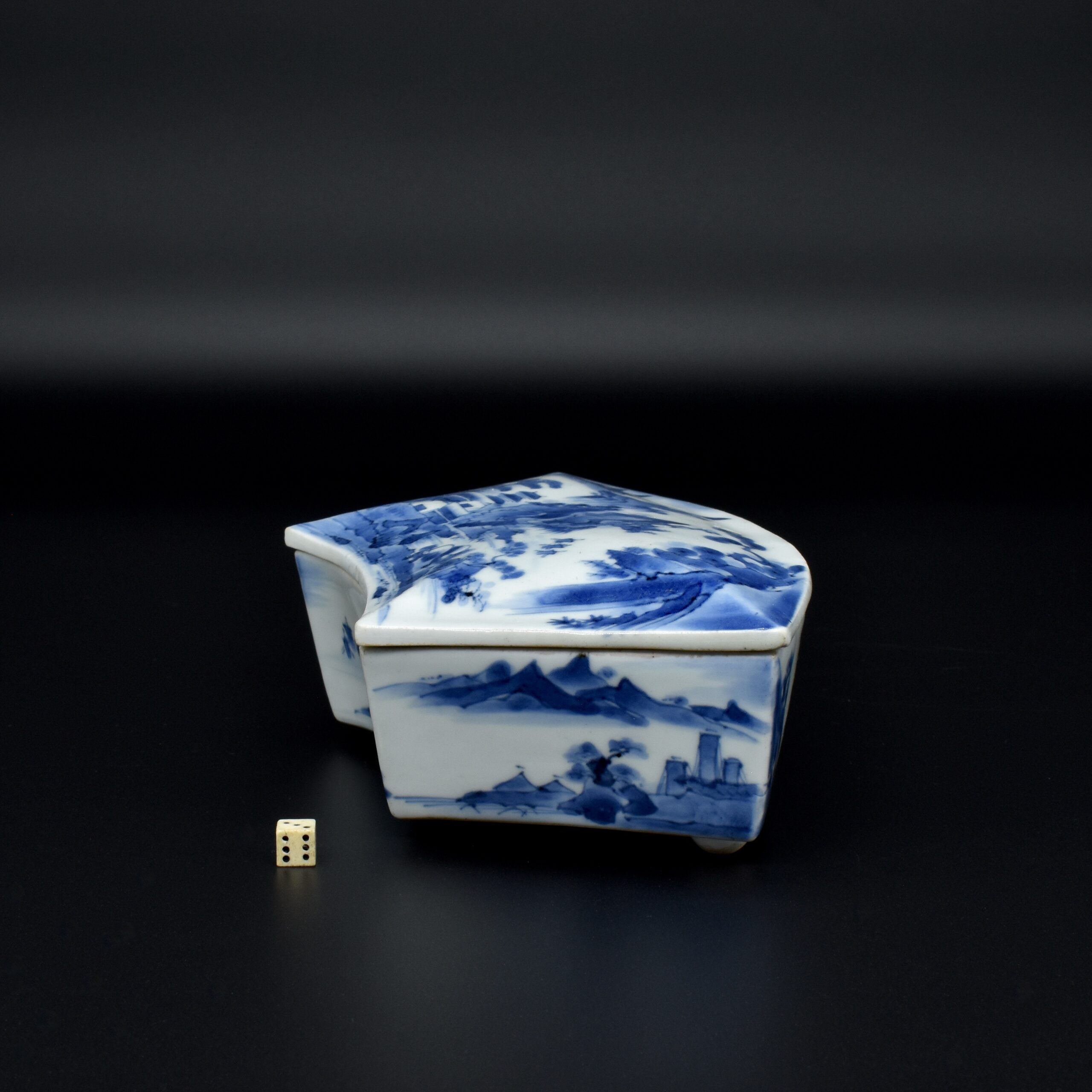
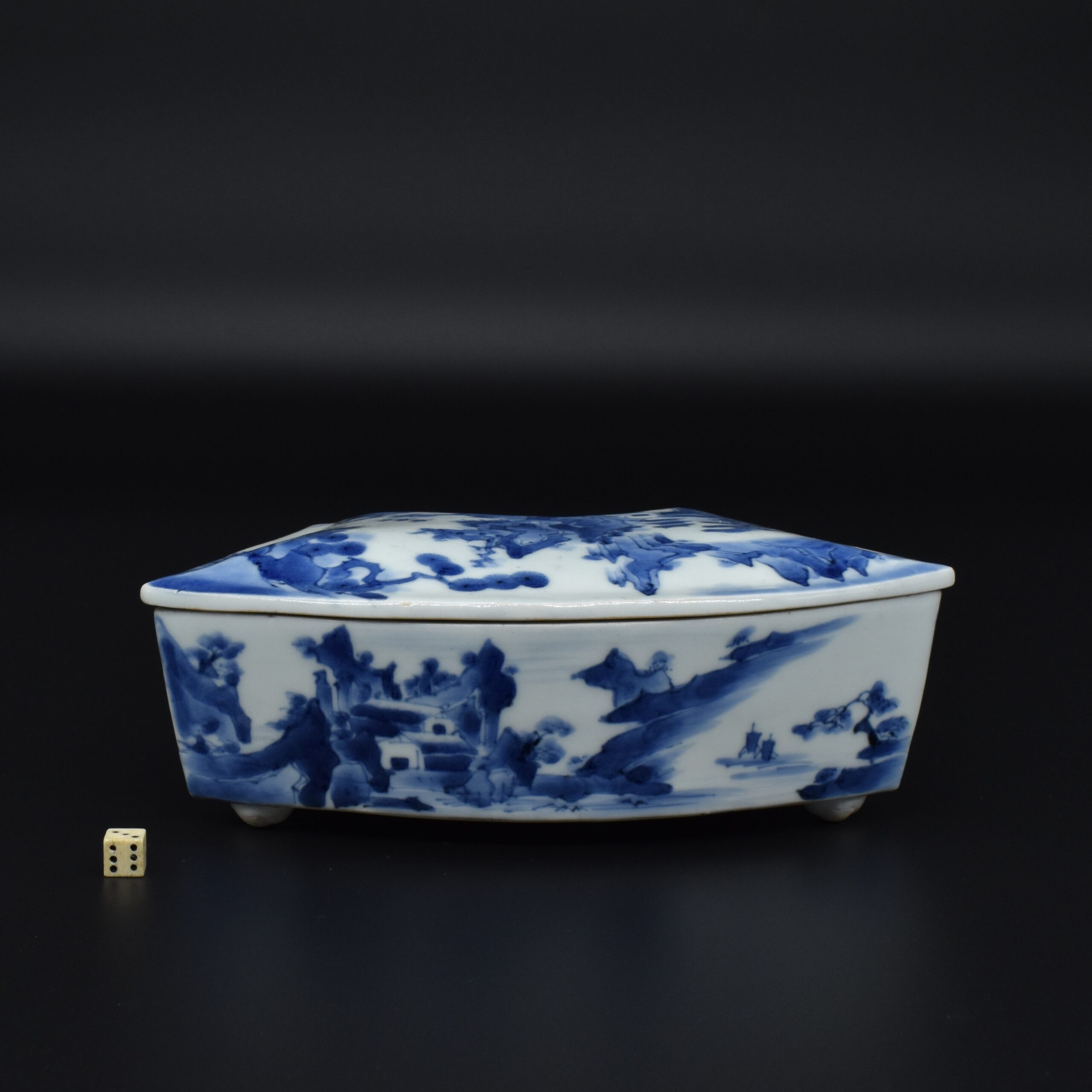
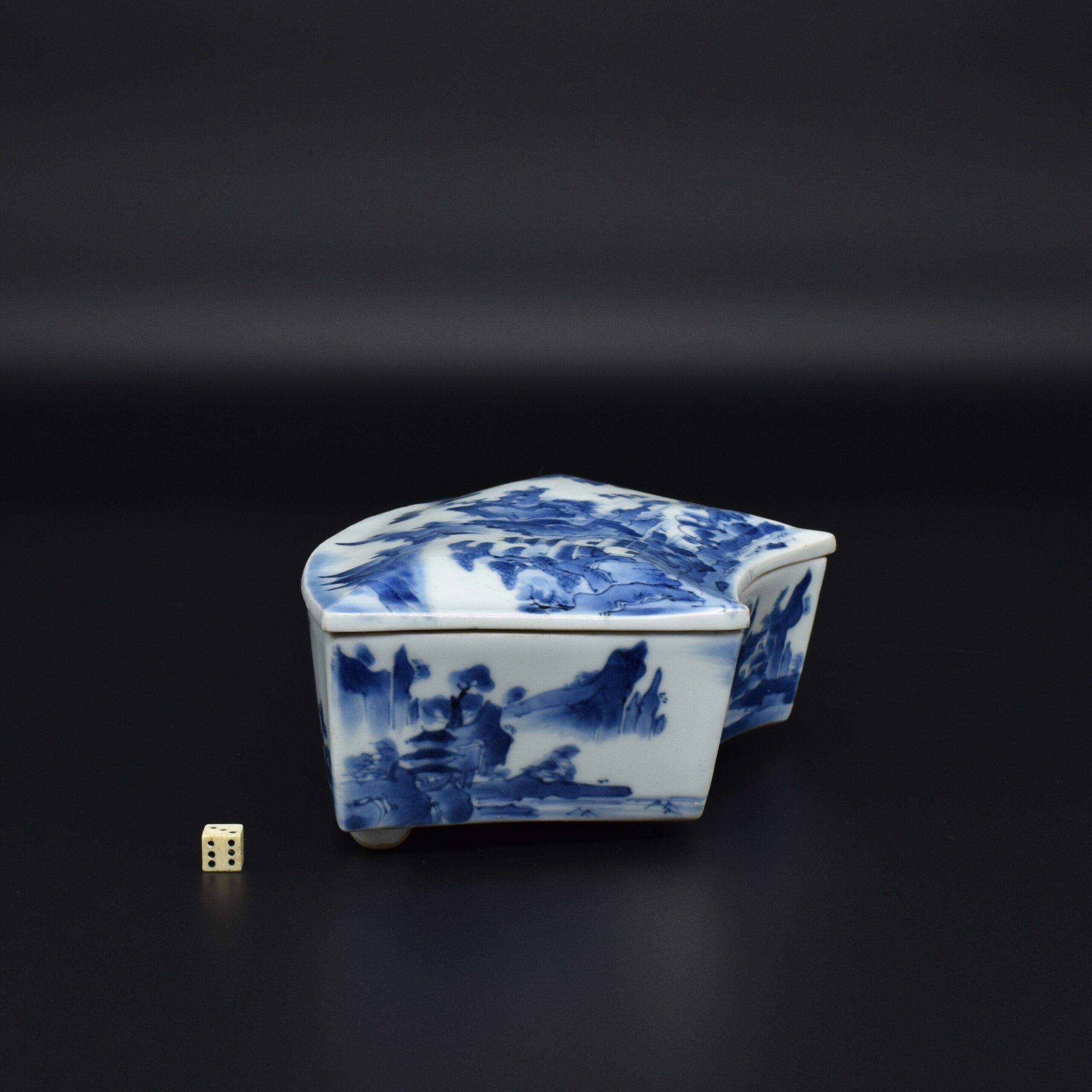
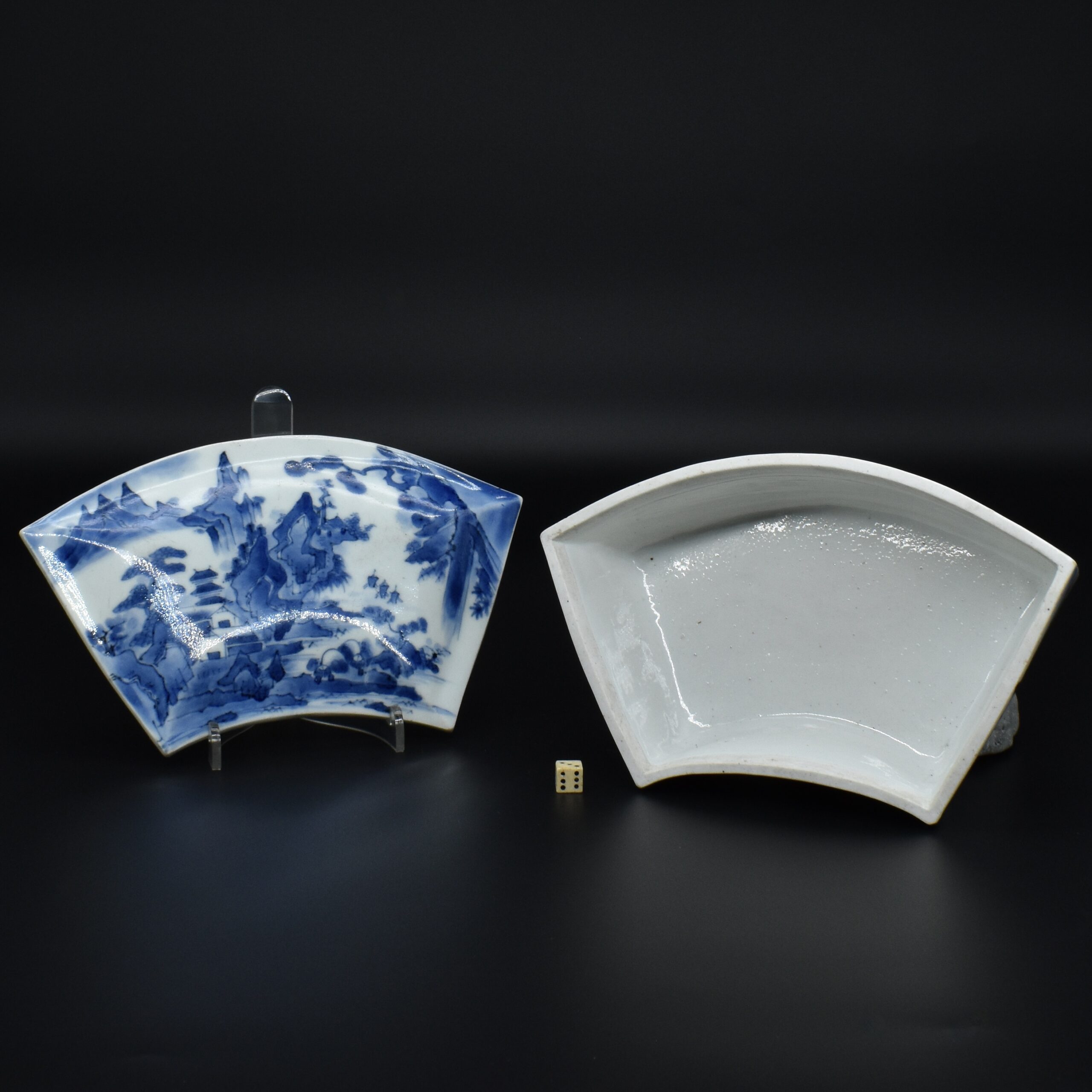
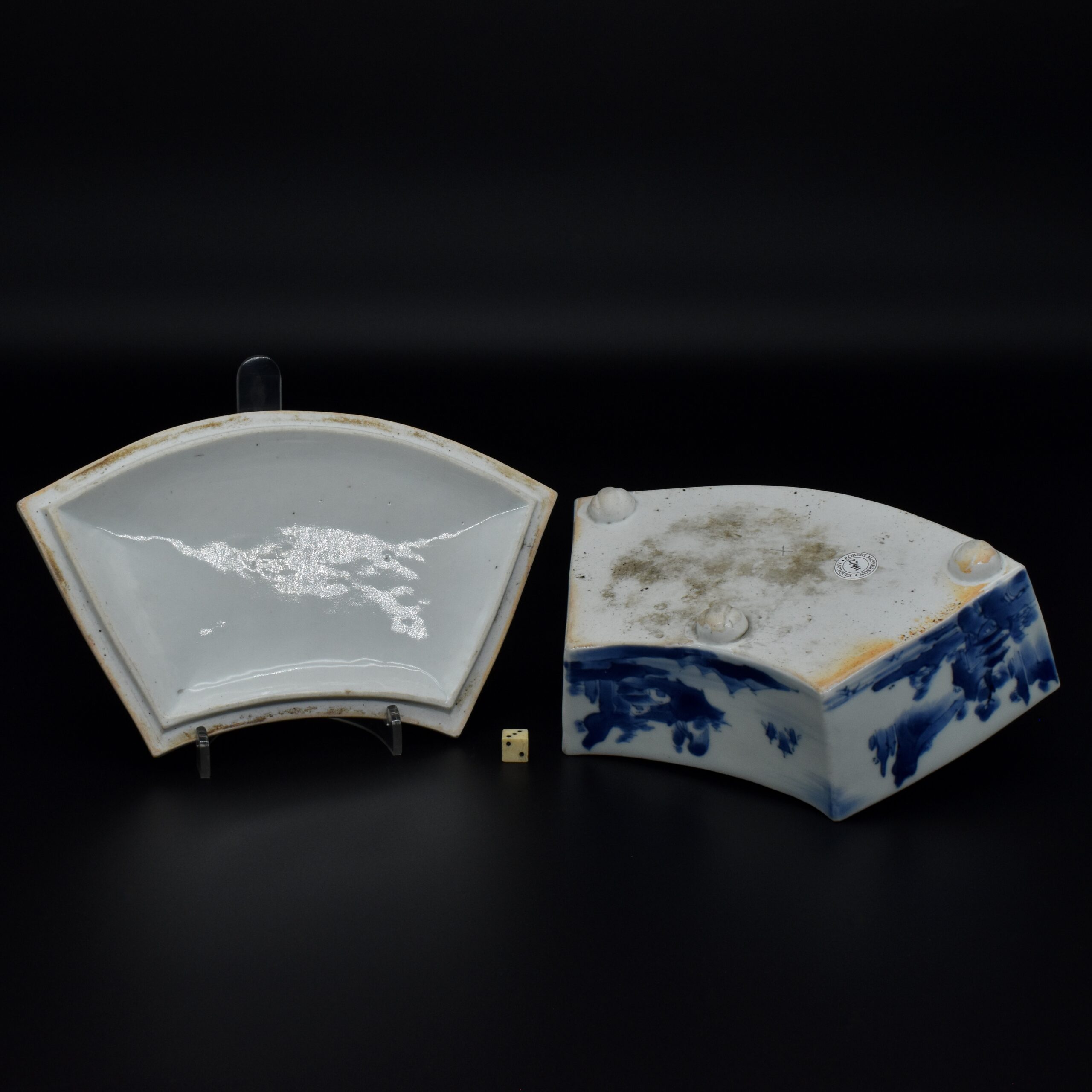
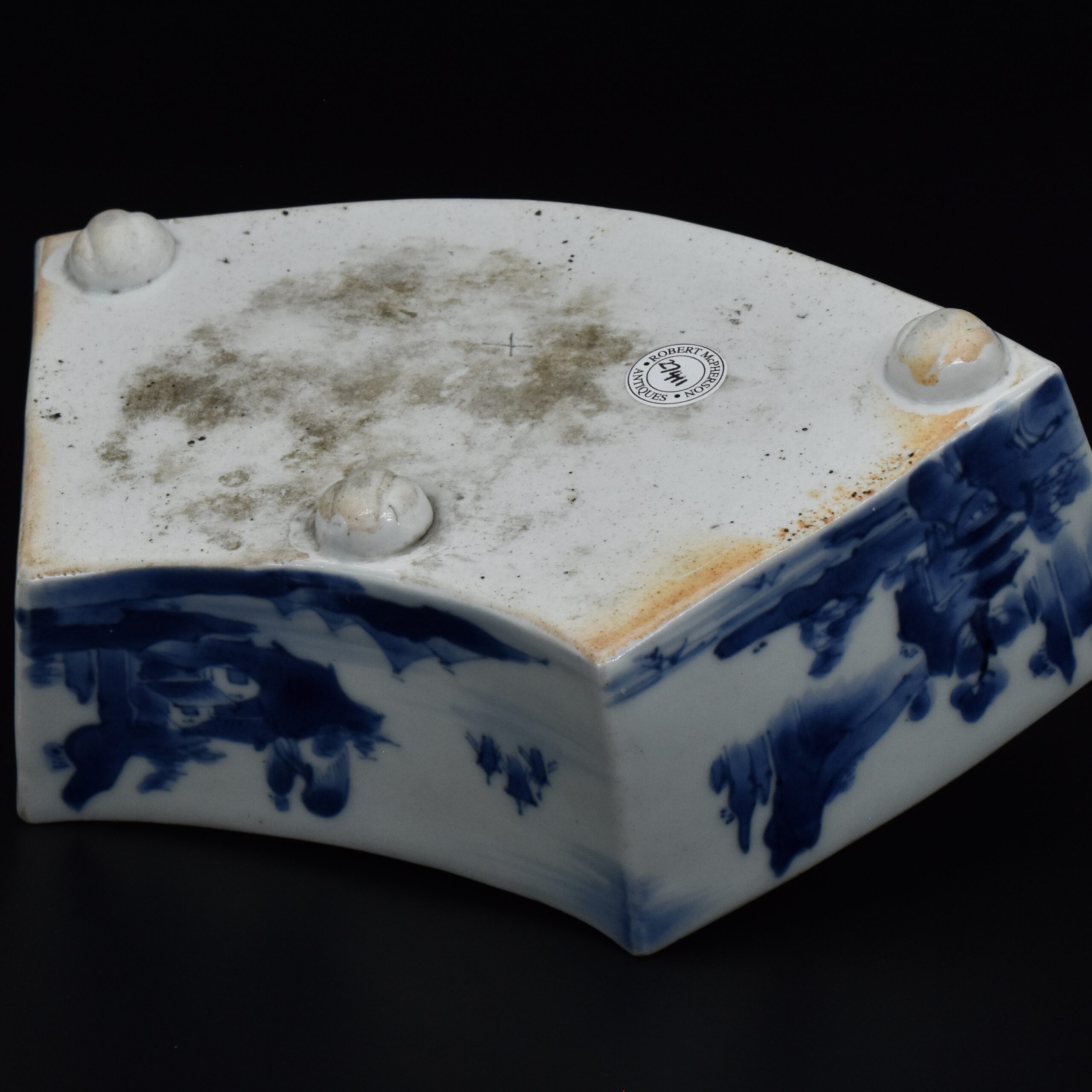
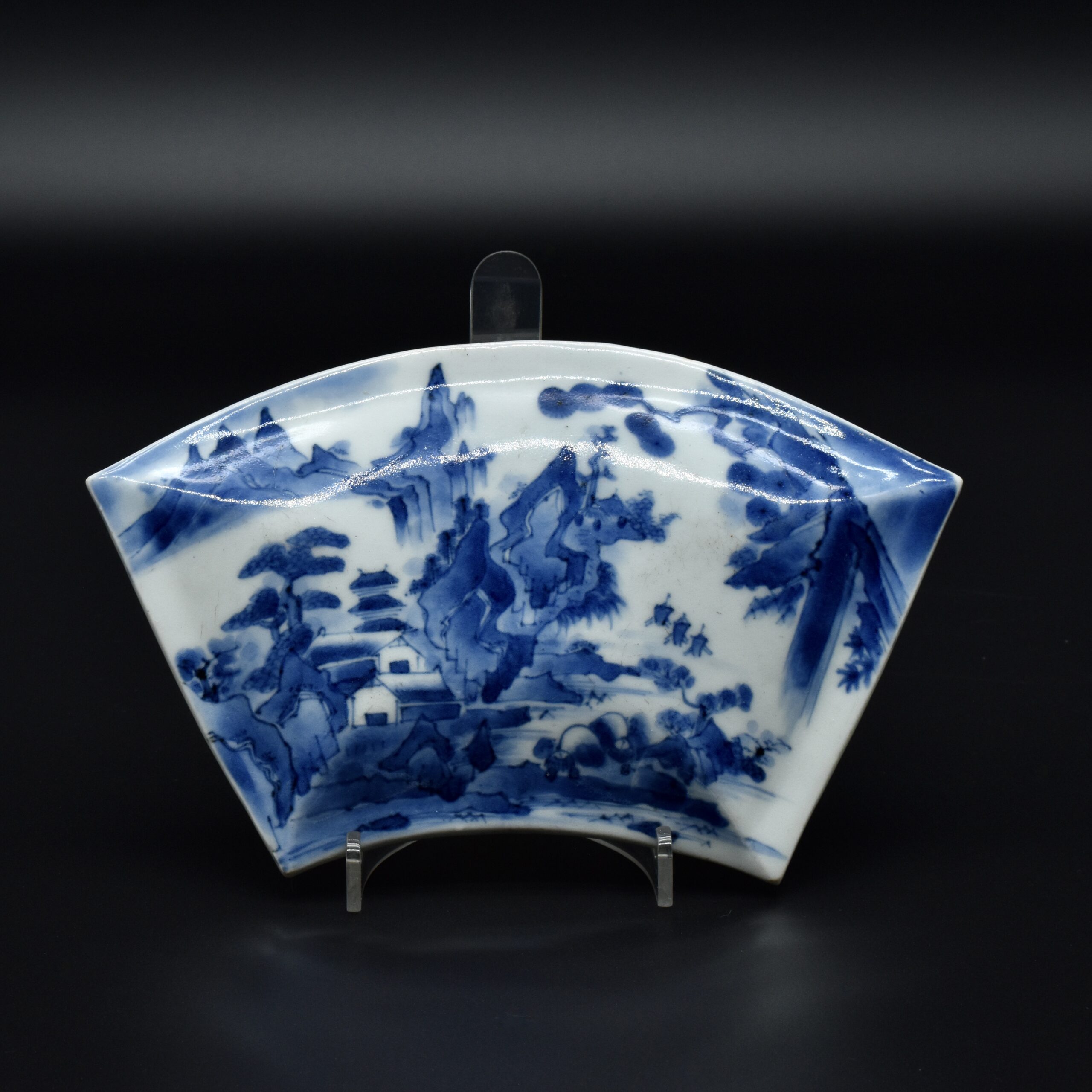
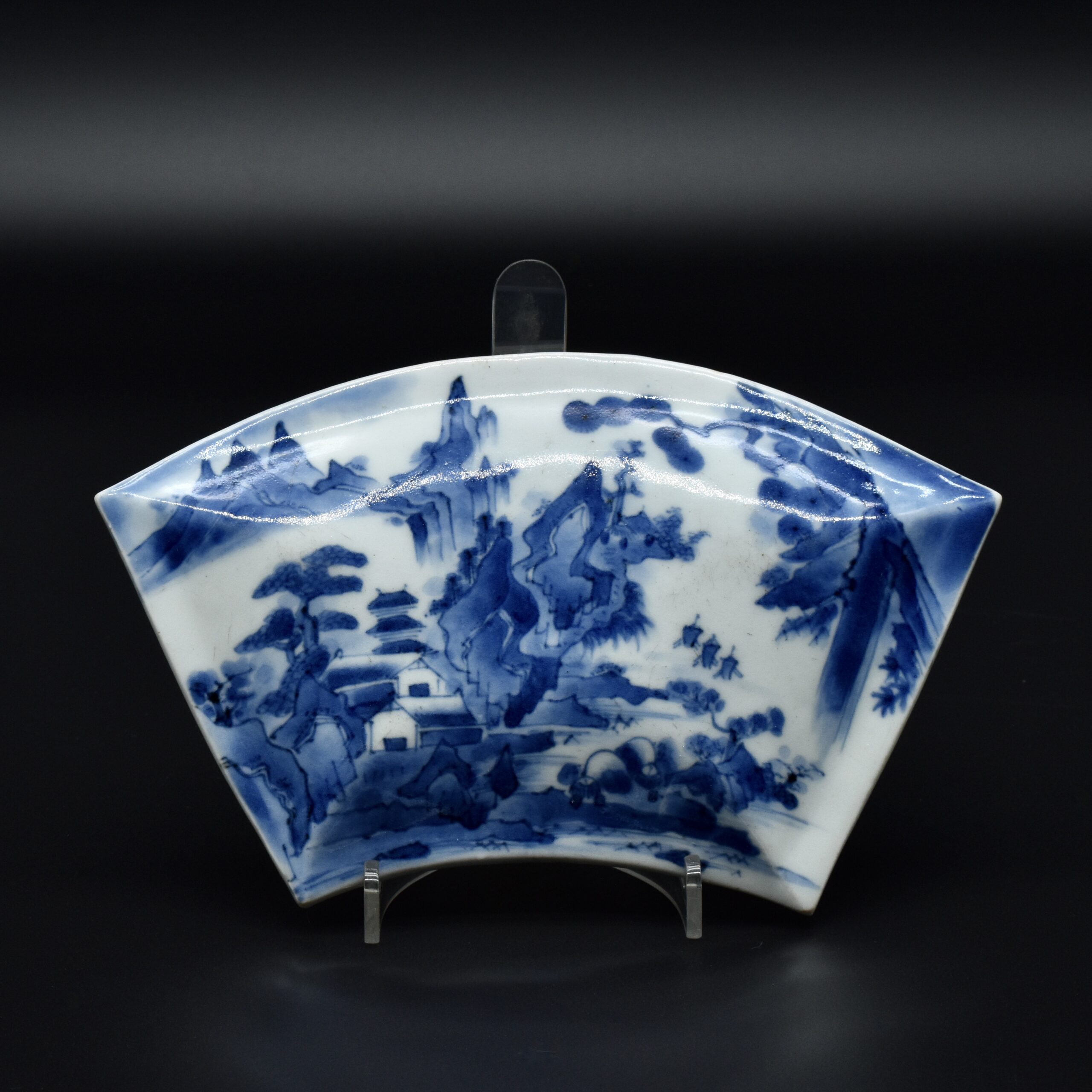
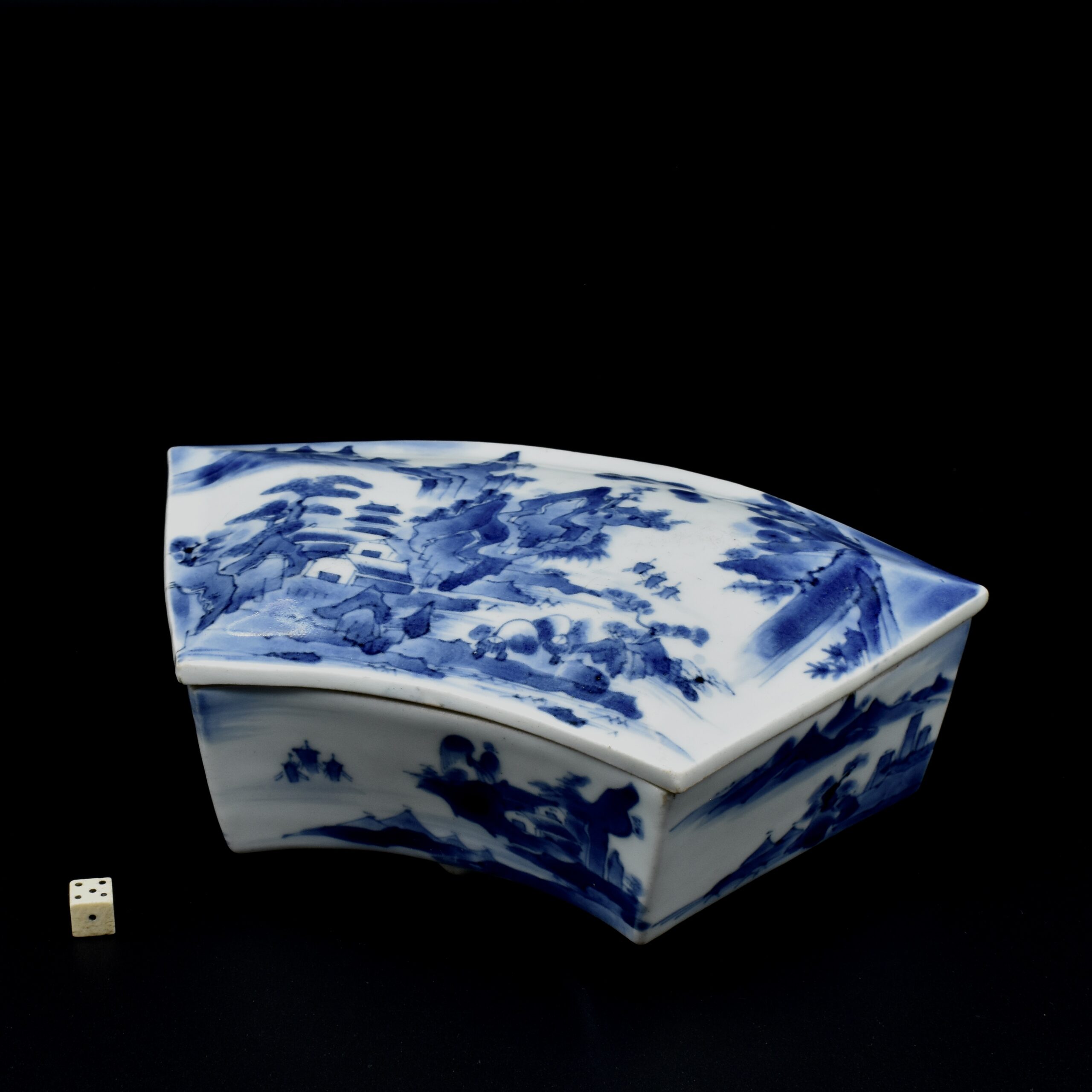
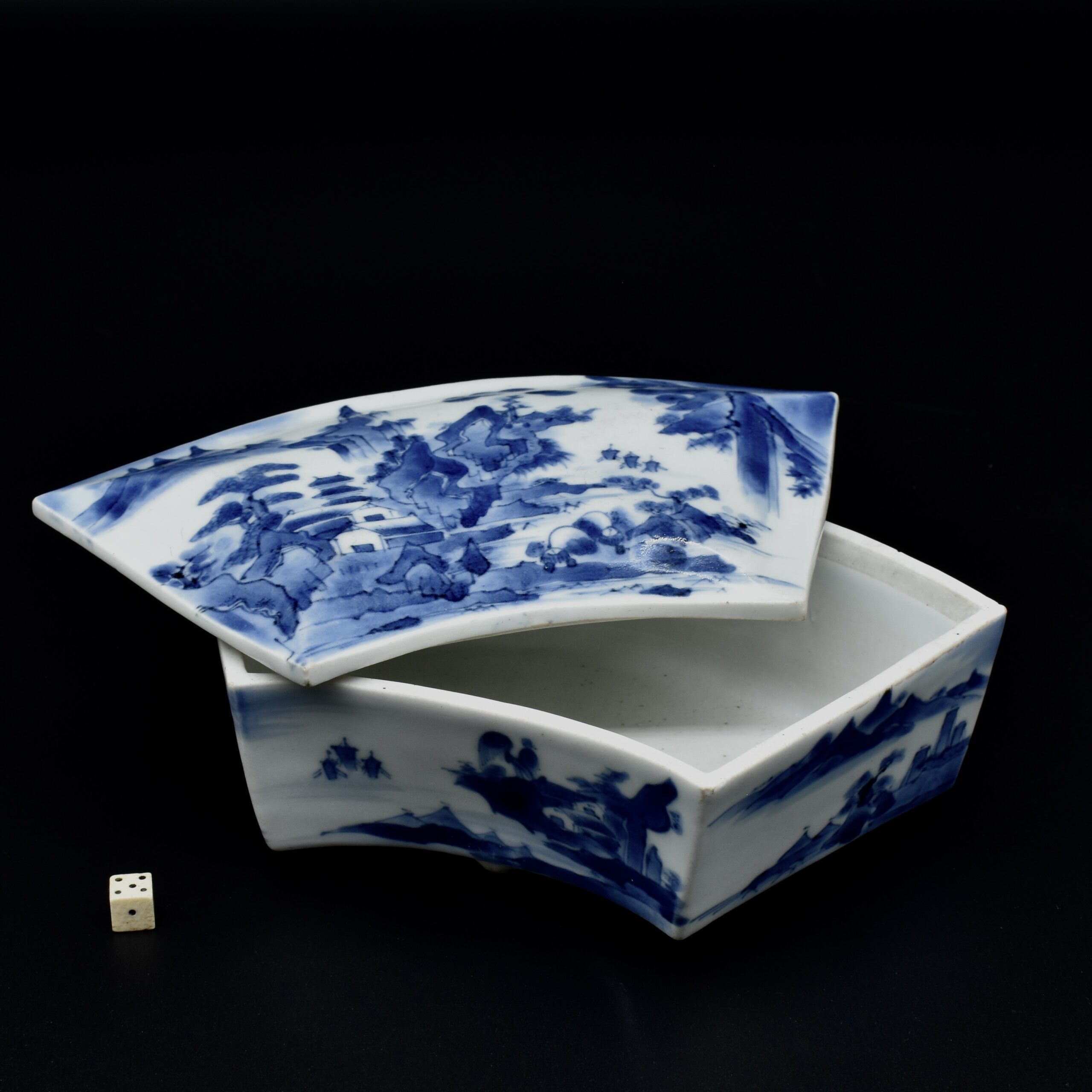
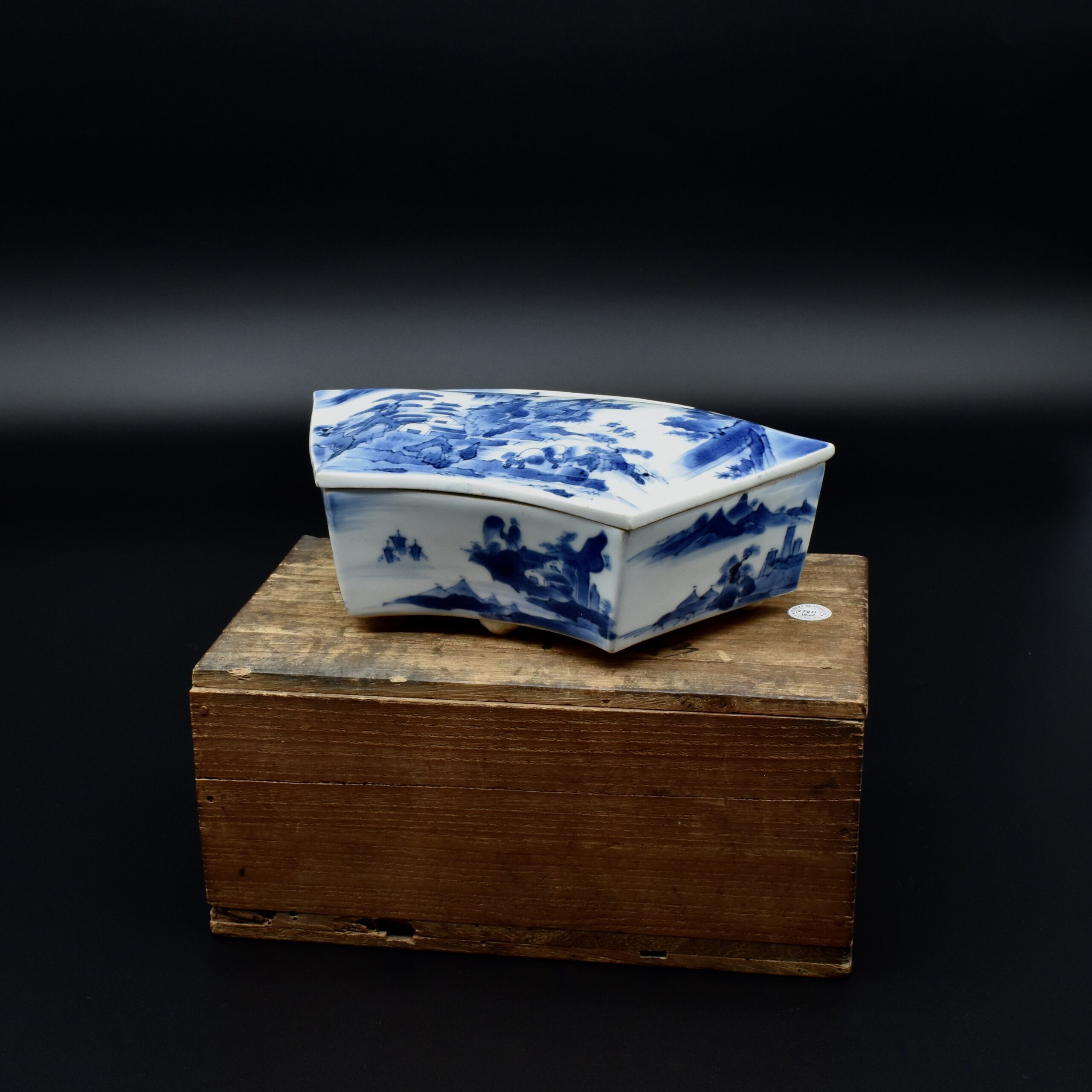
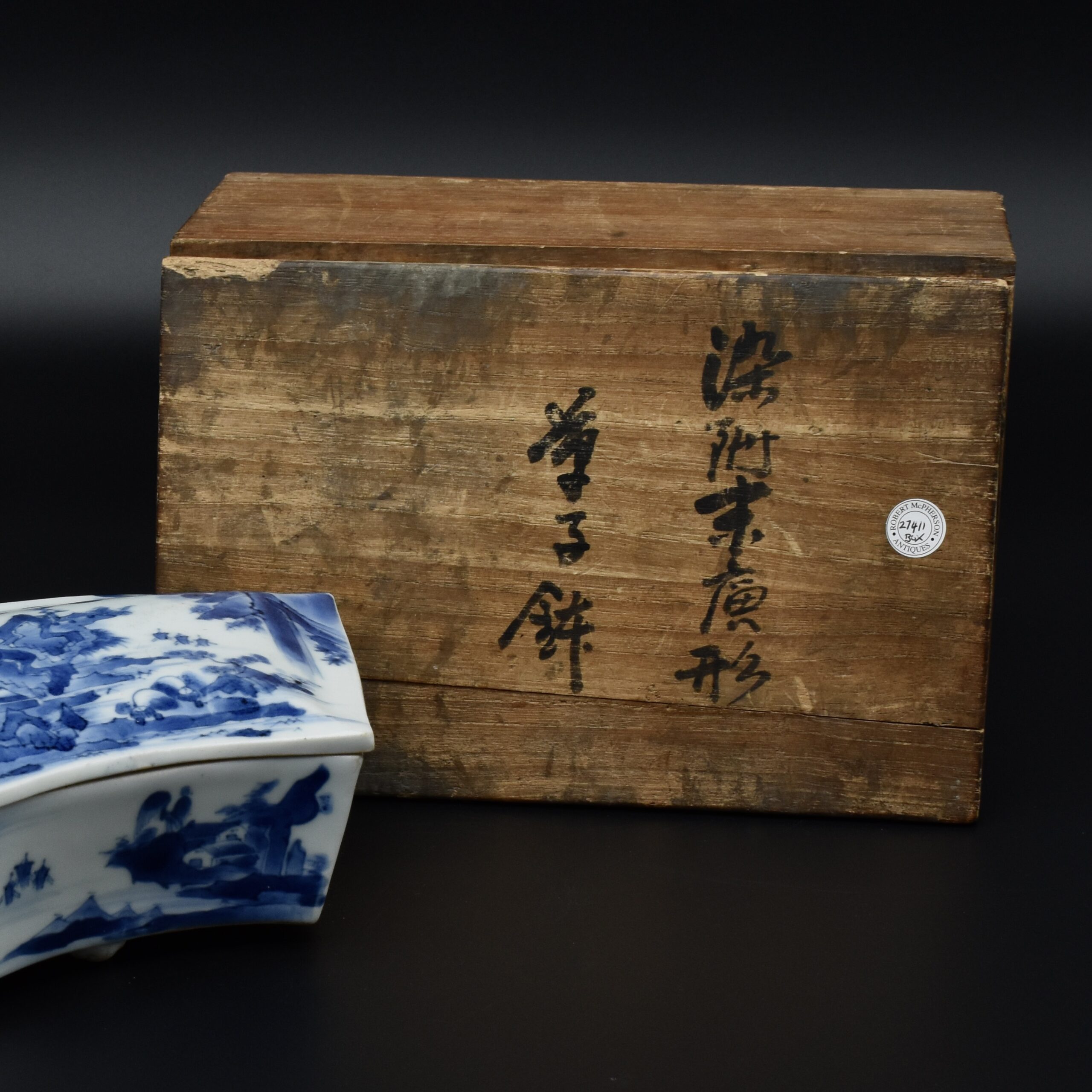
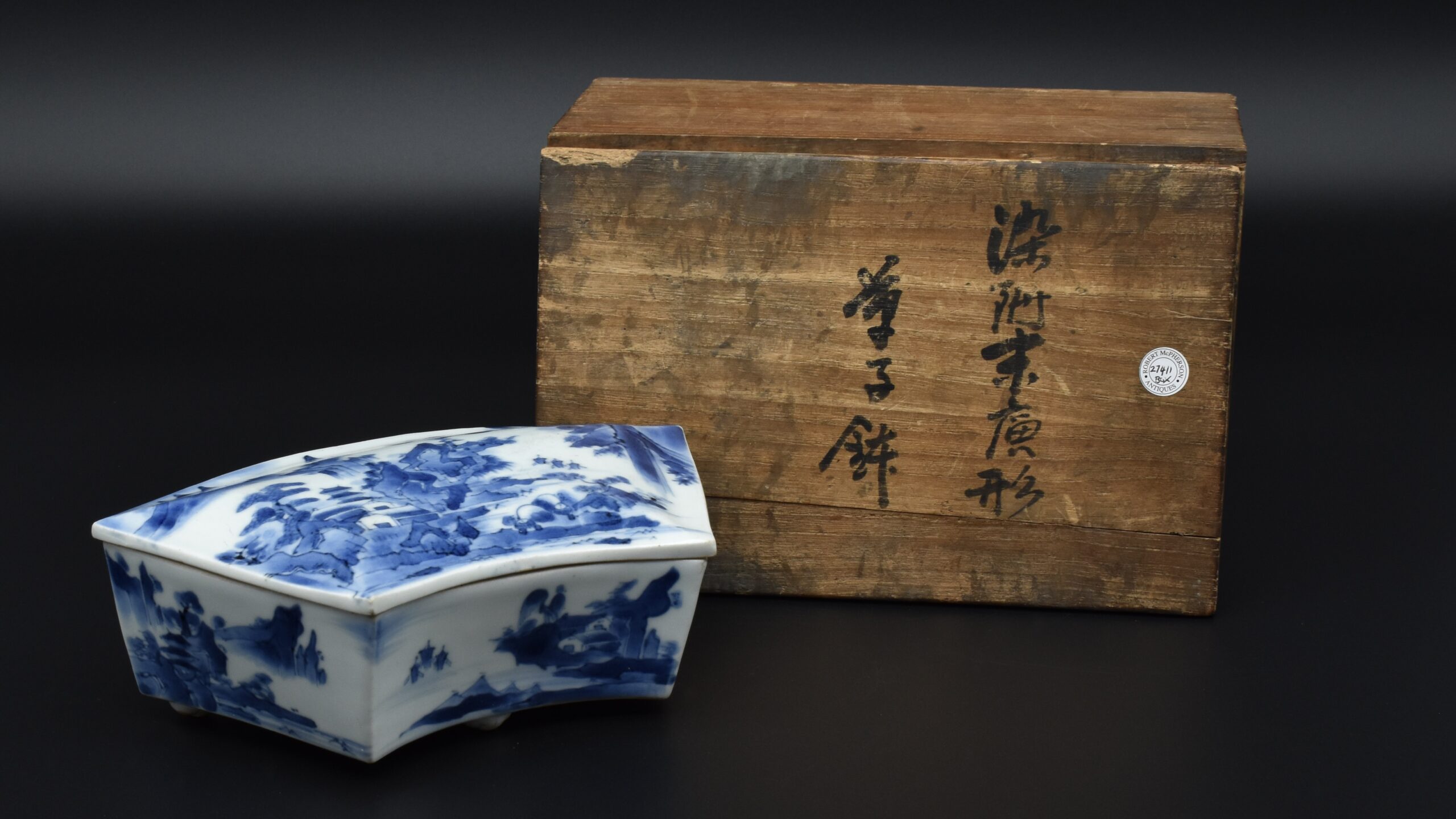
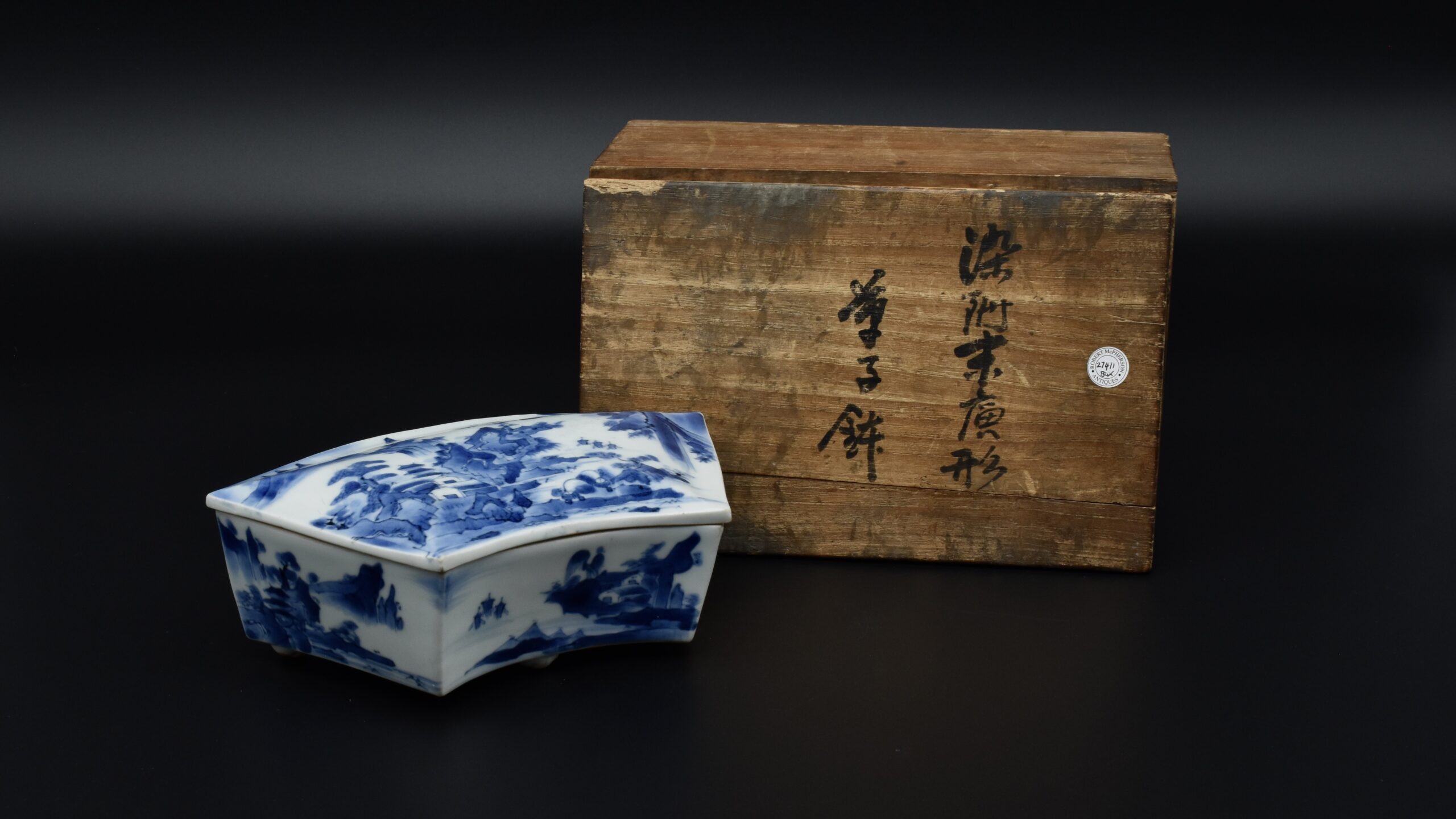
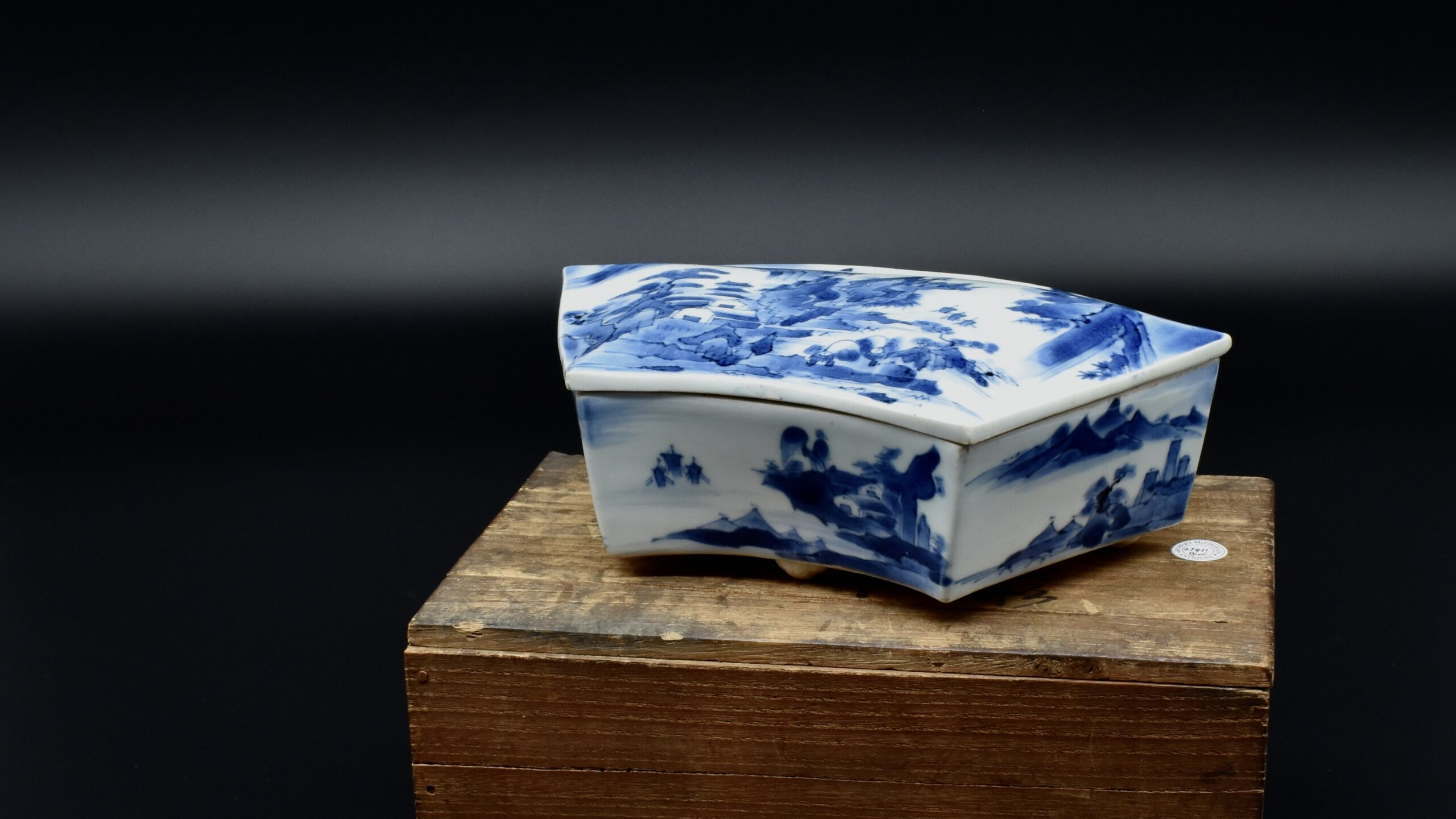
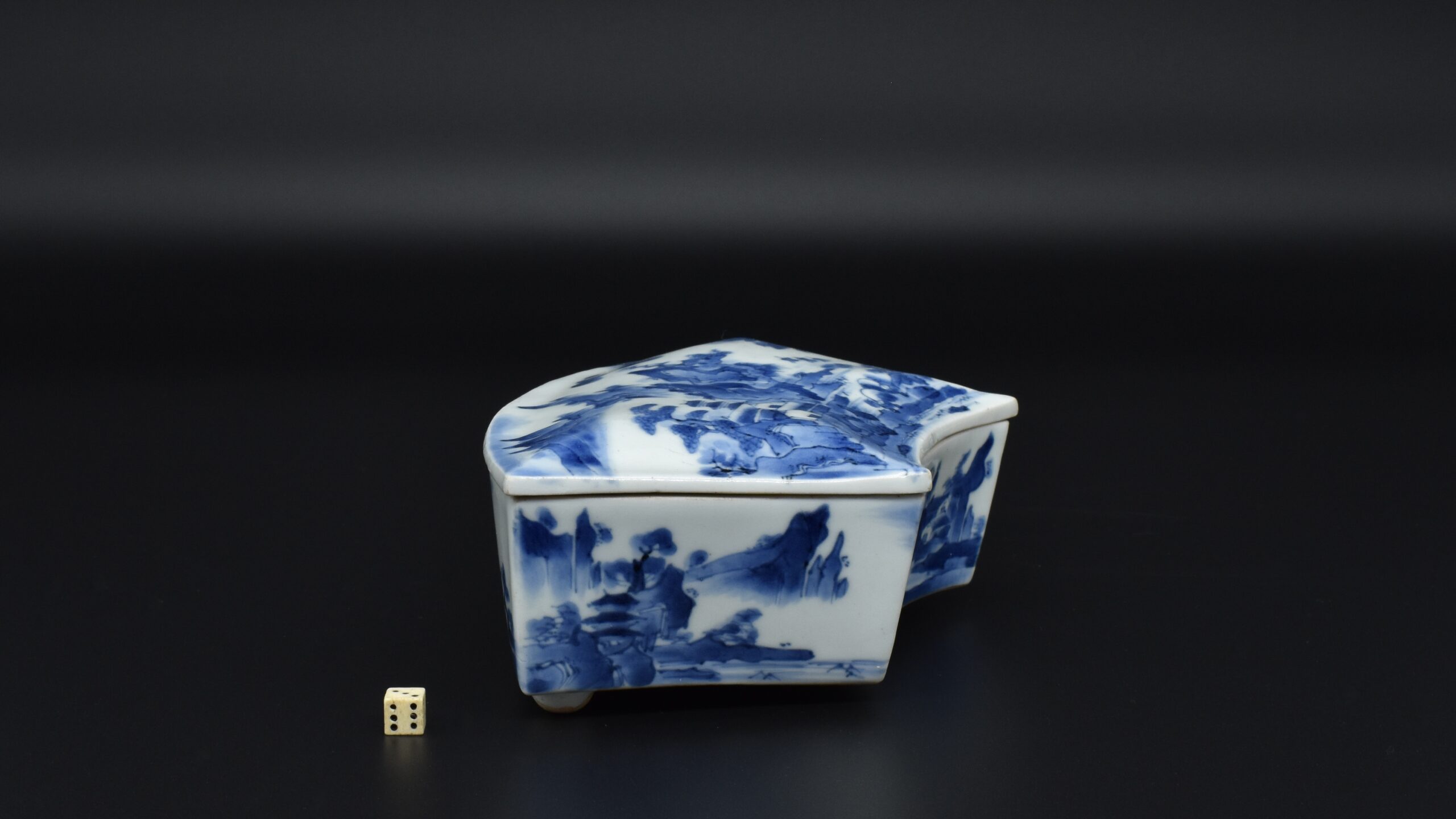
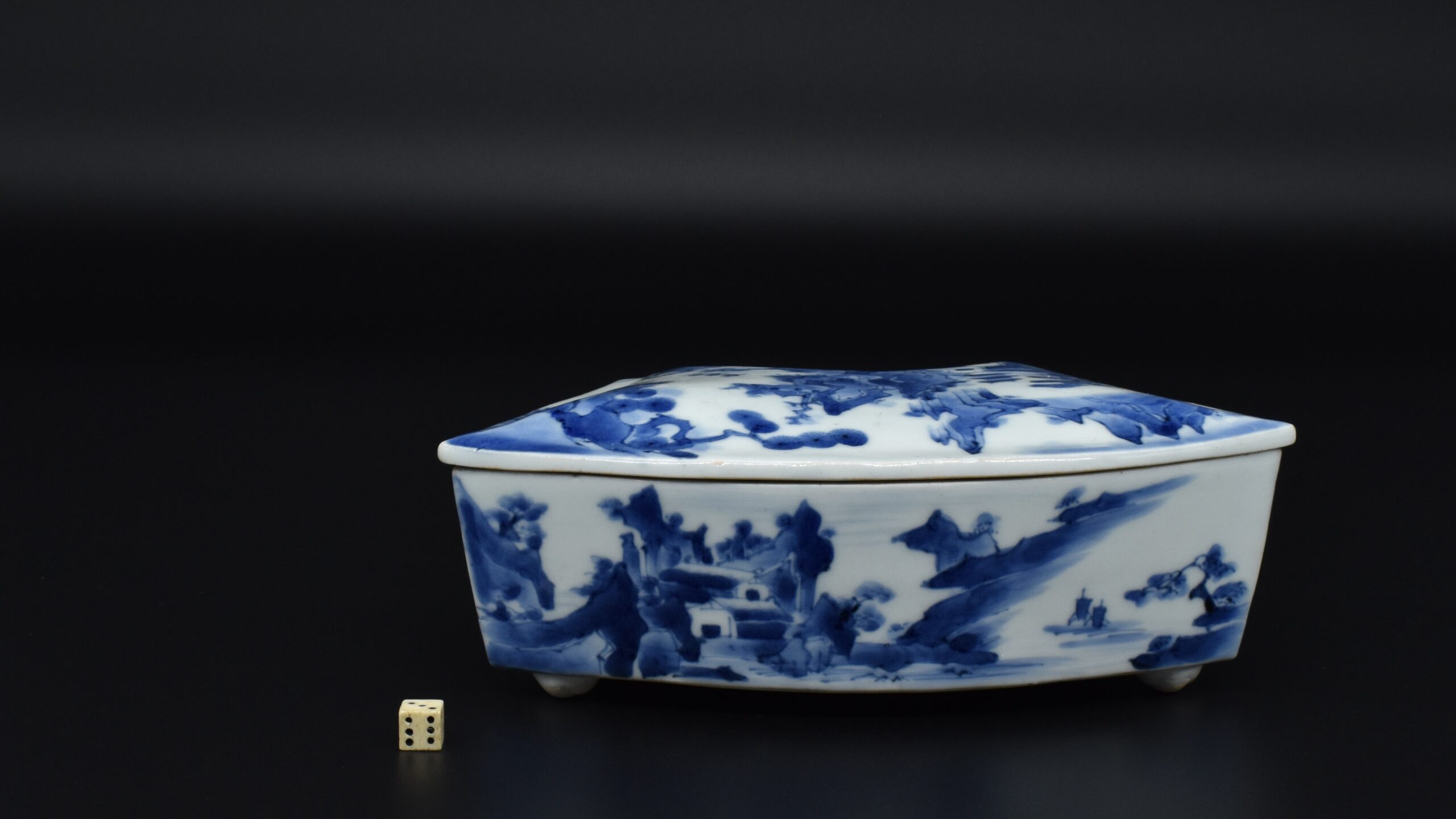
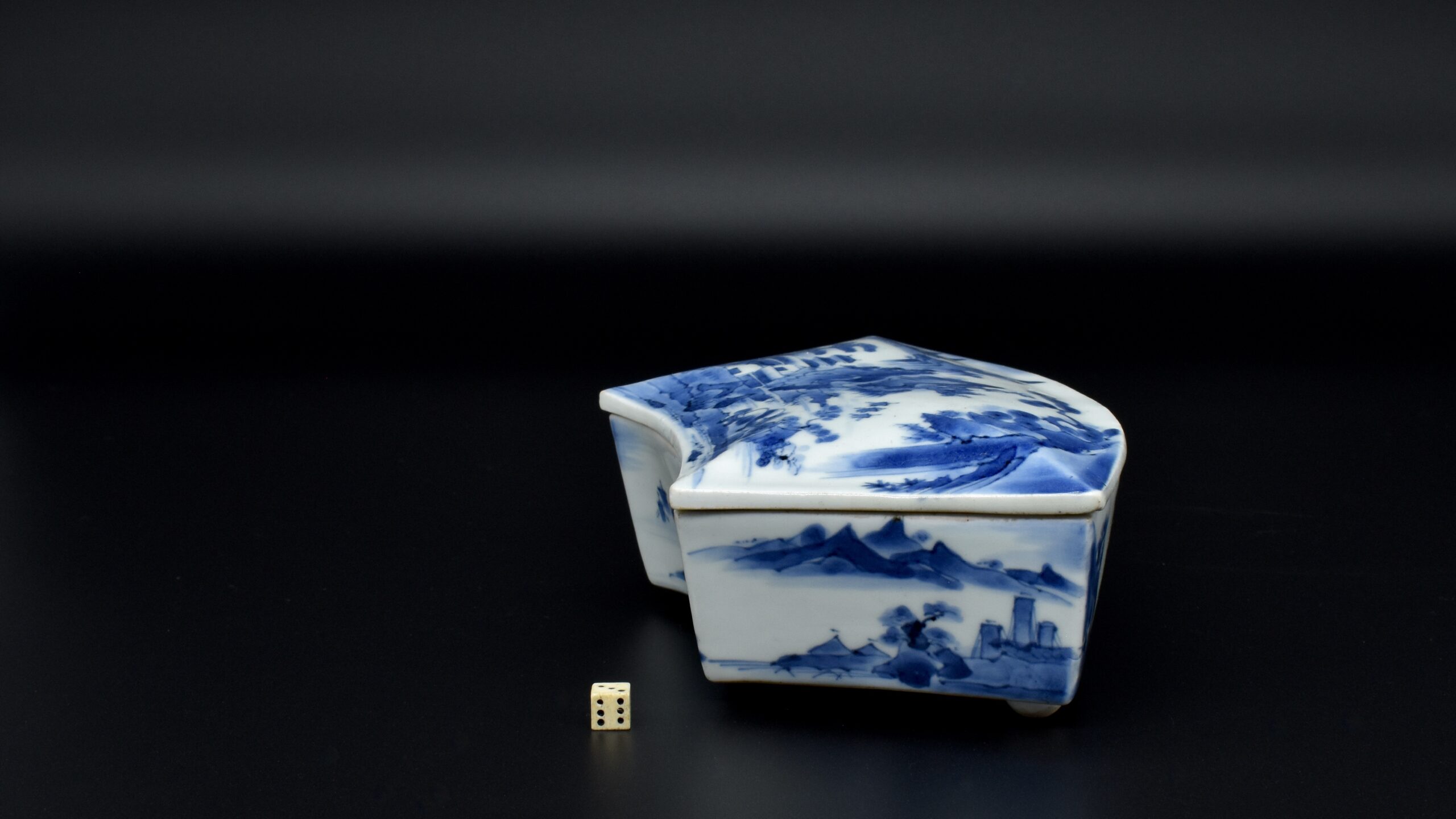
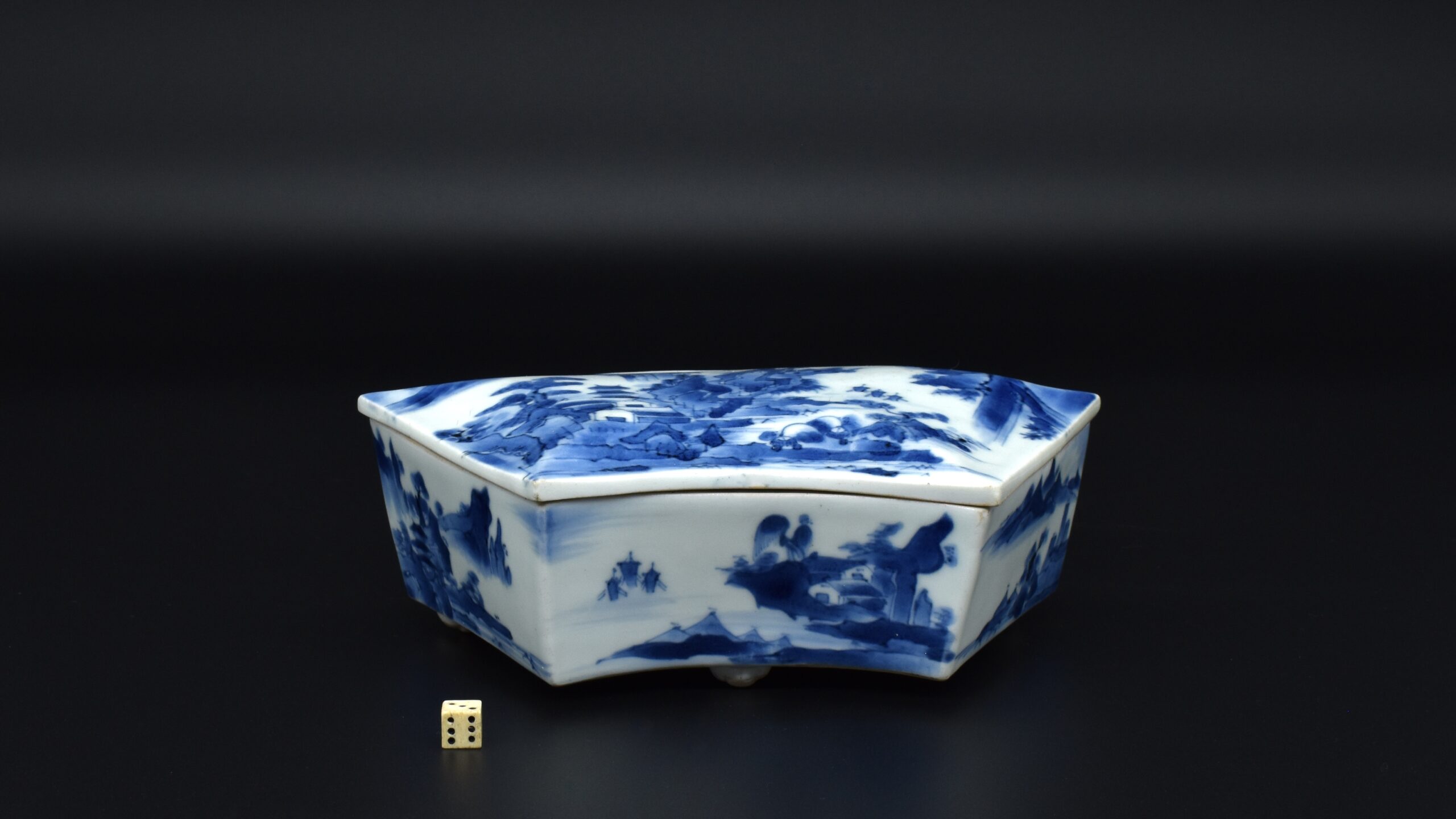
A Rare 17th Century Japanese Porcelain Fan Shaped Box and Cover, Kakiemon or Arita c.1660-1680. Painted in rich tones of blue with graded shading, the scene is an extensive mountainous landscape with dramatic rocks, pine trees, a pagoda, other buildings and three sailing boats. The base of this porcelain box is similarly painted. The base is unglazed, and it has a neatly cut cross that was added prior to firing. It sits on three small double indented rounded feet which are unglazed at the top, glaze has been applied around the line where the feet stuck on with slip, in this case the slip is watered down porcelain clay. Presumably, this was done to help the feet adhere to the unglazed body of the base, it worked well as all three feet are there after around 350 years. It comes with its traditional Japanese ceramic storage box, referred to as Tomobako. In its infinite wisdom Google has translated the inscription on the box as “Deep and sweet but not fishing shape There are three cakes” The three cakes must be the bun shaped feet.
This rare form, a fan shaped box on three unglazed bun-shaped pads is a novelty the Japanese would have appreciated. The variety of design, and form from this period is remarkable, however by around 1700 things became more standardised. That was partly due to a more difficult economic climate in Japan and perhaps it reflected the need to standardise export porcelain to the West, thus saving money. I think this piece would have been made for the domestic market, only a limited number of pieces were exported to Europe at this period. They include European forms that were commissioned by the Vereenigde Oostindische Compagnie (V.O.C.) the Dutch East India Company, such as jugs, tankards and pieces made specifically for individual members of the V.O.C.
Burghley House in Lincolnshire has an important early collection of Japanese porcelain, some of which is porcelain made for the Japanese but it was exported, other pieces are clearly export ware. As far as I know there are, there are no fan shaped boxes of this type in early European collections – please let me know if you know of an example. The painting of this box seems to be Kakiemon, the subject matter, tones of cobalt blue and painting style are typical of Kakiemon porcelain. However, Arita used very similar painting styles. Its also possible that the painters from Arita and Kakiemon didn’t spend their whole working life at just one kiln. It is well known that painters in 18th century Europe travelled to where the work was. Some painters took their work home, they cheated ! Painters at the French Royal Porcelain Factory, Sèvres, stole white porcelain from the factory, smuggling it out and decorated it and fired it at home to earn extra money. The history of ceramics involves people, so things aren’t always as they seem.
SALE PENDING
See Below For More Photographs and Information.
- Condition
- A very small chip to the front top edge c.1 mm, another the similar size or smaller to underneath the cover on the unglazed part.
- Size
- Diameter 19cm (7.4 inches). Depth 6.9 cm (2.7 inches).
- Provenance
- N/A
- Stock number
- 27411
- References
- For a very similar Japanese blue and white porcelain box and cover see: Complete Catalogue of Shibata Collection (Contributors Saga Kenritsu Kyūshū Tōji Bunkakan. Published by the Kyushu Ceramic Museum, 2019) page 174, plate 1381.
Photos
Information
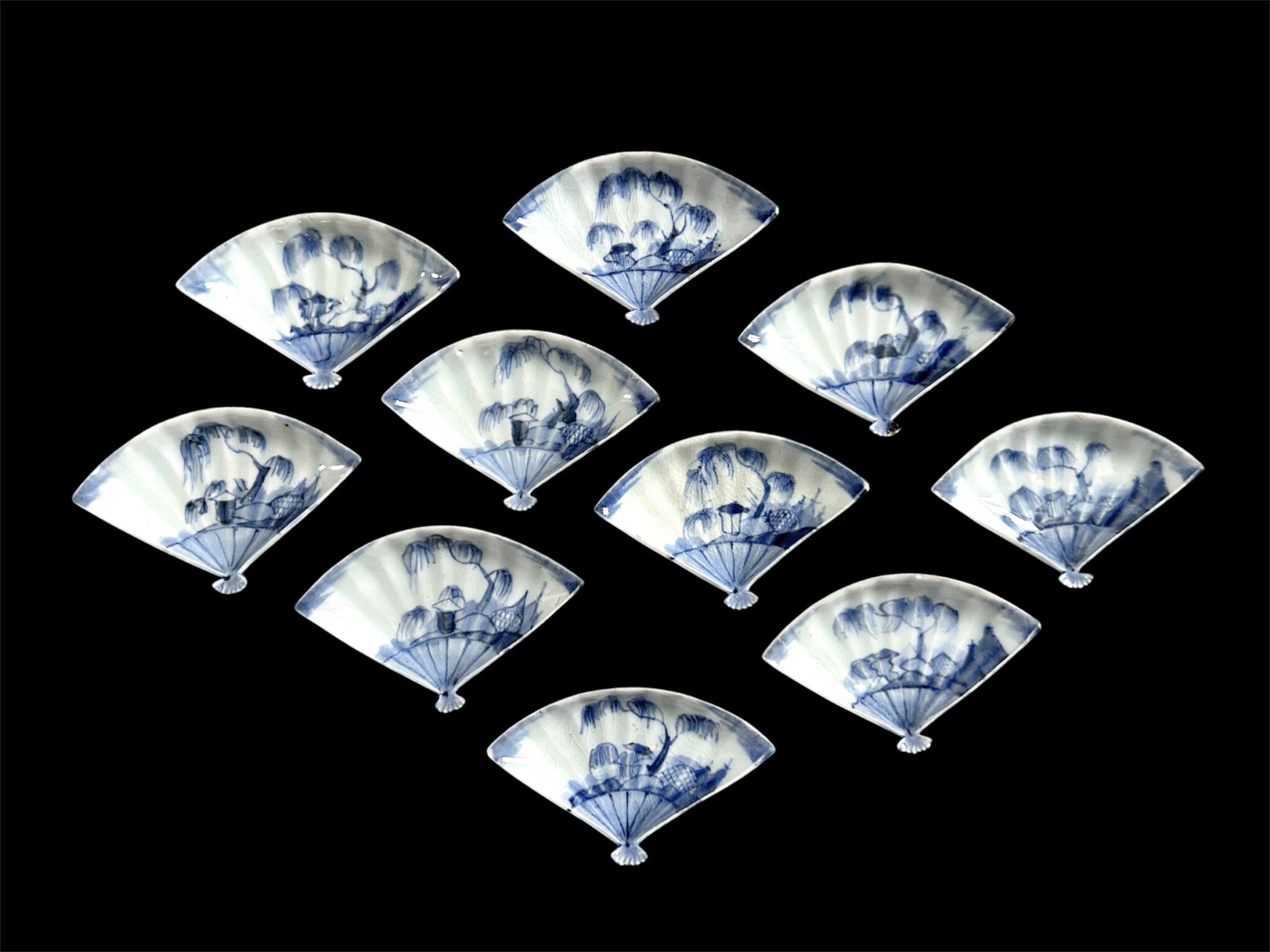
A Rare Set of Ten Small Japanese Blue and White Fan Shape Dishes, Arita Kilns c.1690 – 1720.
Robert McPherson Antiques Sold Archive 27551.
SOLD
See Below For More Photographs and Information
Condition
One dish has two tiny chips, Six of these tiny Japanese porcelain dishes have one tiny chip, Only three are perfect.
Size
Diameter 9.9 cm (3.9 inches), depth 2 cm (0.8 inches).
Stock number
27551
References
For a single porcelain dish of this size, shape and design see : Complete Catalogue of Shibata Collection (Contributors Saga Kenritsu Kyūshū Tōji Bunkakan. Published by the Kyushu Ceramic Museum, 2019) page 314. Item 2502. The Shibata dish has a difference, the back design is of pine needles.
Tomobako Storage Boxes :
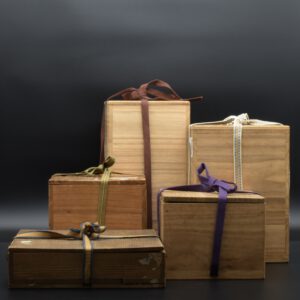
Traditional Japanese ceramic storage boxes, referred to as Tomobako are highly valued and much used in Japan. Most boxes are made from paulownia wood, it is lightweight hardwood and it’s also fire resistant, which is very useful in because Japanese buildings tend to be made of timber and have paper dividers inside. The Islands of Japan are located on a highly complex, unstable, and active geological junction where four major tectonic plates collide and subduct. These islands are essentially built upon the boundaries of these plates, with the archipelago forming as a result of the subduction and volcanic activity caused by these tectonic movements. Therefore the use of tradition tomobako is essential for the survival of ceramics in Japan. Japanese museums don’t have this luxury, so they secure the ceramic objects with nylon, which looks very much like fishing line. The paulownia is a fast growing tree, so it isn’t too expensive. It is believed that the phoenix, symbolising wisdom and prosperity, will only land on a paulownia tree when a worthy ruler is in power.
Tomobako containers that protect, store, and often certify the authenticity of the pottery inside. They are typically signed by the owner of the antique ceramic item in the box. They are tied with cord in a specific way, this is regarded as part of the ritual ceremony among a gathering of friends in Japan. Of course not everything in these boxes is what it might seem. Some contain surprising objects, so you will have to wait and see what we have in these boxes.
Kakiemon Porcelain
While there is much debate about what was actually made at the Kakiemon kilns, and was made at Arita, it seems clear that the Nigoshide body was exclusively used at Kakiemon. There has been allot of Japanese research undertaken at the Kakiemon kilns, and fragments of porcelain as well as moulds have been recovered from the kiln sites, unfortunately I have only found this information in Japanese books (in Japanese). Nigoshide refers to a fine milky-white porcelain body that glows with a warm tint, in Japan it is said to be reminiscent of rice-water. While white porcelain usually sports a blue tint, Nigoshide porcelain has a soft milky-white appearance. Nigoshide was invented in the 1670s as the perfect porcelain body for complimenting the brilliant polychrome overglaze enamel colours created at Kakiemon. It is notable that the Kakiemon enamel decorated pieces with underglaze blue do not use the Nigoshide body, yet fragments of this type have been recovered from the Kakiemon kiln sits. The main period of production of Kakiemon Nigoshide ware was from about 1670 to 1690. Due to lack of the right materials and economic cutbacks, Nigoshide porcelain went out of production by the mid-18th century, however there was a notable decline in production from around 1690.
Kakiemon decoration is usually of high quality, often delicate and with well-balanced asymmetric designs. The designs were normally quite sparse emphasizing the. Kakiemon porcelain was decorated with a great variety of imaginative designs which include elements such as the `banded hedge`, `flying squirrel`, and the `Quail and Millet` design in the West. The `Three Friends of Winter` were also a very popular group of designs, other subject taken from nature include flowers (especially the chrysanthemum, the national flower of Japan) as well as birds and rock-work. Figural subjects such as the so-called `Hob in the Well` were also popular. This design illustrates a Chinese folk tale where a sage saves his friend who has fallen into a large fish-bowl by throwing stones at it, breaking open the pot. Banded-Hedges were a formal device within Japanese traditional gardens, referred as brushwood hedges. Other elements incorporated in the designs, includes `The Three Friends of Winter` (Pine, Bamboo and Prunus). These three plants signify perseverance, as neither the pine nor the bamboo shed their leaves in winter and the plumb (Prunus) flowers at the very end of the winter, heralding the arrival of spring.