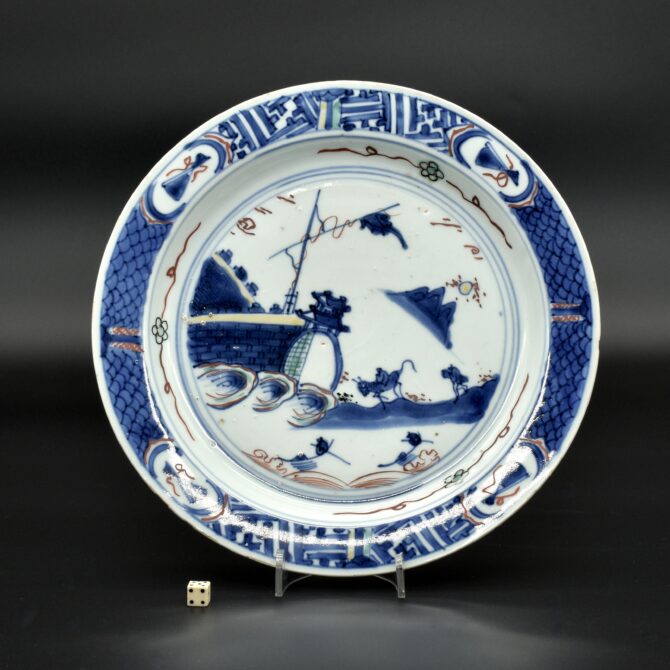
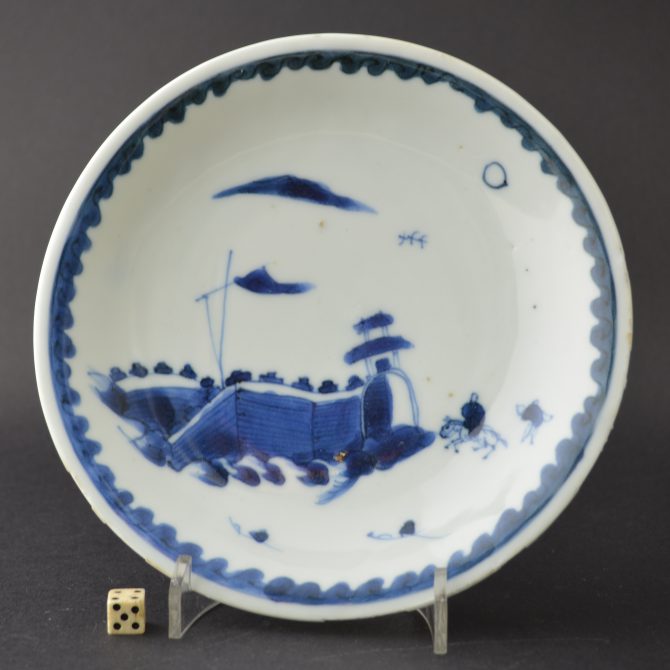
A Late Ming Porcelain Ko-akai ‘Walled Town’ Dish.
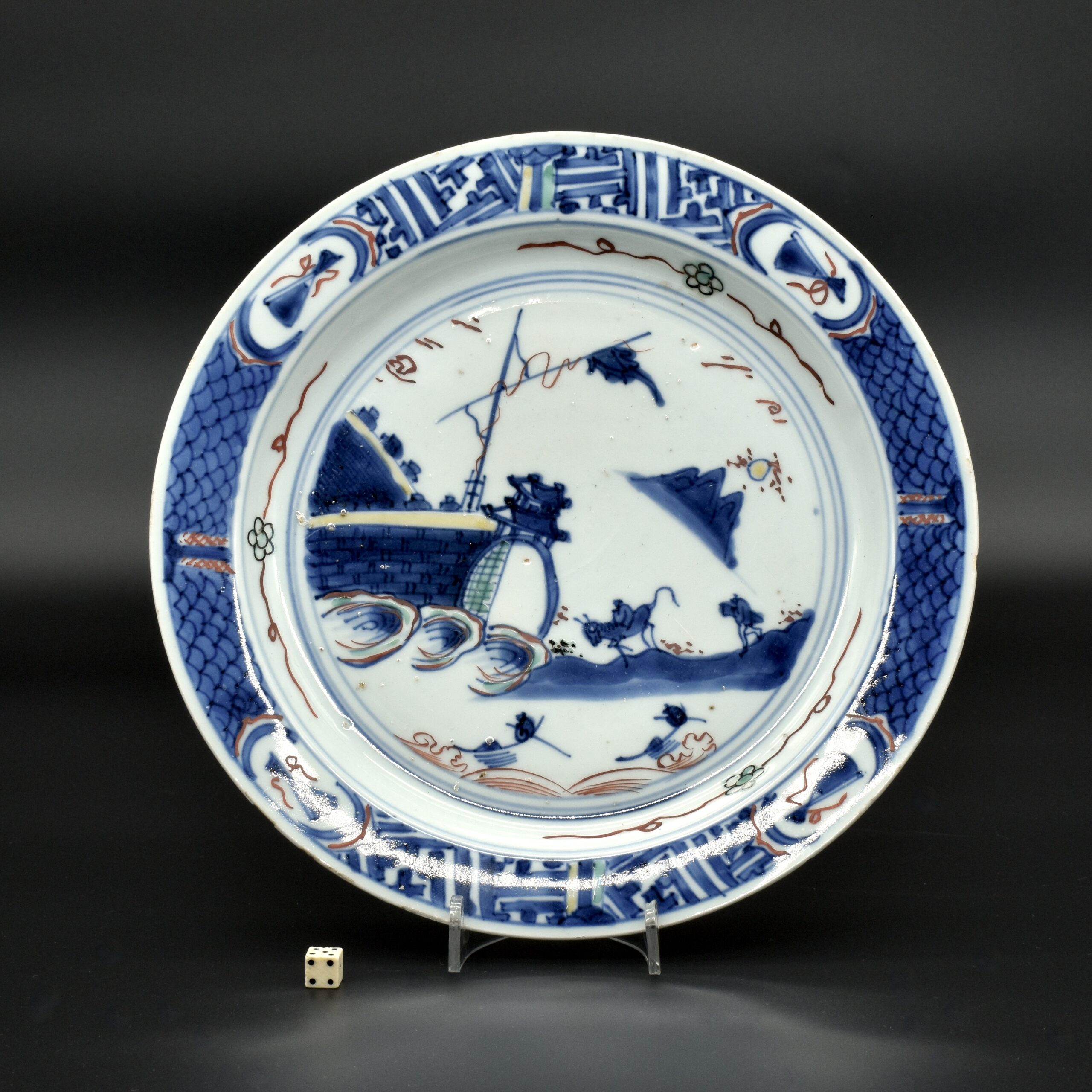
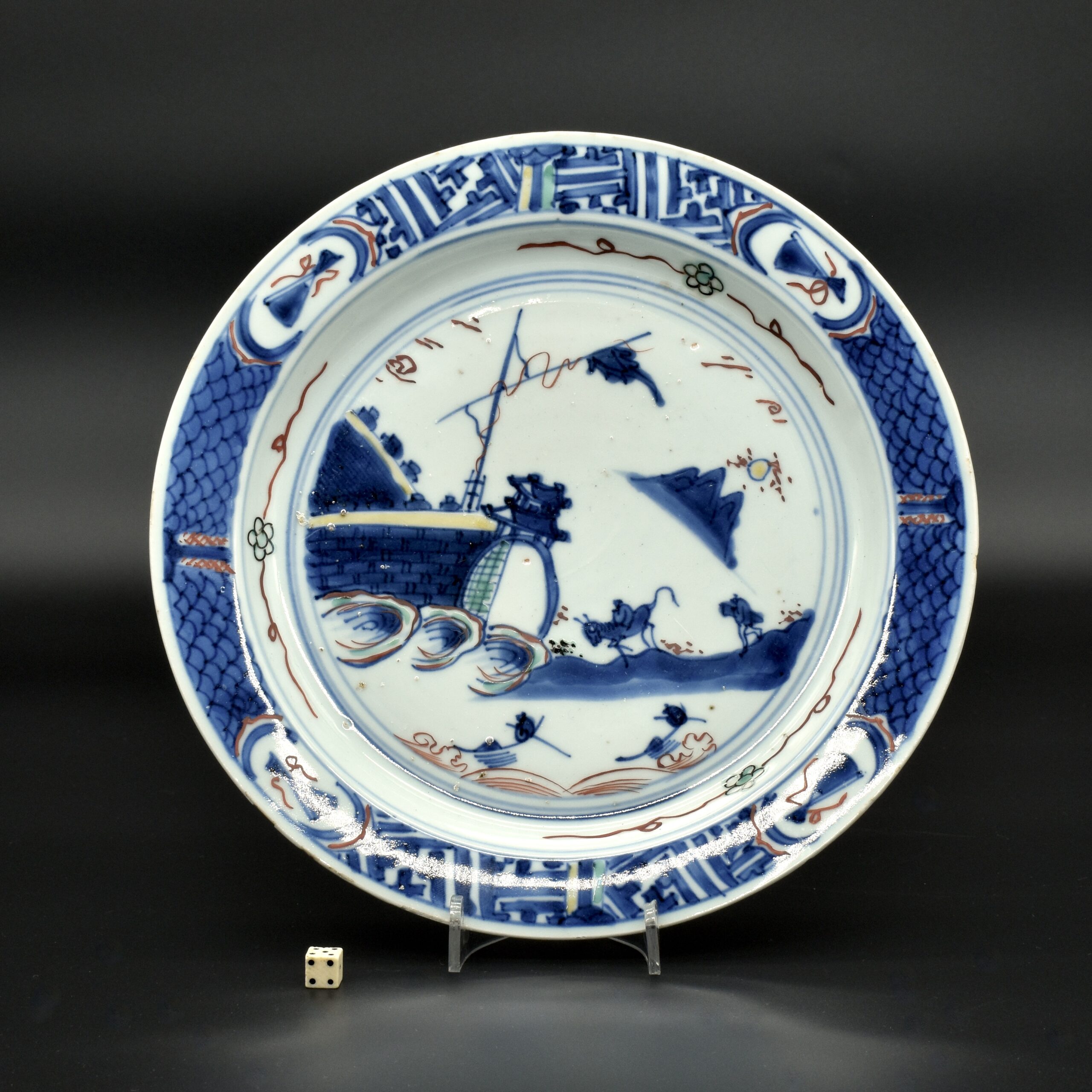
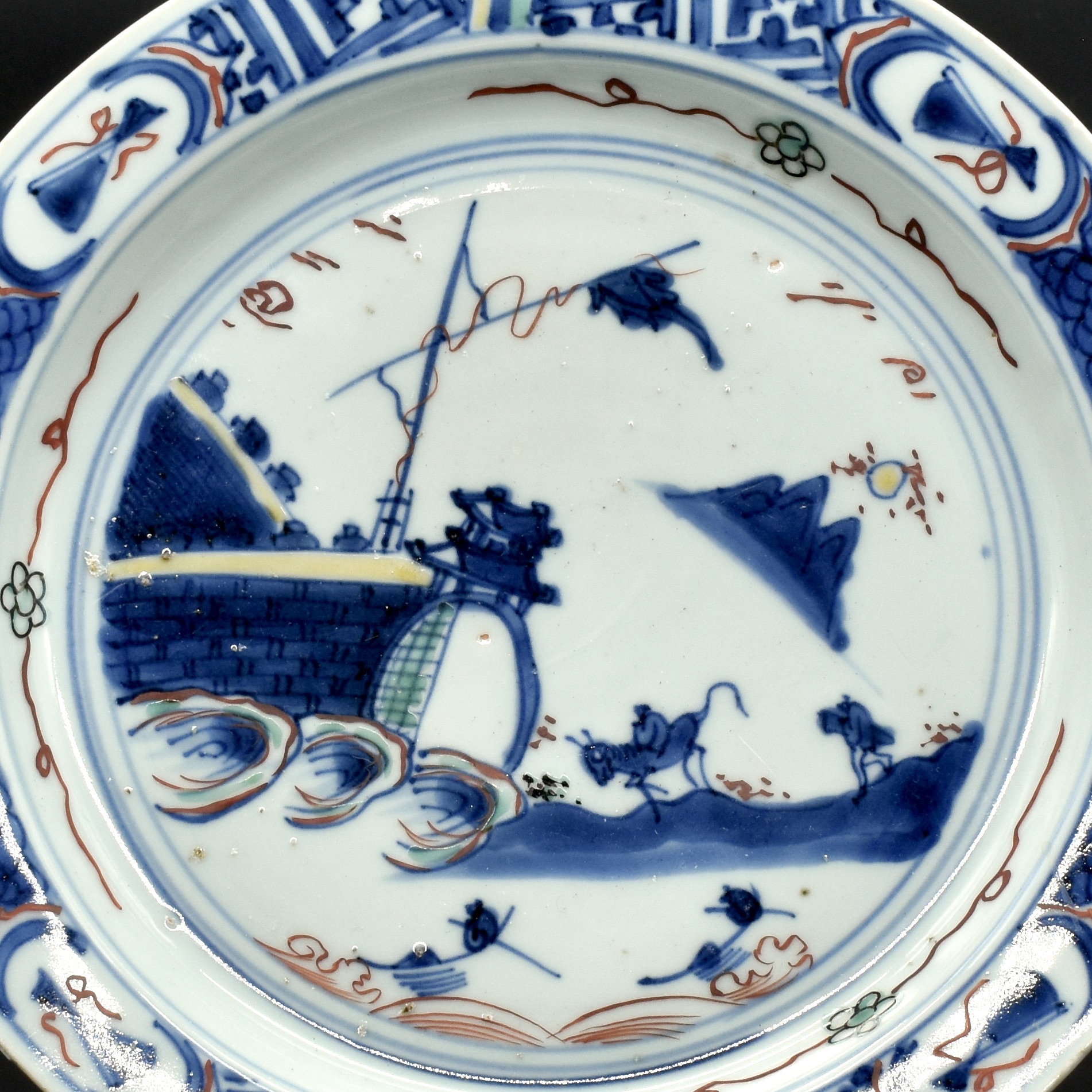
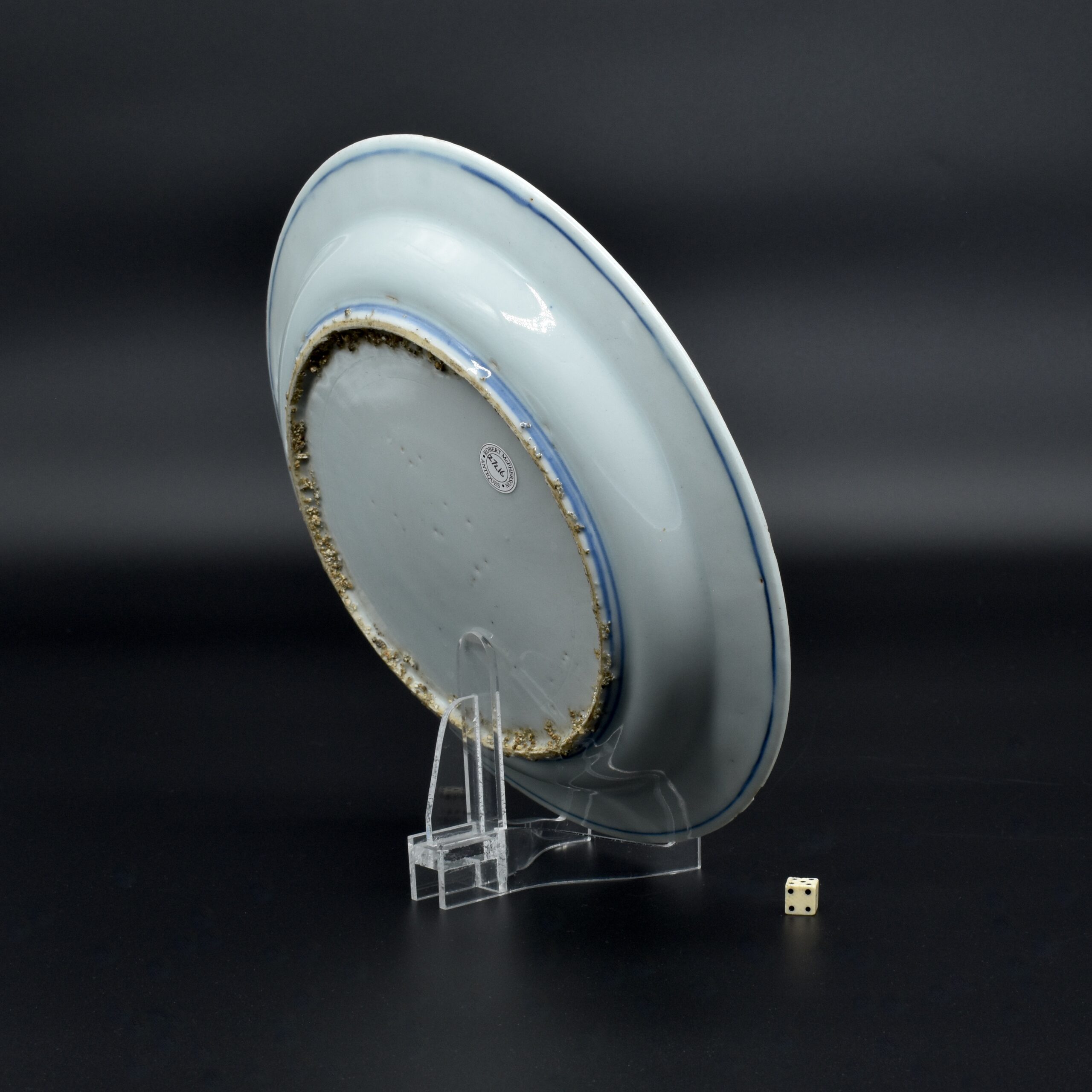
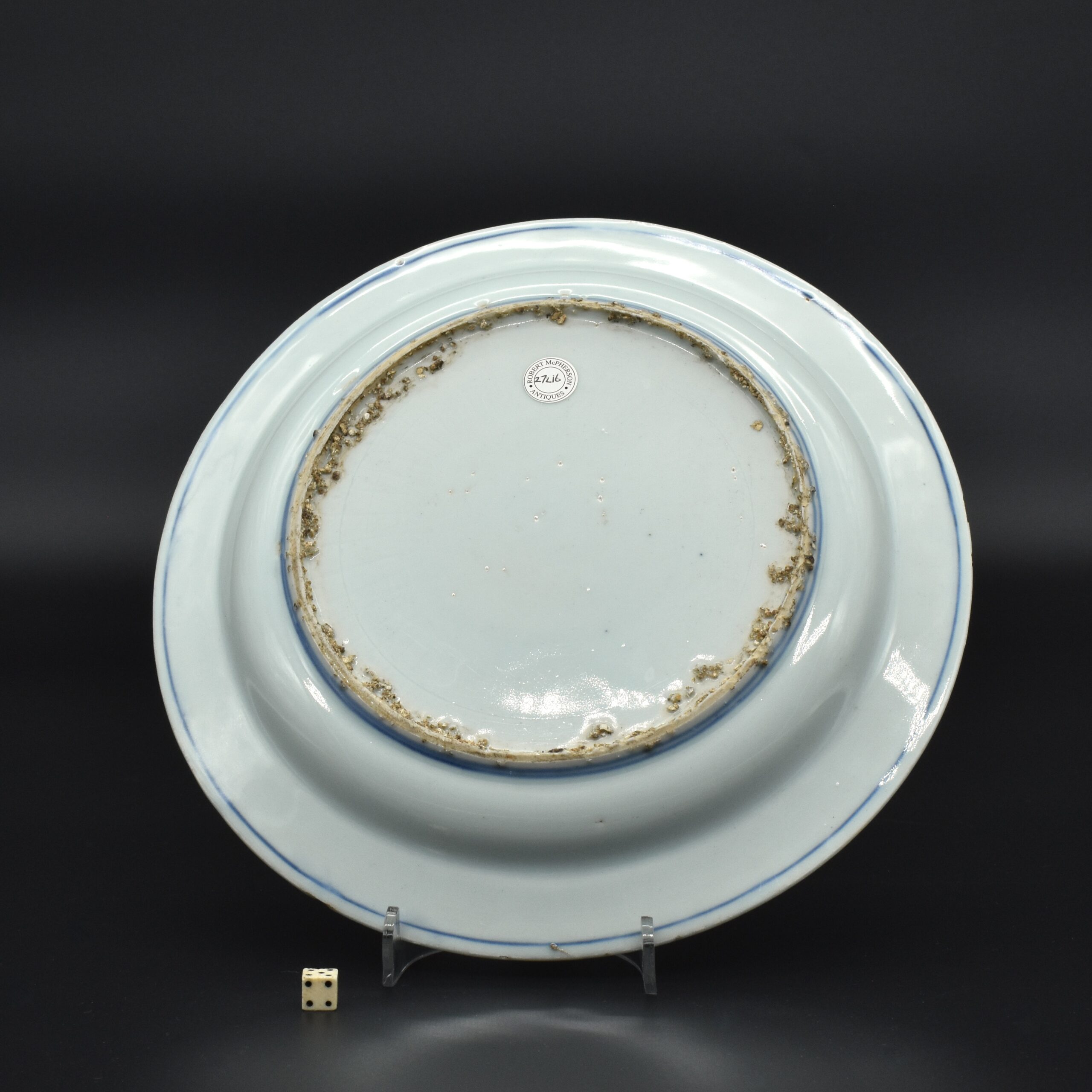
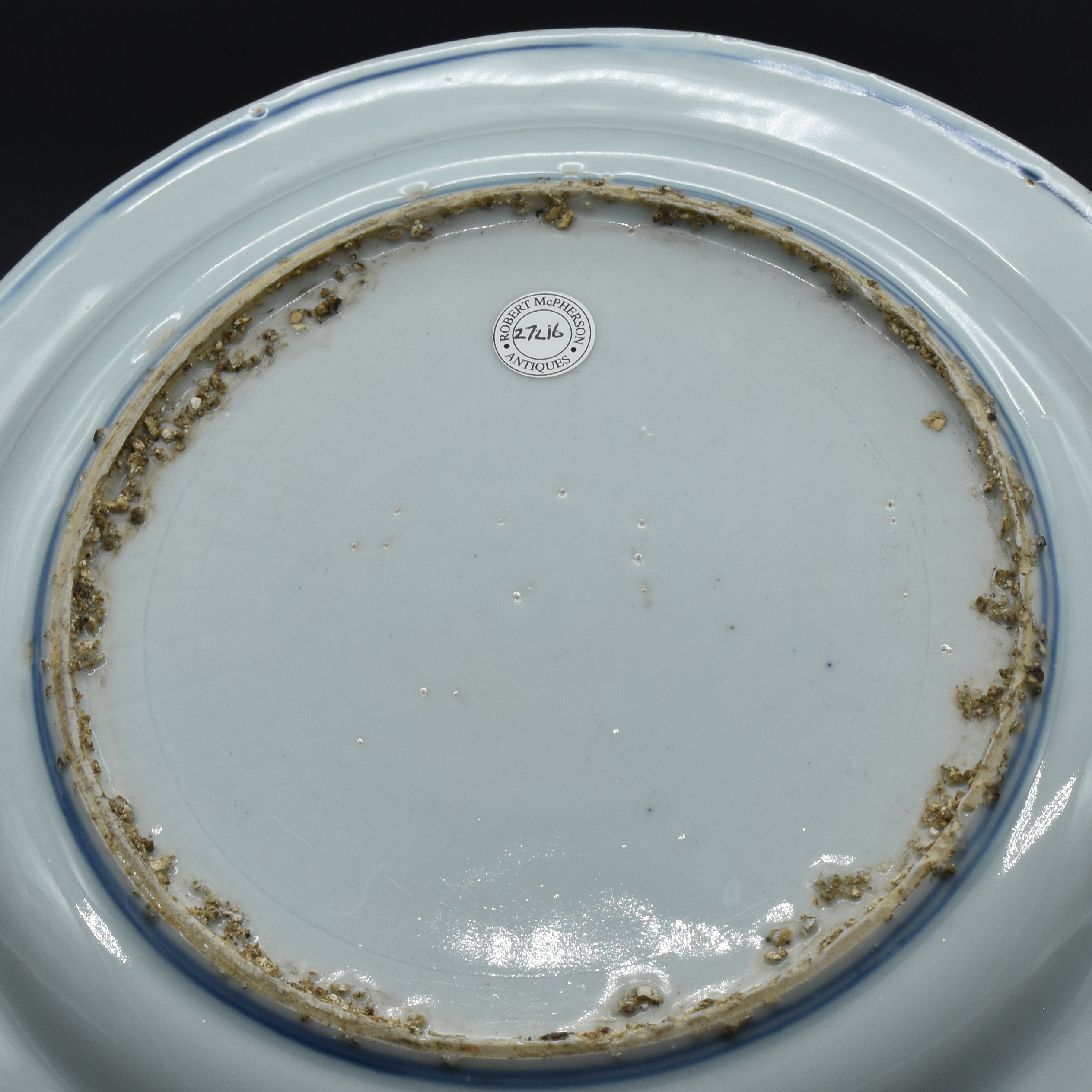
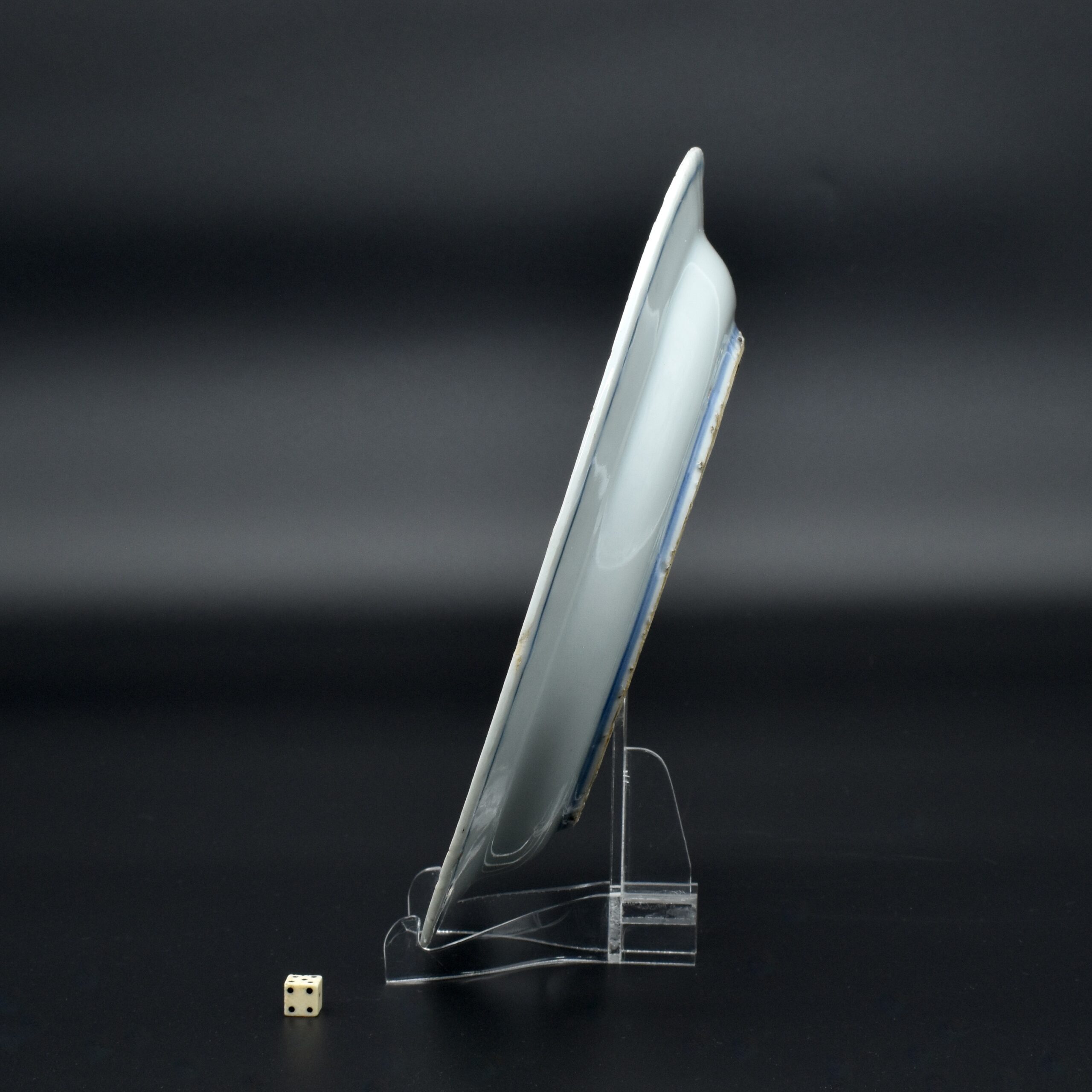
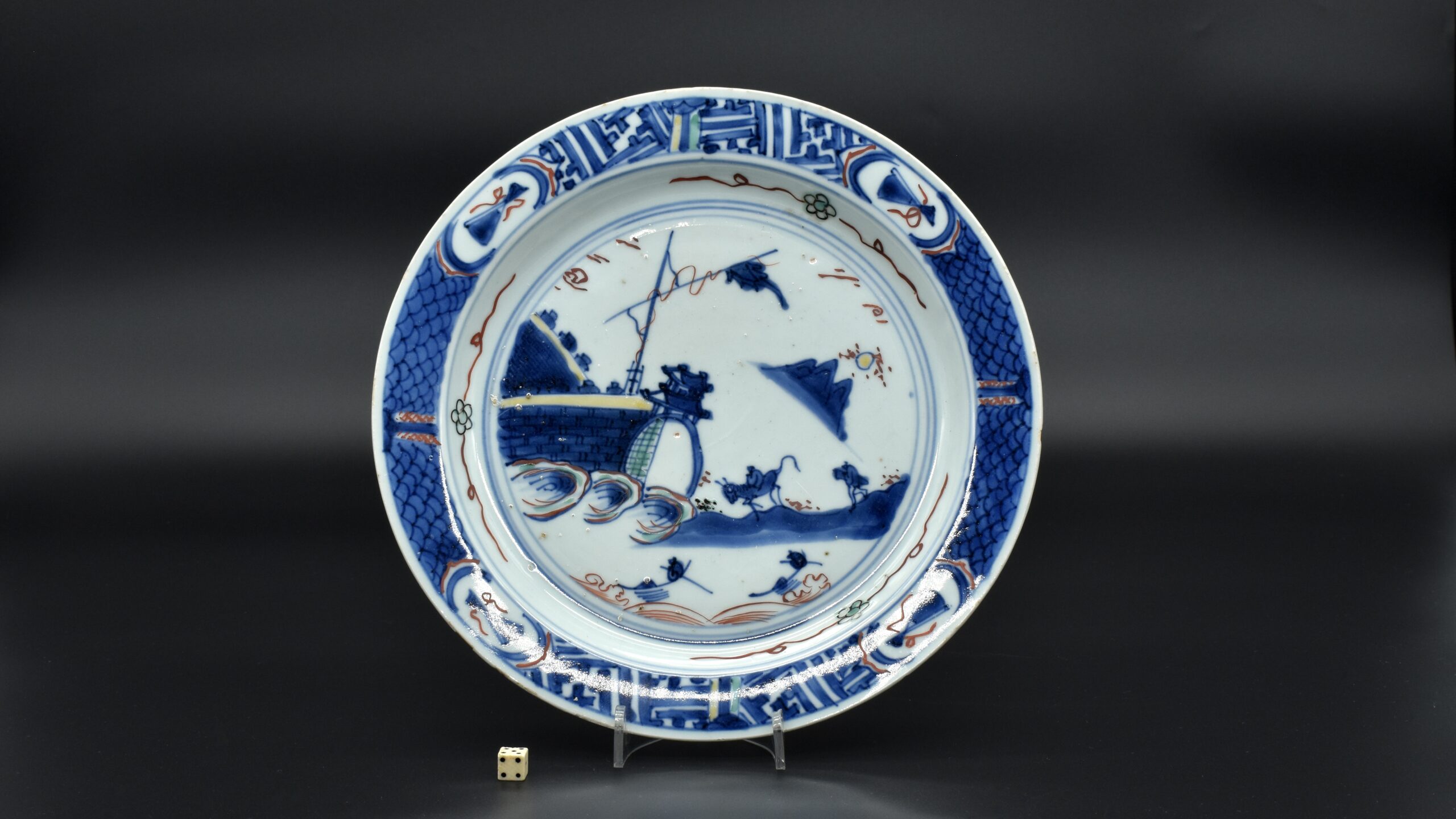
A Large Transitional Porcelain Ko-akai Enamelled ‘Walled Town’ Dish Made for the Japanese Market, Jingdezhen Kilns, Ming Dynasty, Tianqi Period 1621 – 1627 or Chongzhen Period 1628 – 1644, c.1625-1635. This Ming dish Ko-akai Ming porcelain is thickly potted and so it is rather heavy. The dish was decorated in underglaze blue and fired, then it was enamelled and given its finial firing. The glaze is blue grey. This serving dish Mukozuke (literally meaning beyond server) was made in for the Kaiseki meal that accompanies the Japanese tea ceremony. Painted in underglaze cobalt blue with green, iron-red, yellow and black. As with many pieces of Ming porcelain made for the Japanese market, this dish is deliberately made in a way that fits the Wabi-sabi aesthetic of delight in imperfection and accident. The shape is a little uneven, there are mountains at unbelievably odd angle, it is roughly made or should I say made with spirit and energy. The painting is free, the colours have no relationship with reality and there are imperfections such as tiny imperfections left on the surface. The back has allot of kiln grit within and on the footrim. During the late Ming Period the Chinese made a large among of porcelain for the Japanese market, it was made from the Wanli period (1573-1620) and ended in the Chongzhen period (1628-1644), the main period of production being the 1620’2 and 1630’s. The porcelain objects produced were made especially for the Japanese market, both the shapes and the designs were tailored to Japanese taste, the production process too allowed for Japanese aesthetics to be included in the finished object. Its seams firing faults were added, repaired tears in the leather-hard body were too frequent to not, in some cases, be deliberate. These imperfections as well as the fritting Mushikui (insect-nibbled) rims and kiln grit on the footrims all added to the Japanese aesthetic. The shapes created were often expressly made for the Japanese tea ceremony meal, the Kaiseki, small dishes for serving food at the tea ceremony are the most commonly encountered form. Designs, presumably taken from Japanese drawings sent to China, are very varied, often using large amount of the white porcelain contrasting well with the asymmetry of the design.
See Below For More Photographs and Information.
SALE PENDING
- Condition
- Imperfections. These imperfections as well as the fritting Mushikui (insect-nibbled) rims and kiln grit on the footrims all added to the Japanese aesthetic.
- Size
- Diameter 22.1 cm (8.7 inches).
- Provenance
- N/A
- Stock number
- 27216
Photos
Information
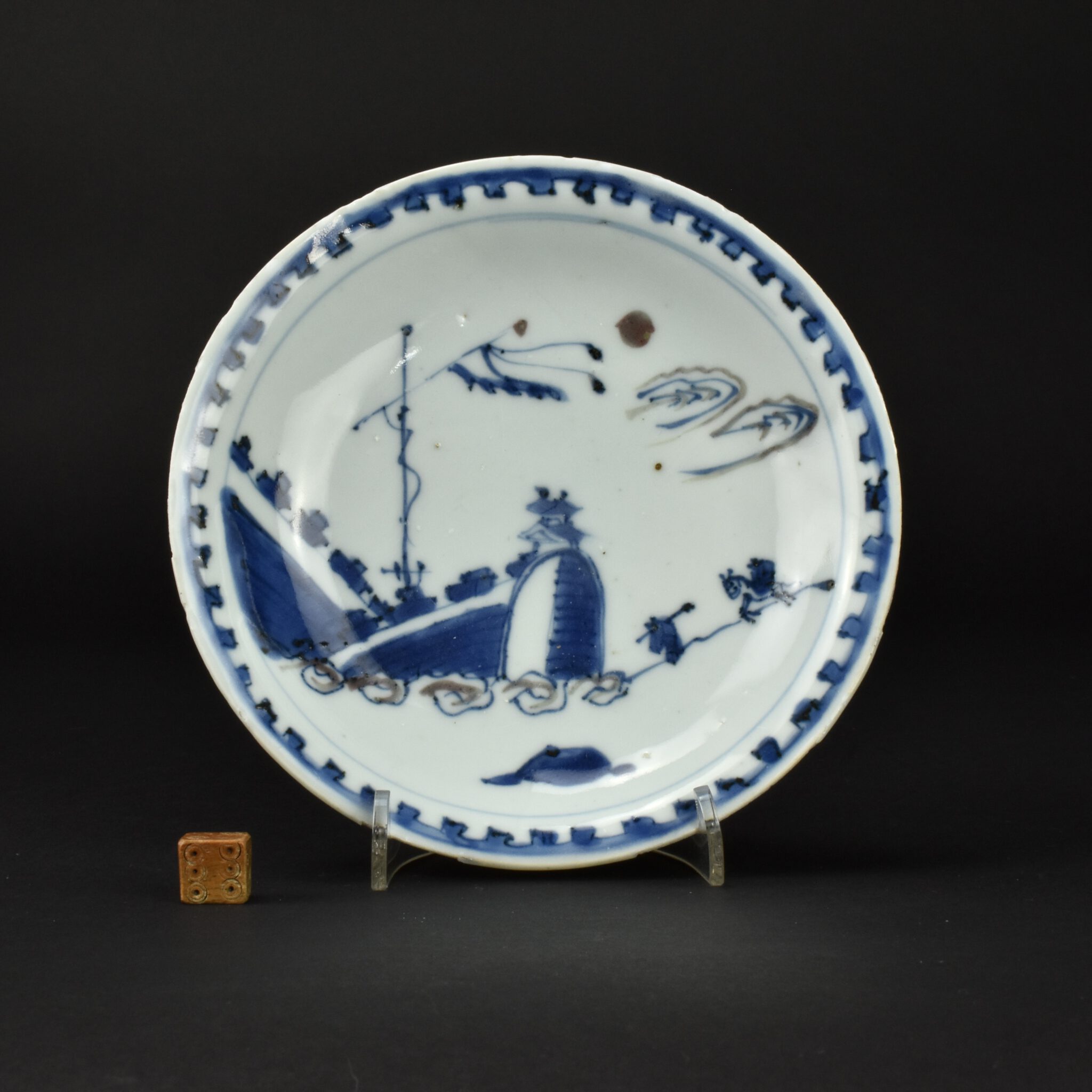
Late Ming Ko-Sometsuke Porcelain 'Walled Town' Dishes, Tianqi Period 1621 – 1627.
Robert McPherson Antiques - Sold Archive.
SOLD
Condition
In very good condition, some fritting.
Size
Diameter : 15 cm (5 3/4 inches)
Provenance
N/A
Stock number
26312
References
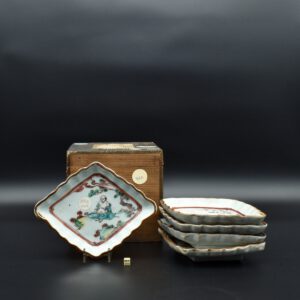
For Tianqi dishes with a version of this design which includes the use of copper red see : The Peony Pavilion Collection: Chinese Tea Ceramics For Japan' Christie's, London, 12th June 1989. Lot 344.
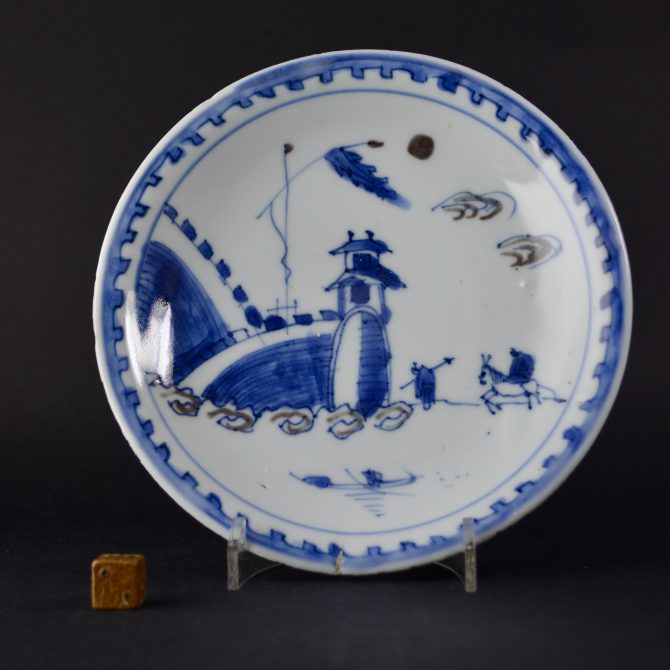
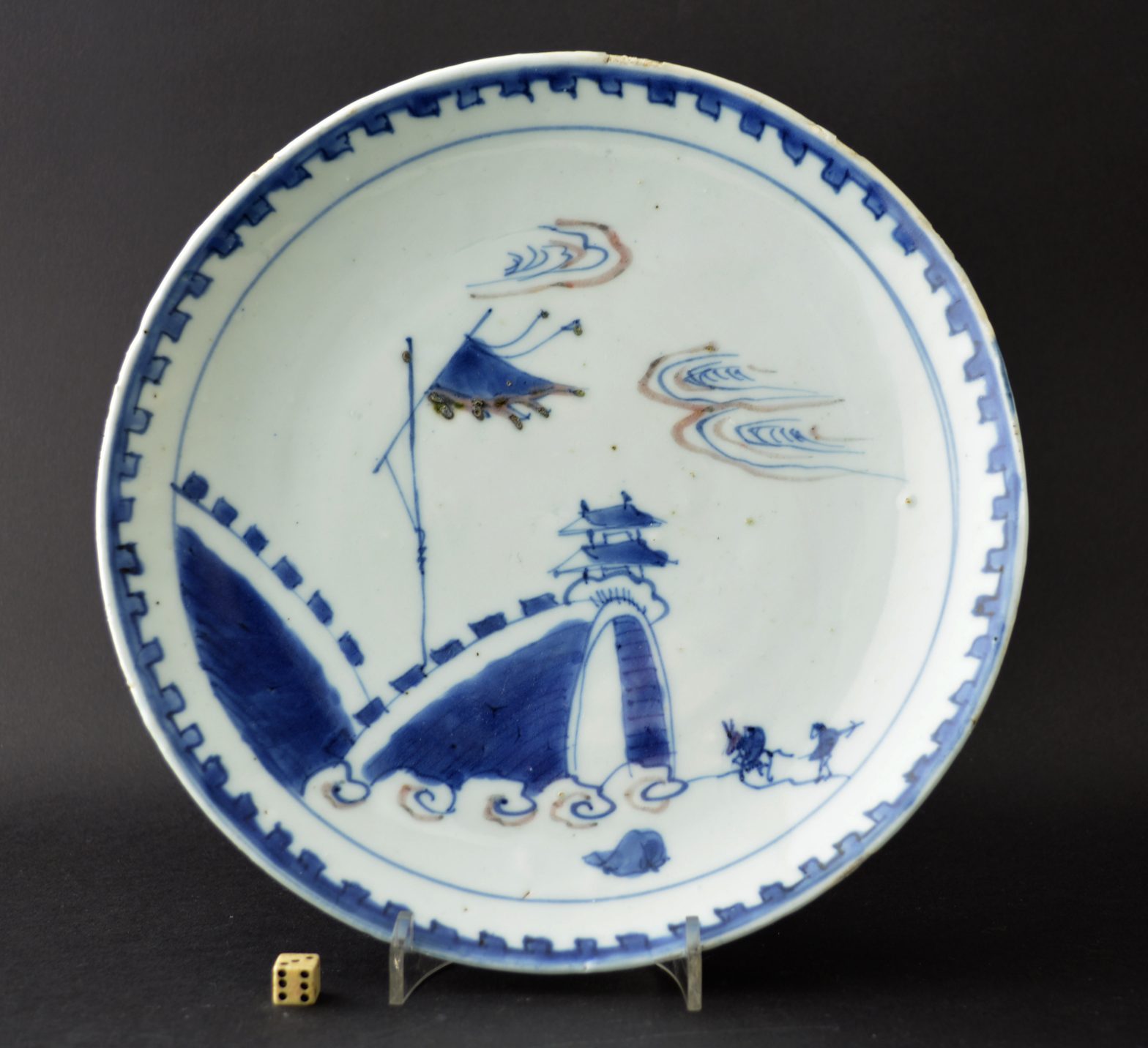
A set of Ming Five Ko-akai Dishes Sold at Christie's, King Street, London in 1989.
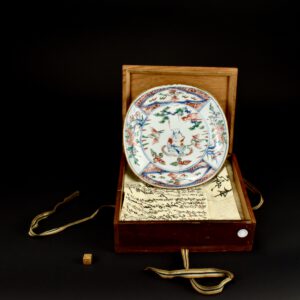
The Peony Pavilion Collection ; Chinese Tea Ceramics for Japan (c.1580-1650). Christie`s London 12th June 1989, lot 350, set of 5. From a Private Collection, this lot was purchased, this piece as well as many others, from the Christie's sale of 1989. I was able to buy the complete group from this private collection. Christie's estimate £3,000 to £4,000 (1989), sold for £3,850.
A Transitional Porcelain Ko-akai Enamelled Dish Made for the Japanese Market.
Robert McPherson Antiques Sold Archive Number 26258
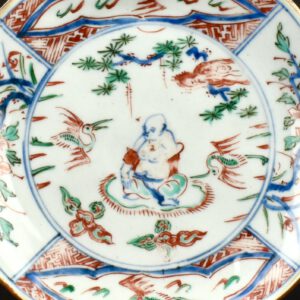
A Transitional Porcelain Ko-akai Enamelled Dish Made for the Japanese Market, Jingdezhen Kilns, Ming Dynasty, Chongzhen Period 1628 – 1644. This Ming dish Ko-akai Ming porcelain is thickly potted and so it is rather heavy. The dish was decorated in underglaze blue and fired, then it was enamelled and given its finial firing. The glaze is blue grey. This serving dish Mukozuke (literally meaning beyond server) was made in for the Kaiseki meal that accompanies the Japanese tea ceremony. Painted in underglaze cobalt blue with green, iron-red, and black. The central scene in the well depicts Budai (Hotei in Japanese), he is a Chinese deity. His name means `Cloth Sack` and comes from the bag that he carries. According to Chinese tradition, Budai was an eccentric Chinese Zen monk who lived during the 10th Century. Bearing in mind the long connection between Zen Buddhism and the Japanese tea ceremony, it is not surprising Budai takes center stage in this design. He sits on a fringed rug with the moon or sun above with pine and a cloud. Two phoenixes flank him, one of which has its head upside down. Below Budai are two ruyi-heads among stylised clouds. The border consists of two facing panels of flowering peony with orchid, the other two facing pales have a cartouche with flying phoenix against a red diaper ground. As with many pieces of Ming porcelain made for the Japanese market, this dish is deliberately made in a way that fits the Wabi-sabi aesthetic of delight in imperfection and accident. The shape is uneven, it is roughly made or should I say made with spirit and energy. The painting is free, there are imperfections such as tiny flecks of the iron red paint left on the surface. The back has allot of kiln grit within the footrim, the rim has been dressed with an iron oxide glaze.
Ming Porcelain for Japan :
During the late Ming Period the Chinese made a large among of porcelain for the Japanese market, it was made from the Wanli period (1573-1620) and ended in the Chongzhen period (1628-1644), the main period of production being the 1620`2 and 1630`s. The porcelain objects produced were made especially for the Japanese market, both the shapes and the designs were tailored to Japanese taste, the production process too allowed for Japanese aesthetics to be included in the finished object. Its seams firing faults were added, repaired tears in the leather-hard body were too frequent to not, in some cases, be deliberate. These imperfections as well as the fritting Mushikui (insect-nibbled) rims and kiln grit on the footrims all added to the Japanese aesthetic. The shapes created were often expressly made for the Japanese tea ceremony meal, the Kaiseki, small dishes for serving food at the tea ceremony are the most commonly encountered form. Designs, presumably taken from Japanese drawings sent to China, are very varied, often using large amount of the white porcelain contrasting well with the asymmetry of the design.
The Transitional Period :
The roots of this unsettled period starts during the later part of Wanli`s reign (1573-1620). At the begging of his reign China was doing very well, new crops from the Americas such as peanuts, maize and sweet potatoes increased food production, while simplified taxes helped the state run smoothly. But this was not due to Wanli`s enlightened reign, but to his Mother championing a man that was to become the Ming dynasties most able minister, Zhang Zhuzheng (1525—1583). Wanli became resentful of Zhuzheng`s control but upon his death became withdrawn from court life. Between 1589 to 1615 he didn`t appear at imperial audiences, leaving a power vacuum that was filled by squabbling ministers. Mongols from the North raided as Japan invaded Korea. Wanli re-opened the silver mines and imposed new taxes but the money was lost due to corruption, as well as being frittered away by the indulgent Emperor himself . The next emperor of Ming China, Tianqi (1621-1627), was bought up in this self indulgent disorganised environment, at the very young age 15 his short reign started. He didn`t stand a chance. Tianqi made the mistake of entrusting eunuch Wei Zhongxian (1568-1627) who Anna Paludan in her excellent book “Chronicle of the Chinese Emperors” (Thames and Hudson, 1998) describes as “a gangster of the first order”. Tianqi was deemed to have lost the Mandate of heaven by the Ming people. Tianqi`s younger brother, the last of the Ming Emperors, Chongzhen (1628-1644), was not able to save the situation. The systems of administration had broken down, corruption was rife and so when a sever famine broke out in 1628 nothing much could be done. Anna Paludan describes the tragic end to the great Ming Dynasty “The final drama was worthy of a Greek tragedy. The emperor called a last council in which `all were silent and many wept`, the imperial troops fled or surrendered, and the emperor, after helping his two sons escape in disguise, got drunk and rushed through the palace ordering the women to kill themselves. The empress and Tianqi`s widow committed suicide; the emperor hacked off the arm of one daughter before killing her sister and the concubines. At dawn he laid his dragon robe aside and dressed in purple and yellow, with one foot bare, climbed the hill behind the now silent palace and hanged himself on a locust tree”. The Great Wall of China, started 2,000 years ago was built to protect China from the Northern barbarian hoards, it was often tested and sometimes failed. The Jin people invaded China, ruling the North between 1115 and 1234, it was their descendants the Manchus, Jurchens from south east Manchuria that took full advantage of the problems of the Ming dynasty. In 1636 they adopted a Chinese dynastic name, the `Great Qing` (Qing meaning pure). The first of the Qing emperors was Shunzhi (1644-1661) but for most of his reign his uncle ran the state. War raged on during this period and it wasn`t until the second Qing emperor Kangxi (1662-1722) that true peace was achieved. Kangxi was a wise and educated man, he became a highly successful emperor bringing China a long period of wealth and stability.