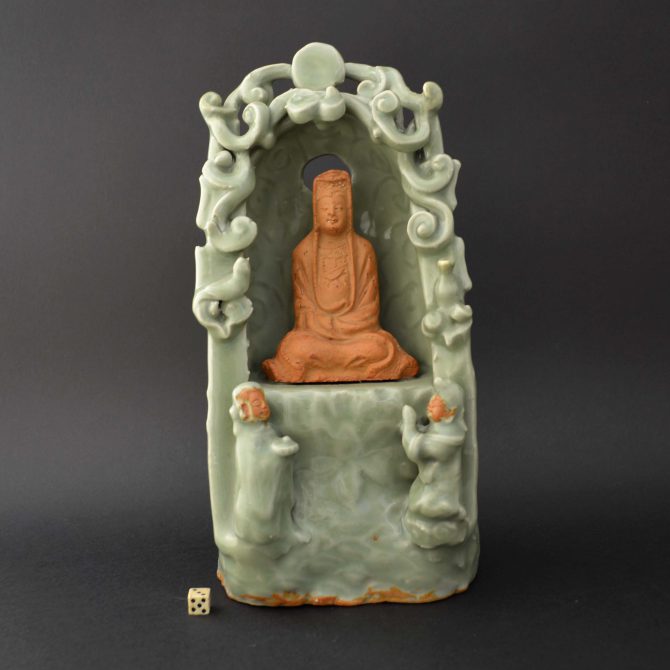
An Early Ming Longquan Celadon Shrine to Guanyin c.1400 – 1450.
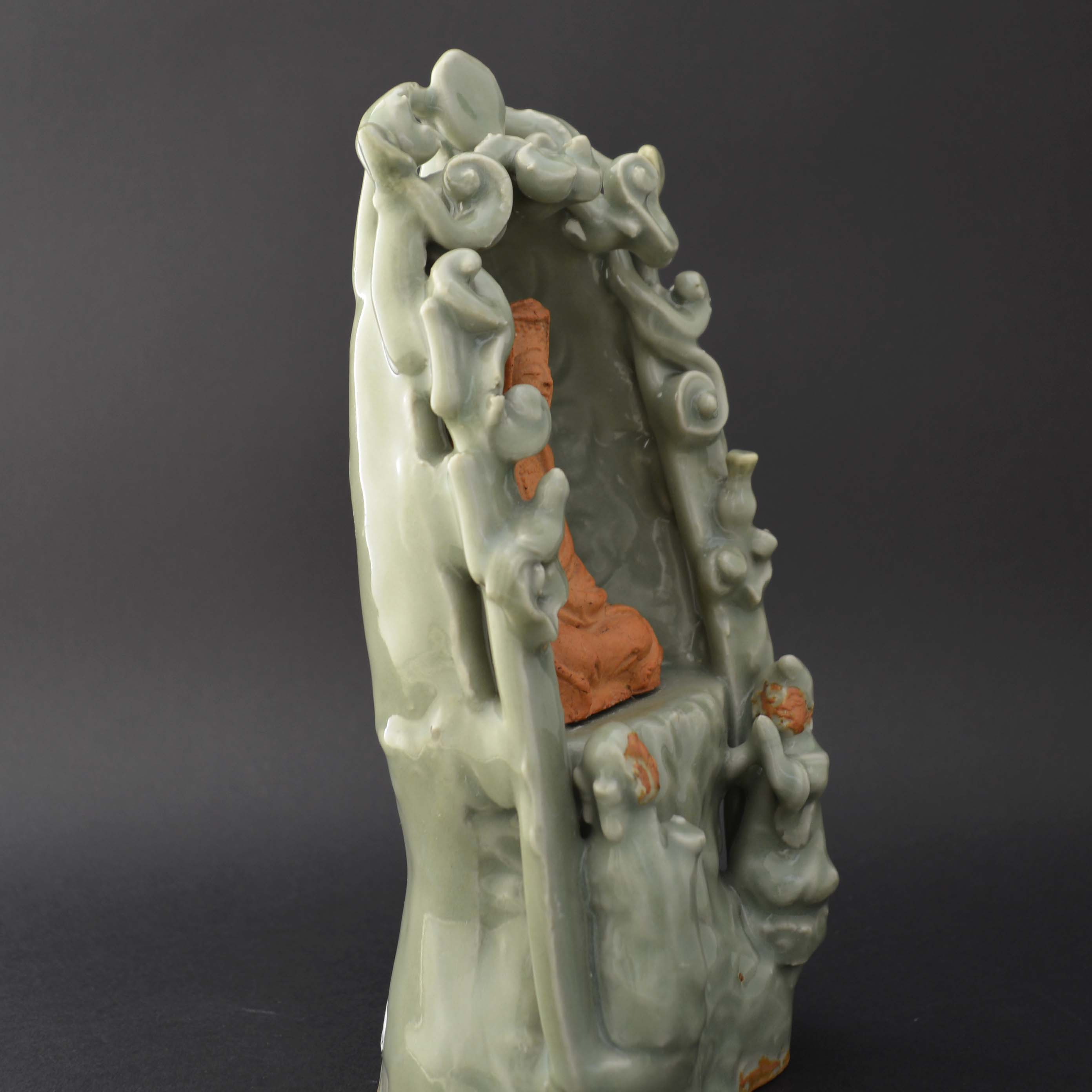
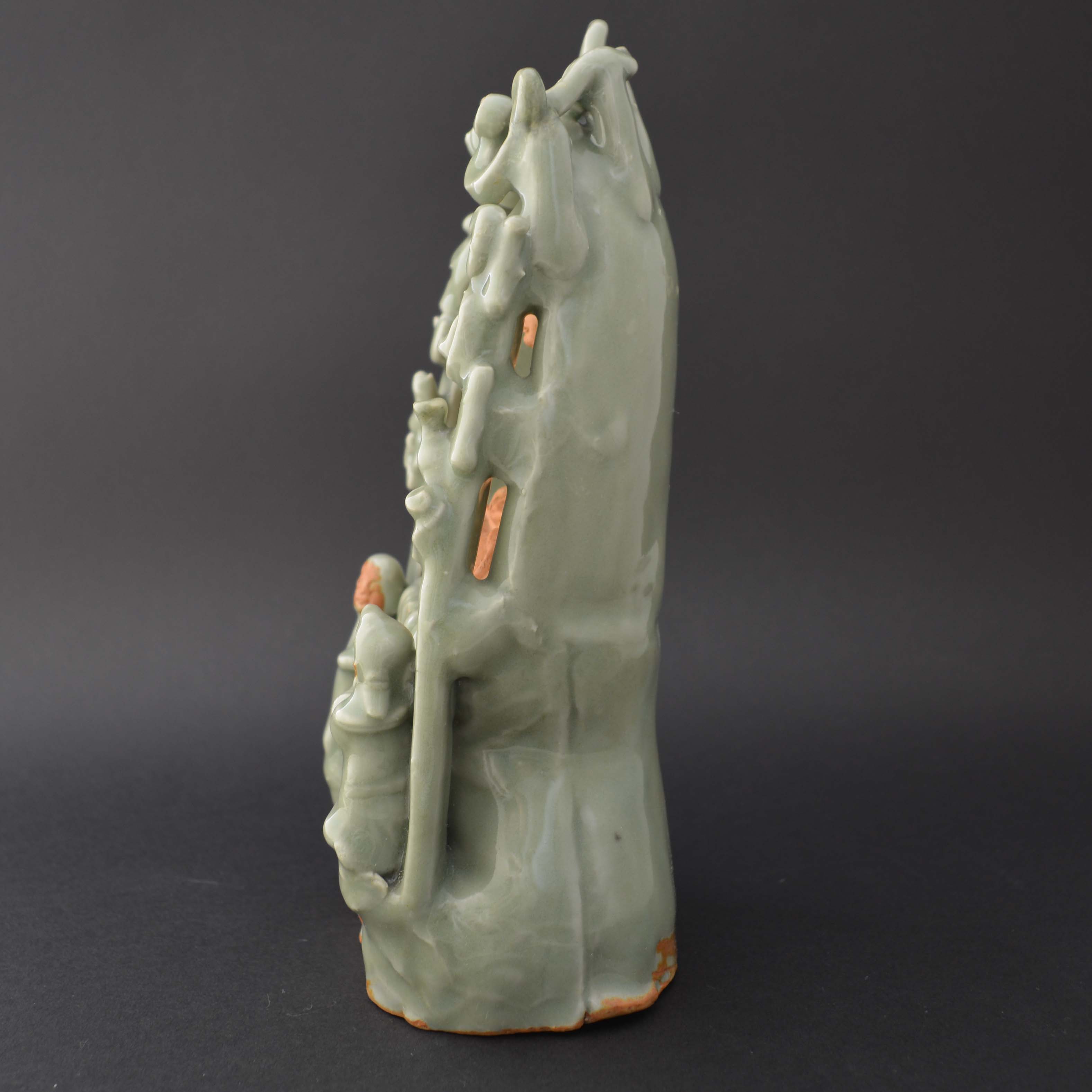
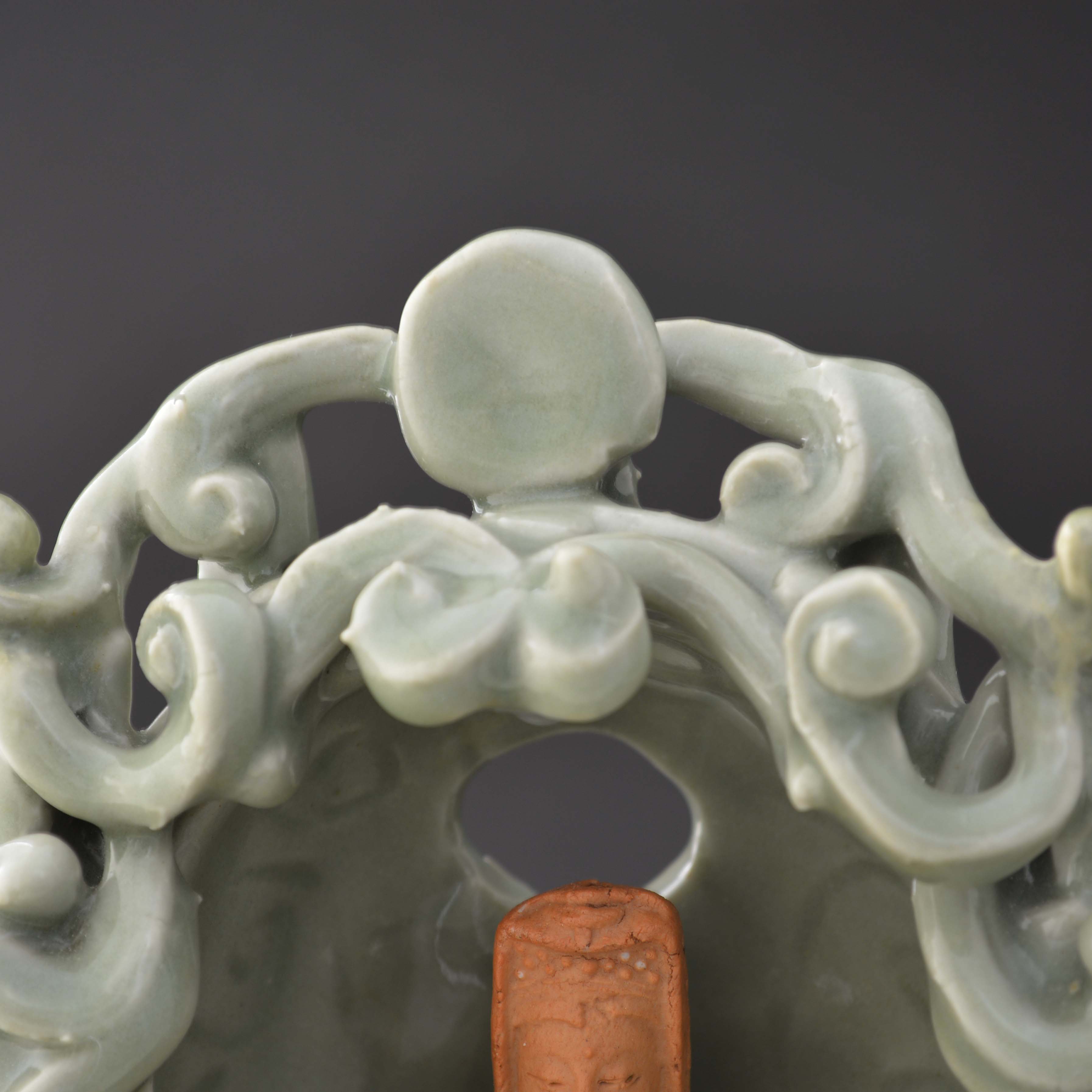
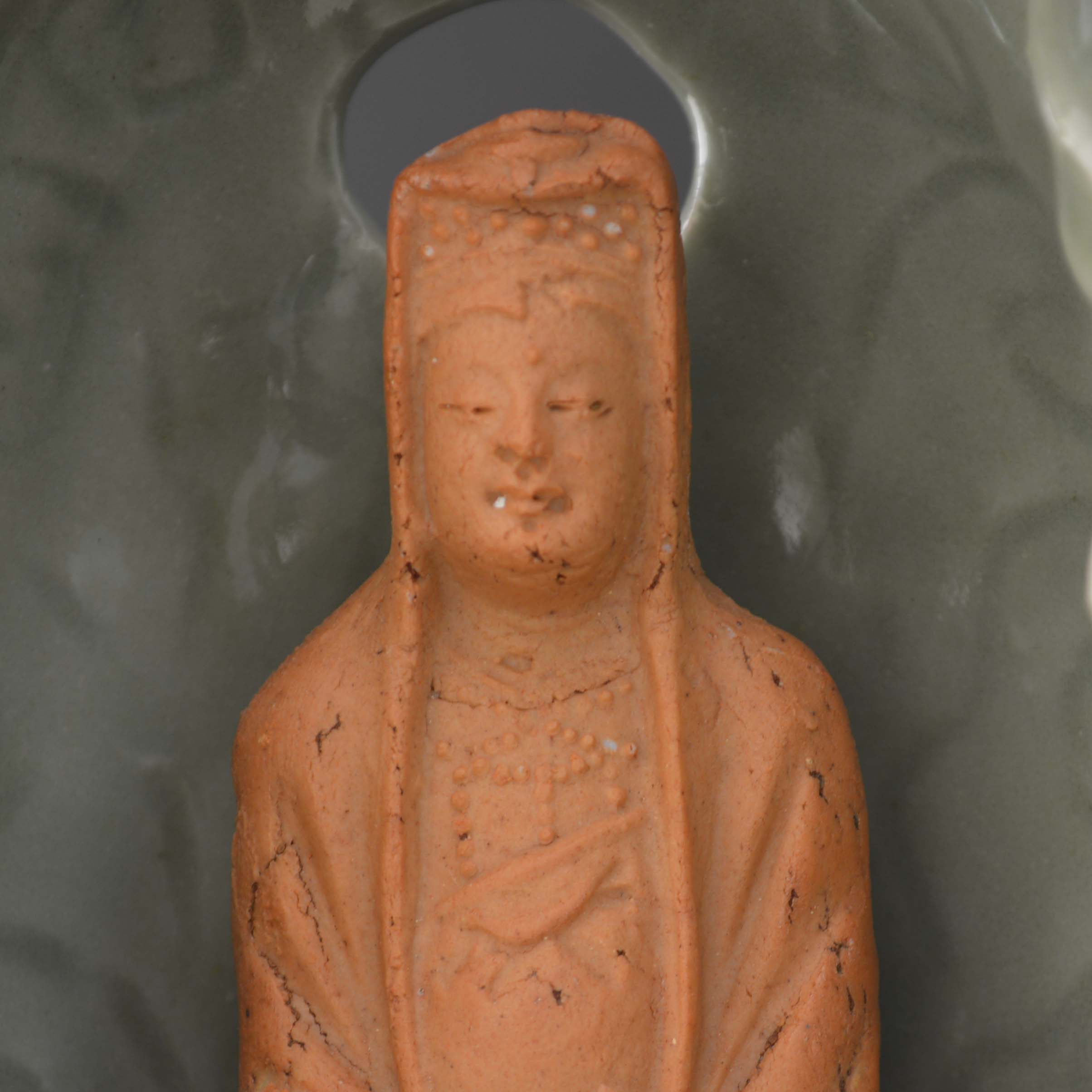
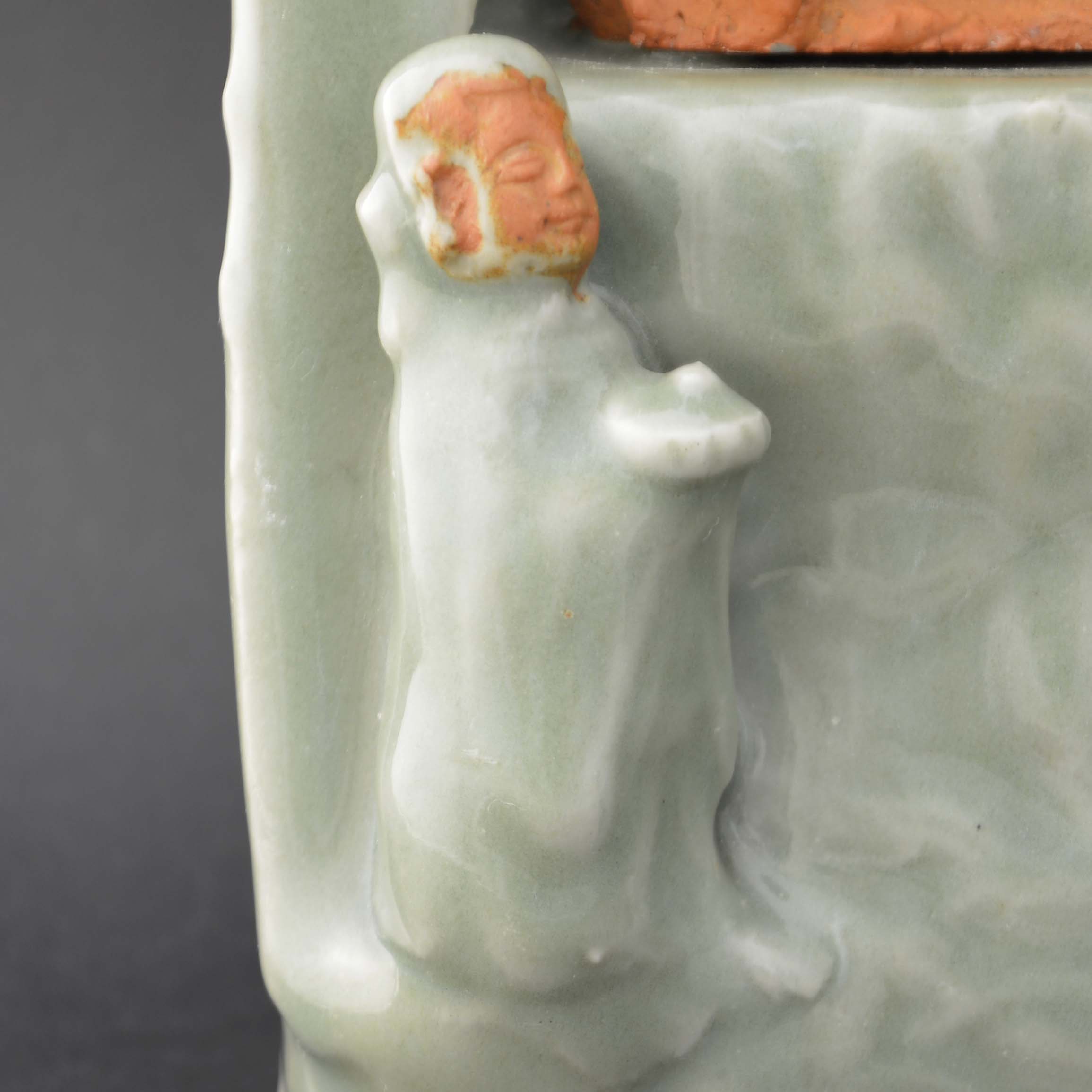
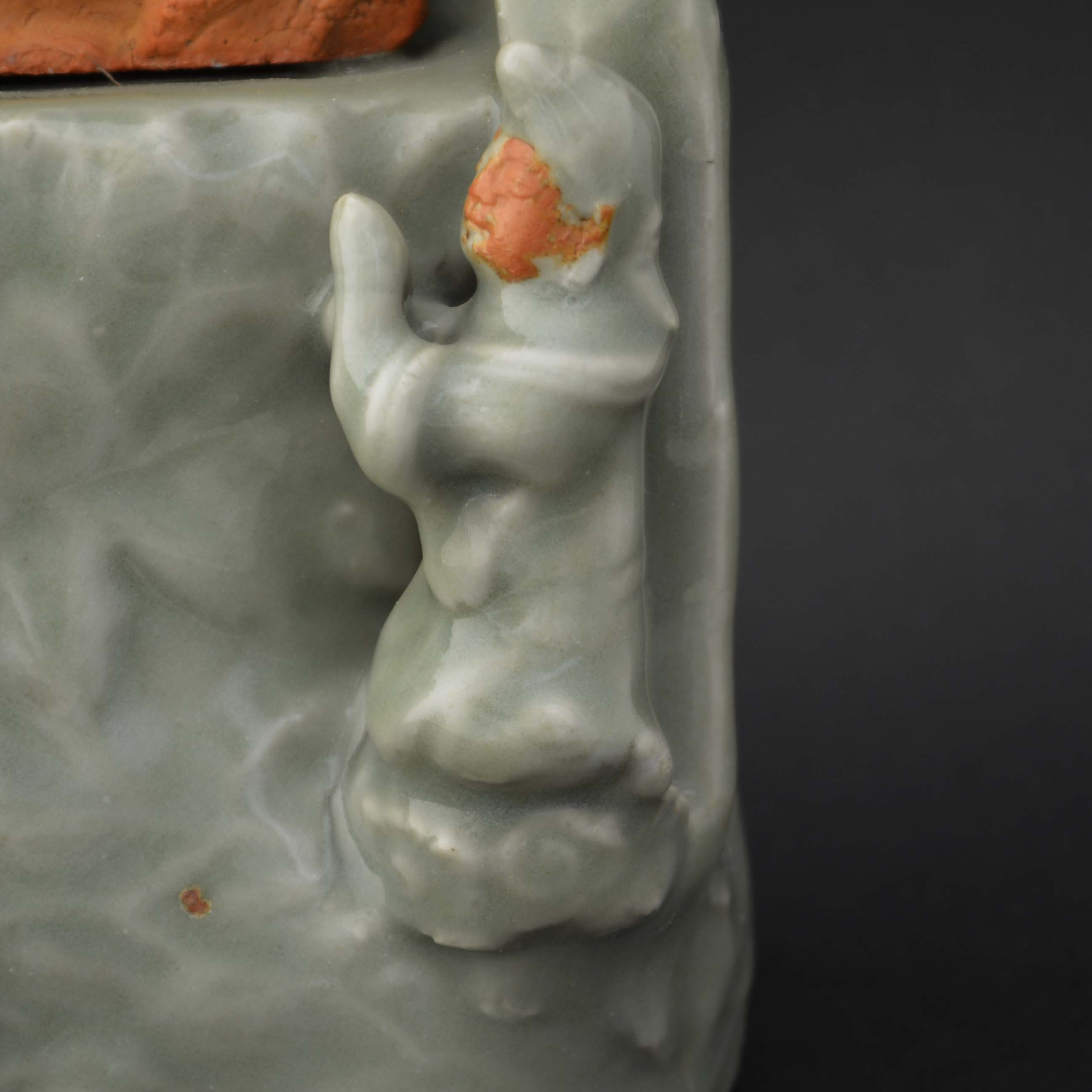
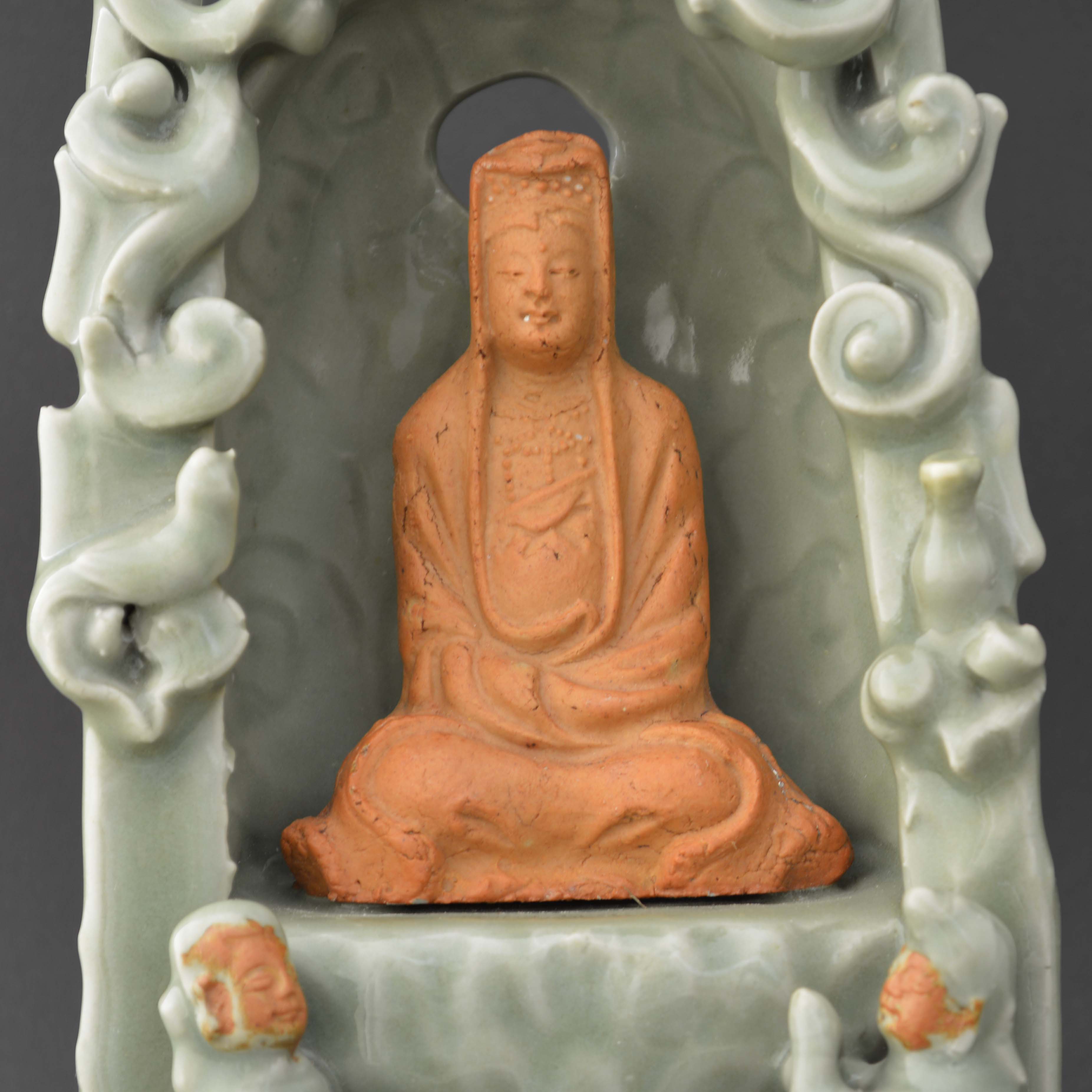
An early Ming celadon ware model of a shrine, Longquan kilns c.1400-1450. The small shrine for home or temple use depicts Guanyin in seated pose on the lotus throne with her two diminutive acolytes below paying homage. Guanyin is in surrounded by a grotto of stylised swirling clouds, the sun disk is above ; her emblems, a bird and a vase are either side of her. Guanyin and the acolytes heads are unglazed and would originally have been gilded.
- Condition
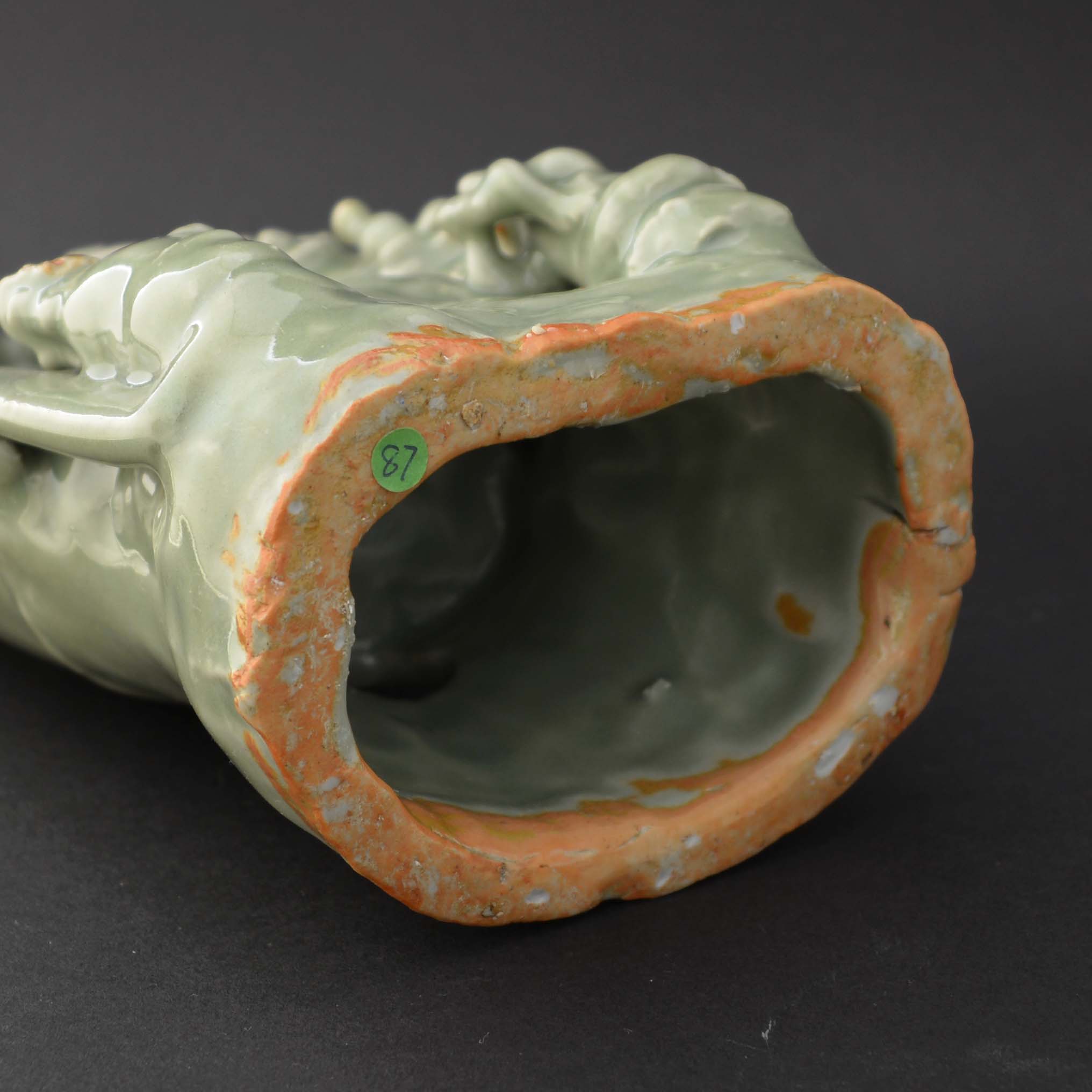
- Some minor repairs, the two outer 'cloud curls' at the top have been restored as has the top of the bottle within the stylised clouds.
- Size
- Height : 25.3 cm (9 inches).
- Provenance
- Robert McPherson Antiques, stock number 8677, purchased 13th of November 1999. NICOLAS THOMPSON COLLECTION : Nicholas de la Mare Thompson (1928-2010), the grandson of the author Walter de la Mare spent his career in publishing. He started at Nesbit where he was editor of the Janet and John series of children’s books but not all of his career was so safe. He wrestled with W.H. Smith over the content of Madonna’s raunchy Sex book on behalf of Paul Hamlyn’s Octopus Group and defeated Margaret Thatcher over Spycatcher. He could not bare dogma or hypocrisy. It was hardly surprising that as a committee member of the O.C.S. he had his own ideas. He read and could recite great swaths of the articles of the Society, he used this not to attack but to stimulate debate. He approached the Society in the same way as he approached his understanding of Chinese ceramics, by stripping it down and starting again using clear empirical thinking. He was very concerned the Society was open to all and was run for the benefit of all members. Nicholas came from a family of collectors, his love of oriental ceramics was broad but his focus was on early monochromes, especially those from the Song dynasty. He bought what he loved, what he thought had merit, not what was said to be good, and certainly not anything because it was fashionable. He didn’t have a stamp collectors approach, filling in the gaps of pre-existing ordered collection, rather he would react to an object, feeling it was right for his collection. Sometimes he wasn’t sure if it was right for his collection or not. He would then “borrow” pieces and live with them, other times he would ask his wife Caroline, who’s eye he trusted, if he should keep the piece or not. He was amused because I was often able to know if he would keep a piece before he did. We discussed “pots” endlessly, he loved to talk about ceramics with a wide variety of people, and enjoyed the company of others on O.C.S. trips as well as in discussion groups or anywhere else. Later on he combined his love of Chinese ceramics with his love of books by extending his library to include rare early books, he used these to trace the development of collecting and scholarship in the 19th and early 20th century. He was fascinated by earlier scholarship, what was not understood but also what they understood and we have lost. He was always reading and wanted to know more right up to the end, he didn’t see impending death as a barrier to knowledge or indeed collecting. The week before he died he questioned, if only for a second, whether it was too late to buy another pot for the collection. He concluded it was not, he was a true collector. Nicolas died on the 25th of April 2010 at the age of 82 after living with cancer for two years. He leaves behind his energetically supportive wife Caroline and his three children. He was a kind, gentle and incredibly civilised man with a very sharp mind and dry sense of humour, he was passionate about the Society, its aims and its members. He was an incredibly supportive and thoughtful friend and is very much missed .
- Stock number
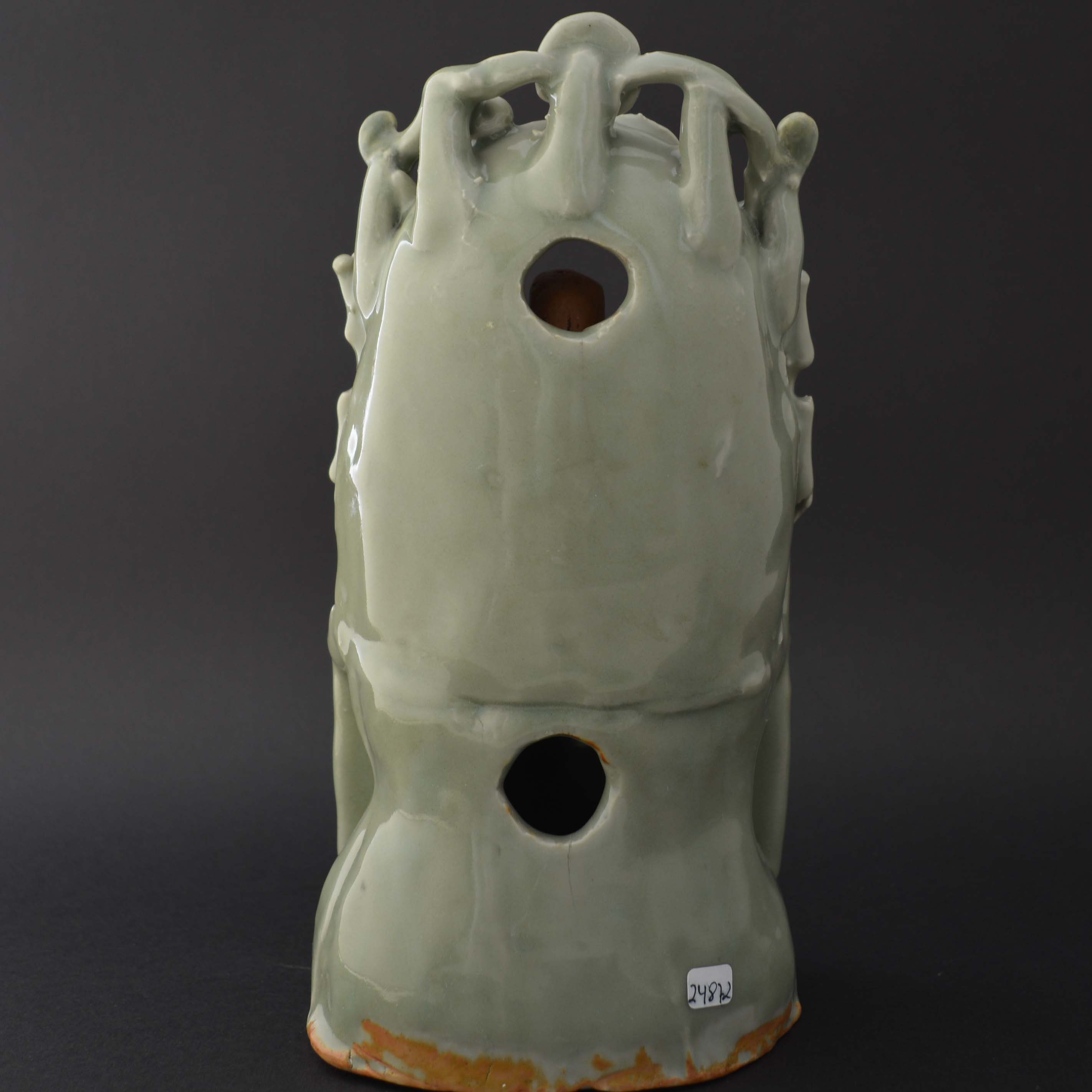
- 24872
- References
- For a far larger and complex Ming shrine given by Sir Percival David dated by inscription to 1406, see : Catalogue of Late Yuan and Ming Ceramics in the British Museum.(Jessica Harrison-Hall, The British Museum Press, 2001. ISBN 0-7141-1488-X) page 499, 16:95.
Photos
Information
Celadon Ware :
Celadon is a term used to describe several types of Chinese stoneware and porcelain, as well a ceramics from other countries, notably from Korea and Japan. The term is a imprecise one, applying to various types of green glazed ceramics, but not all ceramics with green glazes, there are several wares that have a green glaze that are not refereed to as celadon. For example Green Jun and Ge Ware. For this reason there has been a move to try to clarify the situation by using the term `Green Ware`. But for now Celadon is a more familiar and therefore useful term. The origins of the term Celadon are not clear, one theory is that the term first appeared in France in the 17th century and that it is named after the shepherd Celadon in Honoré d`Urfé`s French pastoral romance, L`Astrée (1627), who wore pale green ribbons. (D`Urfe, in turn, borrowed his character from Ovid`s Metamorphoses.) Another theory is that the term is a corruption of the name of Saladin, the Ayyubid Sultan, who in 1171 sent forty pieces of the ceramic to Nur ad-Din, Sultan of Syria. Yet a third theory is that the word derives from the Sanskrit sila and dhara, which mean "stone" and "green" respectively. Celadon ware originated in Zhejiang Province in the Eastern Han Dynasty, however green monochrome glazes can be found on stoneware much before that date. Zhejiang is were the famous Longquan Celadons were made but Celadon wares were also produced at Jiangsu, Hubei, Hunan and Jiangxi. The production of Celadon Ware required a reducing atmosphere of around 1300 degrees C., the colouring agent was a mixture of iron oxide and titanium. The glaze was applied very thickly, and was full of tiny bubbles which defuse the light giving the appearance of richness and softness. Celadon ware originated in Zhejiang Province in the Eastern Han Dynasty, however green monochrome glazes can be found on stoneware much before that date. Zhejiang is were the famous Longquan Celadons were made but Celadon wares were also produced at Jiangsu, Hubei, Hunan and Jiangxi. The production of Celadon Ware required a reducing atmosphere of around 1300 degrees C., the colouring agent was a mixture of iron oxide and titanium. The glaze was applied very thickly, and was full of tiny bubbles which defuse the light giving the appearance of richness and softness.
Guanyin :
Figures of Guanyin are by far the most common of all Blanc de Chine figures and indeed one of the most common images in Chinese figurative art. Guanyin was the Goddess of mercy, She was especially revered in the area where this figure was produced ; Dehua in Fujian Province. But her origins stem from Tibetan Buddhism, she was originally the patron saint of Tibetan Buddhism `Avalokitesvara`. Guanyin is actually the shorter form of the name Guan shi yin, which means “one who observes the voices of the world.” True to her name, Guanyin listens to and understands the worries that plague man`s existence. Because of her mercy and generosity, Guanyin is the most-loved of China`s divinities. the one people turn to for assistance in their everyday lives. Guanyin is specially venerated by those who are hoping to have children or those who are about to set out for sea. Guanyin is usually portrayed wearing a white cape. In her right hand, she holds a dish that has holy water. On her head is a crown in the style of the Amitabha-buddha. She is shown meditating in a seated position. Guanyin has been given the same qualities as the Virgin Mary of Catholic theology, which is why she is sometimes portrayed holding a child in her arms. While the worship of Guanyin in could be traced historically from India, she is the star of countless legends and folk tales in China. Guanyin`s home on earth was the Putuo mountains, located on an island on China`s eastern coast to the south of Shanghai. In China, Putuo-shan is one of the most sacred places in Buddhism and the temple dedicated to Guanyin on the mountain is one of the most important pilgrimage site for Buddhists and non-Buddhists alike. Guanyin`s birth is celebrated on the 19th day of February, and her enlightenment is celebrated on the 19th of September. On those days, the pilgrims flock to Putuo mountain.